
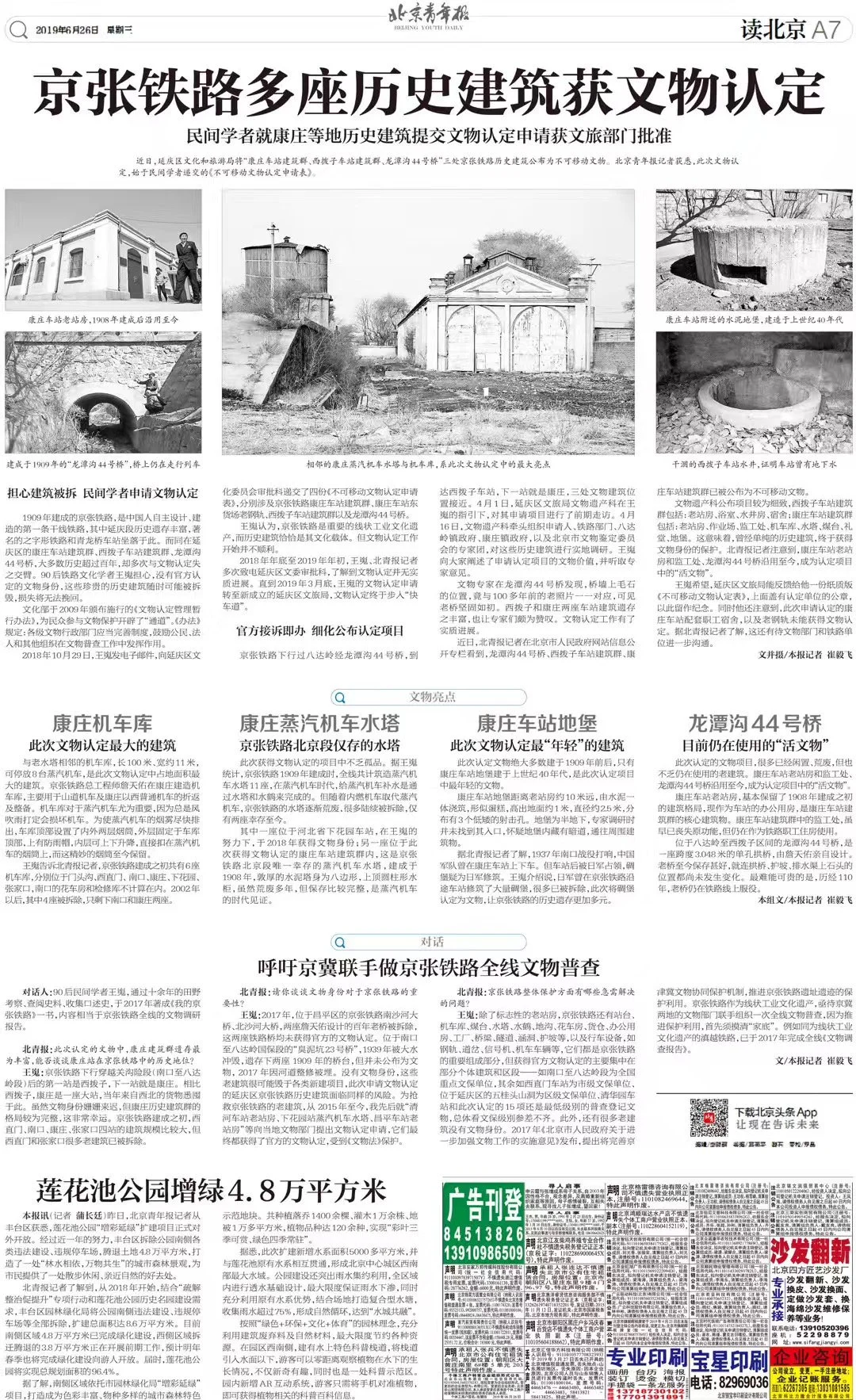
Several Historical Buildings Along the Jingzhang Railway Granted Cultural Property Recognition
June 26, 2019, Beijing Youth Daily
June 26, 2019, Beijing Youth Daily
Folk Scholar's Application for Cultural Property Recognition of Historical Buildings in Kangzhuang and Other Areas Approved by Culture and Tourism Authorities
Recently, the Yanqing District Bureau of Culture and Tourism officially announced three groups of Jingzhang Railway historical buildings—the Kangzhuang Station Building Complex, the Xibazi Station Building Complex, and the Longtangou No. 44 Bridge—as immovable cultural properties. Beijing Youth Daily reporters learned that this cultural property recognition process originated from an Application for Immovable Cultural Property Recognition submitted by a folk scholar.
Built in 1909, the Jingzhang Railway was the first trunk railway independently designed and constructed by Chinese people. Its Yanqing section is rich in historical remnants, featuring the famous Zigzag Railway and Qinglongqiao Station. Meanwhile, the Kangzhuang Station Building Complex, Xibazi Station Building Complex, and Longtangou No. 44 Bridge, also located in Yanqing District, are mostly over a century old yet have repeatedly missed out on cultural property recognition. Wang Wei, a post-90s railway culture scholar, worried that without official cultural property status, these precious historical buildings could be demolished at any time, resulting in irreversible losses.
The Interim Measures for the Administration of Cultural Relics Recognition, promulgated and implemented by the Ministry of Culture in 2009, opened a "channel" for the public to participate in cultural heritage preservation. The Measures stipulate that administrative departments for cultural relics at all levels shall improve systems and encourage citizens, legal persons, and other organizations to play a role in cultural relic census work.
On October 29, 2018, Wang Wei sent an email submitting four Applications for Immovable Cultural Property Recognition to the approval section of the Yanqing District Culture Commission, respectively concerning the Kangzhuang Station Building Complex, the old steel rails of the Kangzhuang Station East Freight Yard, the Xibazi Station Building Complex, and the Longtangou No. 44 Bridge.
Wang Wei believed that the Jingzhang Railway is an important linear industrial cultural heritage, and historical buildings are precisely its cultural carriers. However, the cultural property recognition work did not get off to a smooth start.
From late 2018 to early 2019, Wang Wei and Beijing Youth Daily reporters repeatedly called the approval section of the Yanqing District Culture Commission and learned that there was no substantive progress in cultural property recognition. It was not until late March 2019 that Wang Wei's cultural property recognition application was transferred to the newly established Yanqing District Bureau of Culture and Tourism, finally putting the recognition work into the "fast lane."
Traveling downward along the Jingzhang Railway past Badaling through the Longtangou No. 44 Bridge, one arrives at Xibazi Station, with Kangzhuang as the next stop; the locations of these three cultural relic buildings are close to one another. On April 1, under Wang Wei's guidance, the Cultural Relics Heritage Section of the Yanqing District Bureau of Culture and Tourism conducted a preliminary visit to his applied projects. On April 16, the Cultural Relics Heritage Section spearheaded and organized an expert panel consisting of the applicant, railway departments, Badaling Town Government, Kangzhuang Town Government, and the Beijing Cultural Relics Authentication Committee to conduct on-site research on these historical buildings. Wang Wei expounded on the cultural relic value of the applied projects to everyone and listened to the experts' opinions.
Cultural relic experts discovered at the Longtangou No. 44 Bridge that the positions of the rubble masonry on the bridge walls corresponded one-to-one with old photographs from over 100 years ago, demonstrating that the old bridge remains as solid as ever. The richness of the architectural remnants at both the Xibazi and Kangzhuang stations also deeply impressed the experts. Substantive progress was made in the cultural property recognition work.
Recently, Beijing Youth Daily reporters saw on the information disclosure column of the People's Government of Beijing Municipality website that the Longtangou No. 44 Bridge, Xibazi Station Building Complex, and Kangzhuang Station Building Complex have been announced as immovable cultural properties.
The Cultural Relics Heritage Section published the items in detailed categories: the Xibazi Station Building Complex includes the old station building, bathroom, well house, and dormitories; the Kangzhuang Station Building Complex includes the old station building, operational yard, supervisory office, engine house, water tower, coal platform, auditorium, and bunker. This means that these formerly unprotected historical buildings have finally gained the protection of cultural property status. Beijing Youth Daily reporters noted that the Kangzhuang Station old station building, supervisory office, and Longtangou No. 44 Bridge remain in continuous use, becoming "living cultural relics" among the recognized items.
Wang Wei hopes that the Yanqing District Bureau of Culture and Tourism can feed back a paper version of the Immovable Cultural Property Recognition Form stamped with the official seal of the certifying unit to be kept as a memento. At the same time, he also noted that the auxiliary worker dormitories of Kangzhuang Station and the old steel rails applied for recognition this time failed to obtain cultural property recognition. According to Beijing Youth Daily reporters, this still awaits further communication between the cultural relics department and railway units.
Adjacent to the old water tower, the engine house is 100 meters long and about 11 meters wide, capable of accommodating 8 steam locomotives, making it the building with the largest footprint in this cultural property recognition. Jeme Tien Yow, chief engineer of the Jingzhang Railway, built the engine house in Kangzhuang primarily for the turnaround and servicing of mountain-grade locomotives and ordinary locomotives west of Kangzhuang. Engine houses are particularly important for steam locomotives because exposure to wind and rain invariably damages them. To expel the smoke of steam locomotives as quickly as possible, two layers of smoke jacks—inner and outer—were installed on the roof of the garage: the outer layer was fixed to the top of the garage with a rain cap on it, while the inner layer could be raised and lowered to fit directly over the smoke stack of a steam locomotive, and these ingenious smoke jacks are preserved to this day.
Wang Wei told Beijing Youth Daily reporters that at the time of the Jingzhang Railway's completion, there were a total of 6 engine houses, located respectively in Mentougou, Xizhimen, Nankou, Kangzhuang, Xiahuayuan, and Zhangjiakou, excluding the imperial carriage house and maintenance shed at Nankou. After 2002, four of them were dismantled, leaving only the two in Nankou and Kangzhuang.
Among the items granted cultural property recognition this time, there is no shortage of unique items. According to Wang Wei's statistics, when the Jingzhang Railway was completed in 1909, a total of 11 steam locomotive water towers were constructed along the entire line. In the era of steam locomotives, water replenishment for steam locomotives was accomplished through water towers and water cranes. However, as internal combustion locomotives replaced steam locomotives, the water towers of the Jingzhang Railway gradually fell into disuse, and many were successively dismantled, leaving only two surviving to this day.
One of them is located at Xiahuayuan Station in Hebei Province, which gained cultural property status in 2018 through Wang Wei's efforts; the other is located within the Kangzhuang Station Building Complex recognized this time. This is the only surviving steam locomotive water tower in the Beijing section of the Jingzhang Railway, constructed in 1908. Its stout concrete tower body is octagonal, topped with a cylindrical water tank. Although abandoned for many years, it is relatively well-preserved and serves as a chronological witness to the era of steam locomotives.
The vast majority of the cultural relics recognized this time were built around 1909, with only the Kangzhuang Station bunker built in the 1940s, making it the youngest cultural relic among the recognized items.
The Kangzhuang Station bunker is located about 10 meters away from the old station building. Integrally cast from concrete, it resembles a cake, protruding about 1 meter above ground with a diameter of about 2.5 meters, featuring 3 low firing ports. The bunker is semi-underground, and during their research, experts did not find its entrance, suspecting that the bunker conceals secret tunnels leading to surrounding buildings.
According to Beijing Youth Daily reporters, when the Battle of Nankou broke out in 1937, Chinese troops boarded and alighted trains at Kangzhuang Station. However, the station was later occupied by the Japanese military, and the pillbox is suspected to have been constructed by the Japanese army. Wang Wei introduced that the Japanese military built a large number of pillboxes along stations on the Jingzhang Railway, many of which have been dismantled. Recognizing the pillbox as a cultural relic this time makes the historical remnants of the Jingzhang Railway even more diverse.
Many of the cultural relic items recognized this time have already been idled and abandoned, but there is no shortage of old buildings still in use. The Kangzhuang Station old station building, supervisory office, and Longtangou No. 44 Bridge remain in continuous use, serving as "living cultural relics" among the recognized items.
The Kangzhuang Station old station building basically retains the architectural layout of its initial completion in 1908, currently serving as office space for the station and acting as the core building of the Kangzhuang Station Building Complex. The supervisory office within the Kangzhuang Station Building Complex, although long having lost its original function, is still used as housing for railway workers.
Located in the section between Badaling and Xibazi, the Longtangou No. 44 Bridge is a single-span arch bridge with a span of 3.048 meters, personally designed by Jeme Tien Yow. The old bridge remains extremely well-preserved to this day, and even the positions of the stones on the arch bridge, slope protection, and drainage ditches have remained unchanged. Most precious of all, after enduring 110 years, the old bridge is still in service on the railway line.
Interlocutor: Post-90s folk scholar Wang Wei, who through more than a decade of field investigations, consulting historical archives, and collecting oral histories, authored the book My Jingzhang Railway in 2017, the content of which is equivalent to a cultural relic research report for the entire Jingzhang Railway line.
Wang Wei: The first station after the Jingzhang Railway's downward journey crosses the perilous Guanqou section (the Nankou to Badaling section) is Xibazi, and the next stop is Kangzhuang. Compared to Xibazi, Kangzhuang was a major station where goods arriving from the northwest were stockpiled. Although cultural property status arrived rather late, the layout of the Kangzhuang historical building complex is relatively intact, which is very fortunate. At the initial completion of the Jingzhang Railway, the architectural scales of Xizhimen, Nankou, Kangzhuang, and Zhangjiakou stations were relatively large, but many old buildings at Xizhimen and Zhangjiakou have already been demolished.
Wang Wei: In 2017, the Nashahe Bridge and Beishahe Bridge of the Jingzhang Railway located in Changping District—two century-old bridges designed by Jeme Tien Yow—were demolished; neither of these railway bridges had obtained official cultural property recognition. The "Chouni Keng No. 23 Bridge," located within the nationally protected Nankou-to-Badaling section, was washed away by floods in 1939, leaving behind two bridge abutments from 1909, but it was not announced as a cultural relic and was buried in 2017 due to river channel renovations. Without cultural property status, these old buildings are likely to be destroyed by various new construction projects. The Jingzhang Railway historical buildings in Yanqing District for which cultural property recognition was applied faced the same risk. To rescue the old buildings of the Jingzhang Railway, from 2015 to the present, I successively submitted applications for cultural property recognition to local cultural relics departments regarding the "Qinghe Station old station building, Xiahuayuan Station steam locomotive water tower, Changping Station old station building," etc., and they ultimately all obtained official cultural property status, becoming protected under the Cultural Relics Protection Law.
Wang Wei: Aside from iconic old station buildings, the Jingzhang Railway also features platforms, engine houses, coal platforms, water towers, water cranes, inspection pits, imperial carriage houses, freight warehouses, office buildings, factories, bridges, tunnels, culverts, slope protections, and driving equipment such as steel rails, turnouts, signals, and rolling stock. They are all important components of the Jingzhang Railway, but those that have gained official cultural property recognition are mainly concentrated in partial individual buildings and sections—such as the Nankou-to-Badaling section as a Major Historical and Cultural Site Protected at the National Level, while others like Xizhimen Station are Municipal-Level Protected Cultural Units, the Guiguitou Cave in Yanqing District is a District-Level Protected Cultural Unit, and Qinghuayuan Station as well as the 15 items recognized this time remain at the lowest tier of census-registered cultural relics. Overall, protection levels vary unevenly. In addition, many old buildings lack cultural property status. In 2017, the Implementation Opinions of the People's Government of Beijing Municipality on Further Strengthening Cultural Relics Work was issued, proposing to improve the Beijing-Tianjin-Hebei cultural relics coordinated protection mechanism and advance the protection and utilization of Jingzhang Railway ruins and relics. As a linear industrial cultural heritage, the Jingzhang Railway urgently requires cultural relics departments of both Beijing and Hebei to jointly organize a comprehensive line-wide cultural relics census, because advancing protection and utilization first requires figuring out the "family inventory." For example, the Yunnan-Vietnam Railway, also a linear industrial cultural heritage, completed its line-wide Cultural Relics Survey Report in 2017.
Text / Staff Reporter Cui Yifei
