
Engine Houses
From the late nineteenth to the early twentieth century, as railway construction expanded, major stations and locomotive depots increasingly included engine houses for the storage, servicing, and maintenance of steam locomotives. Early British-style engine houses were commonly built as rectangular sheds, with tracks entering directly through the gable end. Depending on the size of the station or depot, these buildings generally accommodated between two and six tracks.
Along the Peking–Mukden Railway, rectangular engine houses of this type were built at places such as Fengtai, Tanggu, Tianjin, Tangshan, Guye, and Qinhuangdao. Similar forms were also adopted on other railways, including the Lugouqiao–Baoding, Taoching, and Tianjin–Pukou Railways. Although individual engine houses varied in scale and capacity, their overall structure and method of use showed a high degree of consistency, reflecting the standardized character of early railway locomotive facilities.
With the withdrawal of steam locomotives, redevelopment of locomotive depots, and expansion of station facilities, most of these early engine houses were demolished. Today, only partial remains survive at a few locations, including Tanggu, Qinhuangdao, and Pukou.
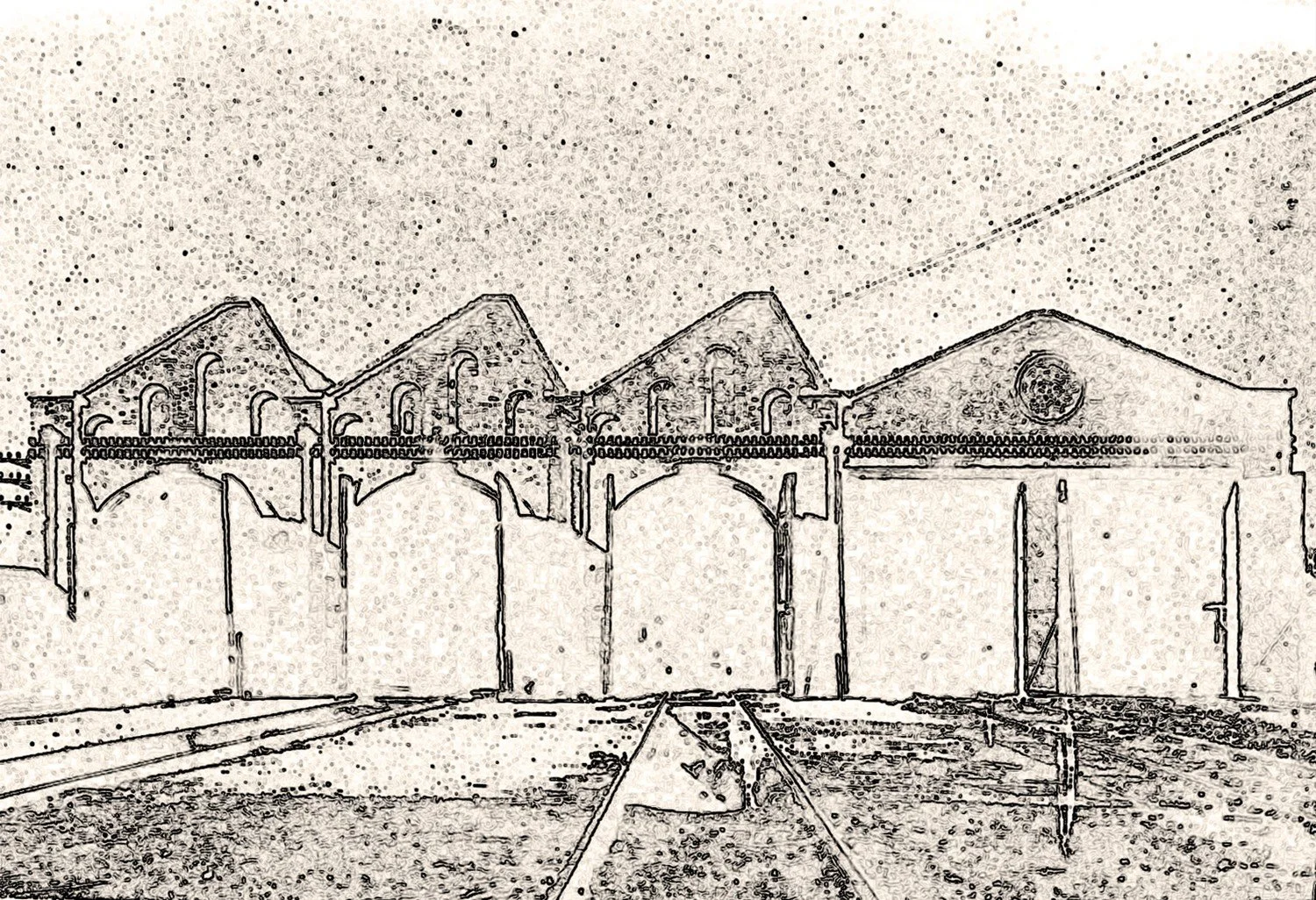
Peking–Mukden Railway
The Fengtai engine shed on the Tianjin–Lugouqiao Railway was completed in 1897. It was a four-road rectangular engine shed capable of accommodating 12 locomotives. The building was destroyed by the Boxers during the Boxer Uprising of 1900. Photographed in 1900.
The second-generation Tanggu engine shed, built in 1908, stood southeast of Tanggu Station. Its dimensions and appearance were the same as those of the Tianjin engine sheds, and it could originally accommodate 12 locomotives. In 1936, the two western roads were converted into an eastern workshop area, reducing its locomotive capacity to eight steam locomotives. Photographed in the 1930s.
In the 1970s, about two-thirds of the second-generation Tanggu engine shed was demolished, leaving only the western third in use as a workshop. Photographed in November 2024.
The Fengtai engine shed was rebuilt to its original form after 1900 and remained in use until the 1970s.
In 2018, the entire Fengtai locomotive depot was demolished and the site redeveloped as a rolling-stock depot. During the project, the plaque inscribed “Guangxu 23rd Year” was not found. Photographed in July 2022.
In the 1970s, a modern locomotive shed was constructed on the site of the original Fengtai engine shed. The plaque inscribed “Guangxu 23rd Year,” which had originally been mounted on the gable, was removed. Photographed in December 2006.
The Zhengyangmen East engine shed of the Imperial Railways of North China was built in 1901 at the Shuiguan Gate, east of Zhengyangmen. Its design followed the same pattern as the engine sheds built on the Tangshan–Tianjin Railway in the 1880s. It was a three-road rectangular shed capable of accommodating six locomotives.
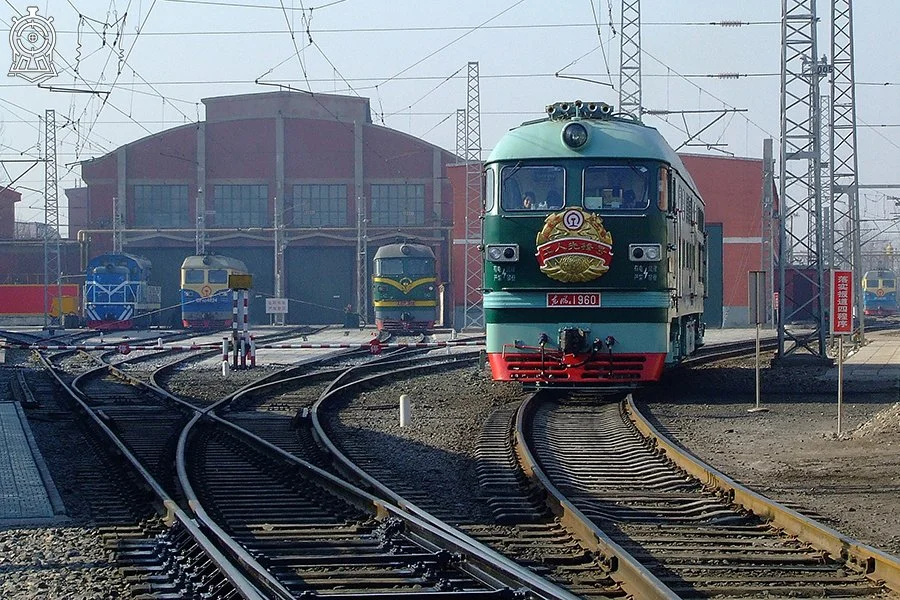
After Beijing Station was relocated to the Chongwenmen area in 1959, the former Zhengyangmen East station complex became the Beijing Diesel Locomotive Depot. The old engine shed was demolished in 1966 during construction of the Beijing Subway. The photograph shows Satellite-type diesel locomotives and imported Soviet NDQ-class diesel locomotives standing in front of the shed.
A modern locomotive shed was later built on the site of Tianjin’s second and third engine sheds. It was demolished during the reconstruction of Tianjin Station in 2007. Photographed in August 2005.
The second and third Tianjin engine sheds, located northwest of Tianjin East Station, were two six-road rectangular sheds, each capable of accommodating 18 locomotives. Photographed in the 1930s.
South facade of the second-generation Tanggu engine shed during the Japanese occupation period. Two plaques were mounted on the gable, reading “Peking–Mukden Railway” and “1908.” Photographed in the 1930s.
The surviving western third of the second-generation Tanggu engine shed. The western façade, visible on the left side of the photograph, still retains its original appearance. Photographed in August 2022.
Interior of the second-generation Tanggu engine shed, showing the western third of the building, which was converted into a railcar shed in 1936. Photographed in the 1930s.
Interior of the second-generation Tanggu engine shed, later converted into a warehouse. The partition wall on the right became the new eastern exterior wall after the eastern two-thirds of the building were demolished. Photographed in August 2022.
The engine shed at the second-generation Tangshan Station stood east of the station. Built in 1908, it was a six-road rectangular engine shed capable of accommodating 18 locomotives. The south façade bore the inscriptions “Tangshan” and “1908.” Photographed in the 1910s.
Site of the engine shed at the second-generation Tangshan Station. After the 1976 Tangshan earthquake, the site was redeveloped as a freight warehouse. Photographed in January 2023.
The second-generation Guye engine shed stood northeast of the station. It was a six-road rectangular engine shed capable of accommodating 12 locomotives. By the 1970s, it had been replaced by a modern locomotive shed. Photographed in the 1930s.
The modern Guye engine shed was demolished in the 2000s. Only the inspection pits remain on the original site. Photographed in January 2023.
The Qinhuangdao engine shed stood southeast of the station and was a six-road rectangular engine shed. Photographed in the 1930s.
The former Qinhuangdao engine shed has since become part of a rolling-stock depot, with only about one-third of the original building surviving. Photographed in June 2024.
The surviving third of the Qinhuangdao engine shed. Its original pitched roof has been replaced by a flat roof, while the former engine-shed doors on the western facade have been sealed. Traces of the original door hinges remain visible. Photographed in June 2024.
Other Railways
South facade of the surviving northern third of the Qinhuangdao engine shed. This wall originally served as an internal partition within the shed and incorporates bricks stamped with the initials “P.M.R.” for the Peking–Mukden Railway. Photographed in June 2024.
The Shanhaiguan engine sheds stood south of the station and consisted of two three-road rectangular engine sheds. Their architectural form was similar to the engine sheds built on the Tangshan–Tianjin Railway in the 1890s.
The Shanhaiguan engine sheds were demolished before the 1970s as the station was expanded. The site was subsequently occupied by office buildings and a car park.
The Baoding engine shed on the Lugouqiao–Baoding Railway stood west of Baoding Station. Its architectural form was similar to the engine sheds built on the Tangshan–Tianjin Railway in the 1890s. It was a two-road rectangular engine shed capable of accommodating six locomotives.
The Jiaozuo engine shed and the headquarters of the Taoching Railway Administration were designed in a late Victorian British industrial style, incorporating decorative elements such as Romanesque Revival arches and Neoclassical pediments. Photographed in 1933. From The Thirtieth Anniversary of the Taoching Railway.
After 1949, the site of the former Baoding engine shed was converted into a materials depot of the Baoding Permanent Way Division. The water tower, coal stage, and engine shed were subsequently demolished. Photographed in June 2024.
The Jiaozuo engine shed. Photographed in 1933. From The Thirtieth Anniversary of the Taoching Railway.
The Taoching Railway was financed and constructed by the Peking Syndicate, a British-Italian financial consortium. Shown here is the Daokouzhen engine shed, a three-road rectangular engine shed built in 1902.
In 1938, the section of the Taoching Railway between Daokouzhen and Youjiafen near Xinxiang was dismantled by the Japanese military, bringing the Daokouzhen engine shed out of service. Today, only the water tower survives on the former site. Photographed in April 2023.
The Jiaozuo engine shed on the Taoching Railway was a four-road rectangular engine shed capable of accommodating 12 locomotives. Built in 1905. From the Taoching Railway Travel Guide.
The Jiaozuo engine shed has since been demolished, and the site redeveloped with apartment buildings. Only the former water tower survives within the depot grounds. Photographed in January 2021.
The Pukou engine shed on the Tianjin–Pukou Railway was a four-road rectangular engine shed. Photographed in November 2022.
The Suzhou engine shed on the Shanghai–Nanking Railway was destroyed by Japanese bombing during the Second Sino-Japanese War. Photographed in the 1930s.
The Great Shed of the Pockerley Waggonway at the Beamish Museum。
South facade and engine-shed doors of the Pukou engine shed on the Tianjin–Pukou Railway. The leftmost doorway retains its original arched head, while the other three openings have been altered with concrete door frames. Photographed by Zhang Xun in 2016.
Whessoe Road Enging Shed——built by the Stockton & Darlington Railway in 1861。
North facade and gable end of the Pukou engine shed on the Tianjin–Pukou Railway. Photographed in November 2022.
Tracing the Origins
East facade of the Pukou engine shed on the Tianjin–Pukou Railway. Photographed by Zhang Xun in 2016.
From the mid-nineteenth century onward, as Britain’s railway network expanded rapidly, engine sheds developed into an increasingly mature functional and architectural system. In addition to the large locomotive depots at major railway centres, many small and medium-sized stations were equipped with rectangular multi-road engine sheds, with tracks entering directly through the gable end and the number of shed roads determined by the size of the locomotive allocation. These buildings were generally simple in construction, combining brick or masonry walls with timber or steel roof trusses, and were designed primarily for the efficient storage, inspection, maintenance, and servicing of locomotives. They became one of the most common types of locomotive facility on British railways during the nineteenth century.
Early engine houses built in China with British engineering participation shared clear similarities with their British counterparts in both functional organization and basic structural form. Engine houses at Fengtai, Tanggu, Tangshan, and Qinhuangdao on the Peking–Mukden Railway, as well as those on the Lugouqiao–Baoding, Taoching, and Tianjin–Pukou Railways, generally took the form of rectangular sheds accommodating two to six tracks. Their gable-end entrances, parallel shed roads, and centralized servicing arrangements closely resembled those of contemporary small and medium-sized locomotive facilities in Britain.
Aviemore shed yard,built in 1898.
Whitby engine shed,built in 1847.
Inverness engine shed
Inverness engine shed
Beamish Engine Shed
Haworth Yard—Keighley & Worth Valley Railway
Didcot Shed——built in 1932.