
Platform Canopies
As British railway architecture spread in China, platform canopies became a common and important feature of station buildings. These canopies were generally attached to one side of the station building or erected above the platform, providing shelter for passengers while waiting, boarding, and alighting.
Early canopies were commonly constructed with iron columns, brackets, and timber or metal roof framing, and some incorporated decorative valance boards along the eaves. Although designs varied between different railways, their structural forms and architectural details often closely resembled those found at British railway stations. Early canopies of different types once survived at stations including Zhengyangmen East, Fengtai, Xizhimen, Shaheji, Guzhen, Zhangbaling, and Zhoujingxiang.
With station reconstruction and the modernization of platforms, many early canopies have been demolished, although a small number of components have been relocated and preserved.
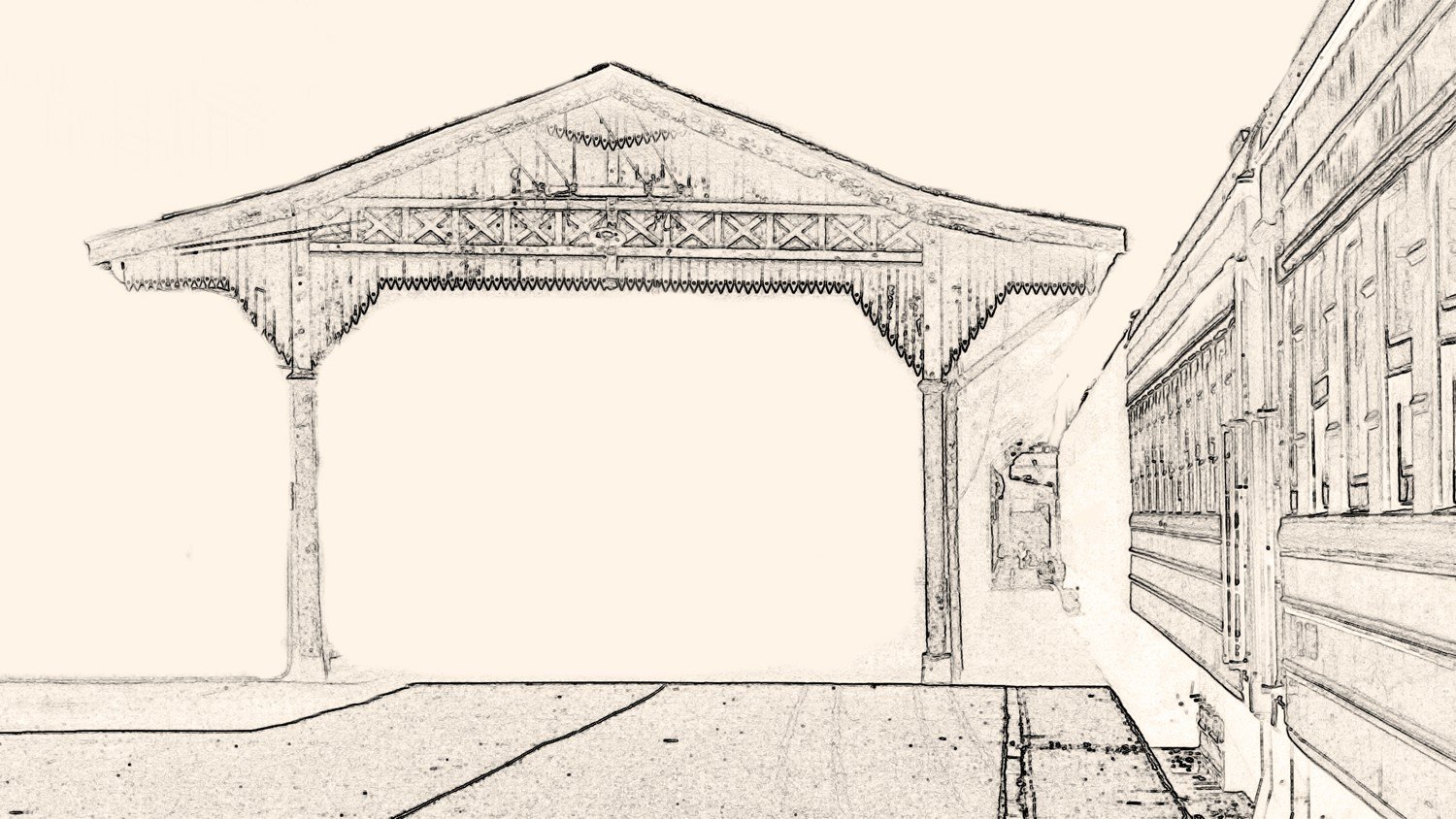
The platform canopy at Zhengyangmen East Station (Peiping East Station) on the Imperial Railways of North China was built in the 1900s. It was removed in 1966 during construction of the Beijing Subway and relocated to Tianjin West Station. Photographed in the 1940s.
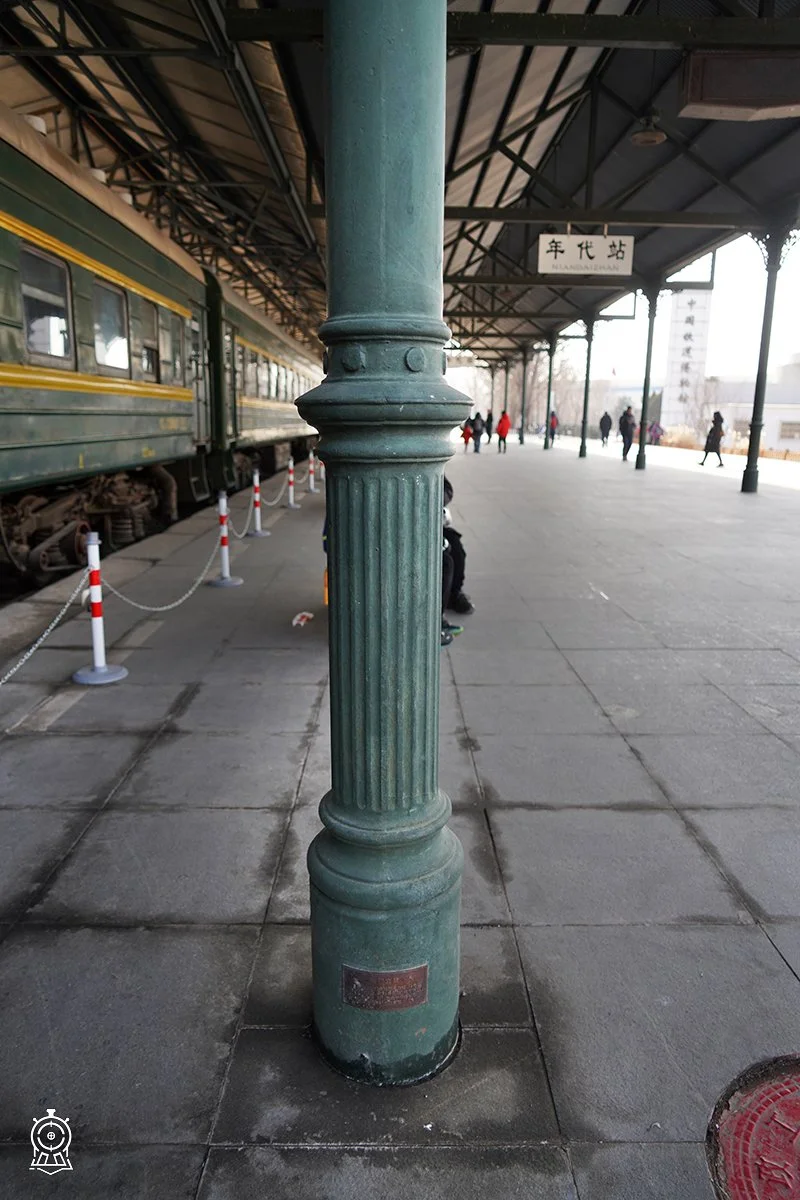
After being relocated to Tianjin West Station, the former Zhengyangmen East Station canopy remained in use until 2009, when it was dismantled again during reconstruction of Tianjin West Station. Jin Wanzhi, then Deputy Director of the China Railway Museum, proposed that it be preserved off-site at the museum. Photographed in February 2024.
The top of a canopy column from Zhengyangmen East Station, now preserved at the China Railway Museum. Photographed in January 2019.
The station-building canopy at Huangtupo Station on the Imperial Railways of North China was built in 1928 and demolished in 2006. Photographed in October 2005.
The station-building canopy at Langfang Station on the Imperial Railways of North China was built in 1900 and demolished between 2007 and 2010. Photographed by Zhang Xun in June 2004.
The first-class waiting room at Tianjin Station on the Imperial Railways of North China. Photographed in 1898.
The station-building canopy of the waiting room on Platform 3 at Tianjin Central Station on the Imperial Railways of North China. Photographed in August 2022.
The station-building canopy at Fengtai Station on the Imperial Railways of North China. In 2023, the railway authorities removed its timber valance boards. Photographed in April 2020.
Tanggu Station on the Imperial Railways of North China. Photographed in November 2019.
Lutai Station on the Imperial Railways of North China. Photographed in the 1930s.
Lutai Station after the 1976 Tangshan earthquake. The station-building canopy and part of the façade collapsed during the earthquake. The canopy and station building were subsequently demolished. Photographed in 1976.
An ancillary building at Xingcheng Station on the Imperial Railways of North China. Photographed in January 2023.
The canopies over West Platforms 1 and 2 at Xizhimen Station on the Peking–Kalgan Railway. Built in the early 1910s, they were originally located over Platforms 1 and 2 of the first-generation Xizhimen Station and were relocated to the second-generation station in 1918. Photographed in the 1930s.
During the reconstruction of Xizhimen Station in 2005, high-level platforms were built in the west yard. The original canopies from West Platforms 1 and 2 of the Peking–Kalgan Railway were retained within the rebuilt station area. Photographed in July 2006.
The canopy over West Platform 1 at Xizhimen Station during station reconstruction. Photographed in August 2005.
A decorative bracket supporting the canopy over West Platform 1 at Xizhimen Station. Photographed in December 2006.
The canopy over West Platform 1 at Xizhimen Station on the Peking–Kalgan Railway. Photographed in December 2006.
The canopy over West Platform 2 at Xizhimen Station on the Peking–Kalgan Railway. Photographed in January 2005.
The timber valance board of a building at the Xizhimen Signal and Communications Depot on the Peking–Kalgan Railway, built in 1918. In August 2022, the building was designated a municipal-level protected cultural heritage site of Beijing. Photographed in November 2016.
The down-platform waiting shelter at Kangzhuang Station on the Peking–Kalgan Railway. Photographed in the 1930s.
The canopy at the northern end of Platform 1 at Zhangjiakou Station on the Peking–Kalgan Railway. Photographed in 2004.
The platform waiting room at Datong Station on the Peking–Suiyuan Railway. Photographed in the 1930s.
The canopy over Platform 1 at Zhangjiakou Station on the Peking–Kalgan Railway. Photographed in 1934.
The station-building canopy at Shaheji Station on the Tianjin–Pukou Railway. Photographed in November 2019.
The platform canopy at Shanghai South Station on the Shanghai–Hangchow–Ningpo Railway. Photographed in 1937.
From the mid-nineteenth century onward, as passenger traffic increased on British railways, the platform canopy gradually became an important component of railway stations. Early canopies were often attached directly to station buildings or waiting rooms, with pitched roofs supported by timber posts, cast-iron columns, and brackets, providing shelter for passengers waiting, boarding, and alighting, as well as for baggage handling. By the second half of the nineteenth century, iron and glass were increasingly used, while canopies became longer and wider, developing into one of the most recognizable architectural features of British railway stations. Historic England notes that from around 1857, the Midland Railway made increasing use of platform canopies combining iron and glass, a form that later became influential in the design of medium-sized British stations.
Different railway companies developed their own approaches to canopy columns, brackets, roofing, and decorative details. Timber valance boards, cast-iron columns, openwork brackets, and sections of glazed roofing were particularly common. These details served practical purposes while also becoming part of each railway company’s architectural identity. Numerous late nineteenth-century station canopies survive in Britain today, demonstrating the increasingly standardized and mature nature of their materials and construction.
From the late nineteenth to the early twentieth century, this mature tradition of platform-canopy design was also introduced into China through British railway engineering. Station-building and platform canopies along the Imperial Railways of North China, Peking–Kalgan Railway, Tianjin–Pukou Railway, Shanghai–Nanking Railway, and Shanghai–Hangchow–Ningpo Railway display comparable characteristics, including pitched roofs, timber valance boards, metal columns, and decorative brackets. These structures should not be regarded as direct copies of any single British station, but rather as the continuation and adaptation of British platform-canopy design under the different railway and local conditions of China.
The station-building canopy at Guzhen Station on the Tianjin–Pukou Railway. Photographed in April 2021.
The canopy over Platform 2 at Nankou Station on the Peking–Kalgan Railway was built in the 1910s and demolished in the 1980s. Photographed in 1920.
The station-building canopy at Zhangbaling Station on the Tianjin–Pukou Railway. Photographed in November 2022.
The station-building canopy at Zhoujingxiang Station on the Shanghai–Nanking Railway. Photographed in January 2022.
Tracing the Origins
The station-building canopy at Chuzhou Station on the Tianjin–Pukou Railway. Photographed in November 2022.
The station-building canopy at Pukou Station on the Tianjin–Pukou Railway. Photographed in November 2019.
The Sino-Western decorative valance board of the station-building canopy at Xieqiao Station. Photographed in July 2022.
Cardiff Central Station
Manchester Piccadilly Station
The station-building canopy at Xieqiao Station on the Shanghai–Hangchow–Ningpo Railway. Photographed in July 2022.
London Paddington Station
Rainhill Station
The station-building canopy at Xiaoxihe Station on the Tianjin–Pukou Railway. Photographed in April 2024.
Birkhill Station
Loughborough Station
Middlesbrough Station
The Quay of Exeter
Porthmadog Station
Aviemore Station
Exeter St Davids Station
Paignton station