
Signal Boxes
As railway traffic increased, signal boxes became important train-control facilities at stations. They were generally located at station throats, platform ends, or areas where points were concentrated, and were used to centrally control points, signals, and train routes, ensuring the safe arrival and departure of trains.
Signal boxes of this type were once found at Zhengyangmen East, Dongbianmen, Fengtai, Yangcun, Tianjin, Tanggu, and Luanxian along the Peking–Mukden Railway, while similar structures also existed at Shanghai North Station and Markham Road Freight Station on the Shanghai–Nanking Railway. Their form derived from the signal box tradition widely used on British railways. They were typically two-storey or elevated structures, with large windows on the upper floor allowing signalmen a clear view over the station yard and passing trains.
With the introduction of electrical centralized interlocking, relay interlocking, and modern signalling systems, most early signal boxes gradually lost their original functions and were demolished. The few surviving examples have become important physical evidence for the study of early railway traffic-control systems in China and British-influenced railway architecture.
The No. 2 Signal Box at Zhengyangmen East Station on the Peking–Mukden Railway stood at the eastern throat of the station. It was demolished together with Zhengyangmen East Station in 1966 during construction of the Beijing Subway.
The No. 1 Signal Box at Dongbianmen Station on the Peking–Mukden Railway originally stood at the eastern throat of the station. It was demolished in 1959 when the railway alignment was altered.
The No. 2 Signal Box at Dongbianmen Station on the Peking–Mukden Railway stood at the western throat of the station. After Dongbianmen Station was demolished in 1959, the building was converted into residential accommodation. It was preserved as a heritage structure during construction of the Ming City Wall Ruins Park in 2002. Photographed in October 2020.
The No. 2 Signal Box at Fengtai Station on the Peking–Mukden Railway stood at the eastern throat of the station. Photographed in the 1930s. From the Peiping–Liaoning Railway Survey Report: Traffic, Communications and Safety.
The No. 2 Signal Box at Zhengyangmen East Station on the Peking–Mukden Railway. Photographed in the 1930s. From the Peiping–Liaoning Railway Survey Report: Traffic, Communications and Safety.
The No. 1 Signal Box at Fengtai Station on the Peking–Mukden Railway stood at the western throat of the station.
The No. 1 Signal Box at Yangcun Station on the Peking–Mukden Railway stood at the eastern end of Platform 1. Photographed in the 1930s. From the Peiping–Liaoning Railway Survey Report: Traffic, Communications and Safety.
The No. 1 Signal Box at Tianjin East Station on the Peking–Mukden Railway. Photographed in the 1930s. From the Peiping–Liaoning Railway Survey Report: Traffic, Communications and Safety.
The East Signal Box at Tianjin East Station on the Peking–Mukden Railway. Photographed in the 1930s. From the Peiping–Liaoning Railway Survey Report: Engineering Works.
The No. 2 Signal Box at Tianjin Central Station on the Peking–Mukden Railway stood at the southern throat of the station. Photographed in the 1930s. From the Peiping–Liaoning Railway Survey Report: Traffic, Communications and Safety.
The No. 2 Signal Box at Tanggu Station on the Peking–Mukden Railway stood at the southern throat of the station. Photographed in August 2022.
The No. 2 Signal Box at Luanxian Station on the Peking–Mukden Railway stood at the eastern throat of the station. Photographed in the 1930s. From the Peiping–Liaoning Railway Survey Report: Traffic, Communications and Safety.
The signal box at Markham Road Freight Station on the Shanghai–Nanking Railway.
The signal box at Shanghai North Station on the Shanghai–Nanking Railway. Photographed in 1937. From John Montgomery.
Tracing the Origins
From the mid-nineteenth century onward, as railway traffic in Britain increased, the operation of points and signals gradually shifted from dispersed local control to centralized operation. By the 1860s, the modern signal box, characterized by an elevated operating room, large areas of glazing, and a centralized lever frame, had largely taken shape and soon became an important part of railway traffic control throughout Britain. Although individual railway companies developed their own distinctive approaches to materials, roof forms, and window patterns, the basic functions and spatial organization of these buildings remained highly consistent.
Early railways in China constructed with British engineering participation also adopted numerous signal boxes with similar characteristics. Examples at Zhengyangmen East, Dongbianmen, Fengtai, Tianjin, and Tanggu on the Peking–Mukden Railway, as well as Shanghai North Station on the Shanghai–Nanking Railway, all display typical features such as locations at station throats, extensively glazed upper floors, and centralized control of points and signals.
Radstock North Box (Didcot Railway Centre) Signal Box
Radstock North Box Signal Box(Didcot Railway Centre)
Whitehead Railway Museum Signal Box
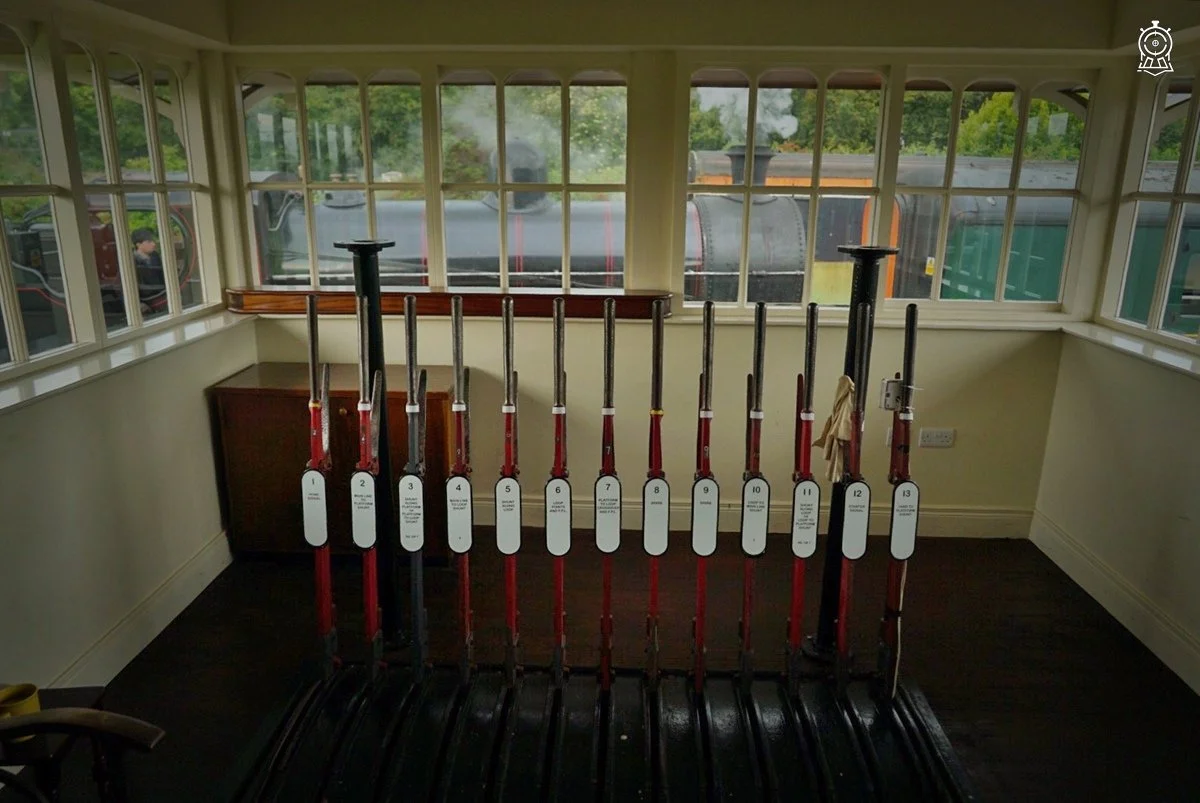
Whitehead Railway Museum Signal Box內部
Rowley Signal Box (Beamish Museum)
Rowley Signal Box (Beamish Museum)
Haltwhistle Signal Box
Corfe Castle Signal Box
Shrewsbury Signal Box
Bo'ness Signal Box
Crowcombe Heathfield Signal Box
Moira Signal Box
Grosmont Signal Box
Bo'ness Signal Box
Shildon Signal Box
Glenfinnan Signal Box