
Third-Class Stations on Various Railways
From the late nineteenth to the early twentieth century, as British engineers, capital, and railway technology entered China, large numbers of third-class stations were built to serve local passenger and freight traffic. Compared with major junctions and first- and second-class stations, third-class station buildings were smaller in scale and more utilitarian in function, yet they still retained clear characteristics of British railway architecture. They became one of the most numerous and widely distributed types of station buildings along China’s early railway network.
These stations did not follow a completely uniform architectural form. Different railways developed their own standards and variations according to construction period, traffic requirements, and engineering systems. Some used simple rectangular brick-and-timber structures; others employed contrasting red and grey brickwork; while many expressed British architectural traditions through pitched roofs, gables, arches, platform canopies, bargeboards, veranda columns, and finials. Third-class stations such as Zhenru and Zhoujingxiang on the Shanghai–Nanking Railway were similar in scale and layout, while Changkou Station on the Taoching Railway featured a Neoclassical pediment on its gable. Earlier stations such as Liangxiang and Liulihe on the Lugouqiao–Baoding Railway preserve the architectural character of the late nineteenth century, when British engineers first became involved in railway construction in China.
Because third-class stations were numerous and relatively low in rank, they were often among the first railway buildings to be demolished during later line expansion, double-tracking, and station reconstruction. Surviving examples such as Zhoujingxiang Station, together with early stations known only from historic photographs, now form a valuable body of physical and visual evidence. They allow us to trace how British railway architectural ideas were transmitted across different railway systems in China, simplified in practice, and gradually adapted to local conditions.
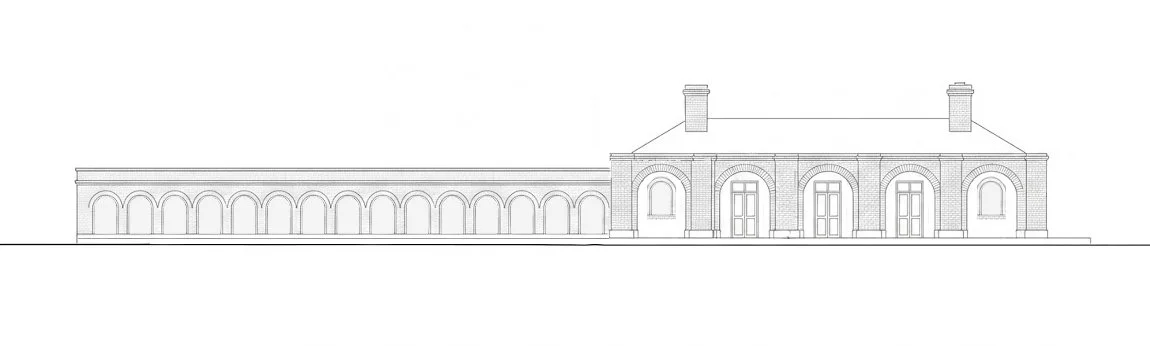
Imperial Railways of North China
Peking–Tungchow Branch of the Imperial Railways of North China
Tongxian South Station was built in 1901 by British forces occupying Beijing at the request of the Qing government. The station stood close to the Grand Canal, while the railway extended westward to the grain depots outside Beijing’s Chaoyangmen Gate. The photograph shows the Tongxian South station building, with a waiting room and ancillary buildings to its west. Photographed in 1940. From the North China Transportation Company.
Street-side facade of Xieqiao Station. The building was constructed using alternating grey and red brickwork. Photographed in December 2018.
Platform side of Xieqiao Station. A blockhouse built during the Japanese occupation period stands within the station grounds. Beginning in 1918, special excursion trains for viewing the Qiantang River tidal bore called at the station each year around the 18th day of the eighth lunar month. Photographed in December 2018.
Yongdingmen Station, built in 1902, had a British-style station building measuring four bays from east to west and two bays from north to south. Railway service first reached this area during the Boxer Uprising of 1900, when Allied forces extended the line from Majiapu toward the Temple of Heaven. The photograph shows Nationalist troops released in 1949. Photographed by Zhou Haiying.
Shanghai–Nanking Railway
Zhenru Station was built in 1905 with a small British-style third-class station building similar in scale and layout to those at Qishuyan and Zhoujingxiang. Its gable featured a ventilation opening and decorative keystone detailing. The station building was later altered and has since disappeared; the site is now occupied by Shanghai West Railway Station. Photographed in 1937.
In September 2002, the century-old Yongdingmen station building was demolished and replaced by a newly built duty office. In the summer of 2006, this building and the platform were also removed during construction of the Beijing–Tianjin Intercity Railway. The photograph shows Yongdingmen Station in 2004. Photographed by Zhang Xun.
Zhoujingxiang Station was built in 1906 and followed the same design as Qishuyan Station. It is the only surviving station building of this type on the Shanghai–Nanking Railway. Photographed in December 2021.
Street-side facade of Zhoujingxiang Station. Much of the original appearance survives, including the platform canopy, bargeboards, and veranda columns. Photographed in January 2022.
Zhengyi Station was built in 1905 and is located below the alignment of the Shanghai–Nanking Railway. One station building and one ancillary structure survive today. After the station opened, hairy crabs and other aquatic products from Yangcheng Lake could be transported to Shanghai within the same day, greatly reducing delivery times for fresh produce and stimulating trade between Zhengyi and Shanghai. The corners, doors, and windows of the station building are decorated with red-brick quoins. In recent decades, its original pitched roof was replaced by a flat roof. Photographed in April 2024.
Shanghai–Hangzhou–Ningbo Railway
The first-generation Xieqiao Station building was built in 1909. It was an eclectic-style station building measuring three bays across and two bays deep. From the Zhelu Youxuan Biao, 1913.
Taoching Railway(Daokou - Qinghua)
Changkou Station was built in 1910 as a small British-style third-class station. The building stood on the south side of the railway, with a platform canopy on the track side. The eastern and western gables were decorated with Neoclassical pediments. Photographed in 1939. From the North China Transportation Company.
Present-day condition of Xieqiao Station. Apart from several windows having been blocked up, the building remains in very good condition. Photographed in July 2022.
In April 1945, the North China Transportation Company dismantled the railway west of Changkou. By 1970, Changkou Station and the surrounding railway had been completely removed. The photograph shows the former site of Changkou Station, looking west. Photographed in January 2021.
Fanling–Sha Tau Kok Branch, Kowloon–Canton Railway
The Fanling–Sha Tau Kok Branch was a 610 mm narrow-gauge railway, built in 1912 and closed in 1928. The only surviving building from the line is the former Hung Leng Station building. It is a simple Chinese rural structure with very little decoration and is five bays wide. Photographed in September 2024.
After the railway closed in 1928, the former Hung Leng Station building was converted into a warehouse. It is now designated a Grade III Historic Building in Hong Kong and remains in relatively good condition. Photographed in September 2024.
Luofa Station was built in 1897. Its second-generation station building followed the same design as that at Yangcun Station. Photographed in the 1930s. From the Survey Report on the Peiping–Liaoning Railway: Engineering Works.
A small station on the Fengtai–Tianjin section of the Tianjin–Lugouqiao Railway, photographed by Jenő Cholnoky on June 24, 1900. Based on an analysis of the surrounding terrain, Wang Wei believes that the photograph was probably taken at Luofa Station. At the time, the Boxer Uprising was underway and this section of railway suffered extensive destruction. The station building was later replaced by a second-generation structure. From Vasárnapi Ujság.
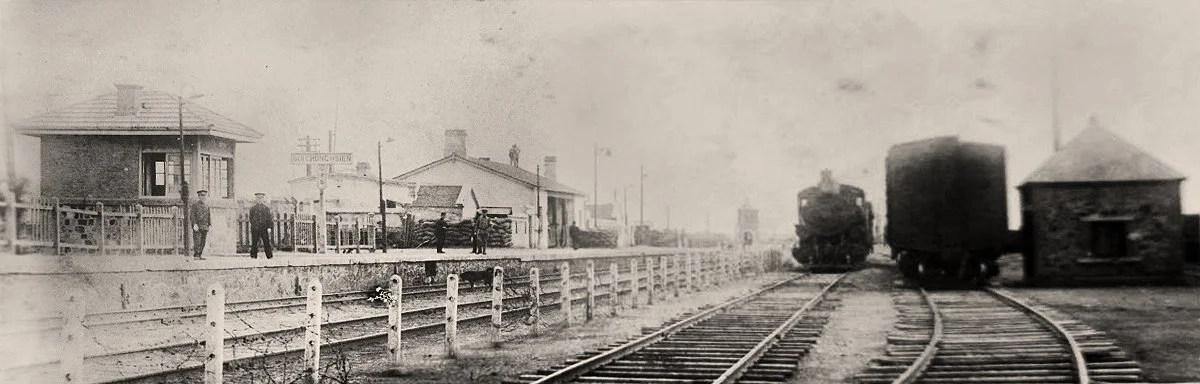
Suizhong County Station was built in June 1897. Its architecture continued the style of station buildings constructed on the Tangshan–Tianjin Railway during the 1880s. The building no longer survives.
Luanzhou Station was built in 1892. Its first station building was a simple British-style structure measuring four bays across and two bays deep. Photographed in the 1900s. From a Japanese postcard.
Because of construction of the Huangtupo–Tianjin third track, the old Luofa Station building was demolished in the early 1990s. Only ancillary buildings survive today. Photographed in August 2022.
After the Boxer Uprising of 1900, the Imperial Railways of North China constructed a second-generation station building at Huangcun, almost identical in scale and appearance to that at Yangcun Station. From the Annals of Beijing Train Operations Depot. Photographed in the 1980s–1990s.
After 1905, as traffic capacity and revenue on the Imperial Railways of North China increased, stations along the line were progressively rebuilt as permanent brick-and-masonry structures. The second-generation Luanzhou Station was constructed during this period as a three-gabled British-style second-class station building. In 1939, with construction of a new double-track bridge over the Luan River, the old Luanzhou Station was demolished and replaced by a new station about 2 km to the west. Photographed in the 1930s. From the Survey Report on the Peiping–Liaoning Railway: Engineering Works.
During the 1990s, construction of the Huangtupo–Tianjin third track and the Beijing–Kowloon Railway resulted in the demolition of the old Huangcun Station building. Photographed in 2007.
The first-generation Langfang Station was completed in 1897 and was one of the larger intermediate stations on the Tianjin–Lugouqiao Railway. Its eastern section consisted of a station building five bays wide and two bays deep, with a tower in the centre; the western section contained a courtyard and ancillary buildings. The station building did not stand immediately beside the railway, but was located below the level of the track formation. Photographed in 1900.
Yangcun Station was built in 1897, and its station building was similar in scale to that at Langfang. It was attacked by the Boxers in 1900 but suffered relatively little damage. The building stood below platform level. Photographed in 1900. From the Annals of Beijing Train Operations Depot.
During the Boxer Uprising of 1900, Langfang Station was attacked by the Boxers, although the building itself suffered only limited damage. After the uprising, the Imperial Railways of North China relocated the station building closer to the railway and constructed the second-generation Langfang Station. Photographed in June 2006.
After the Boxer Uprising ended in 1900, a second-generation station building was constructed beside the platform at Yangcun Station. It remained in use until the 1980s. From a Peking–Mukden Railway photograph album, photographed in the 1910s.
In September 1989, a new Langfang Station opened. The old station building survived until 2010, when the existing railway was realigned northward during construction of the Beijing–Shanghai High-Speed Railway and the building was demolished. Only ancillary buildings in the rear courtyard survive today. Photographed in August 2022.
In 1992, the Huangtupo–Tianjin third-track project opened to traffic, resulting in the demolition of most older station buildings along the route, including the old Yangcun Station. Its former site is now occupied by tracks within the station yard. Photographed in July 2022.
Lugouqiao–Baoding Railway
The first-generation Dingxing County Station was completed in 1899. It suffered relatively limited damage during the Boxer Uprising and continued in use after 1900. Photographed by Georges Brouillard, 1900–1901.
After 1900, the Belgian company that took over the railway constructed a second-generation Liangxiang County Station, replacing the first station building designed and built under British engineering direction. After 1949, the second-generation building was itself replaced by a third-generation station. During reconstruction work in 2025, bricks bearing the inscriptions “PIERRE ENGELS” and “TCHAN-SIN-TIEN” were unearthed and are believed to have possibly come from the second-generation station building. Photographed in May 2024.
The Lugouqiao–Baoding Railway, built between 1897 and 1899, formed the first section of the later Peking–Hankow Railway. Its chief engineer was the British engineer Claude W. Kinder, employed by the Chinese Railway Company and the Peking–Hankow Railway Company. The photograph shows the first-generation Liangxiang County Station, located on the west side of the tracks. It consisted of a main station building and an ancillary building, with British-style finials mounted along the roof ridge. The station was damaged during the Boxer Uprising in 1900. Photographed by Georges Brouillard, 1900–1901.
Huangcun Station was built in 1897. Its first-generation station building was a British-style structure with a hard-gabled roof and was damaged by the Boxers during the 1900 uprising. From Photographic Album of the Boxer Incident, edited by Yamamoto Seiyō, published in Tokyo in 1901.
Site of the first-generation Liulihe Station building, now incorporated into railway property. View looking south. Photographed in May 2024.
Liulihe Station was relatively large. Its first-generation station building stood on the west side of the tracks and was similar in design and scale to Liangxiang County Station. No platform was originally provided directly in front of the building. The station was destroyed by the Boxers in 1900. After repairs in 1901, a second-generation station building was constructed on the platform on the east side of the railway. Photographed by Georges Brouillard, 1900–1901.
The remains of the first-generation Zhuozhou Station building were demolished after the Boxer Uprising and replaced by a second-generation station building. The photograph shows the modern Zhuozhou Station building constructed in the 1990s. Photographed in June 2021.
The first-generation Zhuozhou Station building was completed in 1899 and burned down by the Boxers in 1900. The arched opening on the right was the main entrance to the station building. A stone station-name plaque that had fallen from the gable can be seen lying on the ground. Photographed by Georges Brouillard, 1900–1901.
Dingxing County Station, rebuilt during the mid-twentieth century. Photographed in August 2020.
Yingkou Branch of the Imperial Railways of North China
Qishuyan Station was built in 1906 with a small British-style third-class station building on the south side of the railway. Quoin detailing was applied to the corners of the building, while a canopy with decorative fascia boards sheltered the waiting-room side. The station building no longer survives. Photographed during the Republican period.
The old Tongxian South Station building was converted into railway staff housing in the 1980s and remains well preserved. By 2019, it had been officially recognized as immovable cultural heritage.
Tianzhuangtai Station was completed in April 1900 and functioned as a watering station. In 1944, the Yingkou Branch south of Dawa Station was dismantled, and the recovered rails were reused on the second track of the Shenyang–Shanhaiguan Railway.
Site of Tianzhuangtai Station. Photographed in January 2023.