
Water Towers
Steam locomotives required large quantities of water, making water towers an essential feature of early railway stations and locomotive facilities. These structures were usually located near stations, engine sheds, or other important watering points along the line, using elevated tanks to supply water to steam locomotives.
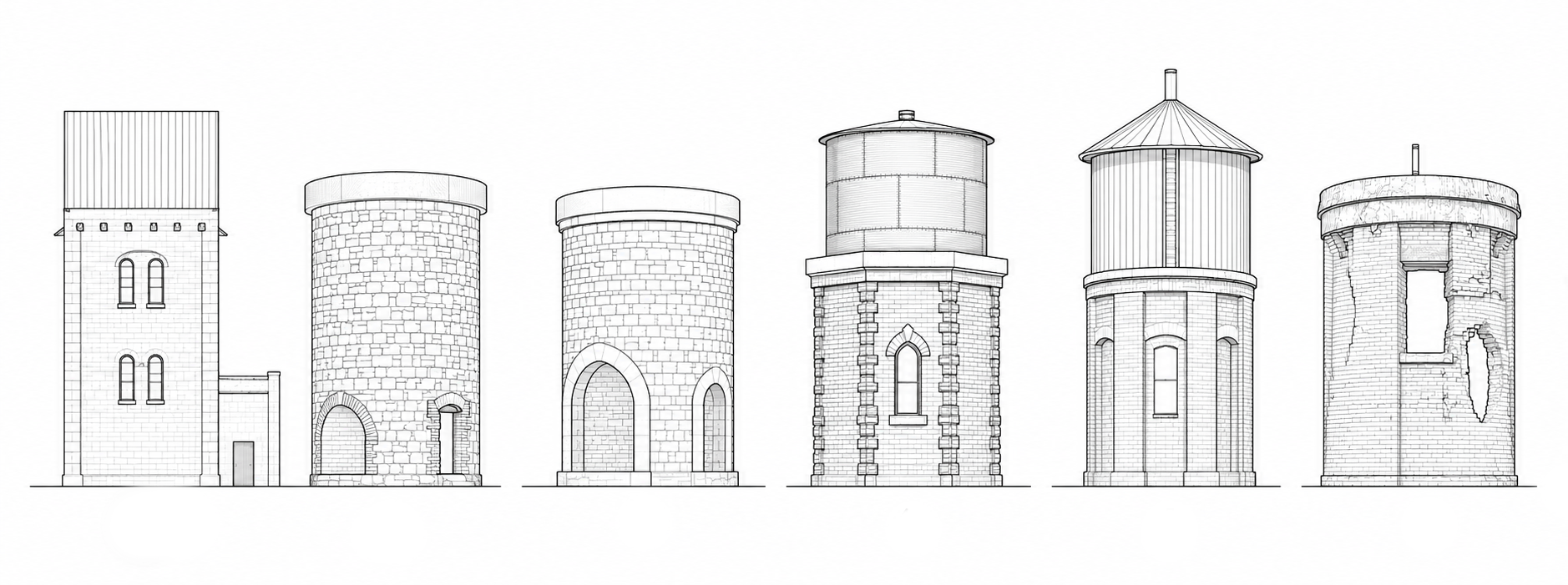
Water towers varied in form and construction materials from one railway to another. Along the Peking–Mukden Railway, examples included octagonal towers and various brick-and-masonry structures, some of whose designs were later adapted by the Peking–Kalgan Railway. Water towers at Baoding, Jiaozuo, and Daokouzhen shared similar architectural forms, reflecting the continuity and transmission of early railway engineering designs between different lines.
With the withdrawal of steam locomotives and the relocation of locomotive facilities, most early water towers gradually fell out of use. In many cases, the water tanks were removed, leaving only the brick or masonry tower structures. These surviving remains are now important physical evidence for the study of early railway water-supply systems and industrial architecture in China.
The Gaoshanzi water tower stood southwest of Gaoshanzi Station on the Peking–Mukden Railway and was built sometime between 1907 and 1928. The structure was octagonal in plan and constructed of brick masonry and concrete. Decorative keystones were placed above the windows, and bricks stamped with the initials “P.M.R.” for the Peking–Mukden Railway were used throughout the building. Elements of this design were later adopted for the Kangzhuang water tower on the Peking–Kalgan Railway in 1909. Photographed in October 2019.
The Raoyanghe water tower stood northeast of Raoyanghe Station on the Peking–Mukden Railway and was built in 1901. By January 2016, only the brick-and-masonry tower structure remained, the water tank having long since been removed. Elements of this design were later adopted for the water towers at Nankou, Xiahuayuan, and Zhangjiakou on the Peking–Kalgan Railway in 1909. Photographed in September 2019.
The Jinzhou water tower stood on the east bank of the Xiaoling River, approximately 2.8 km west of Jinzhou Station on the Peking–Mukden Railway, and was used to supply water to steam locomotives. As of November 2019, the brick-and-masonry structure below the former water tank remained standing. Photographed in November 2019.
The Huangutun water tower stood south of Huangutun Station on the Peking–Mukden Railway. Photographed in October 2019.
The Weijiagou water tower stood on the Tianzhuangtai–Yingkou section of the Goubangzi–Yingkou Branch of the Peking–Mukden Railway. Built in 1900, it was constructed of brick masonry. In 1944, railway materials from the realigned section south of Dawa were removed and reused for construction of the second track of the Shenyang–Shanhaiguan Railway, and the water tower consequently fell out of use. Photographed in January 2023.
The Chuzhou water tower stood south of the old station building at Chuzhou on the Tianjin–Pukou Railway. It was constructed of brick masonry, with reused railway rails supporting the water tank above. Photographed in November 2022.
The Jiaozuo water tower stood within the engine-shed complex northwest of Jiaozuo Station on the Taoching Railway. Built in 1905, its architectural form was similar to that of the water tower at Baodingfu. Photographed in 1933. From The Thirtieth Anniversary of the Taoching Railway.
The water tower of the Taoching Railway Administration stood within the central workshops northwest of Jiaozuo Station. Built in 1905, it no longer survives. Photographed in 1933. From The Thirtieth Anniversary of the Taoching Railway.
The Baoding water tower stood within the engine-shed complex west of Baodingfu Station and was built in 1899. It survived the Boxer Uprising of 1900 without being destroyed. In 1950, the Baoding locomotive depot was relocated to a new site farther west, and the former depot area was converted into a permanent-way materials depot. The water tower was subsequently taken out of service and demolished. Photographed in 1900 by Georges Brouillard.
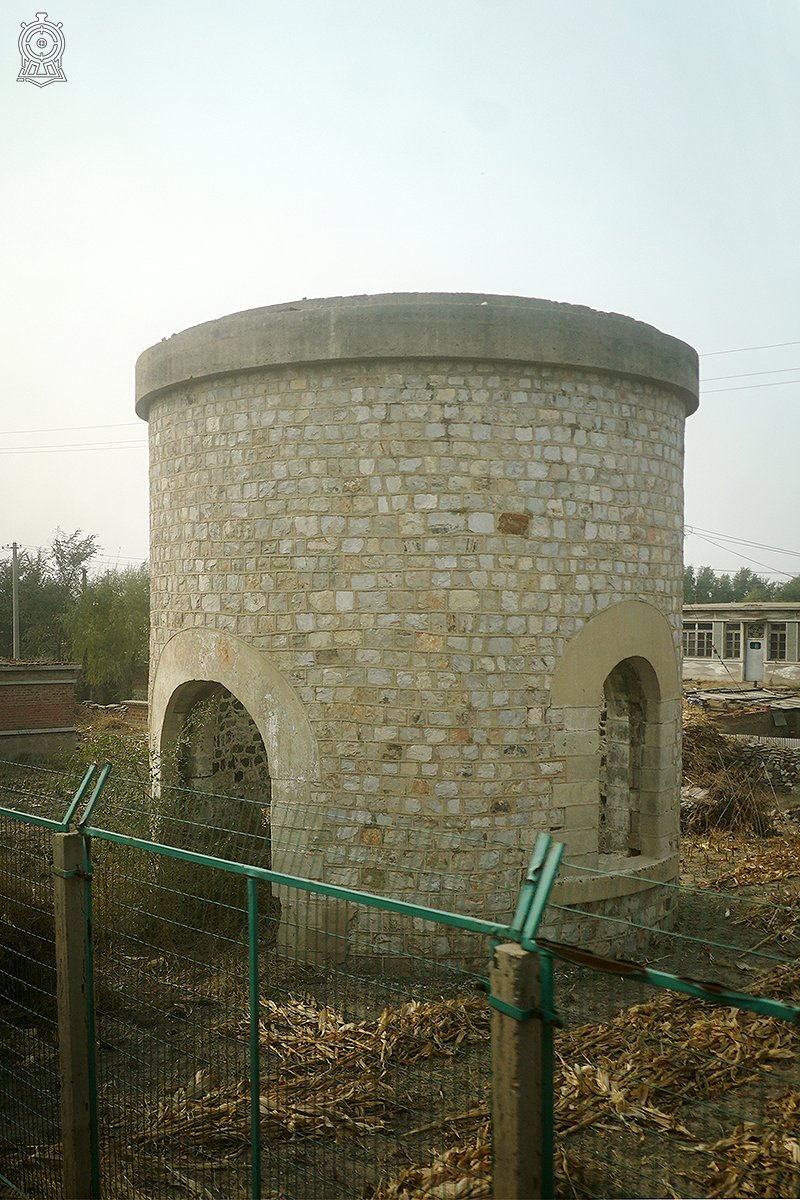
In the 1970s, following the relocation of the locomotive depot, the Jiaozuo water tower was abandoned. Its water tank was removed, and the surviving tower structure was roofed over and converted into a warehouse. Photographed in January 2021.
The Daokouzhen water tower stood within the locomotive depot approximately 1 km north of Daokouzhen Station on the Taoching Railway. Built in 1904, its architectural form was similar to that of the Baodingfu water tower. It was abandoned in 1939 together with the Daokouzhen–Youjiafen section toward Xinxiang, leaving the water tower as the principal surviving structure associated with the former Daokouzhen railway facilities. Photographed in the 1900s.
The Daokouzhen water tower stood within the locomotive depot approximately 1 km north of Daokouzhen Station on the Taoching Railway. Built in 1904, its architectural form was similar to that of the Baodingfu water tower. It was abandoned in 1939 together with the Daokouzhen–Youjiafen section toward Xinxiang, leaving the water tower as the principal surviving structure associated with the former Daokouzhen railway facilities. Photographed in the 1900s.