
Footbridges
Footbridges became one of the most recognizable features of modern railway stations. From the late nineteenth century onward, as British railway engineering accompanied railway construction into China, a number of station footbridges with distinctly British characteristics appeared on major lines such as the Imperial Railways of North China, Peking–Kalgan Railway, Peking–Hankow Railway, and Shanghai–Nanking Railway. A common form featured a steel bridge deck higher in the middle and lower at both ends. On some early examples, the steel girders and other components were manufactured in Britain and shipped to China for assembly, showing a clear structural continuity with contemporary station footbridges in Britain.
This section uses historical photographs, field surveys, and comparisons between similar structures in China and Britain to trace the construction dates, structural characteristics, changing uses, and preservation of these railway footbridges. From Tangshan, Tianjin, Xizhimen, and Zhangjiakou to surviving examples on British railways today, these seemingly ordinary station structures preserve important clues to the transmission and evolution of modern railway engineering technology in China.
In 1907, the second-generation Tangshan Station on the Peking–Mukden Railway was completed with two footbridges. Their steel girders were manufactured in Scotland and Lancashire, Britain. The photograph shows Claude W. Kinder, Chief Engineer of the Peking–Mukden Railway, leaving Tangshan in April 1909.
The footbridge at Tangshan Station, which suffered only minor damage during the 1976 Tangshan earthquake. Photographed in 1976.
The well-preserved Tangshan Station footbridge, still in use today. Photographed in October 2018.
The footbridge at Tanggu Station on the Peking–Mukden Railway. Photographed in the 1930s.
The second-generation Tangshan Station footbridge remains in use today. The photograph shows Claude W. Kinder’s grandson at left, railway historian Peter A. Crush in the centre, and friends during a visit to Tangshan. Photographed in October 2018.
The footbridge at Tianjin East Station on the Peking–Mukden Railway was first built in the 1890s and demolished in the 1980s.
The footbridge at Dongbianmen Station on the Peking–Mukden Railway was built in the 1900s and demolished in the 1950s.
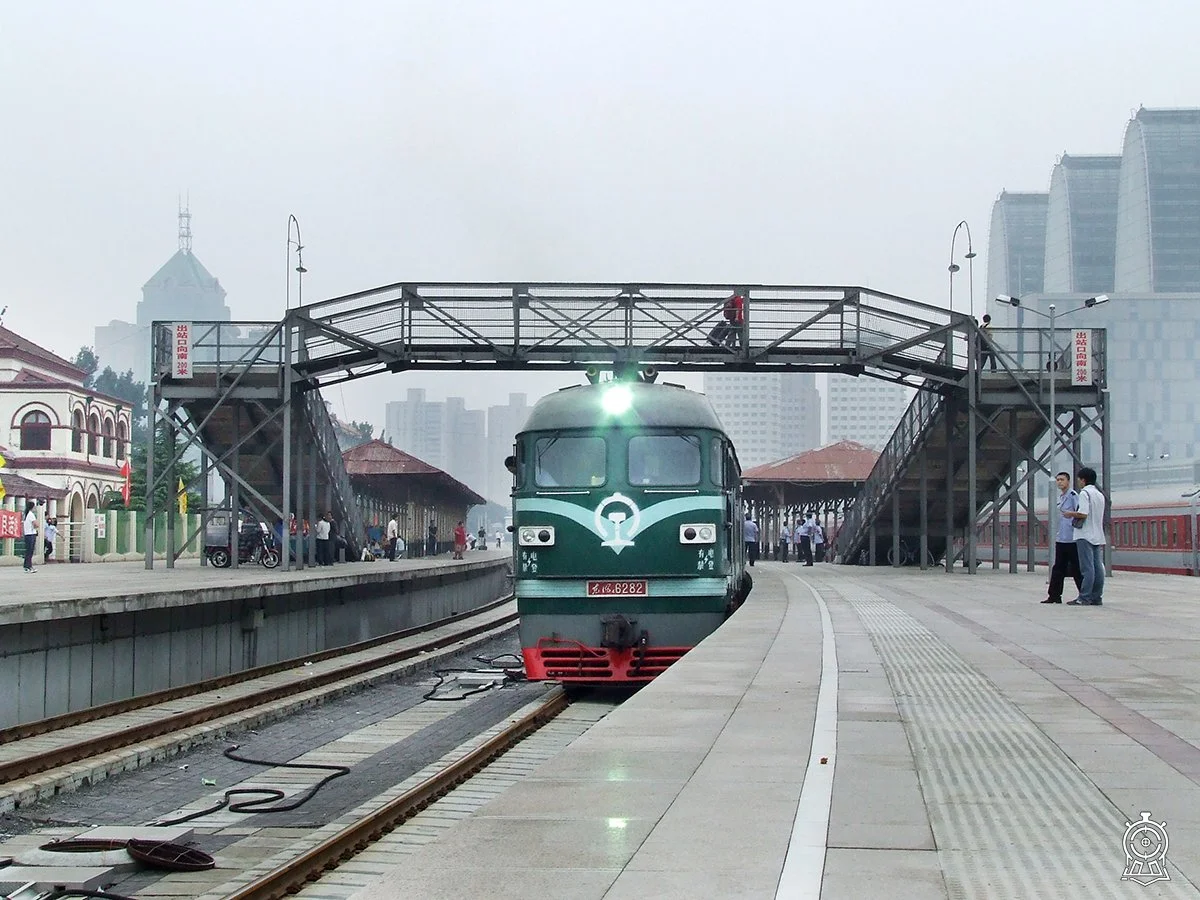
The footbridge at Tianjin Central Station on the Peking–Mukden Railway. Photographed in August 2022.
The footbridge at Langfang Station on the Peking–Mukden Railway. It was demolished in the early 2000s. Photographed in 1937.
The first footbridge at Lutai Station on the Peking–Mukden Railway.
The second footbridge at Lutai Station.
The second-generation footbridge at Luanxian Station on the Peking–Mukden Railway, possibly relocated from Tanggu Station. It was in place by the early 1940s at the latest and was demolished in 2018.
The footbridge at Fengtai Station on the Peking–Mukden Railway. It was demolished in the early 1980s.
The first-generation footbridge at Luanxian Station on the Peking–Mukden Railway. It was demolished in the late 1930s when the station was relocated.
The footbridge at Changli Station on the Peking–Mukden Railway. Photographed in the 1930s.
The footbridge at Beidaihe Station on the Peking–Mukden Railway.
The footbridge at Yingkou (Newchuang) Station on the Yingkou Branch of the Peking–Mukden Railway.
The footbridge at Wuxi Station on the Shanghai–Nanking Railway. Photographed in 1937.
The footbridge at Shanhaiguan Station on the Peking–Mukden Railway was built in the 1900s and demolished in the 1980s.
The footbridge at Jinzhou Station on the Peking–Mukden Railway.
After reconstruction of the west yard at Xizhimen Station in 2006, the footbridge remained in service and survives today. Photographed in July 2006.
The footbridge at Goubangzi Station on the Peking–Mukden Railway.
The footbridge at Xizhimen Station on the Peking–Kalgan Railway. It was originally installed between Platforms 1 and 2 of the first-generation station, and during the 1918 expansion it was relocated to the west yard of the second-generation station. Photographed in June 2005.
The footbridge at Zhangjiakou Station on the Peking–Kalgan Railway was built in the 1910s and demolished in the 1970s. Photographed in the 1930s–1940s.
The footbridge at Fanwangdu Station on the connecting line between the Shanghai–Nanking and Shanghai–Hangchow–Ningpo Railways was built in 1916. In 1999, it was demolished together with the railway and station.
From the mid- to late nineteenth century, as British railways became increasingly double-tracked, station yards expanded, and train frequencies rose, it became progressively more dangerous for passengers to cross tracks at ground level. Footbridges therefore developed into an important part of station infrastructure. Early examples were sometimes constructed in timber, but by the late nineteenth century cast iron, wrought iron, and steel had become increasingly common. The bridge deck usually crossed the station yard to connect separate platforms, with stairs at either end, and some examples were also provided with canopies.
As railway companies built stations on a large scale, footbridges increasingly adopted standardized and related design families. Although different companies varied in bridge profile, truss form, railings, and decorative details, their basic structure was often similar, and many components could be prefabricated in factories and assembled on site. Numerous late nineteenth-century standard-type footbridges survive in Britain today, including examples associated with the Great Western Railway, Midland Railway, and North Eastern Railway.
From the late nineteenth to the early twentieth century, this mature form of station infrastructure also entered China together with British railway engineering. The numerous steel footbridges built along the Peking–Mukden, Peking–Hankow, Peking–Kalgan, and Shanghai–Nanking Railways shared clear similarities with contemporary British station footbridges in structure, components, and use. Some early examples even used steel manufactured in Britain and shipped to China for assembly, providing particularly direct evidence of the continuation and application of standardized British railway-station infrastructure in China.
Bewdley Station
Maze Hill Station
The footbridge at Shijiazhuang Station on the Peking–Hankow Railway was demolished during station reconstruction between 1984 and 1987.
Bo'ness Station
The footbridge at Zhengzhou Station on the Peking–Hankow Railway, built in 1911.
The footbridge at Yancheng (Luohe) Station.
Tracing the Origins
Williton Station
Aviemore Station
Deganwy Station