
Bridges and Culverts
Between 1895 and 1928, as American capital, engineers, and railway technology became involved in railway construction in China, certain concepts and construction methods from modern American bridge engineering were also introduced. Large numbers of bridges and culverts were built along lines such as the Zhuzhou–Pingxiang Railway and the Canton–Samshui Railway, including deck plate-girder bridges, steel truss bridges, brick arch bridges, and a wide variety of small bridges and culverts. Different structural forms were selected according to river width, terrain, railway class, and traffic requirements. Shorter spans commonly used steel plate girders, while larger spans employed trusses; piers, abutments, and arch culverts made extensive use of locally available brick and stone.
Compared with the major bridges on trunk railways, many of the bridges and culverts built with American engineering participation in early China were relatively modest in scale. Their significance lay more in structural calculation, the use of steel girders and standardized components, and the functional separation of piers, abutments, and superstructures. Examples such as the brick arch bridge at Banshanpu, the Yangsanshi plate-girder bridge on the Zhuzhou–Pingxiang Railway, and the Xiushuiyong Bridge on the Canton–Samshui Railway illustrate how American railway bridge engineering methods were adapted to local materials, construction capabilities, and operating requirements in China.
Zhuzhou–Pingxiang Railway
Wayaochong Bridge, located at km 2.7 on the Anyuan–Pingxiang section, is a single-span deck plate-girder bridge. It currently uses British steel girders supplied by the Allies in the 1940s. Both the eastern and western abutments incorporate arched openings. Photographed in March 2021.
Yaolantang Bridge, on the Laoguan–Liling section, was originally built as a three-span deck plate-girder bridge. Its piers resemble the brick piers constructed during the early period of the Zhuzhou–Pingxiang Railway and appear to have been reinforced with concrete at a later date. The bridge was abandoned after the opening of the new Zhejiang–Jiangxi Railway alignment. Photographed in March 2021.
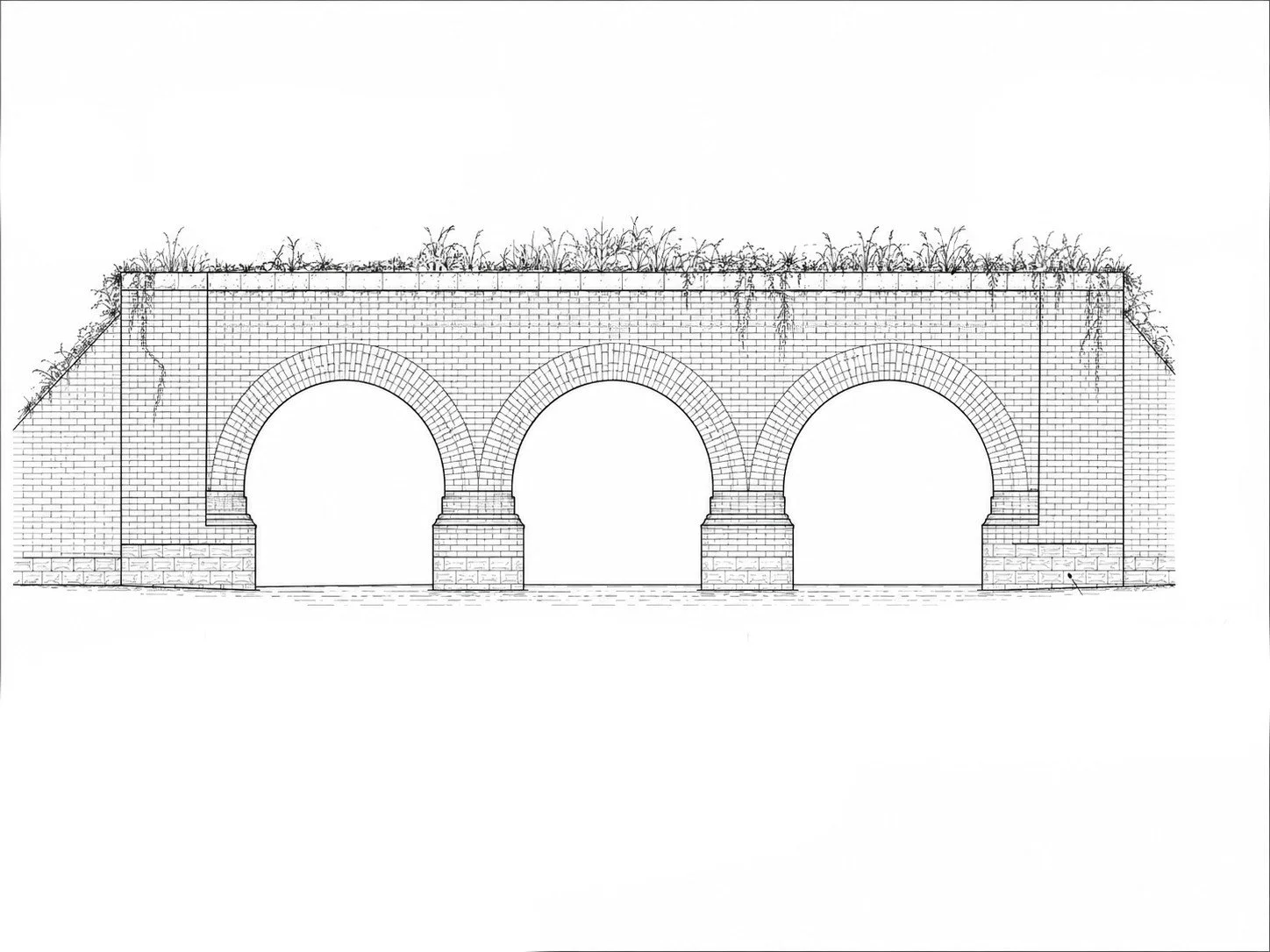
Banshanpu Bridge, located 830 m east of Banshanpu Station, is a three-span brick arch bridge. It is the best-preserved American-influenced bridge surviving on the Zhuzhou–Pingxiang Railway. Photographed in March 2021.
Xinan Yong Bridge was 180 m long and consisted of nine spans, located on the Zoumaying–Xinan section. From the Canton–Samshui Railway Travel Guide, September 1926.
Sanya Port Branch
Second Sanya Bridge, also known as the Jiucun Railway Bridge, was located on the Sanya Port Branch of the Beili–Sanya Railway, designed and built by the Japanese naval garrison authorities between 1941 and 1943. It crossed Tangta Water, a tributary of the Sanya West River. A builder’s plate on one of its deck plate girders reads “AMERICAN BRIDGE COMPANY OF NEW YORK, U.S.A., 1903,” showing that the girder had been manufactured by the American Bridge Company in 1903, decades before the construction of the Hainan railway, and was therefore a reused bridge component. Wang Wei has suggested that the girder is close in date to the construction of the Canton–Samshui Railway. Since the Japanese military made extensive use of rails and bridge materials removed from existing railways in occupied areas of mainland China when building the Hainan railway, it cannot be ruled out that this girder was transferred to Hainan from an earlier railway in South China.
Wooden Railroad Trestle, Monticello Railway Museum, Illinois
The Pingshui River bridges consisted of two separate north and south bridges crossing the northern and southern branches of the Pingshui River south of Pingxiang Station. Both were two-span deck steel-truss bridges. From the Zhuzhou–Pingxiang Railway Travel Guide, October 1919.
Xiashankou Pingshui River Bridge, located on the Yaojiazhou–Xiashankou section, was originally a five-span bridge. The bridge shown here is the second-generation structure; the first bridge was removed during later reconstruction, although remnants of its piers still survive in the river channel. Photographed in March 2021.
Xiushuiyong Bridge on the Canton–Samshui Railway is located 350 m east of Wuyanqiao Station. It is a three-span plate-girder bridge, with a through plate girder in the central span and deck plate girders on the eastern and western spans, for a total length of 35 m. The Shiweitang–Foshan section was originally double track, and both the formation and bridges were constructed accordingly. After the Canton–Samshui Railway was occupied by Japanese forces in October 1938, this section was reduced to single track, while rails and bridge materials were removed for use elsewhere. The original double-track bridge piers at Xiushuiyong still survive today and provide important physical evidence of this history. Photographed in December 2020.
Site of Xinan Yong Bridge. The original bridge has been replaced by a simply supported concrete-girder bridge, although the eastern and western concrete abutments survive. View looking west. Photographed in November 2020.
The Second Sanya Bridge was originally a 1,067 mm-gauge narrow-gauge railway bridge, 52.75 m long, and was the largest bridge on the Sanya Port Branch. The line was converted to standard gauge in 1960. By the 2000s, the Japanese-period bridge had been removed, leaving some original pier remains in the river. A second-generation bridge was built on a staggered alignment and consisted of six spans. In October 2005, upgrading work began on the Hainan West Ring Railway, and this section, together with the old Sanya Station, was closed to traffic. The bridge was completely demolished in 2025. Photographed in February 2021.
From the late nineteenth to the early twentieth century, railway bridge engineering in the United States was undergoing a rapid transition from iron to steel and from experience-based construction toward standardized engineering design. Plate girders were widely used for short-span railway bridges because of their stiffness, ease of fabrication, and straightforward erection, and became extremely common on American railways from the 1890s through the 1920s. Larger river crossings often employed steel truss forms such as the Pratt and Pennsylvania trusses. At the same time, masonry arch bridges continued to be used by some major railway companies where durability and permanent construction were priorities.
Compared with bridges in the United States, contemporary railway bridges in China were generally smaller, designed for lighter loads, and more dependent on locally available materials such as brick and stone. This produced a characteristic combination of American-style steel-girder superstructures with locally built Chinese brick-and-stone piers, abutments, and arch culverts. These structures illustrate how American bridge types, standardized fabrication methods, and engineering concepts were introduced into China and then modified to suit local conditions.
Pingshui River North Bridge and the reconstructed Aozhou Academy in Pingxiang, 2015. The north–south alignment of the Zhuzhou–Pingxiang Railway passes directly through Aozhou, where the academy stands. The line curving to the right, toward the east, is the Zhejiang–Jiangxi Railway constructed in 1937. Photographed in March 2021.
Xiashankou Bridge, located 700 m west of Xiashankou Station, had brick-built piers. According to historical records, 25 of the 27 bridges on the Zhuzhou–Pingxiang Railway used brick-built piers and abutments or brick arch construction. The bridge was later demolished during railway upgrading works. From History of Railway Bridges in China, p. 577.
Yangsanshi Railway Bridge had been altered by the 1910s into an eight-span deck plate-girder bridge. View looking west. From the second issue of the Zhuzhou–Pingxiang Railway Travel Guide, October 1919.
Tracing the Origins
Yangsanshi Railway Bridge, built between 1903 and 1905, was originally a nine-span deck plate-girder bridge carrying the Zhuzhou–Pingxiang Railway across the Lu River north of Liling Station. View looking west. From the first issue of the Zhuzhou–Pingxiang Railway Travel Guide.
Canton–Samshui Railway
Xiaotang Bridge, located on the eastern side of the Xiaotang Station yard on the Canton–Samshui Railway, carried the railway across a drainage channel beside the station. The original concrete parapets and decorative posts on both sides of the bridge deck remain largely intact, preserving details of early railway bridge and culvert construction. Photographed in December 2020.
Danjiang Bridge, located at km 4.1 on the Anyuan–Pingxiang section, is a two-span deck plate-girder bridge. It currently uses British steel girders supplied by the Allies in the 1940s. Photographed in March 2021.
The Pingshui River South Bridge uses the same British steel girders as the North Bridge. Both abutments incorporate arched openings. Photographed in March 2021.
Site of the Yangsanshi Railway Bridge. The bridge has been replaced by a bridge on the double-tracked Zhejiang–Jiangxi Railway. View looking east. Photographed in December 2019.
Site of the Yangsanshi Railway Bridge. The bridge has been replaced by a bridge on the double-tracked Zhejiang–Jiangxi Railway. View looking east. Photographed in December 2019.
Parapet of Xiaotang Bridge. The surviving concrete railing has become one of the few readily identifiable remnants of the Canton–Samshui Railway’s early bridge infrastructure. Photographed in February 2021.
Railroad Bridge over Rocky Run, Illinois
Philadelphia & Reading Railroad Bridge
Shown here is the Pingshui River North Bridge. Its two steel truss spans use British girders dating from the 1940s, while both the northern and southern abutments incorporate arched openings. Photographed in March 2021.
Railroad Bridge over the Hennepin Canal, Illinois
Dock Bridge,NewJersey
Historic Newark Lift Bridge,NewJersey
Lackawanna Railroad Trestle,NewJersey
Former Lehigh Valley Railroad Bridge \ Central Railroad of New Jersey Bridge \ Lehigh and Hudson River Railroad Bridge
Government Bridge over the Mississippi River, Rock Island, Illinois / Davenport, Iowa
Third Humboldt River Bridge on the Union Pacific Railroad, south of Carlin, Nevada
Steel Trestle Bridge at Troy on the Union Pacific Railroad, California
Salmon Bay Railroad Bridge, Seattle, Washington
Steel Bridge over the Willamette River, Portland, Oregon
White Pass & Yukon Route Railroad Bridge, Alaska