
Engine Houses
Between 1895 and 1928, as American engineering technology and railway management practices were introduced into China, some railways built or operated with American participation established engine houses and associated servicing facilities at major stations, locomotive depots, and line terminals. These facilities were used for the storage, inspection, repair, and routine servicing of steam locomotives, and were often grouped with turntables, coal stages, water towers, ash pits, and repair shops to form complete locomotive servicing areas.
In the United States during the same period, engine houses were generally built in two principal forms: rectangular engine houses and fan-shaped roundhouses. Rectangular sheds were more common at smaller locomotive facilities, while fan-shaped roundhouses were better suited to the concentrated storage, turning, and maintenance of larger locomotive fleets, and became a characteristic feature of major American locomotive depots from the nineteenth to the early twentieth century.
This contrast can also be seen in related examples in China. The Zhuzhou–Pingxiang Railway once had a 12-road fan-shaped roundhouse at Anyuan, while the engine house at Foshan on the Canton–Samshui Railway was a two-road rectangular shed. These examples show that the size and form of an engine house were determined primarily by traffic volume, locomotive allocation, and servicing requirements, rather than by any single fixed “American architectural style.”
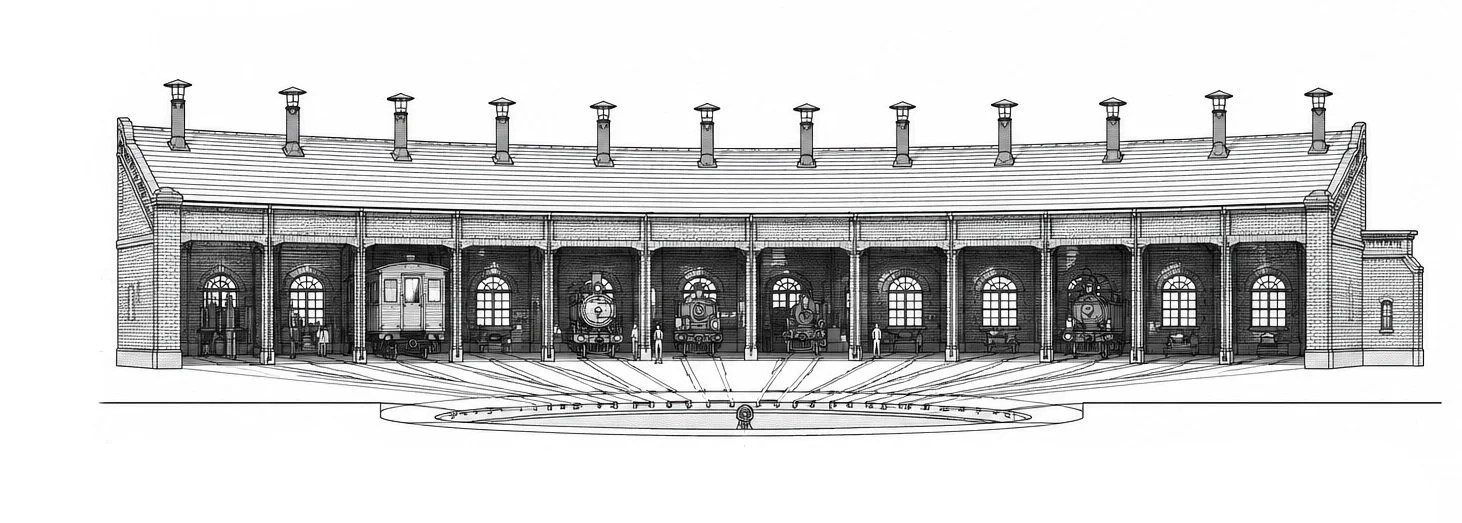
The Zhuzhou–Pingxiang Railway was begun in 1899 to transport coal from Anyuan to a transshipment point, from which it was carried by water to the ironworks at Hanyang and Daye. German and American chief engineers were employed for surveying and construction, and the line was eventually extended to Zhuzhou, where it connected with the Canton–Hankow Railway. At Anyuan, a 12-road fan-shaped roundhouse was built to accommodate Prussian G.5.3 locomotives. From the Journal of the Railway Association, No. 21, 1914.
During the War of Resistance against Japan and the subsequent Chinese Civil War, the Pingxiang–Anyuan Railway suffered repeated damage. Through the study of a 1971 satellite image, Wang Wei found that the fan-shaped roundhouse had already been demolished and the site redeveloped with an auditorium and factory buildings. In 2023, the former roundhouse site became part of the Anyuan Railway Station heritage attraction, where a small fan-shaped structure was newly built as an interpretive reconstruction. The former station building, originally located about 200 m to the southwest, was also reconstructed at the site. Photographed on March 29, 2021.
Tracing the Origins
The Foshan engine house on the Canton–Samshui Railway was a two-road rectangular shed, built in 1903. By the 1980s, the building had disappeared and the site had been converted into a freight yard. From the Canton–Samshui Railway Travel Guide, September 1926.
The Roundhouse, B&O Railroad Museum, Baltimore, Maryland
Interior of the Roundhouse, B&O Railroad Museum, Baltimore, Maryland
1902/1937 Roundhouse and Turntable, Steamtown National Historic Site, Scranton, Pennsylvania
Reading Company Saucon Creek Roundhouse (1918–1919), Hellertown, Pennsylvania
Ruins of a Former Railroad Roundhouse, Phillipsburg, New Jersey
Union Pacific Roundhouse and Turntable (1912–1914), Evanston, Wyoming
Roundhouse and Turntable, California State Railroad Museum, Sacramento, California
Great Northern Railway Interbay Roundhouse and Turntable (1929), Seattle, Washington
B&O Martinsburg West Roundhouse
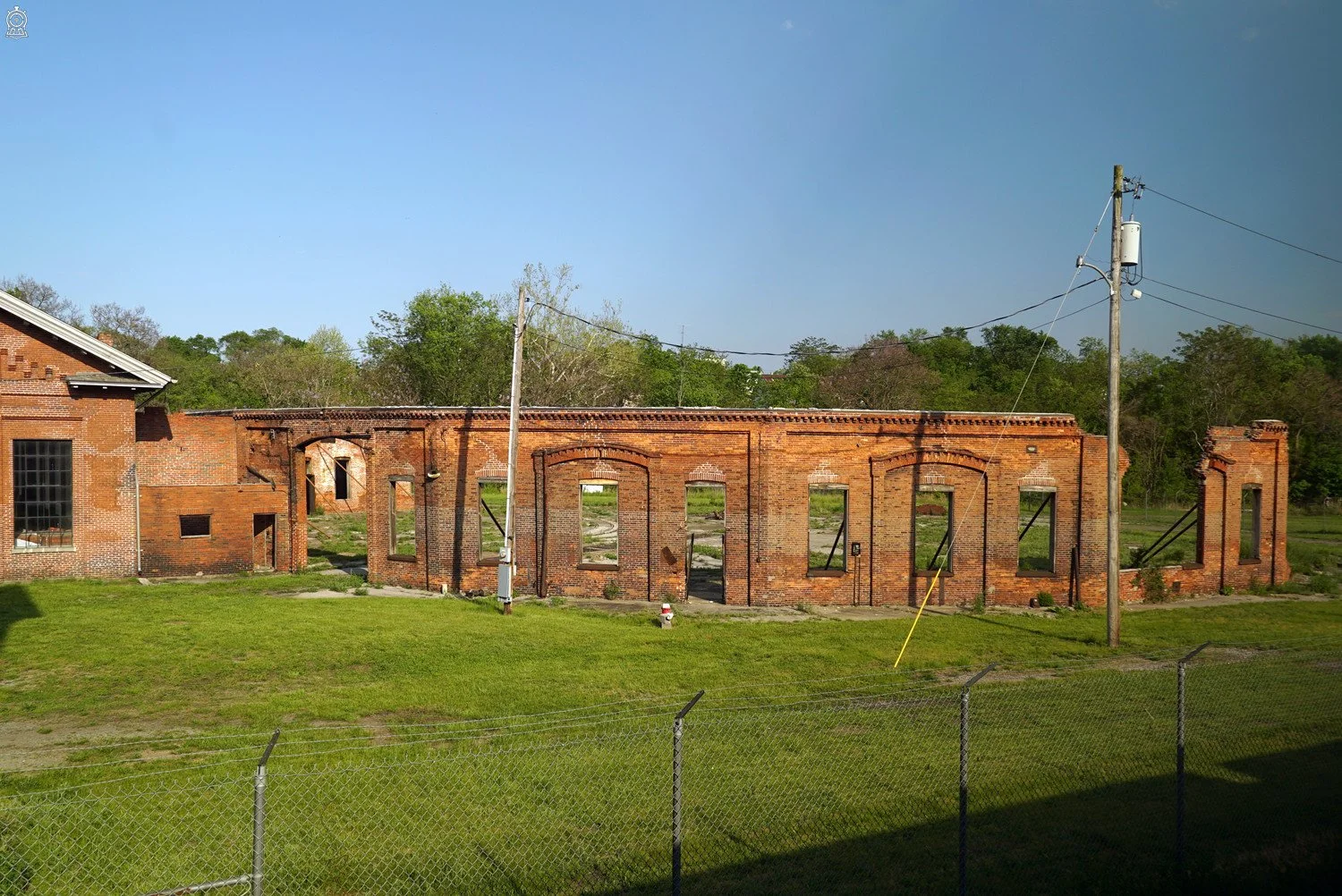
The remains of the second roundhouse at Martinsburg.