
Major Station Buildings
Between 1895 and 1928, as American capital, engineers, and railway technology entered China, a number of major station buildings were constructed. These stations were generally located on important trunk lines, at railway junctions, or in commercial port cities. In addition to handling passenger traffic, they also served functions related to railway administration, urban representation, and public display.
Compared with ordinary small and medium-sized stations, major station buildings were more substantial in both scale and architectural treatment. They were commonly built of brick, stone, or brick-and-timber construction and often included large-span waiting spaces, porticos, towers, gables, and more elaborate Western-style decoration. Some were directly designed with the participation of American engineers or reflected American railway architectural principles. Their plans, structural systems, and passenger facilities likewise demonstrate the influence of contemporary American railway construction and management practices in China.
Anyuan Station, Zhuzhou–Pingxiang Railway
Zhuzhou Station stood on the bank of the Xiang River. The first station building was completed in 1905 and entered service on December 12 of that year, when the entire Zhuzhou–Pingxiang Railway opened to traffic. The main station building had an L-shaped plan and stood on the south side of the tracks. It was a single-story structure with large arched openings on its eastern and northern façades. A station nameboard was mounted at the top of the eastern façade facing the station square, with the Chinese name “Zhuzhou” written from right to left and the English station name below from left to right. In 1911, the Canton–Hankow Railway built a separate Zhuzhou North Station about 1.5 km to the north. The two stations were initially unconnected, and a connecting line was not completed until 1913. Zhuzhou subsequently developed from the terminus of the Zhuzhou–Pingxiang Railway into an important railway junction served by several lines. From the Zhuzhou–Pingxiang Railway Travel Guide, October 1919.
Samshui Station, Canton–Samshui Railway
Pingxiang Station was first established in 1899 near the western gate of Pingxiang. Its first-generation station building was a two-story American-style structure approximately nine bays wide across the main façade. A continuous veranda extended along the western side beneath broadly projecting eaves. The central section rose to two stories and was topped by a triangular gable with a circular ventilation opening. Below it were three adjoining arched windows. From the Zhuzhou–Pingxiang Railway Travel Guide, 1913.
Zhuzhou Station, Zhuzhou–Pingxiang Railway
The first-generation Pingxiang Station building, viewed from northwest to southeast. The single-story connecting wing and the roof of the two-story central section can be seen behind the platform canopy. The station building was destroyed during a Japanese air raid on Pingxiang Station in 1939 and no longer survives. From the Zhuzhou–Pingxiang Railway Travel Guide, October 1919.
Anyuan Station was the eastern terminus of the Zhuzhou–Pingxiang Railway and originally served the shipment of coal from the Pingxiang Colliery. Construction of the railway began in 1899, and the full line opened in 1905. Surveying and design were carried out by the American chief engineer Li Zhi, assistant engineer Makelai, and Chinese assistant engineer Luo Guorui, making it the earliest railway built in Jiangxi. In addition to the station building, the early Anyuan railway complex included a transportation department, rolling-stock department, administrative offices, engine house, workshops, materials depot, turntable, and water-supply facilities, forming a substantial railway-and-mining transportation base. The photograph shows the early station building, platform canopy, and platforms at Anyuan. From the Zhuzhou–Pingxiang Railway Travel Guide, 1913.
Pingxiang Station, Zhuzhou–Pingxiang Railway
Present-day view of Anyuan Station. In the early twentieth century, the station complex included locomotive repair shops, carriage and wagon repair facilities, an engine house, traffic offices, and engineering offices. During the War of Resistance against Japan, the Pingxiang–Anyuan section was dismantled by Chinese Nationalist forces in 1939, and the Anyuan coal mine ceased operation. Although the railway was restored after the war, the early station layout had already changed considerably. The Anyuan coal mine resumed production and underwent expansion in 1954, and the original station building, engine house, and other early railway structures have since disappeared. Photographed in March 2021.
Samshui Station at Hekou, Samshui, the terminus of the Canton–Samshui Railway, was built in 1903. The photograph shows its two-story American-style brick-and-timber station building. After the station opened, it directly connected railway traffic from Canton and Foshan with shipping on the West River and North River, making Samshui an important rail-and-water transshipment hub in the Pearl River Delta. From the Canton–Samshui Railway Travel Guide, 1926.
The restored Samshui Station building. The building stands on the south side of the railway and is arranged on an east–west axis. A single-story waiting room and ancillary rooms adjoin its western side. Following restoration, the station largely recovered its pale yellow exterior walls, pitched roof, and original door and window proportions. It now forms part of the Hekou Century-Old Railway Station Theme Park. Photographed in November 2020.
View eastward across the old Samshui Station building, platform, and station yard. When first built, Samshui Station had two tracks. As the terminus of the Canton–Samshui Railway, large numbers of passengers and goods arriving from Canton and Foshan transferred here to river vessels bound for western and northern Guangdong.
During the Republican period, a second-story balcony was added to the Foshan Station building. The photograph shows an American-built steam locomotive passing in front of the station. From the Canton–Samshui Railway Travel Guide, 1926.
The old Samshui Station building before restoration. The two-story station building still largely retained its original appearance, although the decorative fascia boards of the single-story waiting room had long since been replaced by brick walls, and later warehouse structures had been added to the west. Photographed in December 2019.
Rear facade of Samshui Station. A balcony is supported by decorative cast-iron cantilever brackets similar to those beneath the roof eaves, incorporating Western-style scrolling foliate motifs. The balcony railing also retains ornamental ironwork, preserving much of the original character of this American-style station building. Photographed in December 2019.
Foshan Station, Canton–Samshui Railway
Samshui Station during restoration. The station building was designated a Key Cultural Relic Protection Unit of Samshui City in 1997. Photographed in November 2020.
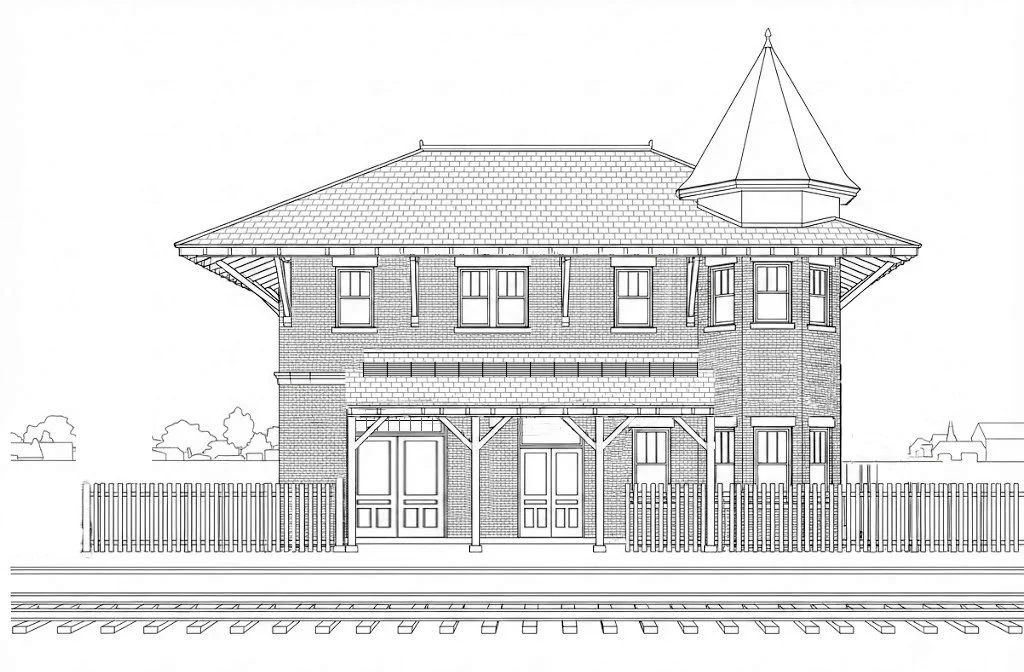
Foshan Station was first established in 1901 and entered service in 1906, becoming an important intermediate station on the Canton–Samshui Railway. Its two-story station building, completed in 1906, featured deeply projecting eaves and displayed clear characteristics of American railway architecture. The building stood on the north side of the main line. This view shows the western and southern façades, with a station sign reading “佛山 / FAT SHAN” suspended from the platform canopy.
South and east facades of Foshan Station. Its most distinctive feature is the octagonal tower, whose side windows provided views over the station yard and tracks, facilitating the observation and control of train movements. The deeply projecting eaves and timber diagonal braces display characteristics associated with American railway station architecture, while also adapting the building to the hot, rainy climate of the Lingnan region. From the Canton–Samshui Railway Travel Guide, 1926.
Present-day site of Pingxiang Station. The original station building has disappeared and its site is now occupied by a four-story station building. Photographed in March 2021.
Grand Central Terminal, New York City
Tracing the Origins
Zhuzhou Station of the Zhuzhou–Pingxiang Railway, located on the bank of the Xiang River, primarily served to transfer coal arriving from Pingxiang onto riverboats for shipment to the Hanyang Ironworks as fuel. After the completion of the Canton–Hankow Railway, the station was at one time known as Zhuzhou South Station. In 1969, after a new freight yard was completed at Zhuzhou, the South Station was closed and the railway from the former triangular junction to the Xiang River was subsequently dismantled. The photograph shows the junction of the Zhuzhou–Pingxiang Railway and the Canton–Hankow Railway. The Zhuzhou–Pingxiang line passed beneath the Canton–Hankow Railway at the end of the road on the right side of the image and then continued about 900 m westward to Zhuzhou Station on the Xiang River. The cluster of buildings in the upper right of the image marks the approximate location of the former station site. The remaining low-rise buildings near the old station were demolished after 2006, and the site is now vacant land. Photographed in March 2021.
Because the construction standards, traffic volumes, and station scales of early Chinese railways were generally lower than those in the United States, even stations classified as “major stations” on Chinese railways built with American participation were much smaller than contemporary large railway terminals in the United States. In scale, they were often closer to medium-sized or even small American station buildings. The following examples of contemporary American railway stations are provided for comparison.
Grand Central Terminal, New York City
When Foshan Station was first built, it had two main tracks and three station tracks, together with an engine house, turntable, and steel water tower. The old station building and yard tracks can be seen in the distance. After the fall of Guangzhou in 1938, part of the double-track section between Guangzhou and Foshan, as well as the Foshan–Samshui section, was dismantled by the Japanese forces. The railway was gradually restored after the end of the war. From the Canton–Samshui Railway Travel Guide, 1926.
By the 1980s, the first-generation Foshan Station building had been demolished and replaced by a second-generation station building. The engine house was also removed and the site converted into a freight yard. In 1993, a third-generation station building was completed as part of a major station expansion project. In 2023, the station was demolished again for reconstruction.
Moynihan Train Hall (the western end of Pennsylvania Station), New York City
Newark Penn Station
Newark Broad Street Station
Portland Union Station , Oregon
King Street Station , Seattle
Washington Union Station
Allentown station (Central Railroad of New Jersey)
Denver Union Station , Colorado
Salt Lake City Union Pacific Depot