
Small Station Buildings
Between 1895 and 1928, relatively few small and medium-sized stations in China were built on railways involving American participation, with the main examples found on the Canton–Samshui Railway and the Zhuzhou–Pingxiang Railway. These stations were modest in scale and generally contained only the basic spaces required for passenger waiting, train operations, the stationmaster, and railway staff. Even so, their plans and functional organization reveal influences from contemporary small railway stations in the United States.
Some station buildings featured a projecting operator’s office on the track side, with windows on three sides so that staff could observe both directions of the line, the platform, and train movements. This was a common feature of small American railway stations of the period. At the same time, the Chinese examples made extensive use of local materials and architectural forms. Small stations along the Zhuzhou–Pingxiang Railway, in particular, often incorporated elements characteristic of eastern Hunan and western Jiangxi vernacular architecture, including grey-tiled pitched roofs, upturned gables, horse-head walls, and Chinese-style eaves. The result was a distinctive combination of American railway functional planning and regional architectural traditions.
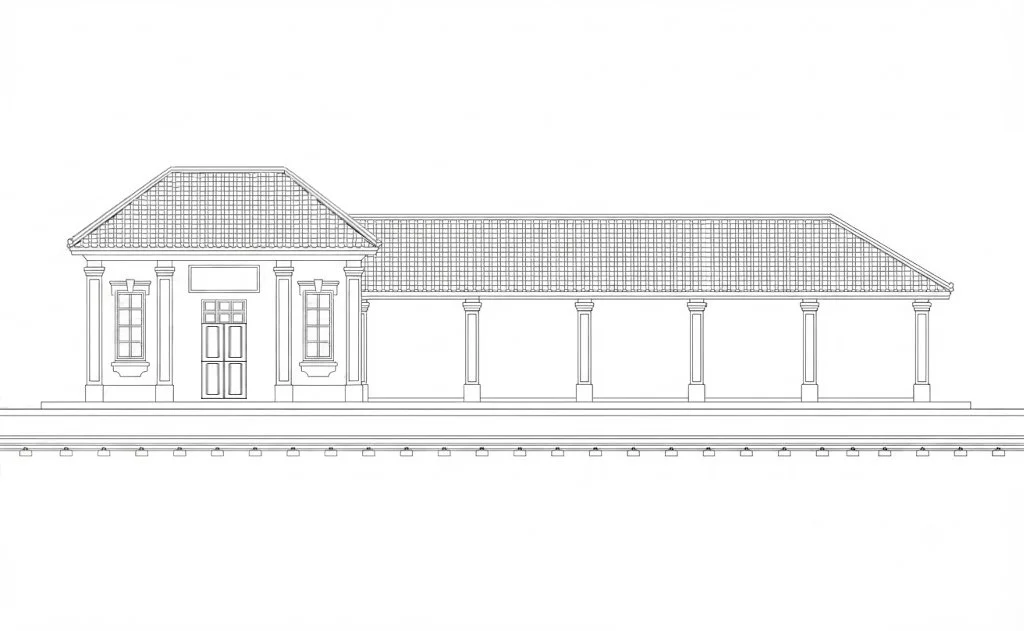
Wuyanqiao Station, located at km 1.79 on the Canton–Samshui Railway, was built in 1903. It had a three-bay American-influenced station building containing the stationmaster’s office and operating room, with a five-bay passenger waiting shelter adjoining its western side. The station stood on a curve and had two arrival and departure tracks. From the Canton–Samshui Railway Travel Guide, September 1926.
Shaobian Station, located at km 7.1, was built in 1903. It had the same three-bay station building as Wuyanqiao Station, but because passenger traffic was lighter, its waiting shelter consisted of only three bays. This section of railway formed the second stage of the line, constructed eastward from Foshan in 1903. Compared with the first group of station buildings west of Foshan, this station type belonged to a second design phase. The original station building no longer survives.
Diantou Station, located at km 11.67, was built in 1903. Its station building and waiting shelter were identical to those at Shaobian Station. The original building no longer survives. From the Canton–Samshui Railway Travel Guide, September 1926.
小塘車站位於廣三鐵路30.9公里處,建於1901年12月-1903年1月,是廣三鐵路首段通車的路線。此站站房建於高坡之上,線路一側設坡道及磚砌護欄。該站老站房已被現代磚混建築取代,坡道及護欄仍維持通車初期之樣貌。攝於2020年12月。
Xinan Station, located at km 43.13, was built between December 1901 and January 1903. It belonged to the first group of station buildings on the Canton–Samshui Railway and consisted of a three-bay structure. The station nameboard was mounted above the office doorway beneath a gable. The waiting room directly adjoined the office and opened toward the track through a large arched opening and doorway. Ancillary buildings, including the Third Railway Police Substation, extended from the far end. The station building no longer survives. From the Canton–Samshui Railway Travel Guide, September 1926.
Baiguanpu Station, built between 1903 and 1905, was located at km 86 on the Zhuzhou–Pingxiang Railway and served as a small station on the Liling–Zhuzhou section. The smaller stations on this railway did not simply copy American station architecture. Instead, modern railway functions were combined with traditional architectural elements from eastern Hunan and western Jiangxi, including grey-tiled pitched roofs, upturned gables, horse-head walls, and Chinese-style eaves. The result was an eclectic railway architecture with a strong regional Hunan–Jiangxi character. The building no longer survives. From the Zhuzhou–Pingxiang Railway Travel Guide, October 1919.
Site of Baiguanpu Station, view looking west. Photographed in March 2021.
Yaojiaba Station, located at km 71, was one of the smaller stations on the Zhuzhou–Pingxiang Railway. Its station building was identical to that at Baiguanpu and consisted of a single-story brick-and-timber structure arranged lengthwise along the platform. The roof and gables displayed pronounced Chinese architectural features. Compared with larger stations such as Zhuzhou and Pingxiang, it was modest in scale and primarily served local passenger and freight traffic as well as train crossings. The building no longer survives. From the Zhuzhou–Pingxiang Railway Travel Guide, October 1919.
A simple brick station building on the site of Yaojiaba Station, view looking west. Photographed in March 2021.
Laoguan Station, located at km 34, was built between 1899 and 1903 as a small station on the Pingxiang–Liling section. Its layout was similar to other small stations on the line, with two parallel rows of buildings aligned with the railway and a station nameboard mounted on the façade. It represented a typical intermediate station on the Zhuzhou–Pingxiang Railway. The building no longer survives. From the Zhuzhou–Pingxiang Railway Travel Guide, October 1919.
Klamath Falls station, Oregon
After 2009, the old station building at Wuyanqiao was demolished, marking the disappearance of the last surviving small station building of the Canton–Samshui Railway. Photographed in December 2019.
A modern station building erected on the site of Laoguan Station. After the railway was realigned, the building was converted for use as a bus station. View looking north. Photographed in March 2021.
Tracing the Origins
Centralia Union Depot, WA
Banshanpu Station, located at km 58 on the Zhuzhou–Pingxiang Railway. On the track side, the central operator’s office projected outward from the main station building and had windows on three sides, allowing staff to observe the station yard and train movements. Two large arched openings on the left led to the waiting room, while the three rooms on the right were used by railway staff and the stationmaster. The building no longer survives. From the Zhuzhou–Pingxiang Railway Travel Guide, October 1919.
Site of Banshanpu Station, view looking east. Photographed in March 2021.
Xiashankou Station, located at km 20 on the Zhuzhou–Pingxiang Railway, was built between 1899 and 1903. Its station building followed the same general design as the other small stations on the line. The original building no longer survives. From the Zhuzhou–Pingxiang Railway Travel Guide, October 1919.
Present-day view of Xiashankou Station, looking east. Photographed in March 2021.
American participation in the construction of small and medium-sized railway stations in China was relatively limited. On the Zhuzhou–Pingxiang Railway, for example, many small stations did not directly imitate American station architecture in appearance. Instead, they made extensive use of pitched roofs, gables, and other forms derived from the traditional architecture of eastern Hunan and western Jiangxi, giving them a strong regional character.
However, when their plans and functional organization are examined, clear connections with contemporary small railway stations in the United States can still be identified. One of the most characteristic features was the projecting operator’s office, or bay, on the track side of the station building. Windows were provided on the front and both sides of the projection, allowing railway staff to observe both directions of the line, the platform, and train movements simultaneously. This combination of a projecting operator’s office with three-sided visibility was common in small American railway stations from the late nineteenth to the early twentieth century.
These stations can therefore be understood as a combination of American railway functional planning and local architectural forms. Their outward appearance became increasingly localized, while the internal organization of train operations, sightlines, and functional zoning retained principles associated with modern American small-station design. This also demonstrates that American railway architecture was not simply copied when introduced into China, but was gradually adapted under the influence of local materials, climate, and traditional building practices.
Geneseo, Illinois
Geneseo, Illinois
Kelso Multimodal Transportation Center ,WA
Union Pacific Depot — Evanston, Wyoming.
Essex ,Valley Railroad , Connecticut
Bureau Junction, Illinois
Orange station (NJ Transit)
Bethlehem station (Central Railroad of New Jersey), Pennsylvania
West Liberty, Iowa
Snoqualmie, Washington
Glen Ridge, New Jersey
Galesburg, Illinois
Harpers Ferry, West Virginia