
water tower
As the United States became involved in the construction and operation of several railways in China, water towers were commonly installed near major stations, locomotive depots, and engine houses to supply water for steam locomotives. On early steam railways, water towers were as essential as coal stages, ash pits, and turntables, and their distribution often reflected the importance of a station and the operational range of its locomotives.
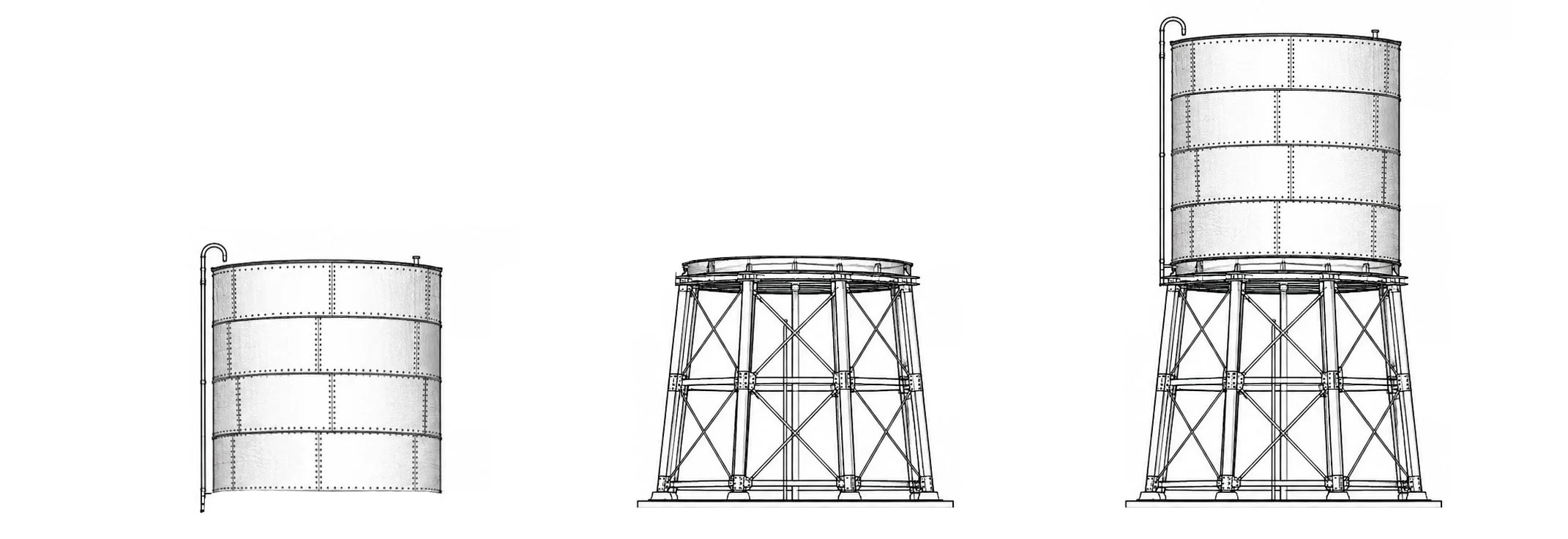
American railway water towers generally took the form of elevated tanks, commonly using wooden or steel reservoirs supported by timber, steel, or masonry structures. They were usually accompanied by water columns, pump houses, and other related supply facilities. Some examples closely resembled contemporary railway water towers in the United States, demonstrating the direct application of American railway engineering technology in China.
The water tower at Shiweitang Station on the Canton–Samshui Railway stood at the western end of the platform and supplied water to both the station and steam locomotives. The tower was demolished in 2002. From the Canton–Samshui Railway Travel Guide, September 1926.
The east water tower at Foshan Station stood at the locomotive standing area east of the station building. Its lower section was supported by a timber framework, with a metal water tank above. A vertical lifting-type water crane was installed on the track side. In the photograph, an American-built AM-class steam locomotive is preparing to take water. The tower had disappeared by the 1980s. From an early twentieth-century postcard.
The west water tower at Foshan Station on the Canton–Samshui Railway stood on the north side of the station’s western throat. Its lower section consisted of a steel-frame supporting structure, while the upper section contained the water tank. A swiveling water crane on the track side supplied water to steam locomotives. The tower had disappeared by the 1980s. From an early twentieth-century postcard.