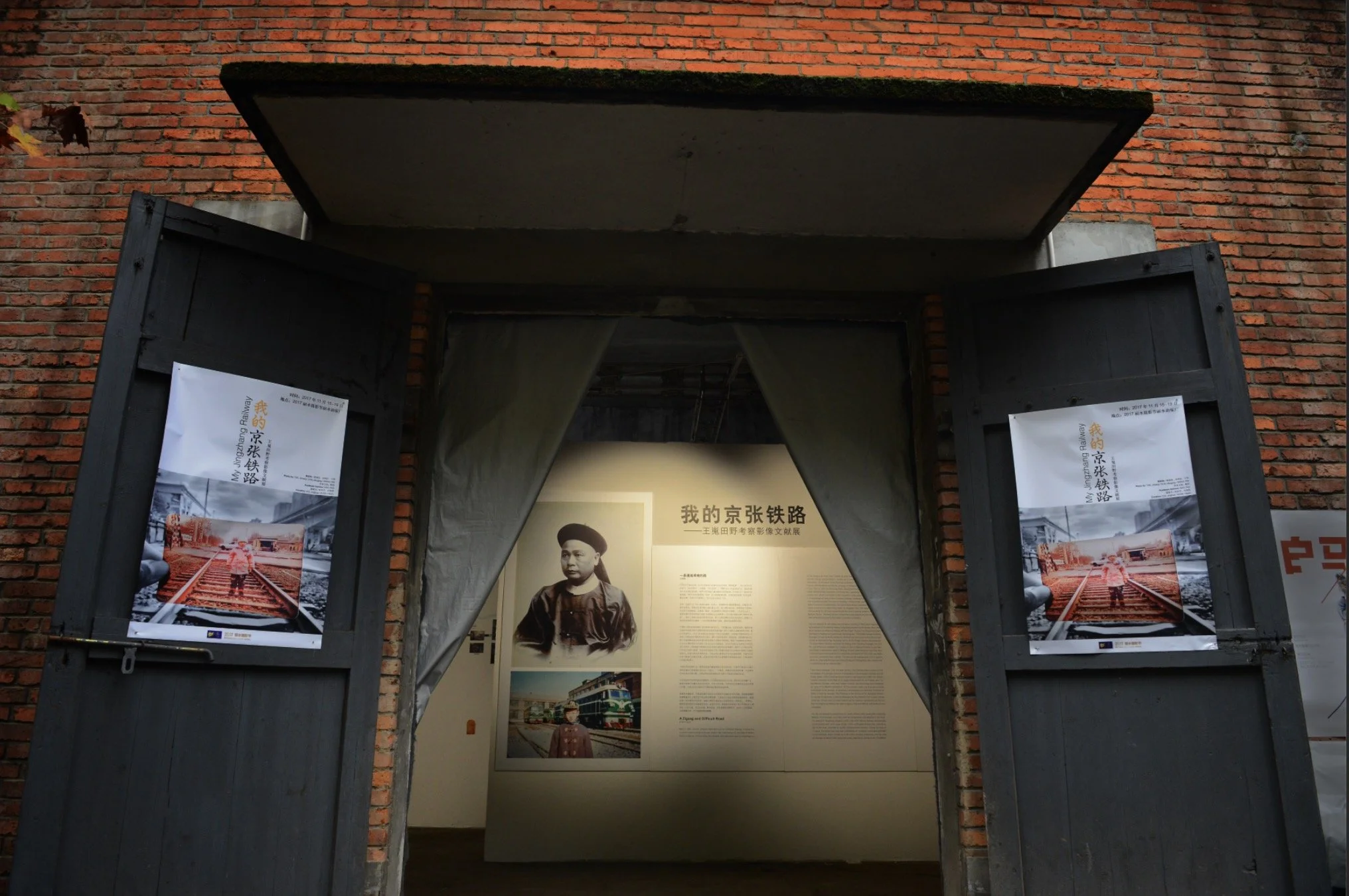
My Beijing-Zhangjiakou Railway: A Photographic and Documentary Exhibition of Field Investigations by Wang Wei
A Winding and Arduous Road
— By Guo Guanglin
In 1865, British merchant Durand laid about 500 meters of an "exhibition railway" outside Beijing’s Xuanwu Gate. Shocked that vehicles could move with flying speed, the Chinese public and officials regarded it as a "demonic device," resulting in an imperial decree to dismantle it.
In the 1868 Treaty of Tianjin, the Qing court refused to allow foreigners to build railways in China. In 1876, the Wusong Railway, built without authorization by British and American merchants, was torn down due to unanimous domestic opposition. In 1881, Li Hongzhang used the pretext of building a "road" to construct the Tangshan-Xushuge Railway. Later, because conservative officials submitted memorials arguing that "the roaring locomotive will disturb the Eastern Qing Tombs," he was forced to use horses for traction, literally turning a train into a horse-drawn carriage. Later, the anti-foreign "Boxer Rebellion" ripped up railways and killed foreigners, and the Empress Dowager Cixi enthusiastically declared war on all major powers, only to flee for her life to Xi'an after being defeated by foreign armies. On her return journey to Beijing, someone took the opportunity to invite her onto a train. During this desperate escape, the Empress Dowager finally felt that the train was faster and more comfortable than a sedan chair. This was the historical backdrop of China before the imperial sanction of the Beijing-Zhangjiakou Railway.
More than a century has passed. Studying abroad and emigrating to Europe and the Americas have become a frantic trend, and China’s high-speed rail has ranked first in the world. Western modern material civilization is no longer labeled as "barbarian techniques." Yet, amidst the spectacle society of capital, many people are indulging in overconsumption and a state of euphoria where amusement is pursued to the point of death. The road to China’s modernization, spanning three centuries, mirrors the winding, faltering, and arduous journey of the Beijing-Zhangjiakou Railway.
Do not treat My Beijing-Zhangjiakou Railway as a simple visual comparison; it serves more as a clue for introspection and critical reflection. The industrious Yongzheng Emperor and the English philosopher John Locke (1632–1704), revered as a thinker of modern enlightenment, were basically contemporaries. During his 13-year reign, Emperor Yongzheng personally reviewed over 30 million words of memorials, averaging over a thousand words written with a soft brush every day. Meanwhile, those steadfast defenders who opposed reform and institutional change—were they not people who had studied classical literature bitterly and pored over books until their hair turned white? Yet, despite being learned to the point of owning "five cartloads of books," which of them could ever comprehend Locke’s modern concept of a social contract? The publication of Gustave Le Bon’s The Crowd: A Study of the Popular Mind in France coincided almost synchronously with the raging Boxer Rebellion in China; one can hardly imagine traditional Chinese culture ever nurturing a sociological work of that kind. A civilization that had continued for several millennia was not only sluggish in development and breakthrough, but when facing advanced civilizations, its profound traditional culture instead became a burden and even a resistance that held it back. This is not to negate traditional culture, but rather to recognize that we must face up to its negative factors. Chinese culture was inherently the result of continuous integration and development; in this new era, Chinese culture is in even greater need of continuously absorbing new content. Only by doing so can the Chinese nation truly rejuvenate.
The exhibition or book collection My Beijing-Zhangjiakou Railway is a creative work spanning a century. It acts as a relay and a continuation of pioneers like Jeme Tien Yau and others who blazed the trail through arduous efforts in China’s modernization drive. These two sets of images, separated by a century, are not merely objects of simple visual appreciation; they form an indispensable link and complement between two sets of historical documents. Photography, born as an adaptation to modern civilization, holds fast to its modernist stance. This makes it the most widely used and popularized medium as well as the most advanced cultural form. Its documentation function not only testifies to the contradictions and problems of contemporary society in real time, but also provides near-objective collateral material for the writing of historical documents.
We are grateful to Mr. Jeme Tien Yau, as a founder and trailblazer, for his contributions to China’s modernization construction. We are grateful to the late-Qing photographer Mr. Tan Jintang for leaving us these precious images, which provide us with the most adequate conditions to understand those difficult years a century ago and approach primary historical sources. We are also grateful to post-90s youth Wang Wei for turning his personal passion into a form of knowledge and a sense of responsibility. The visual text presented before us is historical, contemporary, and oriented toward the future! As a historical figure in China once said, taking history as a mirror can help us understand the rise and fall of nations.
In other words, history is the best textbook. Whether for an individual or a country, only by respecting history can one hope to avoid repeating past mistakes!