
Wandering for Over a Decade, the Old Station Signs of Beijing South Station Hope for a New Home
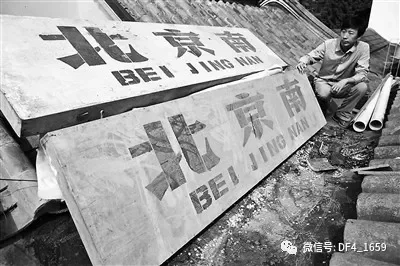
On the roof of a residential house in Xicheng District, Guo Yue shows the old "Beijing South" station signs to a Beijing Youth Daily reporter.
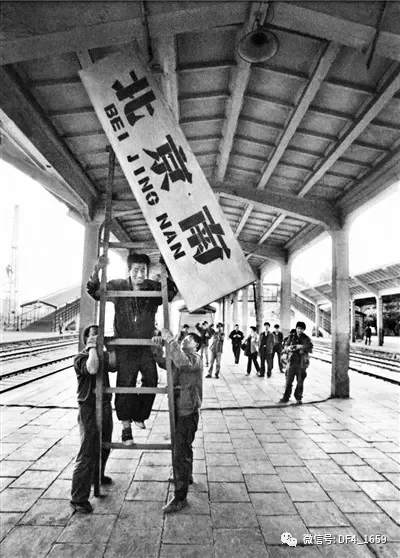
Beijing South Station was closed for renovation in May 2006, and a Beijing Youth Daily reporter once used black-and-white film to record the historic moment when the sign was taken down.
April 22, 2019, Beijing Youth Daily
Ten years ago, at the entrance of a scrap yard, railway enthusiasts including Guo Yue discovered two old "Beijing South" station signs and immediately transported them to their home for safekeeping. Recently, however, Guo Yue's single-story home began renovations, and the future storage of the old station signs has become a difficult problem; he hopes to find a better destination for them. Railway culture scholars believe that the old station signs of Beijing South Station are markers of its renaming, and although their age is not particularly distant, they possess a certain historical value that relevant departments should collect and protect.
Scrap Yard Discovery of Abandoned Station Signs: Railway Fans Transfer and Store Them at Home
Speaking of the bond between Guo Yue and the old South Station signs, it dates back to the retirement of the old South Station and the opening of the new South Station into operation. In early December 2009, one of Guo Yue's railway enthusiast friends was riding an intercity train between Beijing and Tianjin when he noticed two station signs leaning against the entrance of a scrap recycling yard near South Station. Believing the signs held historical value and should not be discarded so easily, he and Guo Yue took action.
On the night of December 12, 2009, Guo Yue and his partners drove a sedan to transport and preserve the station signs. Due to the space limitations of the sedan, only one station sign could fit at a time, requiring them to make two round trips. After a successful transfer, the six partners even posed for a commemorative photo with the signs. Beijing South Station underwent closed-off renovation in 2006, and three years later, the station signs appeared at the scrap yard. Guo Yue analyzed that these two station signs were likely initially stored by the railway department, but with various changes brought by the completion of the new South Station, the old signs were ultimately discarded.
Home Renovations Place Signs on the Roof; Future Fear of Having No Place to Display Them
Recently, in a courtyard in Bingmasi Hutong, Xicheng District, a Beijing Youth Daily reporter climbed with Guo Yue to the corner of the sloping roof of his house. Guo Yue cautiously lifted a piece of plastic sheeting, revealing the two old "Beijing South" station signs, their surfaces covered in dust and looking weather-beaten. The signs are 245 centimeters long, 60 centimeters wide, and 10 centimeters thick, constructed from plywood. Painted with black characters on a double-sided white background, "Beijing South" is written in bold Song typeface, with pinyin marked below the Chinese characters. Compared to today's lightbox-style signs, the wooden signs of the past look simple and unadorned.
Guo Yue told the Beijing Youth Daily reporter that these two signs were transported to his home on December 12, 2009, and had been stored inside the house for nearly ten years. Recently, when his house started renovations, the two signs were placed on the roof. Guo Yue admitted that once the house renovation is completed and the entire family moves in, there will certainly be nowhere to display these two pieces.
Multiple Contacts for Unconditional Donation, But Still No Response to Date
It is understood that around 2012, Guo Yue and his partners contacted Beijing South Station, and the explicit reply given was "no place to accommodate them." Subsequently, they approached the China Railway Museum; the other party was initially quite interested and even asked for the dimensions of the signs, but later there was no further follow-up. Finally, they even contacted Beijing Jinggang Metro Co., Ltd. (Beijing Metro Line 4 passes through Beijing South Station), but the other party declined to accept them.
Guo Yue introduced that donating these two station signs to a museum or station is in hopes that they can play a greater historical value, allowing more people to understand the history of Beijing South Station. Otherwise, they can only be stored in his own home.
Expert Perspective
Physical Evidence of the South Station Renaming; Once Hung Inside the Station Platform Canopy
The Overview of Station Systems of the Beijing Railway Bureau records that Beijing South Station was formerly named Yongdingmen Station (formerly called Majiapu Station), established in 1897, renamed Beijing South Station on January 1, 1988, and classified as a first-class station. From this, it can be judged that the Beijing South station signs should date from after 1987. In other words, the history of these two signs can be up to 31 years old.
According to the Beijing Youth Daily, on May 10, 2006, the old Beijing South Station began closed-off renovation. As the railway station with the longest history in Beijing's urban area, the upgrade and renovation of South Station attracted many citizens to bid it farewell, and the Beijing Youth Daily reporter was among them.
On May 10, 2006, when South Station initially closed, railway enthusiasts and Beijing Youth Daily reporters frequently took photos inside the station as mementos. Around May 12, railway staff began dismantling the station signs inside the South Station canopy, and the Beijing Youth Daily reporter once recorded this historical moment using black-and-white film. After this sign was taken down, it was hauled away by staff and subsequently its whereabouts became unknown. Three years later, Guo Yue and his partners discovered the old station signs at the scrap yard.
Railway culture scholar Wang Wei introduced that in his memory, there should have been about four such signs inside the canopy of the old Beijing South Station, some of which are preserved by the China Railway Museum. Railway enthusiasts could consider donating the old station signs in their possession to the Community Railway Museum of Jingtie Jiayuan or the History Museum of the China Academy of Railway Sciences.
Wang Wei also mentioned that the long history of Beijing South Station largely remains on paper, leaving relatively few related historical remnants. Beijing South Station was originally named Majiapu Station, and only a portion of the foundation of the old station remains, while other old buildings are basically nonexistent. In 1988, Yongdingmen Station was renamed Beijing South Station, and these two signs should have been changed at that time, serving as historical witness to the name change. It was not until South Station closed for renovation in 2006 that the old station signs disappeared from the public view.
Through expansion and reconstruction, the new Beijing South Station has risen from the ground, and the traces of the old South Station have almost vanished completely. As rare physical witnesses of the old South Station, these station signs, although not extremely old, are important landmarks and are worth cherishing. The spontaneous protection behavior of railway enthusiasts reflects the public's humanistic literacy and historical responsibility for building railway culture.
Text and photos by Beijing Youth Daily reporter Cui Yifei
