
Two Units Collect the "Beijing South" Old Station Signs
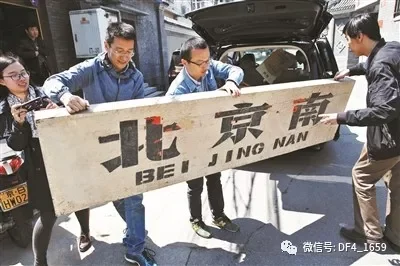
Guo Yue and his partners moving the "Beijing South" old station signs
Photography / Beijing Youth Daily reporter Cui Yifei
April 26, 2019, Beijing Youth Daily
Follow-up
Our Staff Report (Reporter Cui Yifei): On April 23, following our publication of the report titled "Wandering for Over a Decade, Old Station Signs of Beijing South Station Hope for a New Home," a total of three units expressed their willingness to accept them. Yesterday noon, the Capital Museum and the Beijing South Station Area Management Committee respectively completed the handover of the old station signs with railway enthusiast Guo Yue.
Ten years ago, railway enthusiasts including Guo Yue rescued two old "Beijing South" station signs from a scrap yard and had been keeping them at home ever since. Recently, because Guo Yue's home began housing renovations, the future storage of the old station signs—serving as landmark physical evidence of Beijing South Station's renaming—became a difficult problem.
At noon yesterday, Beijing Youth Daily reporters once again visited Guo Yue's home in Bingmasi Hutong, Xicheng District. The two station signs were stacked on the roof, each measuring 245 centimeters long, 60 centimeters wide, and 10 centimeters thick, constructed by splicing plywood together. "Beijing South" was written in bold Song typeface with black characters on a double-sided white background, with pinyin marked below the Chinese characters. Compared to today's lightbox-style station signs, the old wooden signs appeared rustic and weather-beaten.
Guo Yue and his fellow railway enthusiast friends carried the station signs into the courtyard, and a brief handover ceremony began. "Your noble act will play an important role in the inheritance of Beijing South Station's history and culture!" Cong Weiqing, Deputy Director of the South Station Area Management Committee, tightly grasped Guo Yue's hand and subsequently presented him with a red-covered Certificate of Honor.
According to Beijing Youth Daily reporters, the South Station Area Management Committee was established in 2010. Although its history is relatively brief, they recognized that the old station signs carry precious memories for many cadres, staff, and passengers. At this stage, they plan to hang the old station sign on the wall of the management committee's office building inscribed with the characters "Loyalty, Cleanliness, and Responsibility." Once the new office location is put into use, they plan to combine the old station sign with other historical relics to establish a thematic exhibition room, allowing the broad base of regional workers to trace their roots.
Ms. Du Xiaojun from the Collection Acquisition Group of the Capital Museum introduced that the old station sign received this time is made of wood, and the Capital Museum's storage rooms feature constant temperature and humidity, providing a superior preservation environment for the artifacts. She expressed gratitude to the collector for their trust in the Capital Museum, and stated that when a suitable exhibition arises in the future, the old station sign will be displayed.
At 12:40 PM, Guo Yue and his partners lifted the two station signs into the transport vehicles of the South Station Area Management Committee and the Capital Museum respectively, and watched as they drove away. The two old station signs finally found new homes.
Although they failed to acquire the old station signs, the person in charge of the Jingtie Jiayuan Community Railway Museum felt no regret. Mr. Jin Wanzhi, founder of the community railway museum and Vice Chairman of the China Railway Museum and Cultural Relics Committee, introduced that for the old station signs, both the Capital Museum and the South Station Area Management Committee are ideal destinations, and these two units can allow this landmark object to exert even greater historical value. At the same time, he extended his gratitude to Guo Yue and others for their selfless contributions to safeguarding railway culture.
