
103-Year-Old Old Station Building of Changping to Be Relocated and Protected Aug 20
August 20, 2018 Legal Evening News
Legal Evening News (Reporter Cui Yifei) By the railway tracks of Changping Railway Station, an abandoned old house has stood for 103 years. This historical relic from the time of the station's construction recently received official rescue-style cultural relic recognition, but due to the construction of the Jingzhang High-Speed Rail, the historic building will be relocated and protected. This will also become the second old station building of the Jingzhang Railway—a national industrial cultural heritage—to undergo relocation protection.
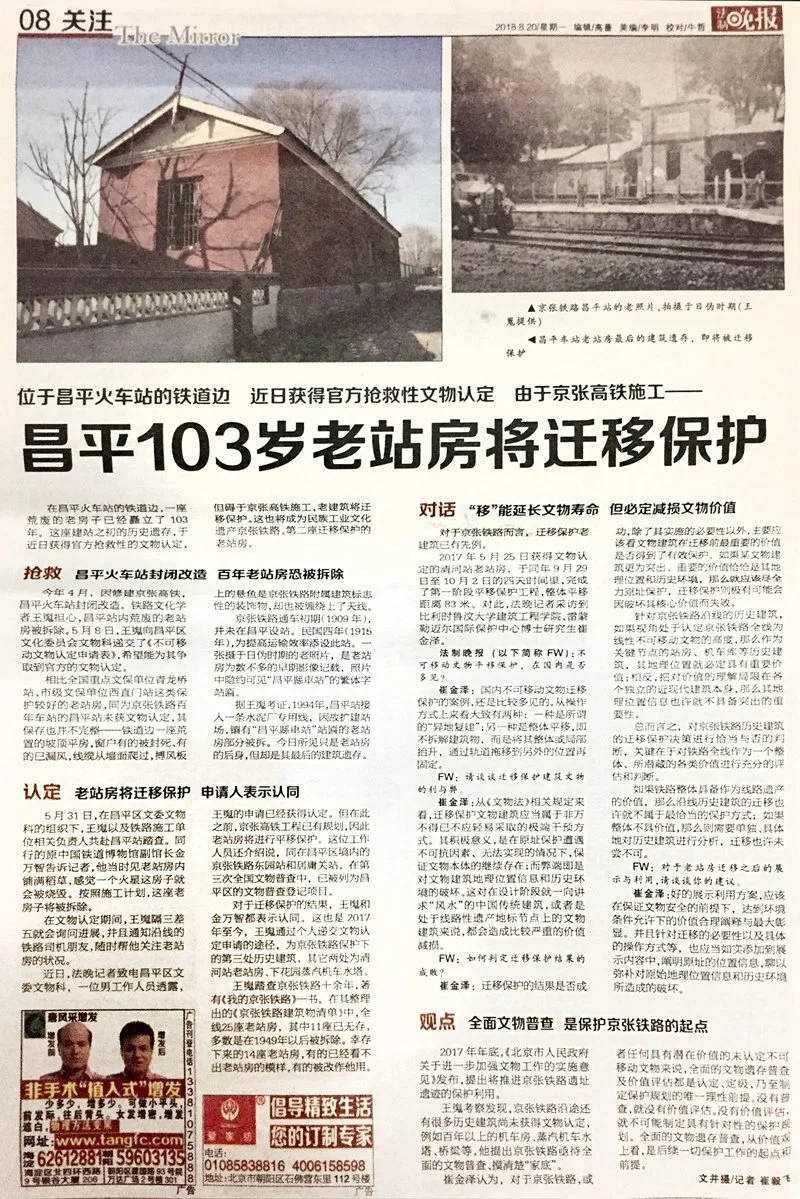
Rescue: Changping Railway Station Closed for Renovation, Century-Old Station Building Feared Demolished In April, due to the construction of the Jingzhang High-Speed Rail, Changping Railway Station was closed for renovation. Railway culture scholar Wang Wei worried that the abandoned old station building within Changping Station would be demolished. On May 8, Wang Wei submitted an Application Form for the Recognition of Immovable Cultural Relics to the Cultural Relics Section of the Changping District Culture Commission, hoping to secure official cultural relic recognition for it. Compared to better-protected old station buildings like the Qinglongqiao Station (a major historical and cultural site protected at the national level) and the Xizhimen Station (a municipal-level protected cultural site), Changping Station—also a century-old station on the Jingzhang Railway—had not obtained cultural relic recognition, and its preservation was incomplete: an abandoned flat-roofed brick house by the railway tracks had some windows sealed shut and others leaking wind; cables crawled across the wall, and the hanging-fish decoration on the bargeboard, which is a signature ornamentation of Jingzhang Railway auxiliary buildings, was even tangled with an antenna. During the early opening period of the Jingzhang Railway (1909), no station was established at Changping. In the fourth year of the Republic of China (1915), this station was added to improve transportation efficiency. An old photograph taken during the Japanese puppet regime period is one of the few early visual records of the old station building, in which the traditional Chinese character station plaque reading "Changping County Station" can be faintly seen. According to Wang Wei's textual research, in 1994, a dedicated cement factory line was connected to Changping Station, and due to station yard expansion for this reason, part of the old station building embedded with the "Changping County Station" plaque was demolished. What can be seen today is only the rear portion of the old station building, yet it remains its final surviving architectural vestige.
Recognition: Old Station Building to Be Relocated and Protected; Applicant Expresses Agreement On May 31, organized by the Cultural Relics Section of the Changping District Culture Commission, Wang Wei and relevant persons in charge from the railway construction unit traveled together to Changping Station for an inspection. Jin Wanzhi, former deputy curator of the China Railway Museum who accompanied them, told reporters that he saw the old station building filled with straw at the time, feeling that a single spark could burn the house down. According to the construction plan, this old house was scheduled for demolition. During the cultural relic recognition period, Wang Wei would inquire about the progress every few days and notify his railway driver friends along the route to help him keep an eye on the condition of the old station building at any time. Recently, a Legal Evening News (WeChat ID: fzwb_52165216) reporter called the Cultural Relics Section of the Changping District Culture Commission, and a male staff member revealed that Wang Wei's application had been granted recognition. However, prior to this, the Jingzhang High-Speed Rail project already had its layout planned, and therefore the old station building would undergo translation-relocation protection. This staff member also introduced that the Jingzhang Railway Dongyuan Station and Juyongguan Station, both located within Changping District, had already been listed as cultural relics census registration items of Changping District during the Third National Cultural Relics Census. Regarding the outcome of relocation protection, both Wang Wei and Jin Wanzhi expressed agreement. This is also the third historical building under Jingzhang Railway protection for which Wang Wei has successfully secured cultural relic recognition through individual applications since 2017. The other two are the Qinghe Station old station building and the Xiahuayuan steam locomotive water tower. Wang Wei has investigated the Jingzhang Railway for over a decade and authored the book My Jingzhang Railway. In the Jingzhang Railway Buildings List compiled by him, among the 25 old station buildings along the entire line, 11 no longer exist, most of which were demolished after 1949. Among the 14 surviving old station buildings, some can no longer be recognized as old station buildings, and some have been repurposed.
Dialogue: "Relocation" Can Extend the Lifespan of Cultural Relics, But Will Inevitably Diminish Their Value For the Jingzhang Railway, there is already a precedent for the relocation protection of historic buildings. The Qinghe Station old station building, which obtained cultural relic recognition on May 25, 2017, completed the first phase of its translation-relocation protection project within four days from September 29 to October 2 of the same year, with an overall translation distance of 83 meters. In regard to this, Legal Evening News reporters interviewed Cui Jinze, a doctoral researcher at the Department of Civil Engineering, Faculty of Engineering Science, KU Leuven, Belgium, and the Raymond Lemaire International Centre for Conservation. Legal Evening News (WeChat ID: fzwb_52165216; hereinafter referred to as FL): Is the translation-relocation protection of immovable cultural relics common in China? Cui Jinze: Cases of relocation protection for immovable cultural relics in China are still relatively common. From the perspective of operational methods, there are roughly two types: one is so-called "off-site reconstruction"; the other is overall translation, which means not dismantling the building, but lifting it entirely or partially and dragging it to another position via tracks before securing it. FL: Please discuss the pros and cons of relocating and protecting architectural cultural relics. Cui Jinze: From the perspective of relevant provisions in the Cultural Relics Protection Law, the relocation protection of cultural relic buildings should be an extreme form of intervention that is not easily adopted unless absolutely necessary. Its positive significance lies in ensuring the continued existence of the cultural relic itself when in-situ protection encounters irresistible factors and cannot be realized; while the drawback is the destruction of the geographical location information and historical environment of the cultural relic building. For traditional Chinese architecture, which has always emphasized "feng shui" at the design stage, or cultural relic buildings located at landmark nodes of linear heritage sites, this will cause relatively serious value diminishment. FL: How should one judge the success or failure of a relocation protection outcome? Cui Jinze: Whether the outcome of relocation protection is successful depends, apart from the necessity of its implementation, primarily on whether the most important values of the cultural relic building prior to relocation have been effectively protected. If a cultural relic building's more prominent and important value happens to be its geographical location and historical environment, then every effort should be made to protect it in situ, and relocation protection is highly likely to fail due to the destruction of its core value. Regarding the historical buildings along the Jingzhang Railway, if the perspective is set at the height of recognizing the entire Jingzhang Railway line as a linear immovable cultural relic, then historical buildings such as station buildings and locomotive sheds—serving as key nodes—must possess important value in their geographical locations; conversely, if the understanding of value is confined to individual modern and contemporary independent buildings themselves, then their geographical location information may not possess prominent importance. In short, making a proper or improper judgment on the decision of relocation protection for the historical buildings of the Jingzhang Railway hinges upon a comprehensive evaluation and judgment of the various values latent within the railway line as a whole. If the railway as a whole possesses the value of a linear heritage, then the relocation of historical buildings along the route may not be the most appropriate protection method; if the entirety lacks value, then the historical buildings need to be analyzed individually and specifically, and relocation might not be out of the question. FL: Please share your suggestions regarding the exhibition and utilization of the old station building after its relocation. Cui Jinze: A good exhibition and utilization plan should achieve a rational interpretation and maximum manifestation of value under the permissible environmental conditions, on the premise of ensuring the safety of the cultural relics. Furthermore, details regarding the necessity of relocation and the specific operational methods should also be faithfully added to the exhibition content, clarifying the original site's location information to somewhat compensate for the damage inflicted upon the original geographical location information and historical environment.
Perspective: Comprehensive Cultural Relics Census Is the Starting Point for Protecting the Jingzhang Railway At the end of 2017, the Implementation Opinions of the People's Government of Beijing Municipality on Further Strengthening Cultural Relics Work was released, proposing to promote the protection and utilization of the ruins and relics of the Jingzhang Railway. Wang Wei's investigations revealed that there are still many historical buildings along the route of the Jingzhang Railway that have not yet obtained cultural relic recognition, such as locomotive sheds, steam locomotive water towers, and bridges dating back over a century. He proposed that the Jingzhang Railway urgently requires a comprehensive cultural relics census to figure out its "family assets." Cui Jinze believes that for the Jingzhang Railway, or any unrecognized immovable cultural relic with potential value, a comprehensive census of cultural relic remains and value evaluation are the only rational preconditions for recognition, grading, and even the formulation of protection plans. Without a census, there is no value evaluation. Without a value evaluation, it is impossible to formulate targeted protection plans. From a value perspective, a comprehensive census of cultural relic remains is the starting point and prerequisite for all subsequent protection work.
Text and Photos / Reporter Cui Yifei
