
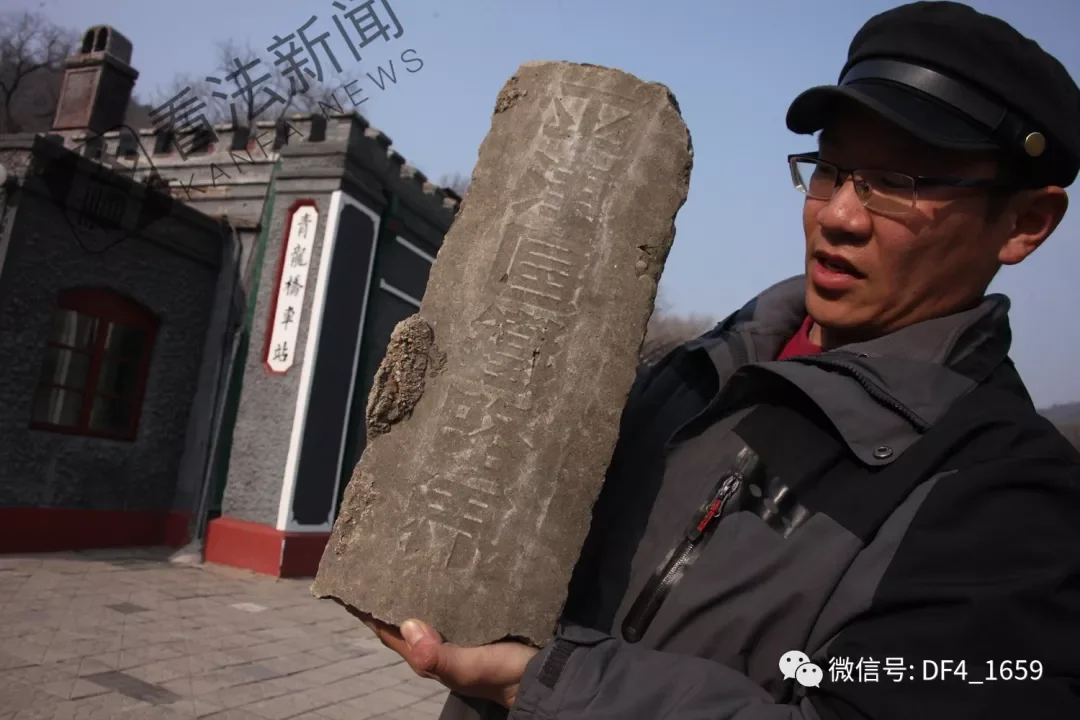
Pictured above: Wang Wei transporting the boundary marker to Qinglongqiao Station on the Beijing-Zhangjiakou Railway for preservation.
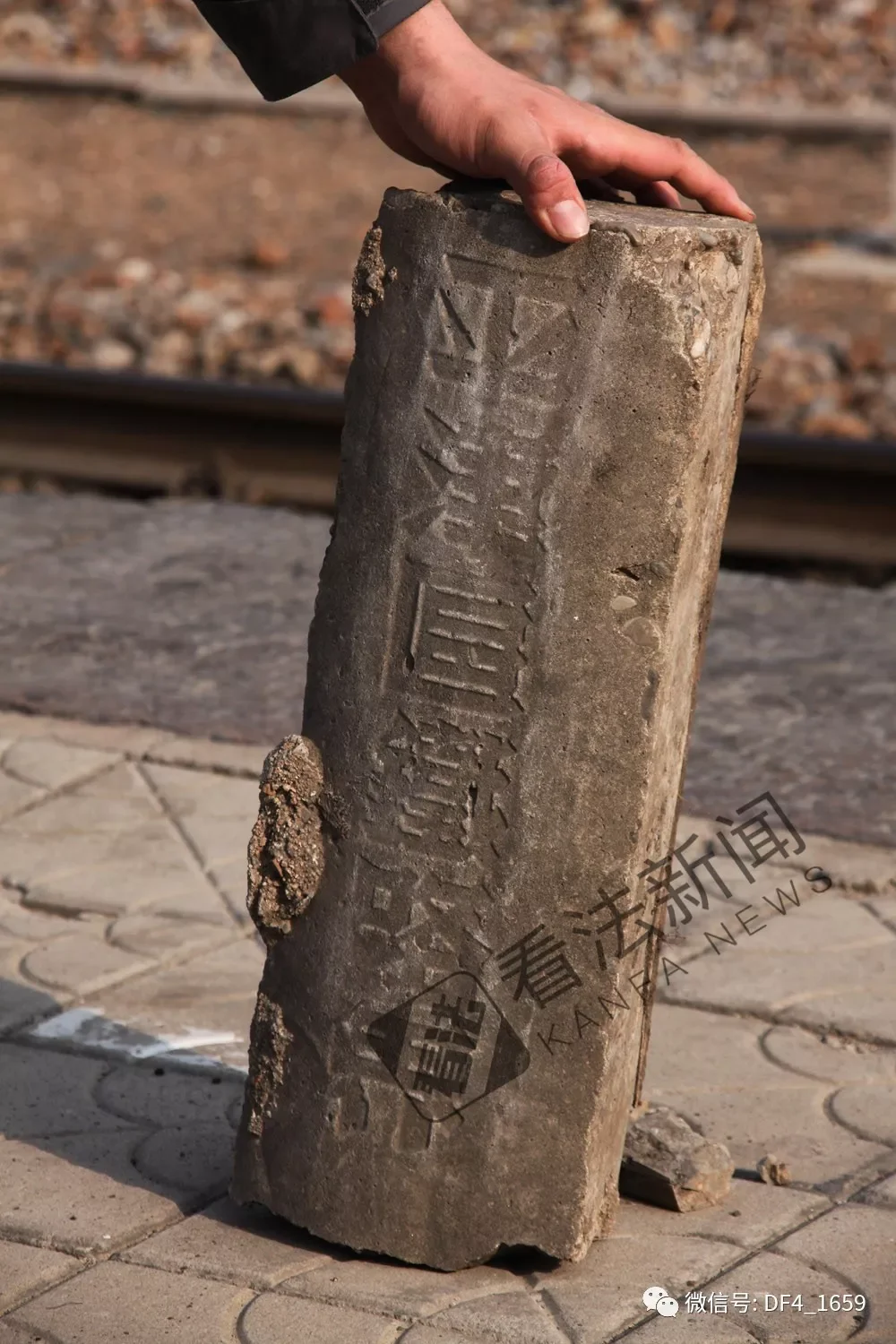
Pictured above: Close-up of the stone tablet reading "Beijing-Tianjin Region Railway Boundary".
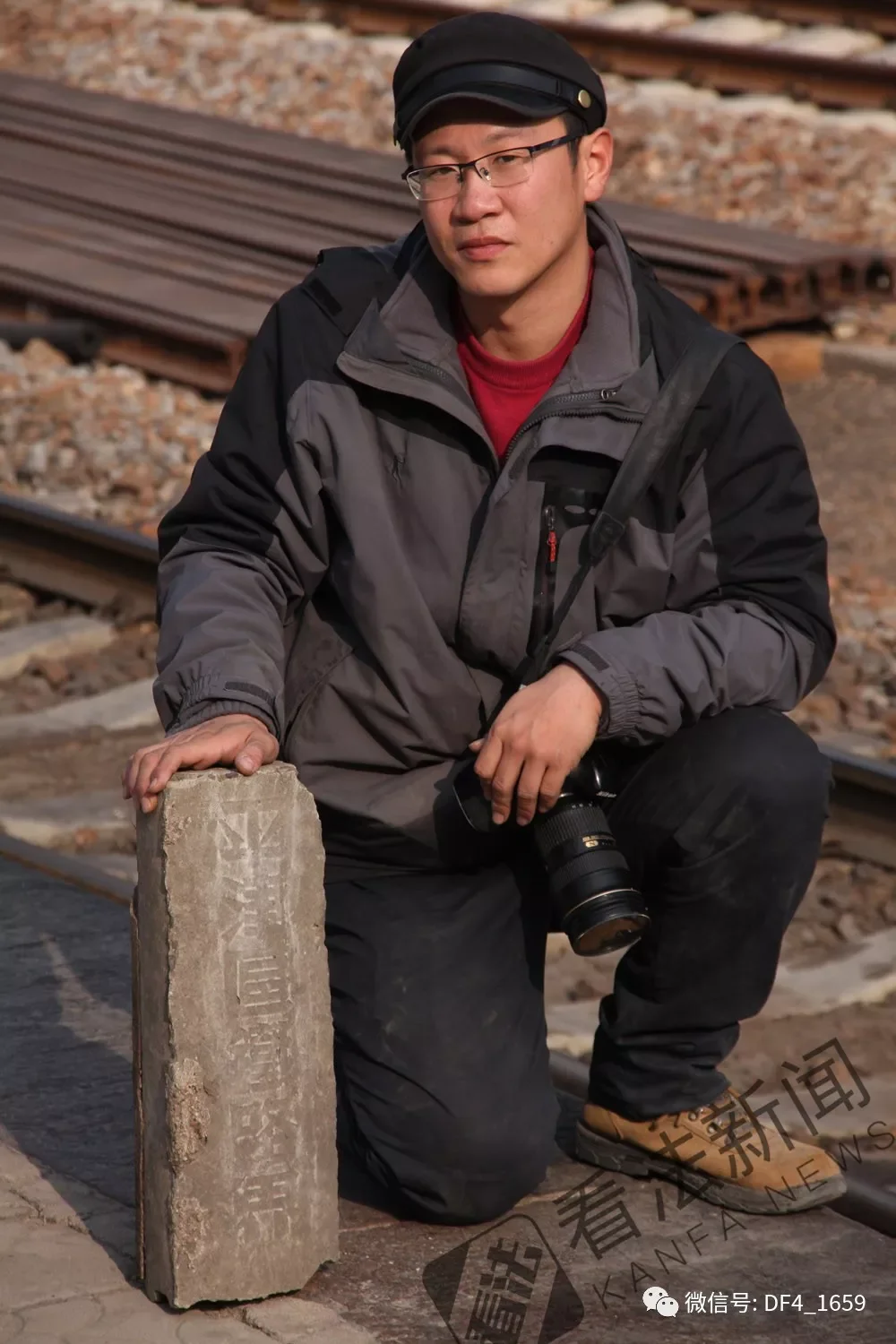
Pictured above: Wang Wei posing for a commemorative photo with the stone tablet. Photo / Legal Evening News / Law Vision News Reporter Cui Yifei
March 13, 2018, Legal Evening News
Legal Evening News / Law Vision News (Reporter Cui Yifei) — Yesterday afternoon, railway cultural scholar Wang Wei came to Qinglongqiao Station on the Beijing-Zhangjiakou Railway and handed over a concrete boundary marker to Station Master Yang Cunxin for preservation. This railway boundary marker has a history of 72 years and possesses material value for studying the regional administration and management of the Beijing-Zhangjiakou Railway during the Republic of China era.
Rare Railway Boundary Marker Discovered Inside an Abandoned Building
On the hillside near Juyongguan Station along the Beijing-Zhangjiakou Railway, an abandoned railway bungalow area survives, possessing a history of over a century. Recently, during an inspection, Wang Wei, author of My Beijing-Zhangjiakou Railway, discovered a concrete boundary marker inside the building featuring six traditional Chinese character stamps: "平津區鐡路界" (Beijing-Tianjin Region Railway Boundary). Although the carved characters are not deep, the strokes are robust, sturdy, and straight-lined.
As a senior cultural scholar researching the Beijing-Zhangjiakou Railway, this was the first time Wang Wei had ever seen such a boundary marker. "It really is strange, I just have such an affinity for old artifacts!" Wang Wei told Legal Evening News / Law Vision News reporters.
This boundary marker is slender in shape with a fracture at the bottom. The surviving portion is about 50 centimeters high, and the side with the stamps exhibits a slight arc, with the handwriting clearly legible. The edges are slightly damaged, but the overall piece is basically intact.
Wang Wei deduced that this boundary marker was likely planted near Juyongguan Station in the past, and after being abandoned, it was placed in the courtyard until the courtyard became desolate and unmanned. Yesterday afternoon, Wang Wei moved the boundary marker to Qinglongqiao Station on the Beijing-Zhangjiakou Railway, where Station Master Yang Cunxin received and took charge of preserving the boundary marker.
Qinglongqiao Station is a National Key Cultural Relic Protection Unit. On the basis of maintaining operational safety, the station staff also engage in the collection of related cultural relics. Station Master Yang Cunxin told Legal Evening News / Law Vision News reporters that the boundary marker sent by Wang Wei is very unique and enriches their cultural relic reserves. He believes that this stone tablet served as a zoning boundary marker between the railway and the local jurisdiction.
Republic of China Era Railway Boundary Marker, Seventy-Two Years of History
Wang Wei told Legal Evening News / Law Vision News reporters that after the victory in the War of Resistance against Japanese Aggression, the Ministry of Communications of the National Government adjusted the regional administrative divisions of various local railways. In March 1946, it was announced that the national railway system would implement a trunk-line district management system. Railway administrative bureaus were established, including the Beijing-Tianjin Region, Jinpu Region, Jinghu Region, Zhegan Region, Yuehan Region, Xianguiqian Region, Pinghan Region, Longhai Region, Kunming Region, and Jinji Region, to manage the trunk lines and their branch lines within their respective districts. Additionally, a special commissioner's office was established in the Northeast to govern five railway administrative bureaus: Jinzhou, Shenyang, Jilin, Qiqihar, and Mudanjiang.
At that time, the Beijing-Tianjin Region Railway Administrative Bureau governed the Pingsui Line, the Bening Line (Beijing-Shanhaiguan section), and the Tonggu Line (Tongzhou-Gubeikou section), with Beijing as the center radiating out three railways crossing the Great Wall.
Wang Wei analyzed that this boundary marker is a product from the establishment of the Beijing-Tianjin Region Railway Administrative Bureau in March 1946, used to clearly indicate that areas inside the boundary marker were under railway administration, while areas outside belonged to local administration. After the founding of the People's Republic of China, Beiping was renamed Beijing, and the former Beijing-Tianjin Region Railway Administrative Bureau passed into history. It can be said that this boundary marker is a physical witness testifying to the fact that the Beijing-Zhangjiakou Railway belonged to this bureau from 1946 to 1949.
Yesterday afternoon, Station Master Yang Cunxin placed the boundary marker inside the station's exhibition area, laying a solid foundation for future research work.
Text and photos by/Reporter Cui Yifei
