
93-Year-Old Old Rail Serves as Traffic Signpost, Witnessing the Menzhai Railway
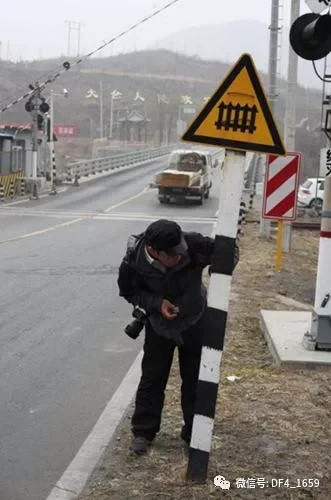
The old steel rail near the 45-kilometer crossing, used as a traffic signpost.
Photo: Legal Evening News Reporter Cui Yifei
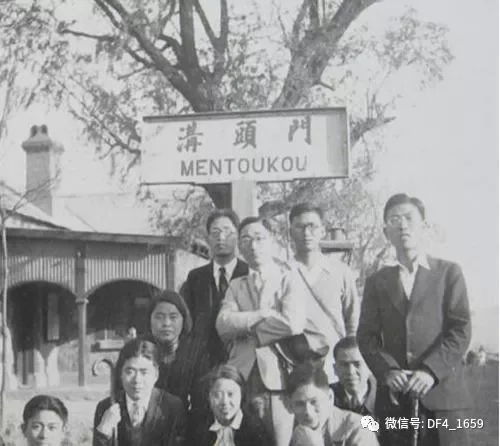
An old photograph of Mentougou Station; below the Chinese characters on the station sign, Wade-Giles romanization is indeed used.
(Excerpted from Kongfuzi Old Book Network)
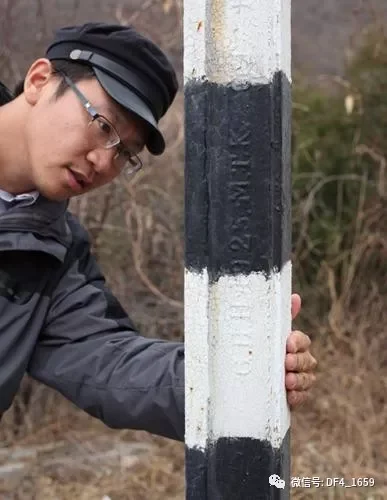
Wang Wei is searching for the inscriptions on the steel rail.
November 21, 2018, Legal Evening News
Legal Evening News (Reporter Cui Yifei): A retired old steel rail records a mountain railway in Beijing's Mentougou District and its demolished old station building. Among the many century-old rails discovered by railway culture scholar Wang Wei, this 93-year-old rail is not the most historic, but it is extremely rare and information-rich.
The discovery site of the old rail is located at the 45-kilometer crossing in Mentougou District, where the Mentou-Zaitang Railway and National Highway 109 intersect. Wang Wei recently discovered that an old steel rail had been planted by the side of the road and used as a traffic signpost. Even though the rail had been coated with thick paint, Wang Wei, relying on his heritage intuition honed from years of field surveys, spotted raised inscriptions on one side of the rail: "G.H.H. 1925 M.T.K - C.T RY." Wang Wei explained that in addition to English abbreviations, the text also features the "Wade-Giles romanization system."
Thomas Wade (1818–1895), who served as a British diplomat and renowned sinologist, lived in China for over forty years and invented a system using Roman letters to transcribe Chinese pronunciation, which was widely used in Europe and America before being gradually replaced by Pinyin. On the central station plaques of old station buildings along the Jingzhang Railway, Chinese characters were mostly accompanied by Wade-Giles phonetic annotations.
Wang Wei interpreted that "G.H.H." is the abbreviation of a German factory, "1925" is the casting year of this rail—making it 93 years old—and "M.T.K - C.T" is the Wade-Giles abbreviation for MEN TOU KOW - CHAI TANG, translating into Chinese as "Mentougou-Zaitang," with "RY" being the abbreviation for railway. It can be deduced that this rail was once used on a railway line and later repurposed as a traffic signpost after being decommissioned.
According to the Mentougou Cultural Relics Chronicle, in the seventh year of the Republic of China (1918), proposed through joint consultations by the Beiyang government's Ministry of Communications, Ministry of Agriculture and Commerce, and Ministry of the Navy, and resolved by the State Council, the official-merchant joint venture Zaitang Coal Mining Co., Ltd. was established. Financed by individuals including Chairman Li Shizhen, the Menzhai Railway (from Chengzi, Mentougou to Zaitang) was constructed. Due to warfare and other reasons, it was only built as far as Banqiao (Muchengjian Coal Mine). Spanning a total length of 33 kilometers, construction began in April 1924, and the line opened to traffic upon completion in 1928.
Wang Wei noted that 1925, the year this rail was cast, coincided precisely with the construction period of the Menzhai Railway. Judging from the inscriptions on the rail, it should have been custom-ordered by the builders specifically for the Menzhai Railway. Unfortunately, the railway ultimately failed to reach Zaitang, and the old Mentougou station building was demolished in 2003. Having previously discovered numerous late-19th-century rails along the Jingzhang Railway, Wang Wei stated that while this rail is not the oldest, these inscriptions were the first of their kind he had ever encountered.
Wang Wei believes that although the Menzhai Railway was not fully completed, it played a significant role in facilitating the outward transport of coal from areas such as Muchengjian, Datai, and Wangpingcun in Mentougou District, and has remained in use to this day. However, written records regarding this section of railway are relatively rare. Historical material evidence like this rail should be cherished and properly protected.
Responsible Editor: Zhang Lin (EN049)
