
Photo / Legal Evening News / Law Vision News Reporter Cui Yifei
January 31, 2018, Legal Evening News
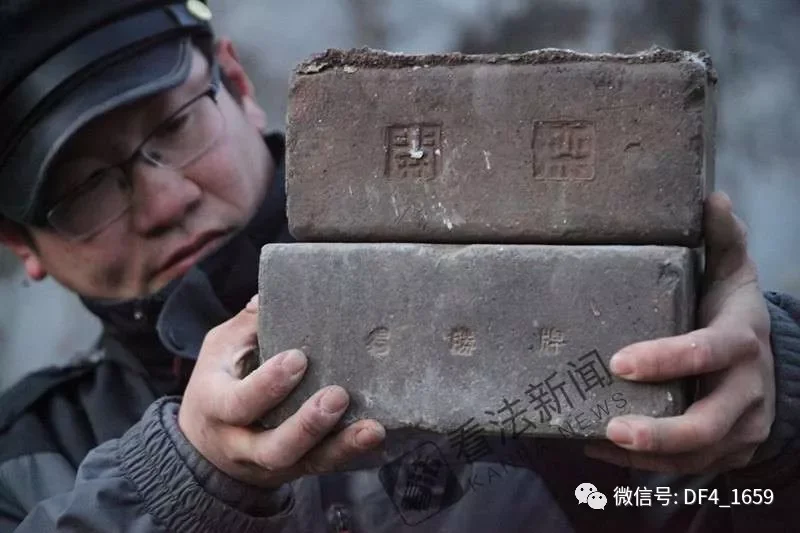
Legal Evening News / Law Vision News (Reporter Cui Yifei) — Recently, railway cultural scholar Wang Wei discovered dozens of rare character bricks in the Guanguan section of the Beijing-Zhangjiakou Railway, suspected to date from the Republic of China era. However, the specific purpose of these rare old bricks awaits further textual research by scholars.
Wang Wei told Legal Evening News / Law Vision News reporters that the first time he saw such bricks was on the platform of Juyongguan Station, where two pieces were used to pave the road surface. Recently, in an abandoned auxiliary building along the Guanguan section of the Beijing-Zhangjiakou Railway, he discovered that there were over 20 similar bricks, both intact and fragmented, scattered inside and outside the building.
Legal Evening News / Law Vision News reporters noticed that the bricks are dark red in color, with basically uniform dimensions: 23 centimeters long, 10.5 centimeters wide, and 10.5 centimeters high, weighing up to 5 kilograms. Compared to ordinary bricks, their exterior is more delicate, smooth, and of higher density. The most distinctive feature is that some bricks are stamped with the traditional Chinese characters "開灤" (Kailuan), while others bear the stamp "得勝牌" (Desheng Brand).
Legal Evening News / Law Vision News reporters found that in 2016, the Xinmin Evening News reported that Kailuan bricks had been unearthed during construction near Nanchang Road in Shanghai. Relevant researchers stated that at the end of the 19th century, Li Hongzhang dispatched people to establish the Kaiping Coal Mine in Tangshan, simultaneously setting up brick kilns. By the Republic of China era, Kailuan bricks were one of China's most exported industrial products, featuring high temperature resistance, wear resistance, erosion resistance, and exceptional quality.
In his article Kailuan Bricks and Modern Chinese Architecture, Mr. Huang Zhiqiang introduced that the production of machine-made bricks in China originated from the construction of the Kailuan Coal Mine. The Kaiping Mining Administration (predecessor of Kailuan) required a large number of refractory bricks and high-strength architectural bricks (clinker bricks) for mine construction, which were initially contracted out to Taochengju, the first ceramic workshop in Tangshan. While building the coal mine, the Kaiping Mining Administration introduced advanced foreign brick-making machinery and equipment, constructing brick kilns to fire various brick products, thus pioneering the production of machine-made brick products in China.
With the further expansion of production scale, the brick products were also sold to major cities across the country and exported overseas, finding wide application in industrial production and engineering construction. Tangshan brick products became one of the representative industrial products of modern China.
Among the numerous early brick products from Tangshan, Kailuan bricks were the most outstanding. Kailuan bricks were fired using high-quality fireclay produced in Tangshan as raw material, utilizing the latest brick-making machines and kilns, resulting in superior quality.
Wang Wei deduced that the Kailuan bricks and Desheng Brand bricks found on the Beijing-Zhangjiakou Railway both originated from Tangshan. As for why they appeared along the Beijing-Zhangjiakou Railway, further textual research is required. Jin Wangzhi, former deputy curator of the China Railway Museum, expressed that upon learning of the appearance of Kailuan bricks on the Beijing-Zhangjiakou Railway, he would conduct research on the matter, noting that this was the first time he had heard of such a discovery.
