
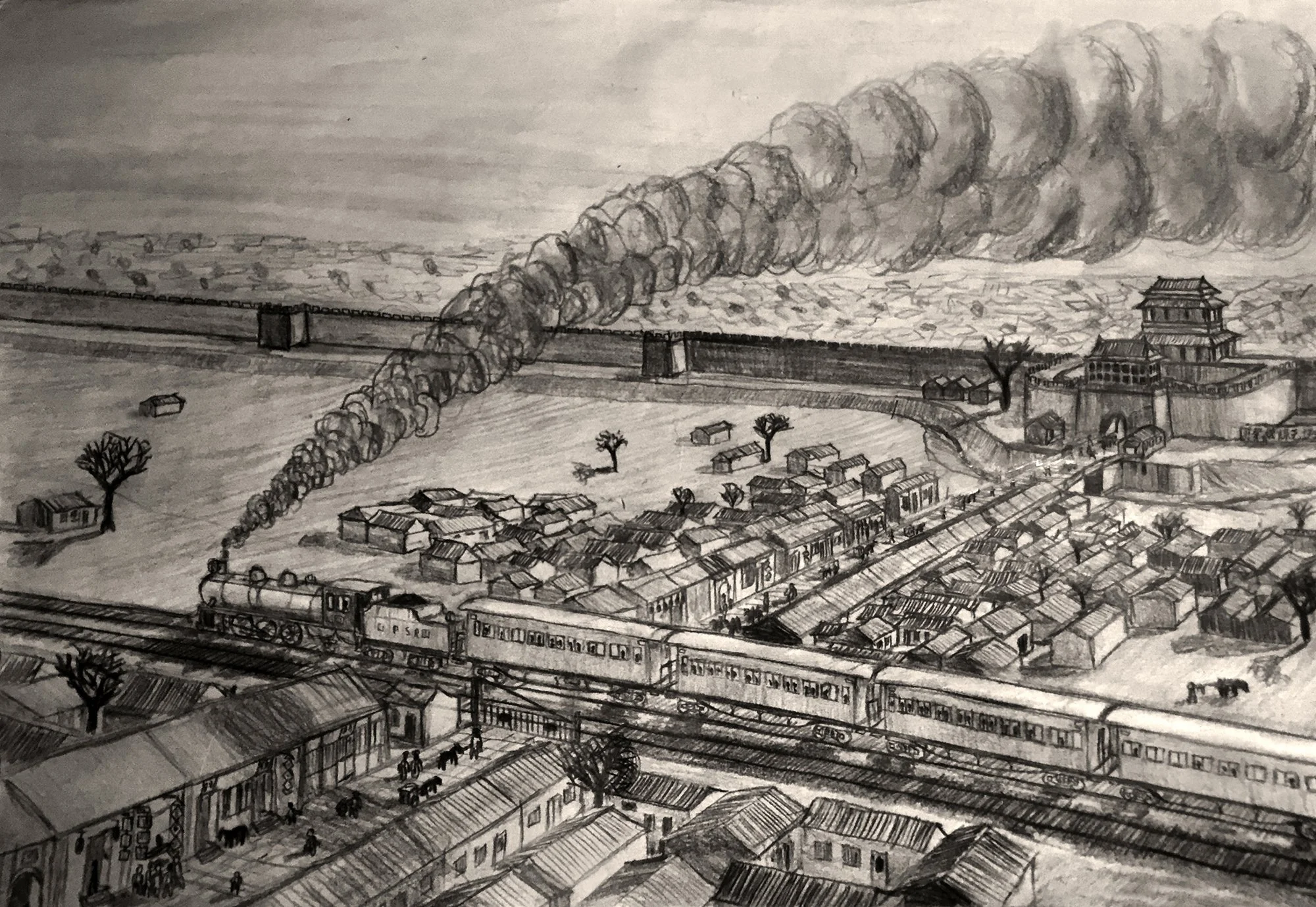
Guang'anmen Level Crossing in the 1920s, with a northbound train running along the Beijing Outer City wall to cross Guang'anmen Avenue. Viewed from southwest to northeast. Painted in January 2015.
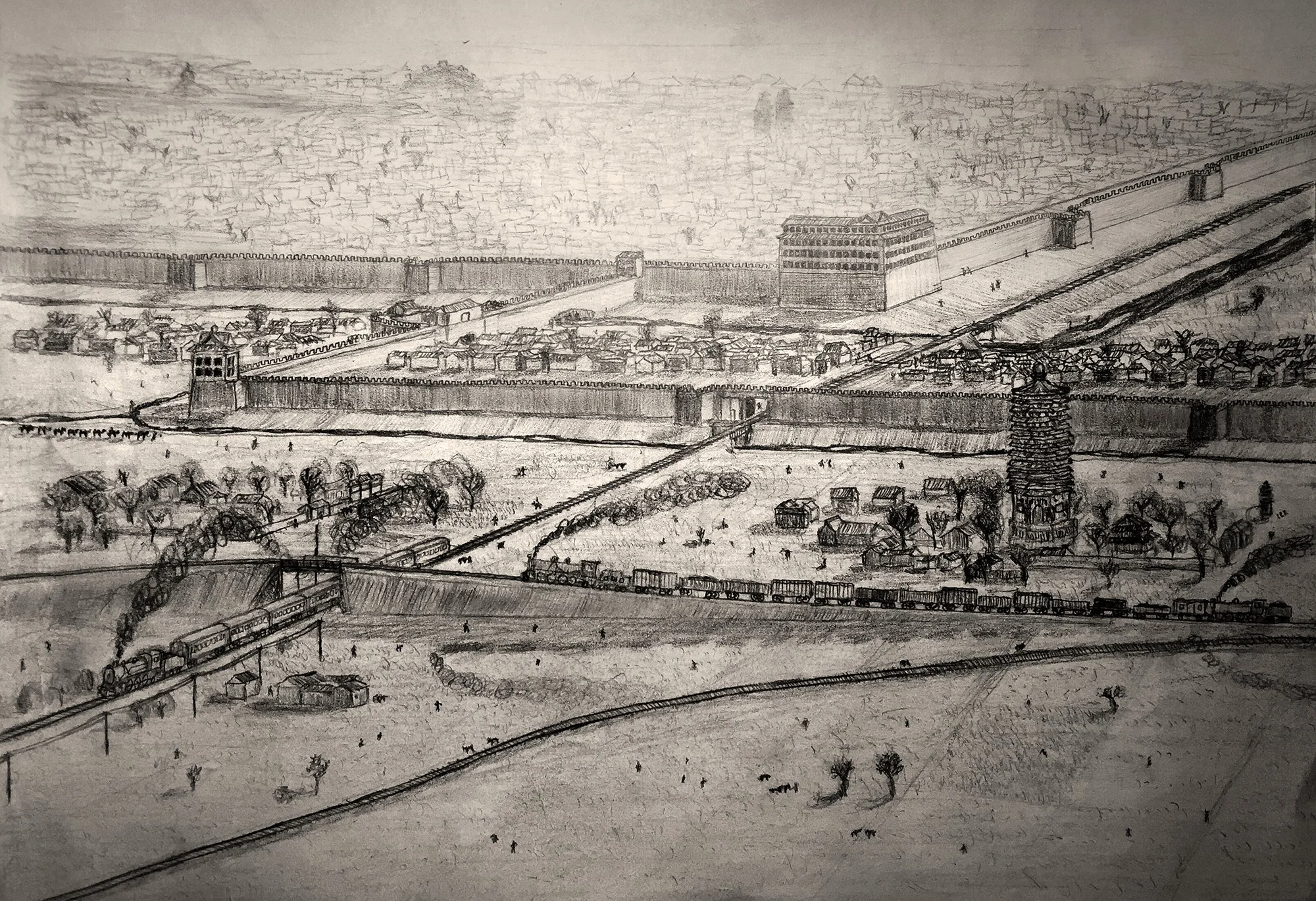
Bird's-eye view looking from southwest to northeast from the No. 5 overpass at Xibianmen. Above the Beijing-Hankou Railway as it exits the inner city of Beijing stands the Beijing-Zhangjiakou Railway overpass. To the southwest of the overpass is the connecting line between Xibianmen Station and Guang'anmen Station, which became the main line of the Beijing-Kowloon Railway formed in the 1990s. At the junction of the connecting line and the Beijing-Zhangjiakou line, the Liao Dynasty Tianning Temple Pagoda is visible. Painted in August 2016.
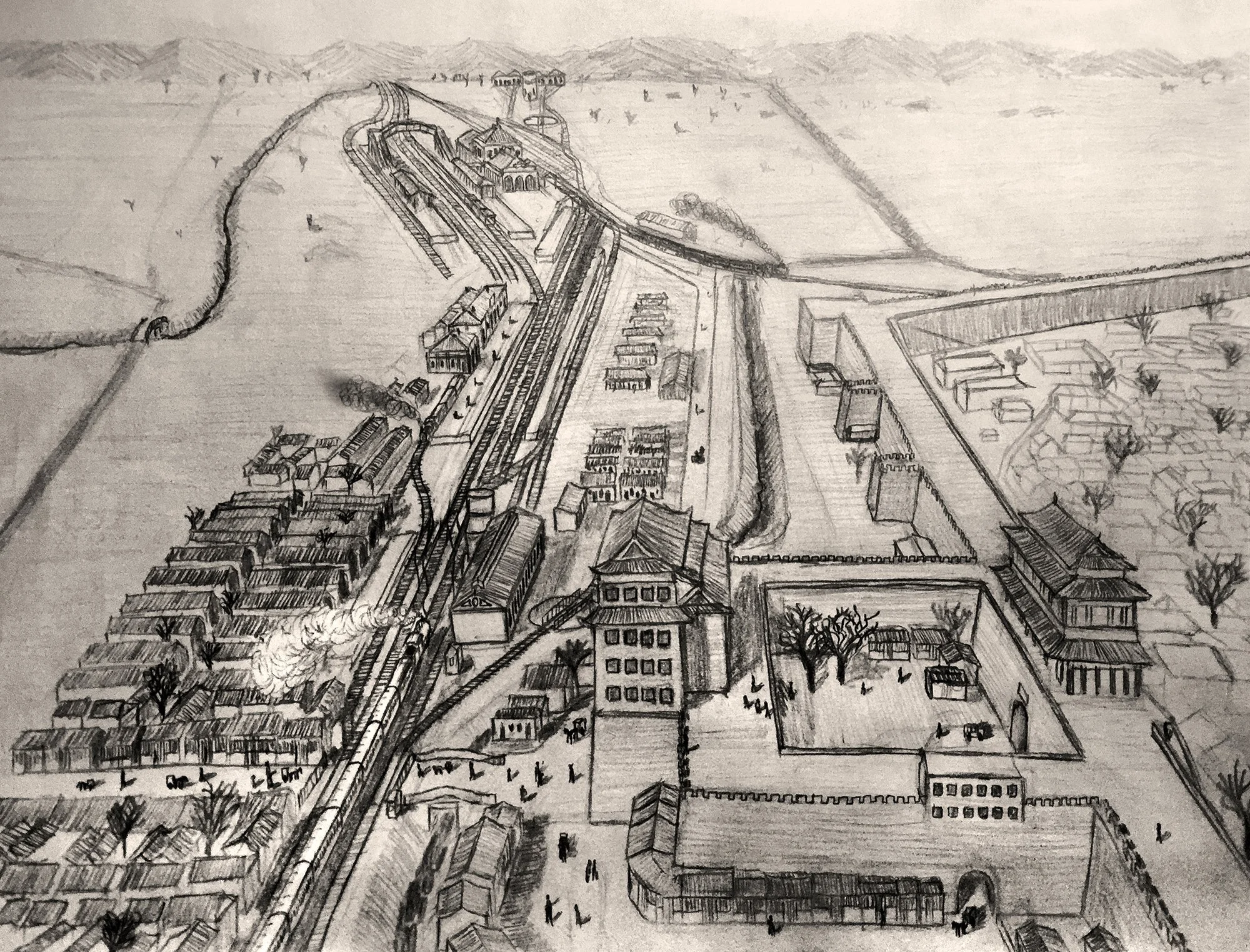
Restoration drawing of the Xizhimen Station expansion in 1918: In the foreground, the engine house, railway quarters, and station building date back to the initial section of the Beijing-Zhangjiakou Railway built in 1906; in the distance, the station building, overpass, and engine house are part of the northward expansion of Xizhimen Station in 1918. When the second-generation station building was completed, the first-generation station building and platforms were promptly demolished. Viewed from south to north, painted in May 2015.
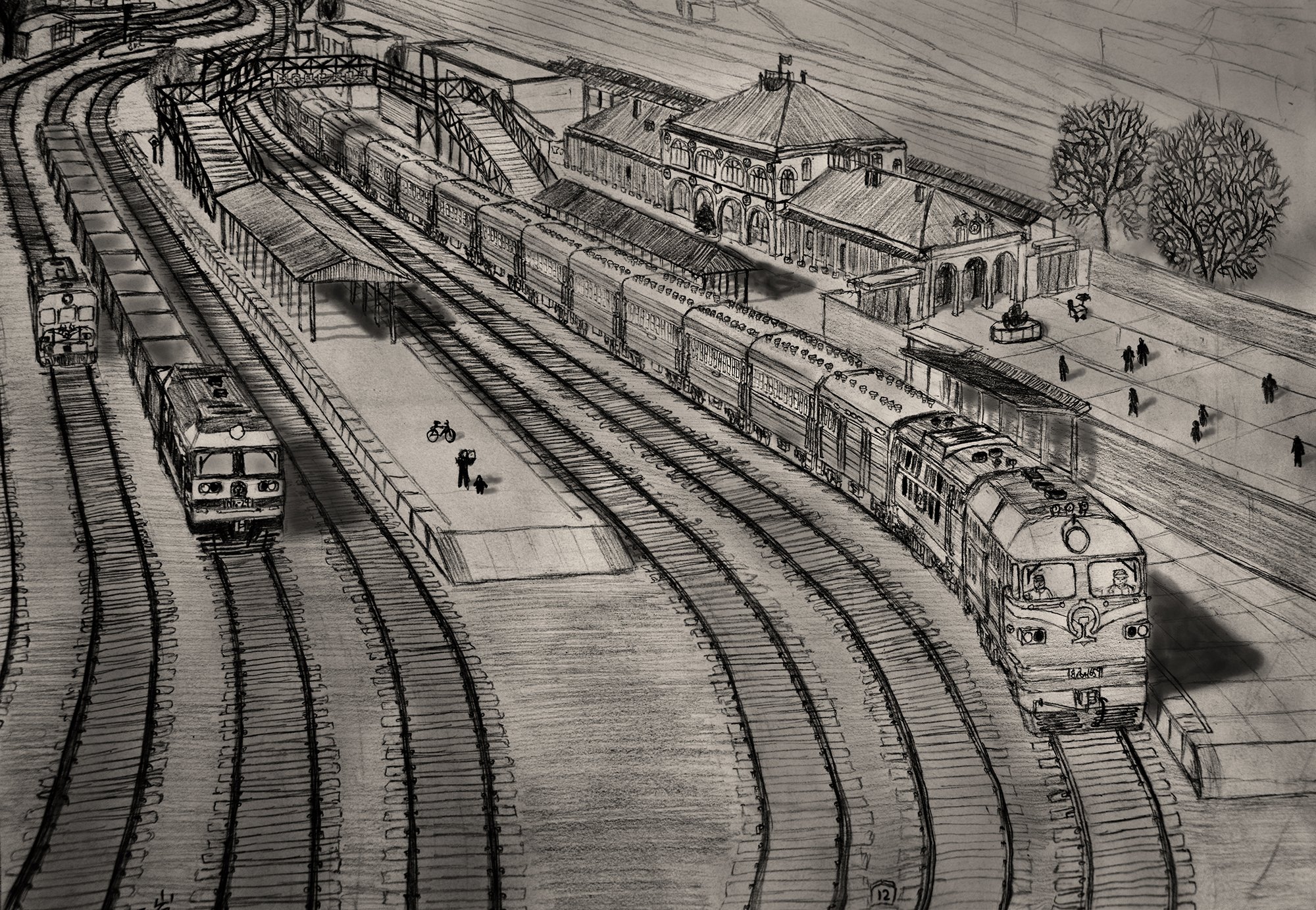
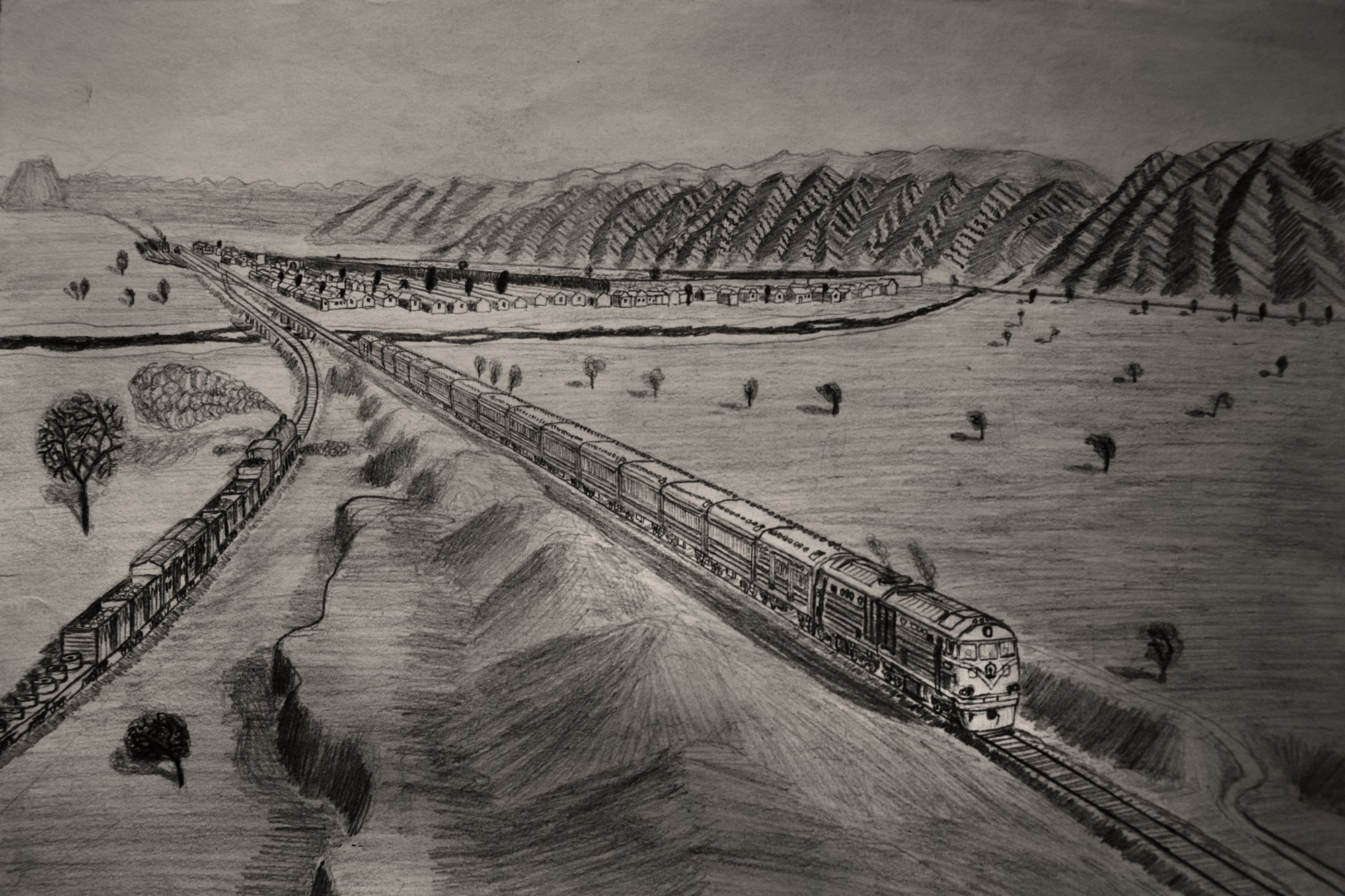
Scene of the west yard of Xizhimen Station in the 1990s, viewed from south to north. On the right is an inbound up-train hauled by a Dongfeng 4 or NY7 diesel locomotive (the Jingbao route of the 1990s). The west yard featured two platforms with three tracks in between. Because the railway loading gauge back then was smaller than it is today, the track spacing was relatively close. Once, Master Chen Xinhui, who was stewing fish inside a mechanical refrigerator car parked on the middle West Track 2, was smelled by a train attendant from a passenger car on the adjacent West Track 1; Master Chen easily handed the delicacy right over to the attendant. Painted in September 2012.
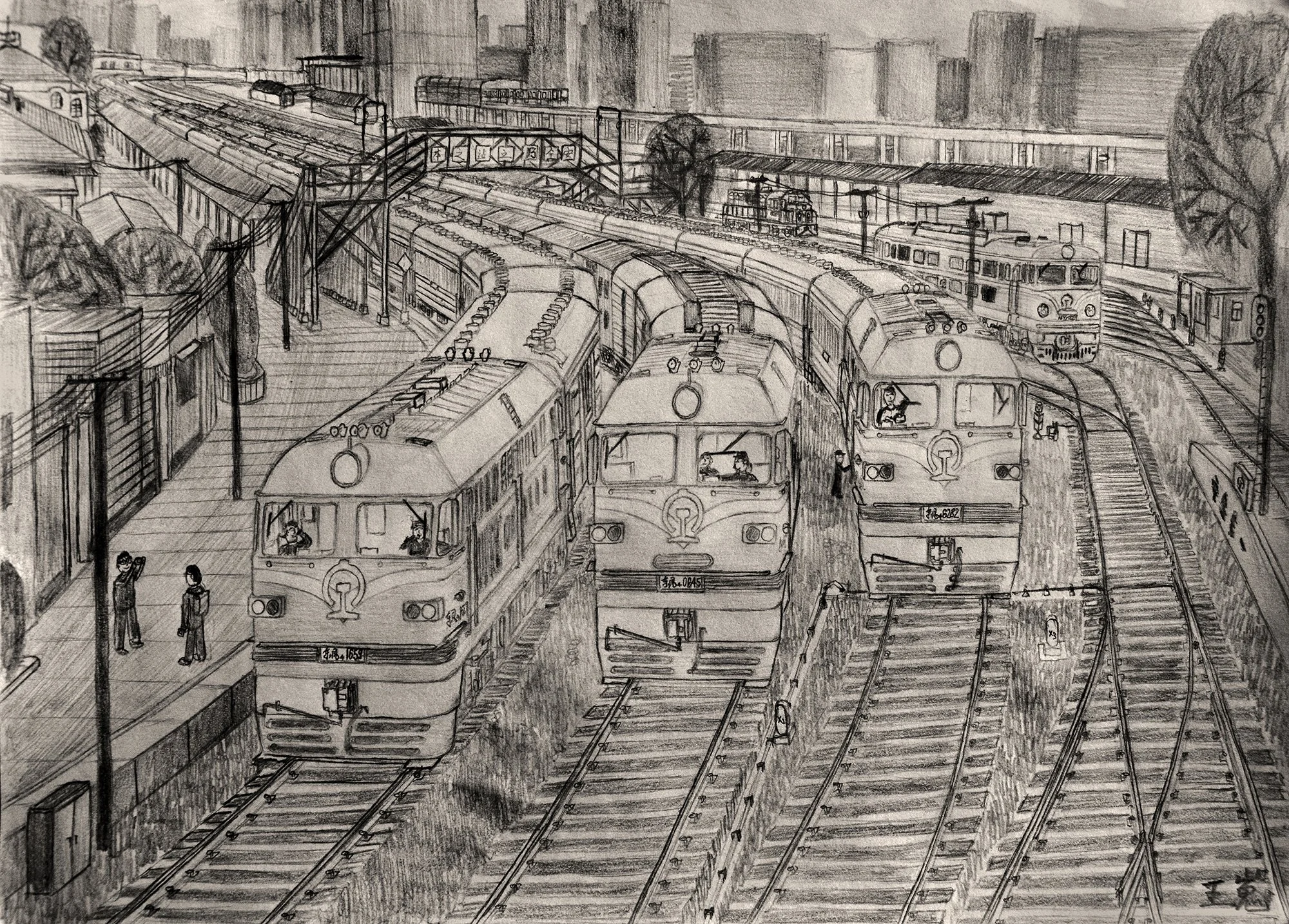
North side of the west yard of Xizhimen Station prior to 2006, where the phrase "Safety is the Foundation of the Station" was once inscribed on the overpass. Viewed from north to south, painted in September 2013.
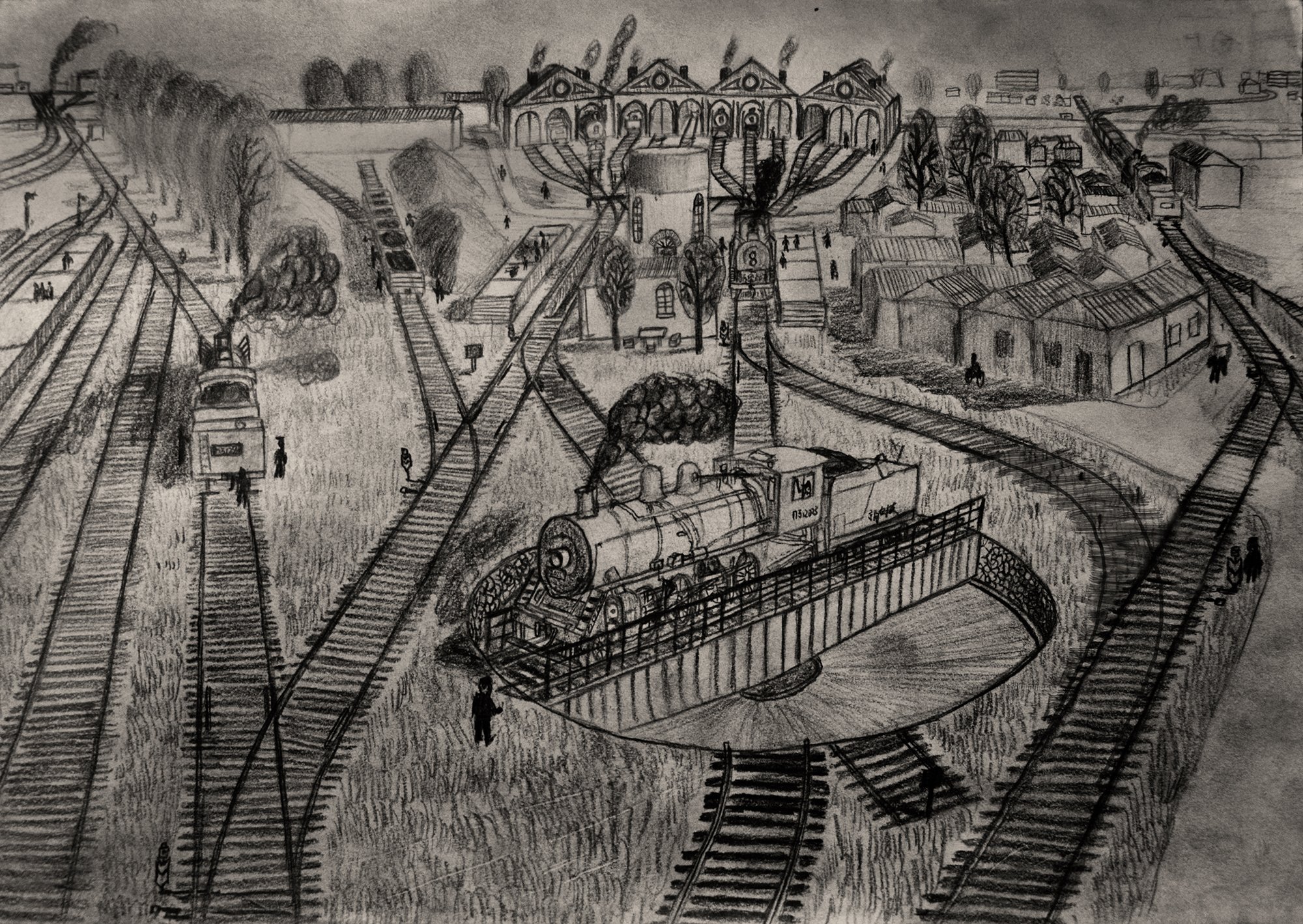
On the east side of the east yard of Xizhimen Station (south of the Xizhimen turnaround section) was a turntable used for reversing locomotives. Because the turntable had a small diameter, it could only accommodate smaller locomotives such as MK1, MK6, PL9, MK12, and miscellaneous MK classes, and was unable to fit Forward-class (Qianjin) locomotives. Consequently, the small local freight and passenger trains running between Nankou and Xizhimen would make northbound trips operating in reverse (backing up) to Xizhimen, and then run forward on the southbound trip back to Nankou. After steam locomotives were phased out in the 1980s, this turntable gradually fell into disuse until it was dismantled in 1996. Painted in November 2014.
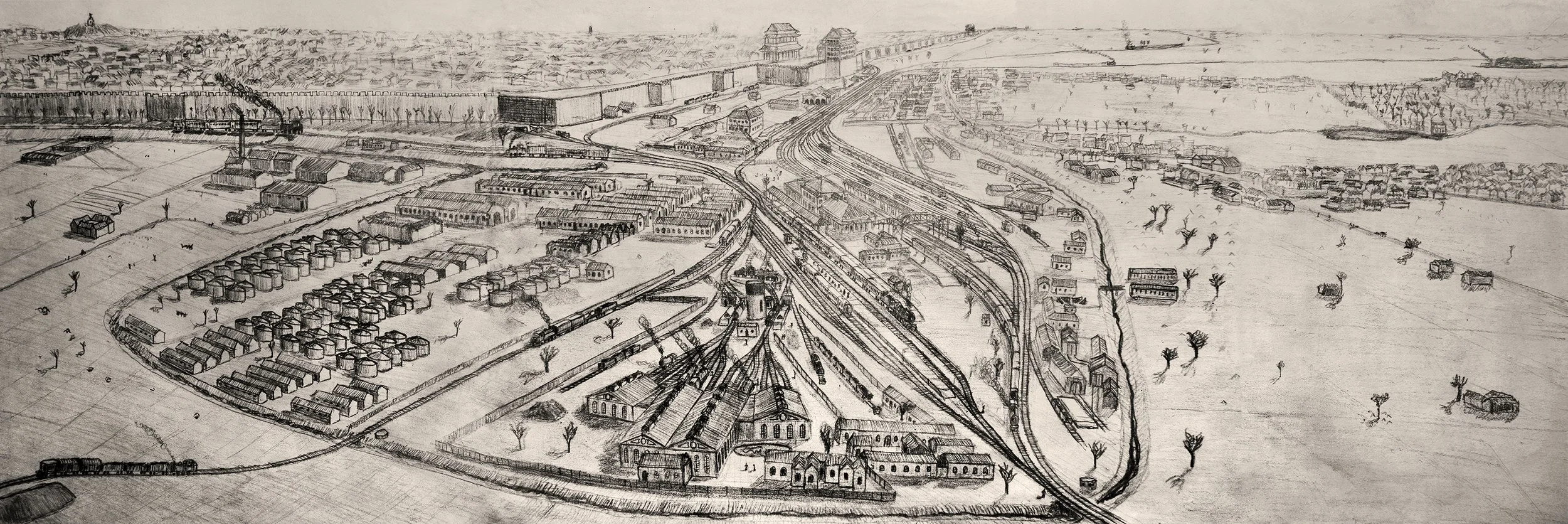
Restoration drawing based on a 1940s floor plan of Xizhimen Station, viewed from north to south. Before our eyes is the "glyph-shaped" (几-shaped) Diversion River excavated for the expansion of Xizhimen Station. To the south of the Diversion River is the Xizhimen Engine House, which served as the Xizhimen turnaround section after 1949. The east yard of the station once featured an East Platform 2 used for the arrival and departure of Circle Line branch trains. Painted in December 2016.
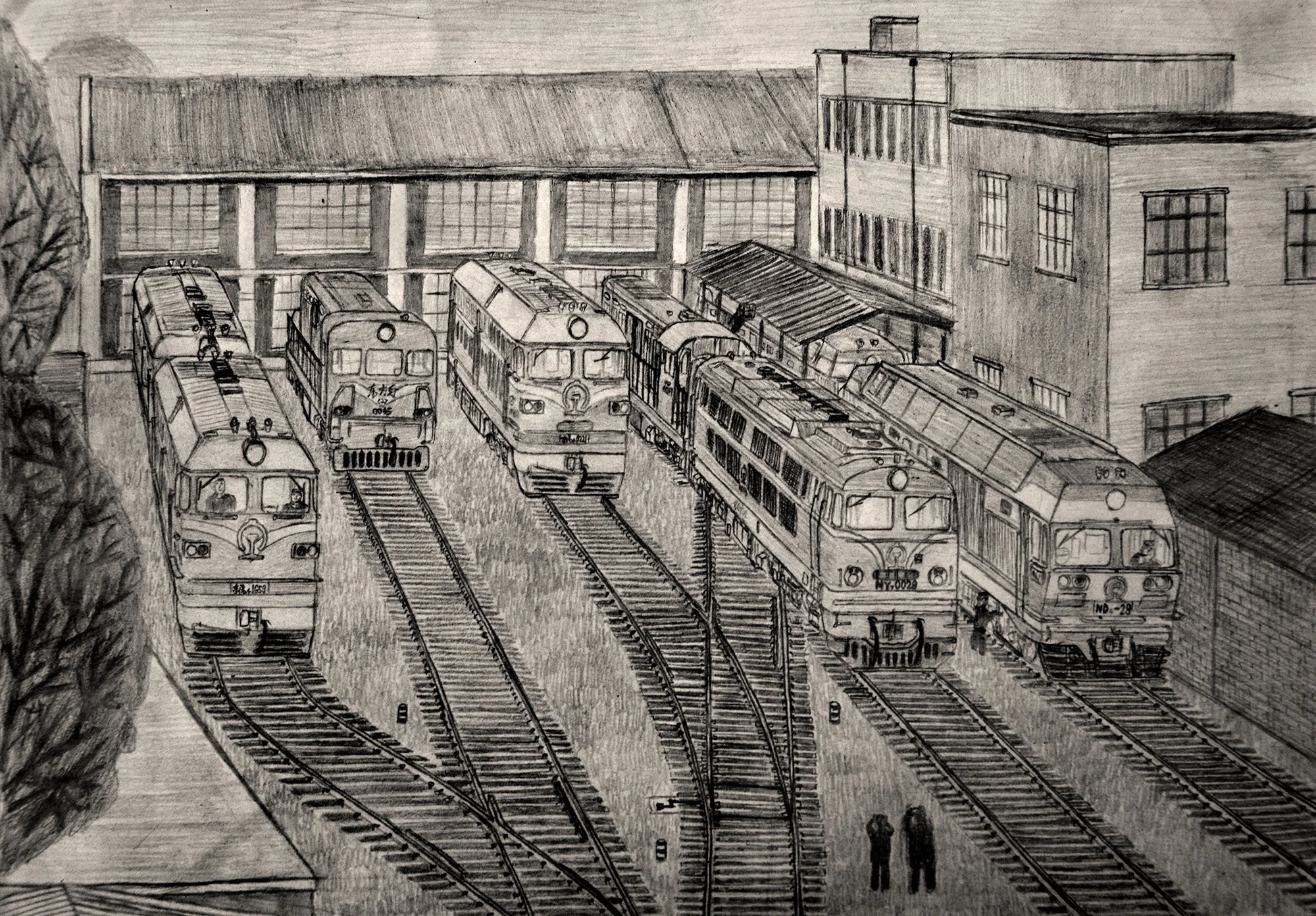
Restoration drawing depicting the scene of the Xizhimen Engine House in the 1990s. At that time, Dongfeng 4, Dongfanghong 2, Dongfanghong 5, ND4, and NY7 diesel locomotives were frequently stationed within the depot. Painted in September 2013.
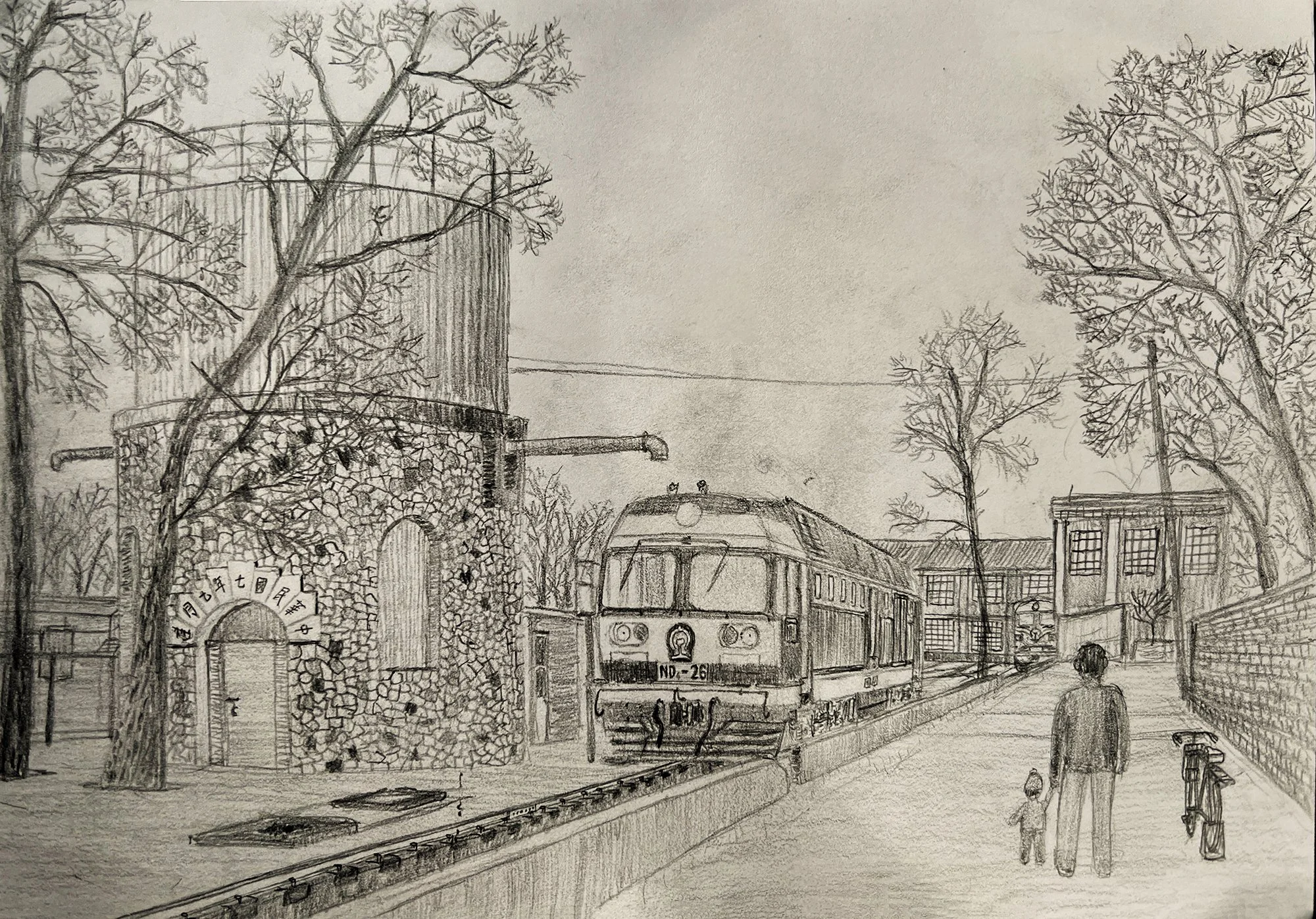
In the 1990s, an ND4 diesel locomotive undergoing servicing in front of the Xizhimen water tower. (ND4 Locomotive: The prototype was the French CC 72000 diesel locomotive)Painted in April 2022.
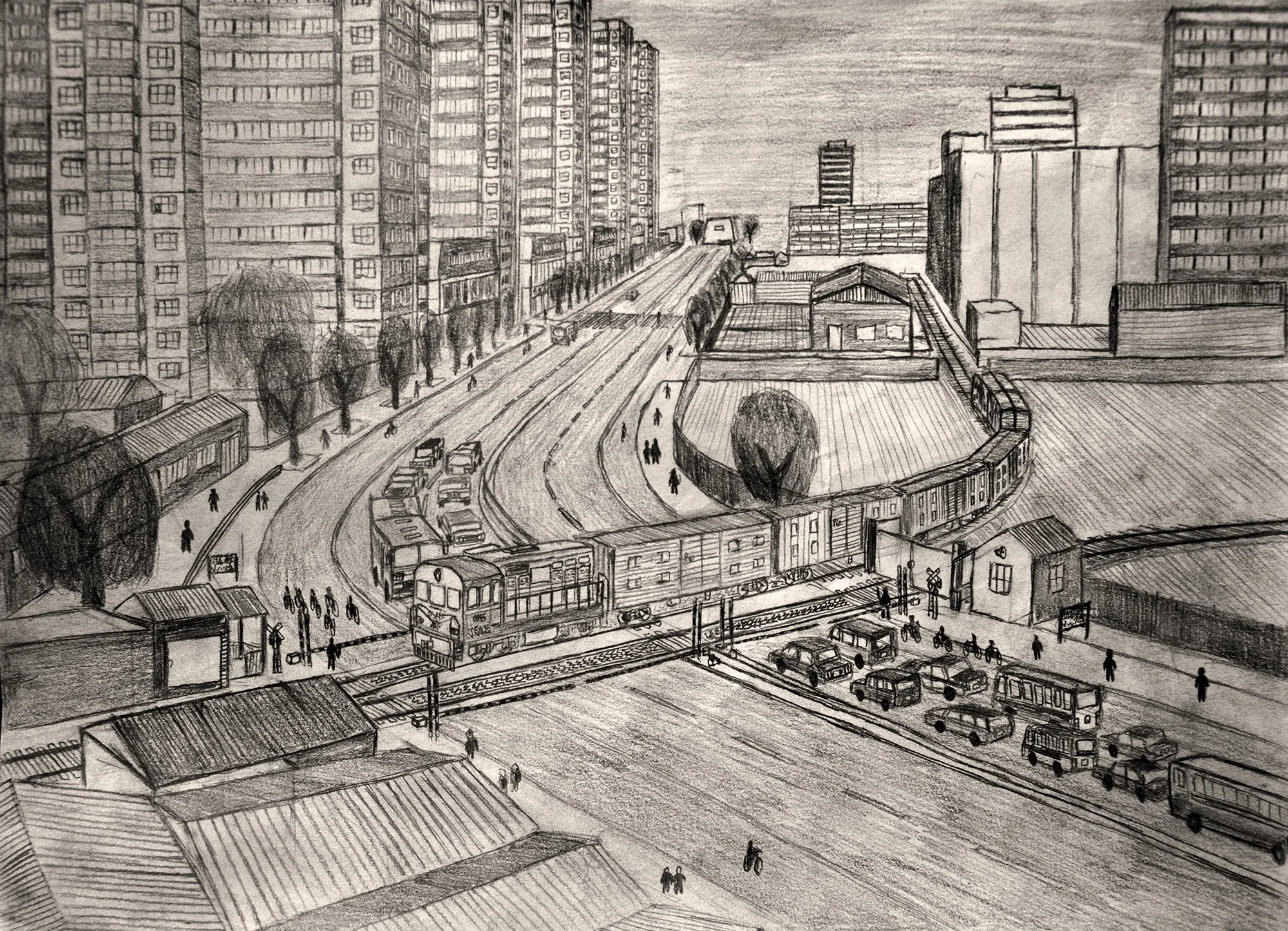
Mingguangcun Level Crossing on the northeast side of Xizhimen Station, which featured a dedicated military warehouse spur and a coal briquette factory siding. The level crossing was dismantled around 2001, and the original site was redeveloped into the Wenhui Bridge. Viewed from south to north, painted in December 2013.
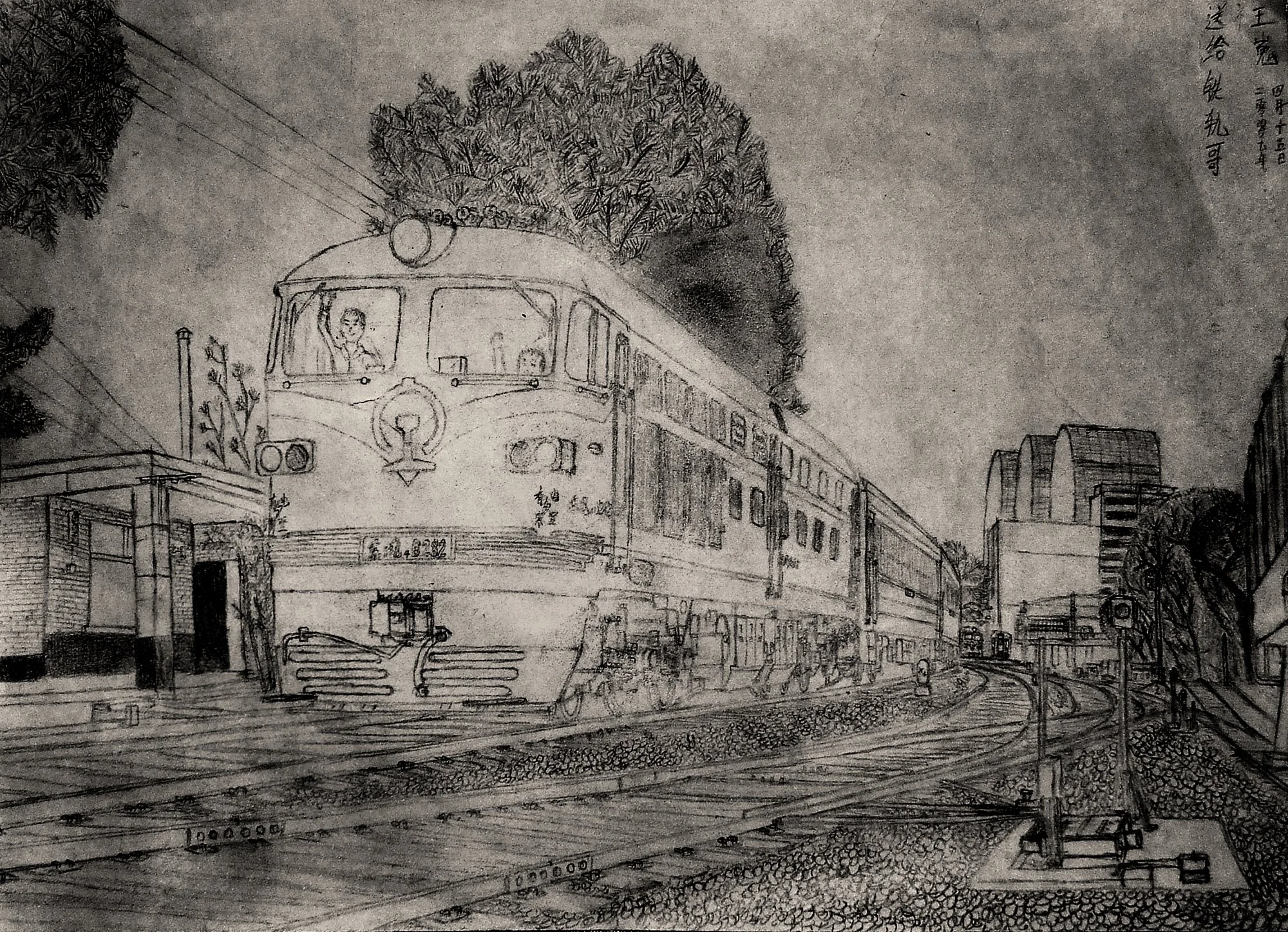
The northern part of the west yard of Xizhimen Station prior to its renovation in 2005. Painted in April 2007.
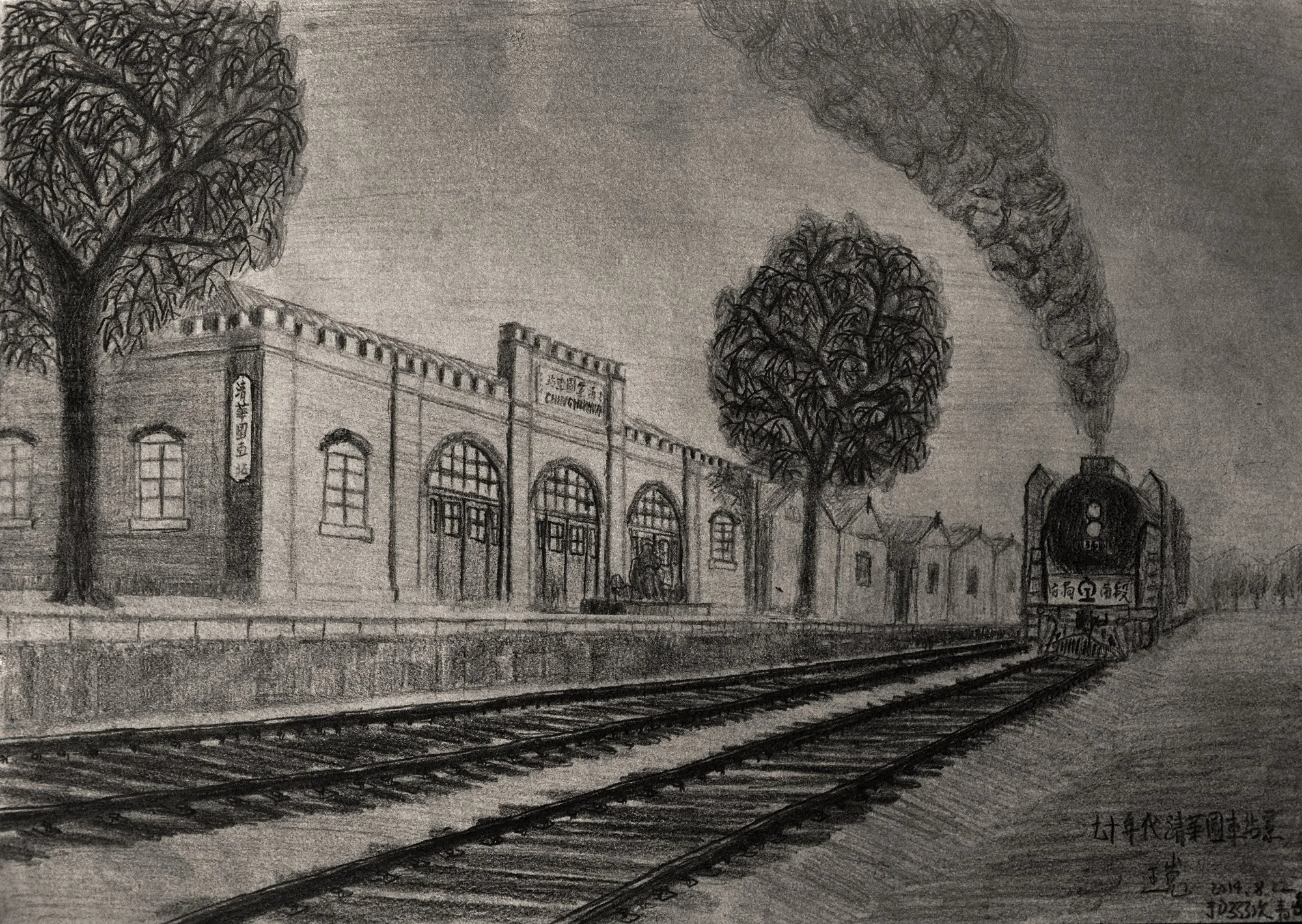
Based on eyewitness descriptions, the author hand-painted the original appearance of Qinghuayuan Station in the 1970s. In the early 1980s, nearly half of the old Qinghuayuan station building was demolished, fading into the alleys southwest of Wudaokou. Viewed from south to north, painted in September 2014.
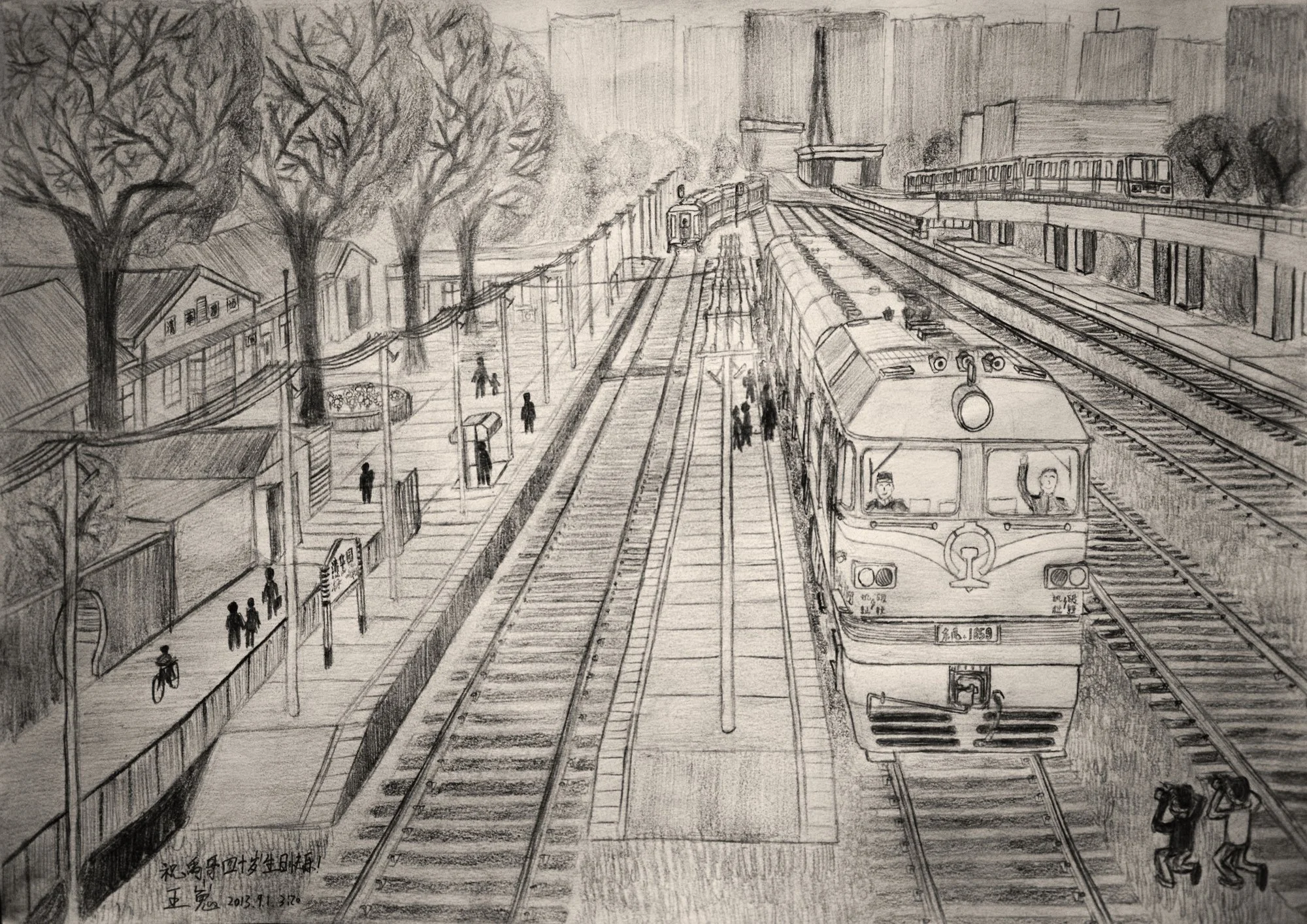
In 1960, due to the expansion of Tsinghua University, Qinghuayuan Station was relocated 1 kilometer southward. In 2008, to accommodate the operation of the S2 line, the yard of the second-generation Qinghuayuan Station was renovated: the platform between Track 1 and Track 2 was dismantled, the station yard was reduced from six tracks to four, and a pedestrian overpass was added. In 2016, due to the construction of the Beijing-Zhangjiakou High-Speed Railway, the Qinghuayuan Station yard was demolished. The image shows the scene prior to the 2008 renovation, viewed from north to south, painted in September 2013.
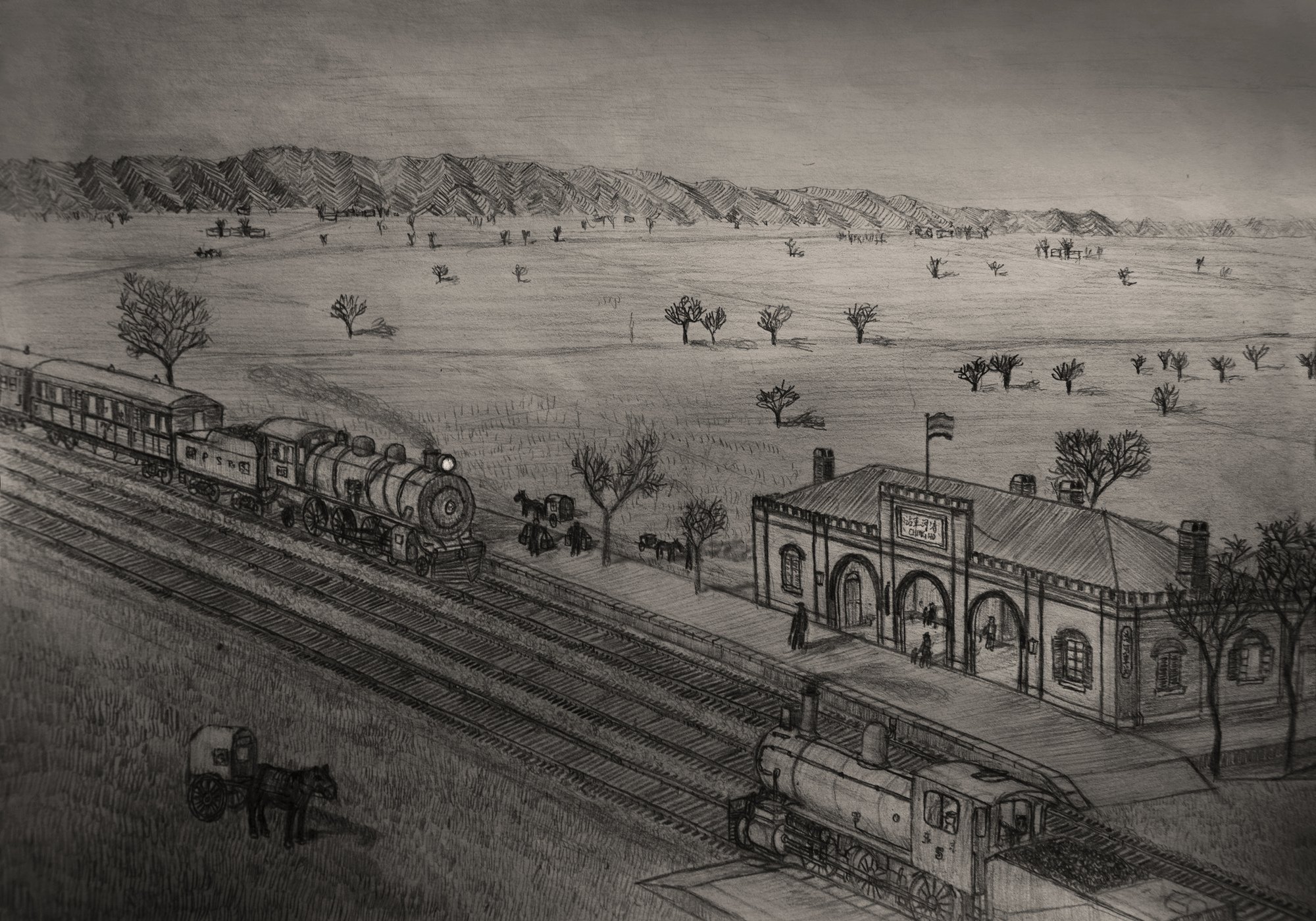
Qinghe Station in the 1920s. At that time, a section of steel rail was hung on the exterior wall of the waiting room to serve as a train arrival announcer: when an outbound (down) train was about to depart from the adjacent station, the on-duty staffer would strike it once with a hammer; if an inbound (up) train was about to depart from the adjacent station, the staffer would strike it twice. Viewed from southwest to northeast, painted in December 2016.
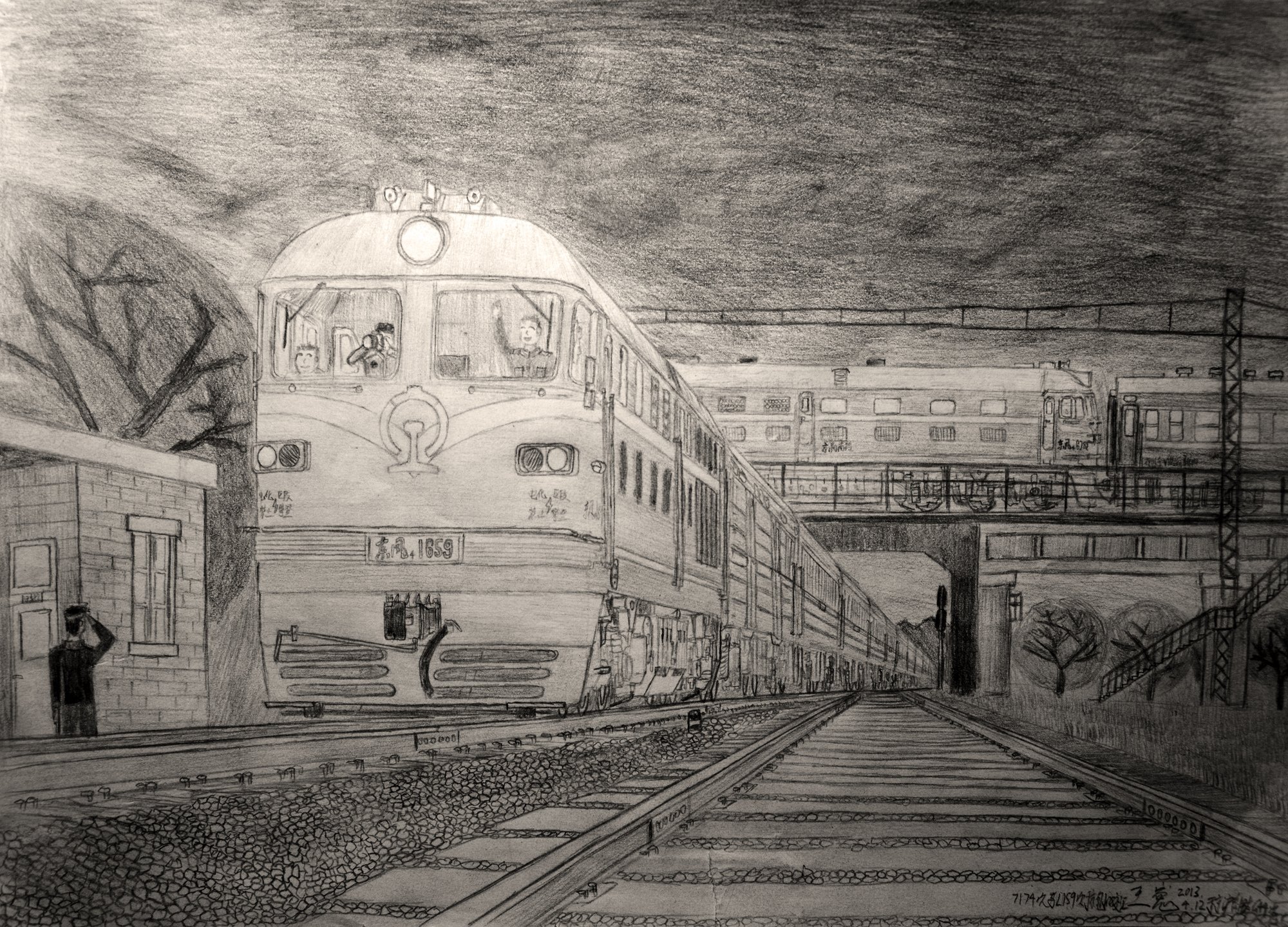
At the 28-kilometer block post, there was an assistant on-duty station worker who, regardless of day or night, wind or rain, would stand firm at his post of many years and salute passing trains with a military salute. As a veteran, he held a deep affection for the military, a profound bond with the railway, and an immense sense of responsibility for his work. In return, locomotive drivers—and even the conductors at the tail end of the trains—would wave to acknowledge and return the salute as they passed by. However, as time passed, this station worker has since retired, and the northern track of the 28-kilometer block post was also dismantled during renovations in recent years. Viewed from south to north, painted in April 2013.
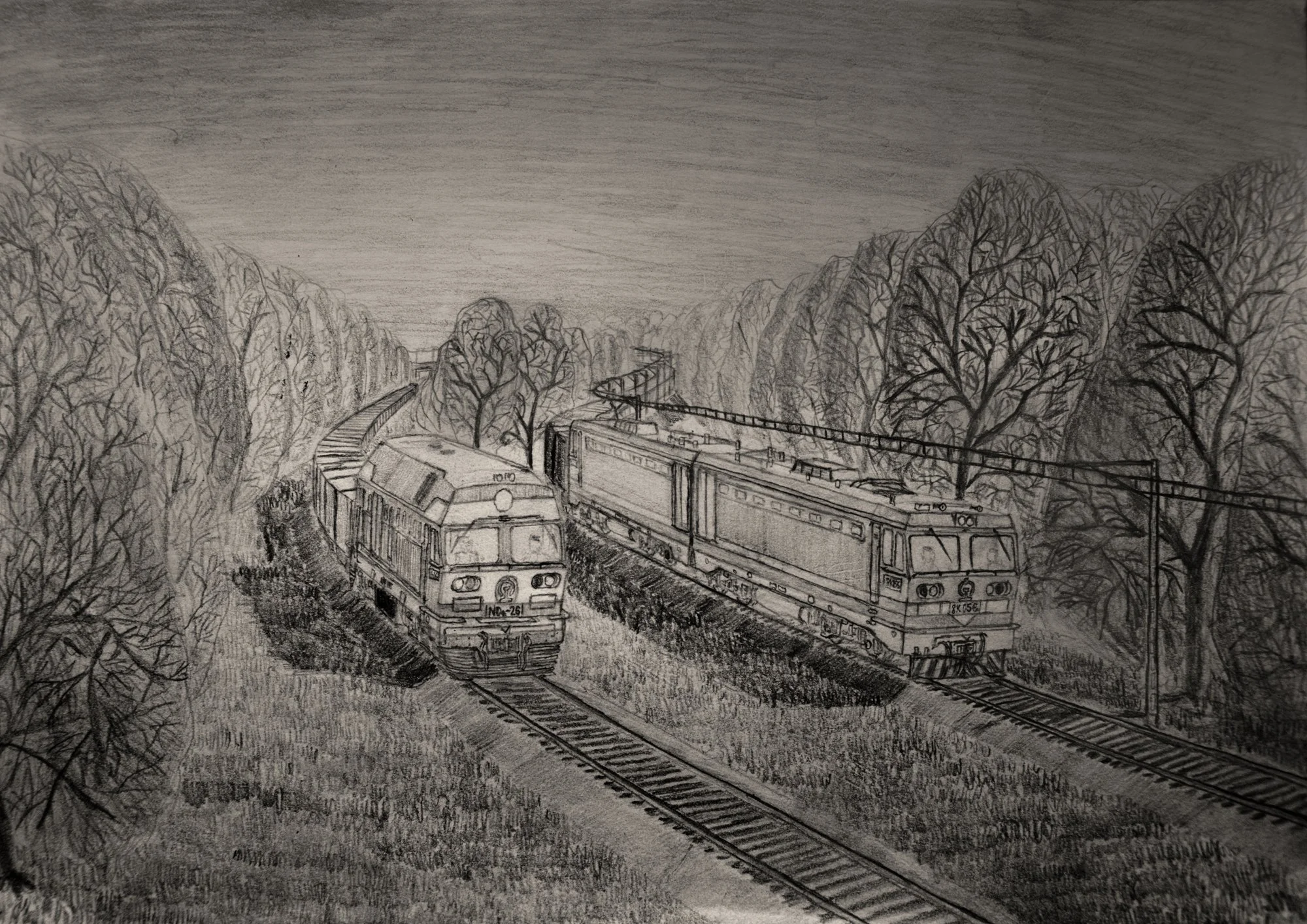
Two kilometers north of the 28-kilometer block post, the Huangtudian-Shahe connecting line (Northeast Ring Line)—which once crossed over the main line of the Beijing-Zhangjiakou Railway—merged with the Beijing-Zhangjiakou Railway and ran parallel all the way to Shahe Station. The restoration drawing above depicts the late 1980s, shortly after the opening of the newly operational Huangtudian-Shahe connecting line. An 8K electric locomotive from the Fengtaixi Locomotive Depot is hauling a freight train down the overpass, running parallel in the same direction as a southbound train hauled by an ND4 diesel locomotive on the Beijing-Zhangjiakou Railway. (8K locomotive—The prototype was the French BB 15000 electric locomotive;ND4 Locomotive: The prototype was the French CC 72000 diesel locomotive)Viewed from north to south, painted in August 2014.
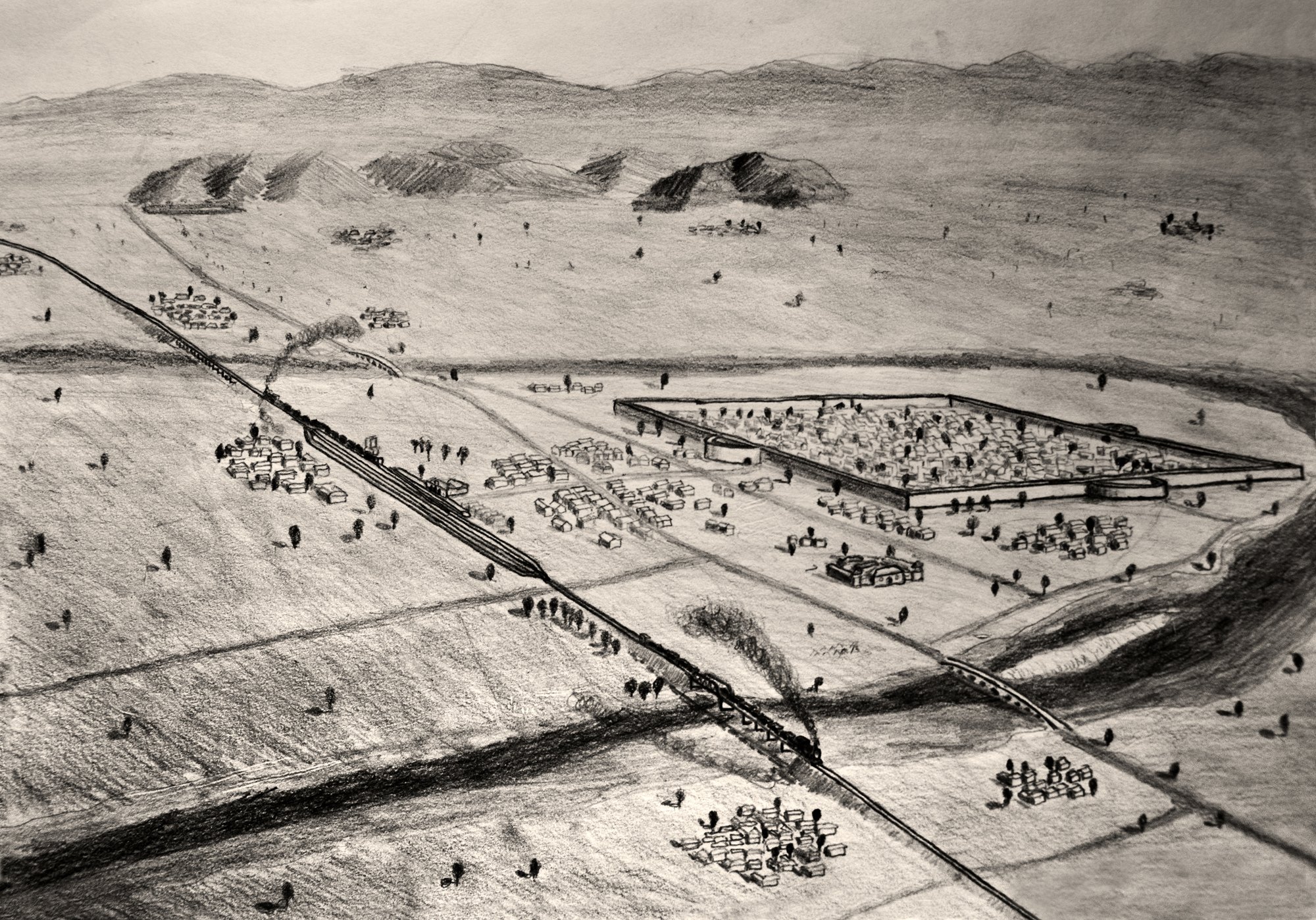
Shahe Station and the Ming Dynasty Gonghua City, located between the South Shahe and North Shahe rivers. Viewed from south to north, painted in August 2014.
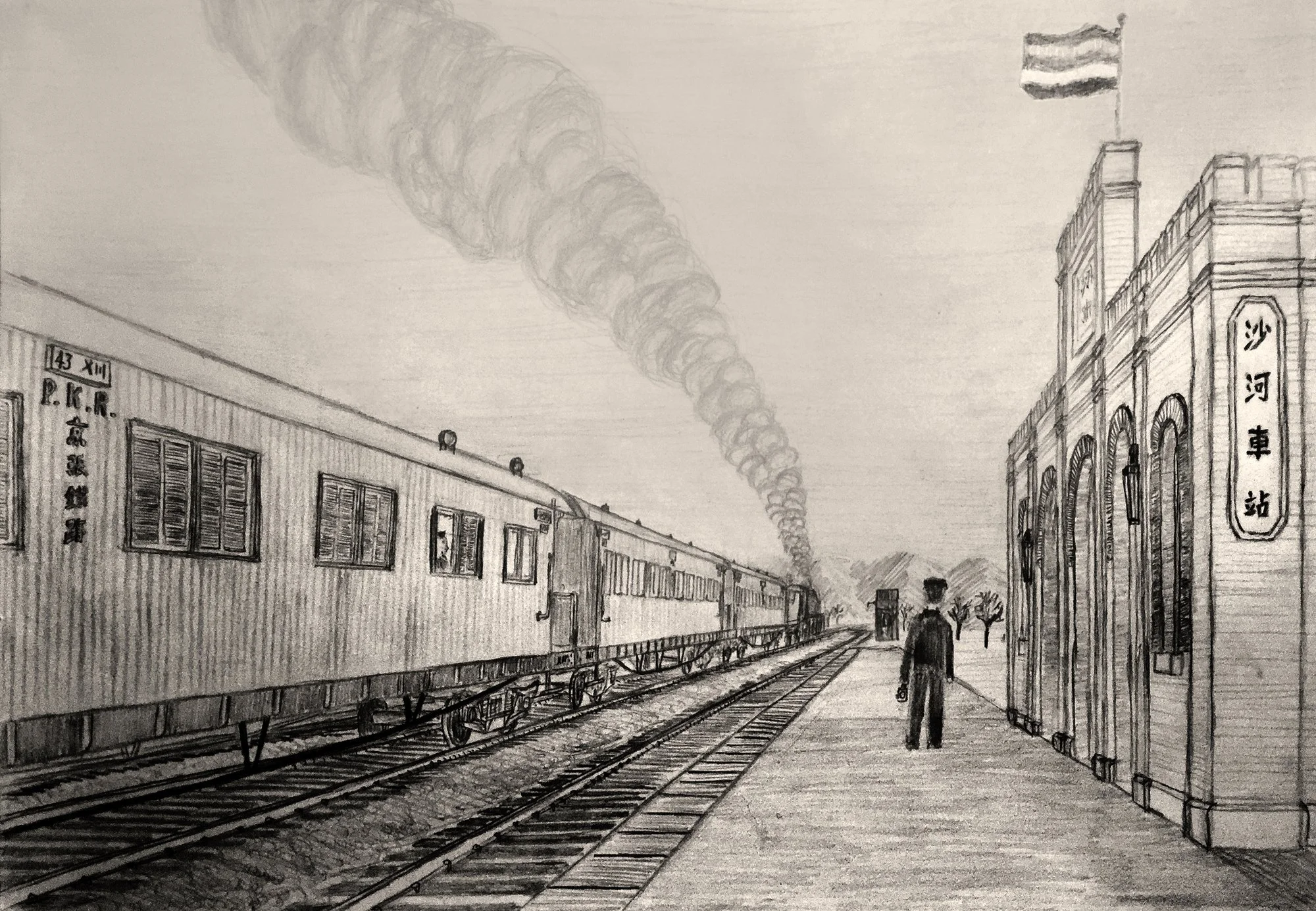
Shahe Station in the early Republic of China era. The station building was located on the east side of the tracks, and a locomotive water tower was situated at the northern end of the station. According to veteran station workers, before the old station building was demolished in 1986, the vertical plaque on the south side was still intact. Viewed from south to north, painted in June 2015.
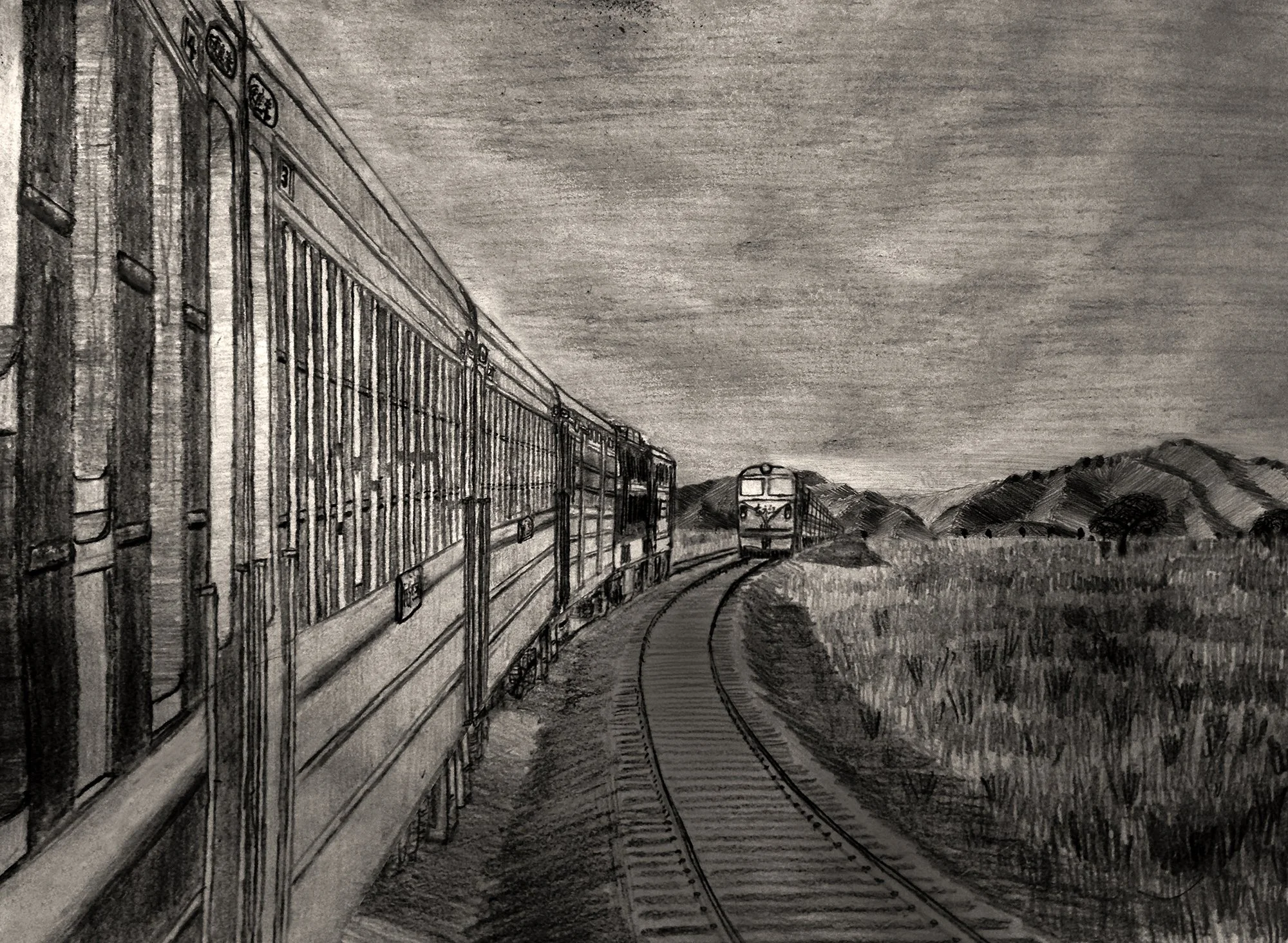
The Shahe-Changping section had its second track added in 1986. The image shows a meeting/passing of upbound and downbound trains. Viewed from south to north, painted in August 2014.
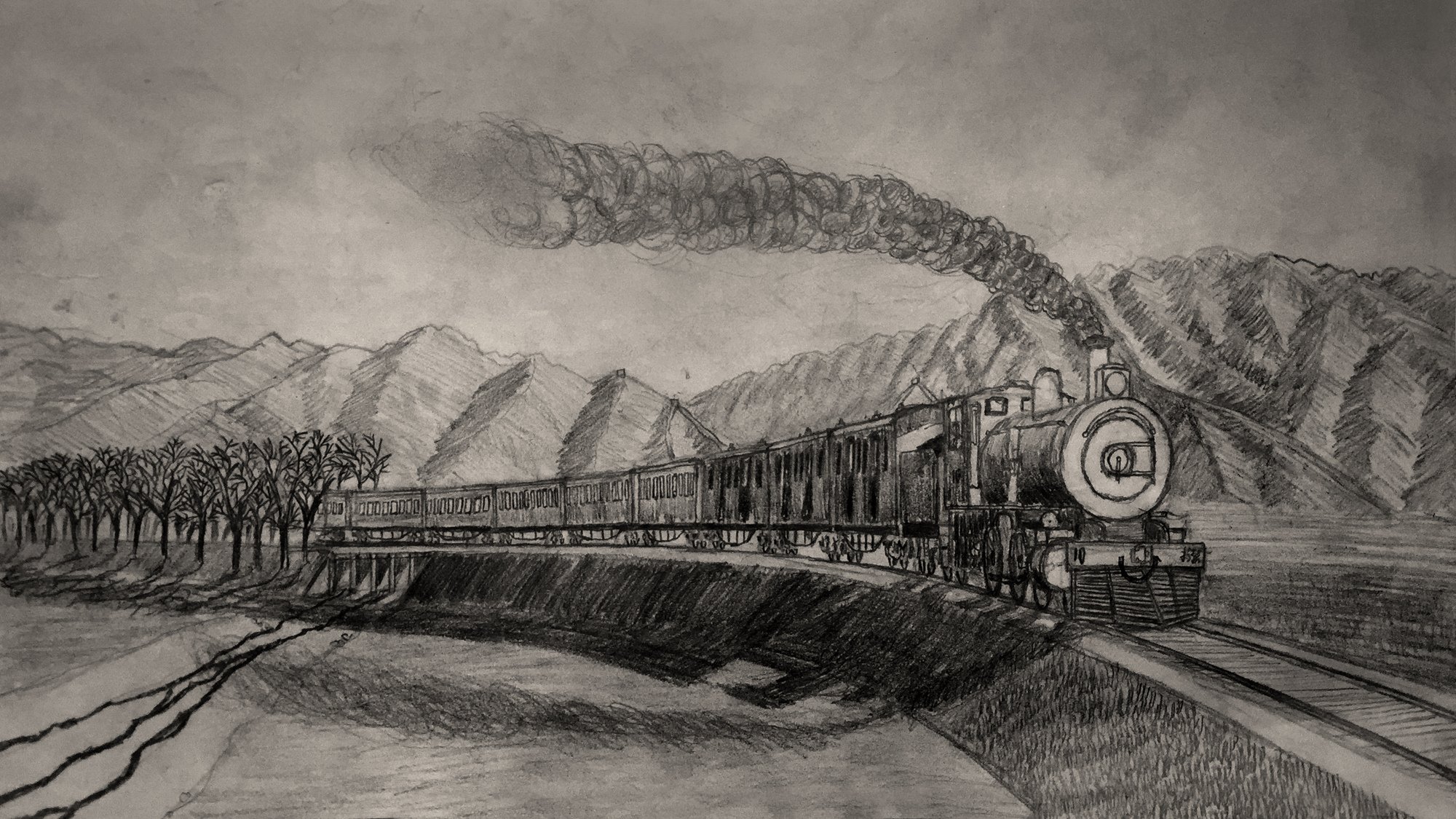
After passing the curve 2 kilometers north of Changping County Station, the railway crosses Bridge No. 19 and turns northwestward. The illustration depicts a Mogul-type 10 locomotive hauling an upbound passenger train across Bridge No. 19. Viewed from south to north, painted in January 2015.
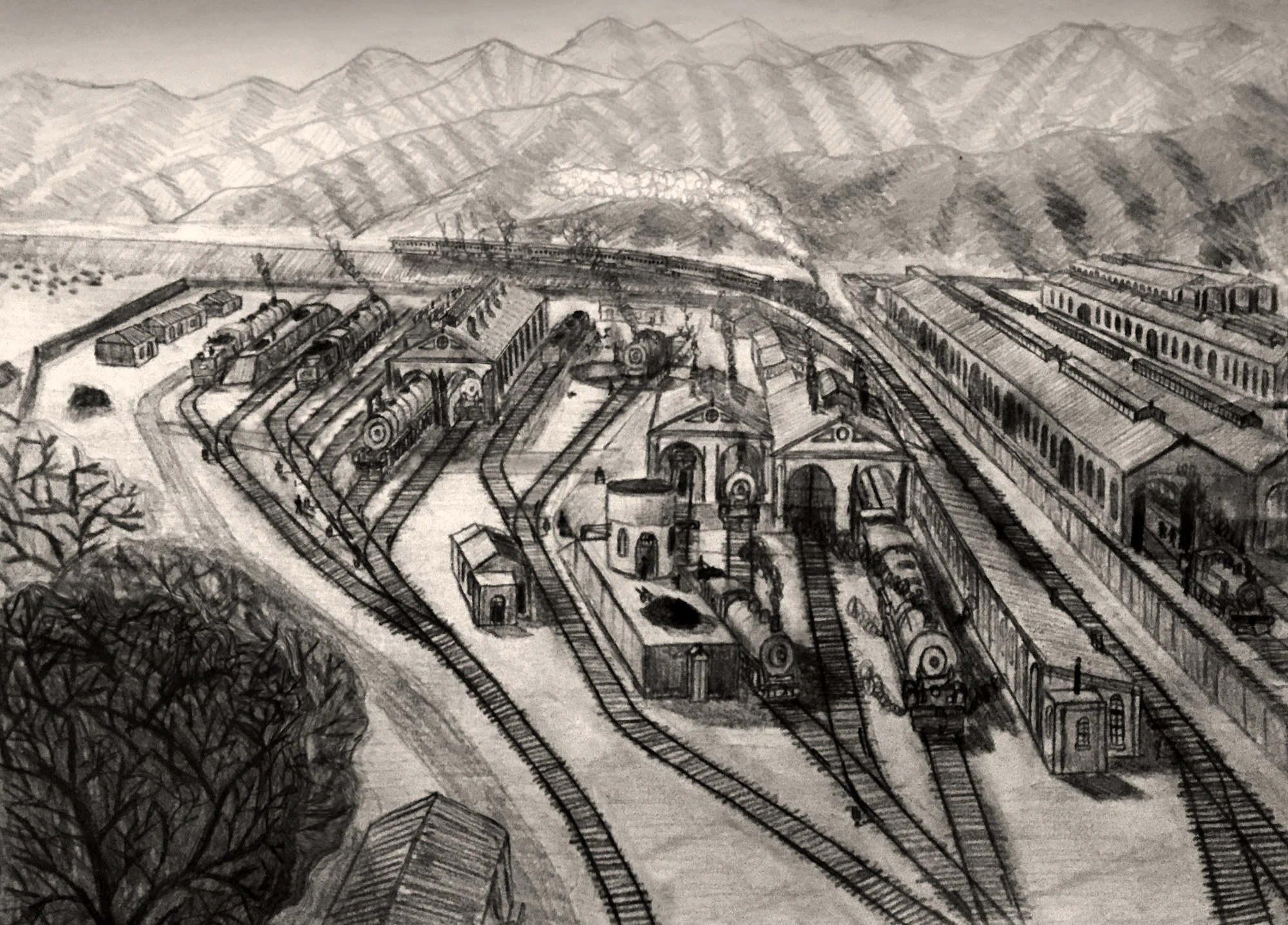
Panorama of the Nankou Locomotive Depot in the 1930s. At the time, the depot featured four engine houses, a water tower, and a coaling stage, with the two engine houses on the right having been built during the initial opening of the Beijing-Zhangjiakou Railway. In the 1970s, the third and fourth engine houses on the left were demolished. Viewed from east to west, painted in January 2015.
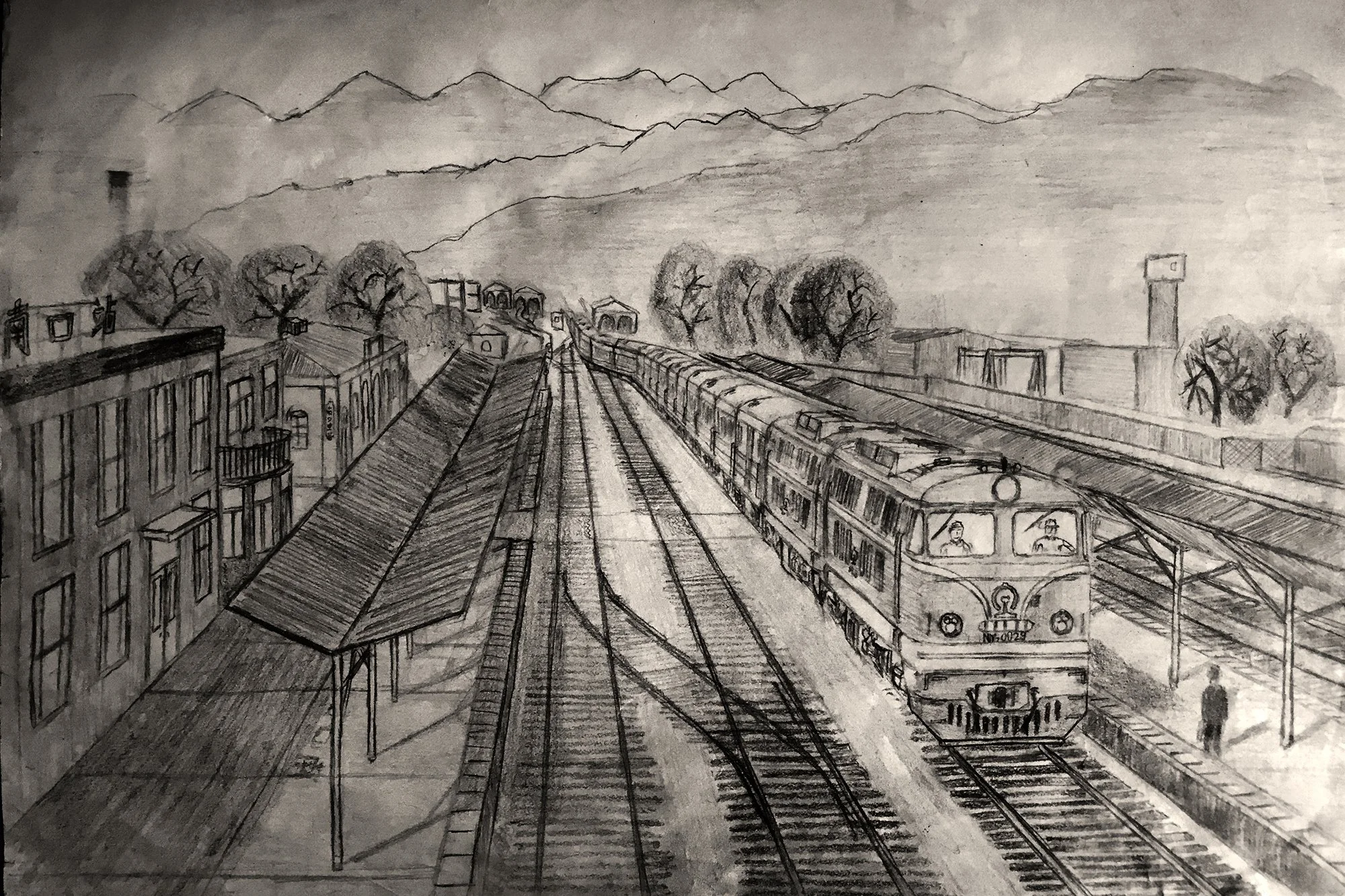
Double-headed NY7 diesel locomotives hauling the K3 international train as it pulls into Nankou Station—a scene that remained unchanged for over twenty years.(NY7 locomotive—The prototype was the Henschel DH 4000.) Viewed from east to west, painted in April 2014.
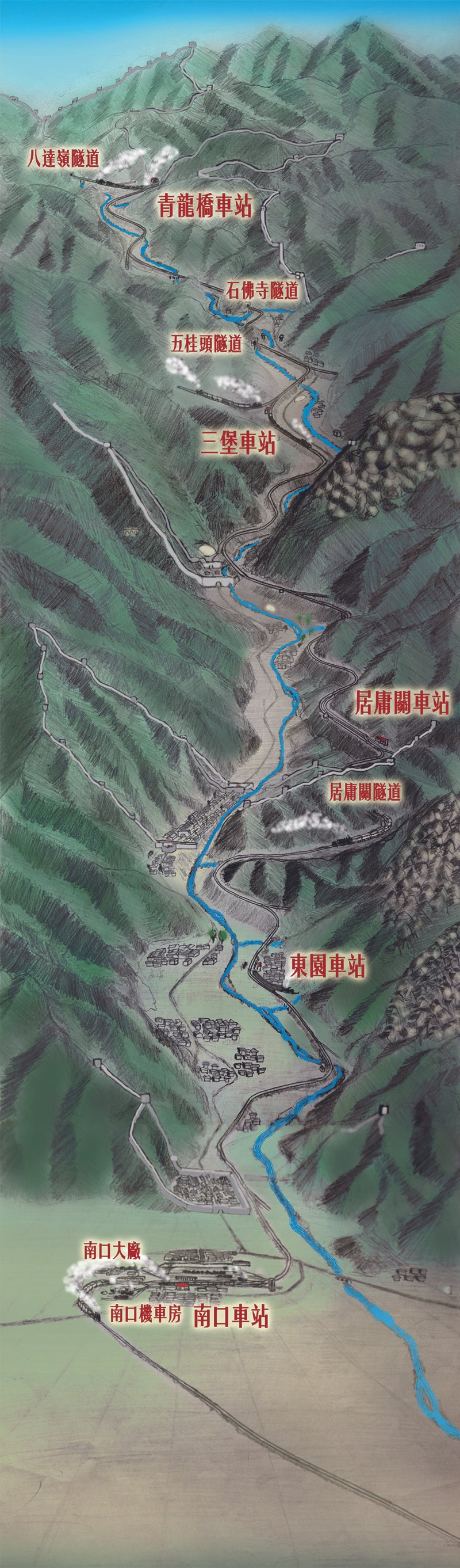
Panorama of the Guanguan section of the Beijing-Zhangjiakou Railway in the 1930s, viewed from southeast to northwest, painted in August 2014.
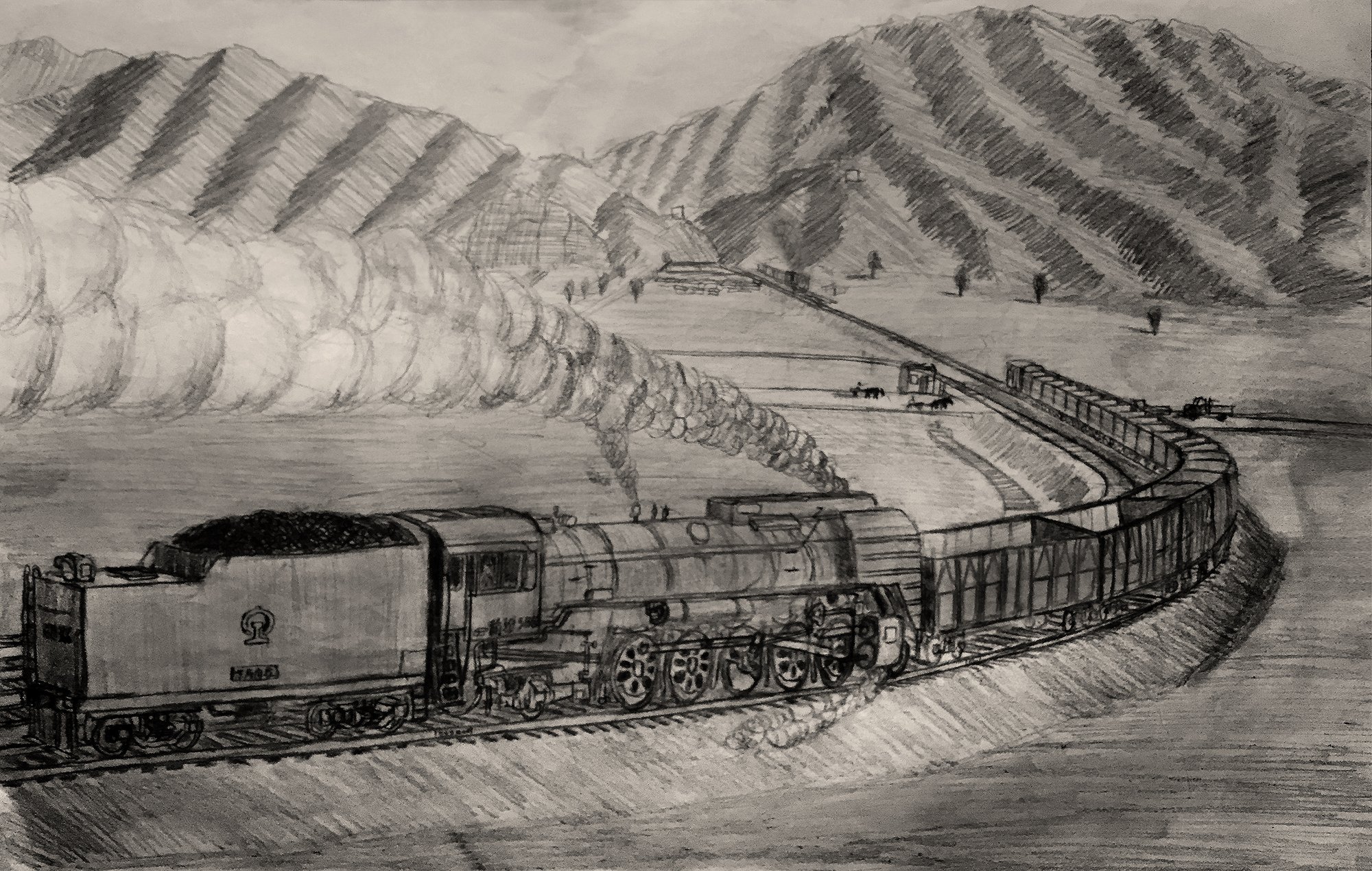
From the 1960s to the 1980s, a QJ-class locomotive pushed an empty train with a total weight of about 450 tons up the mountain, with a caboose attached to the front of the train for lookout duties. Viewed from south to north, painted in January 2015.
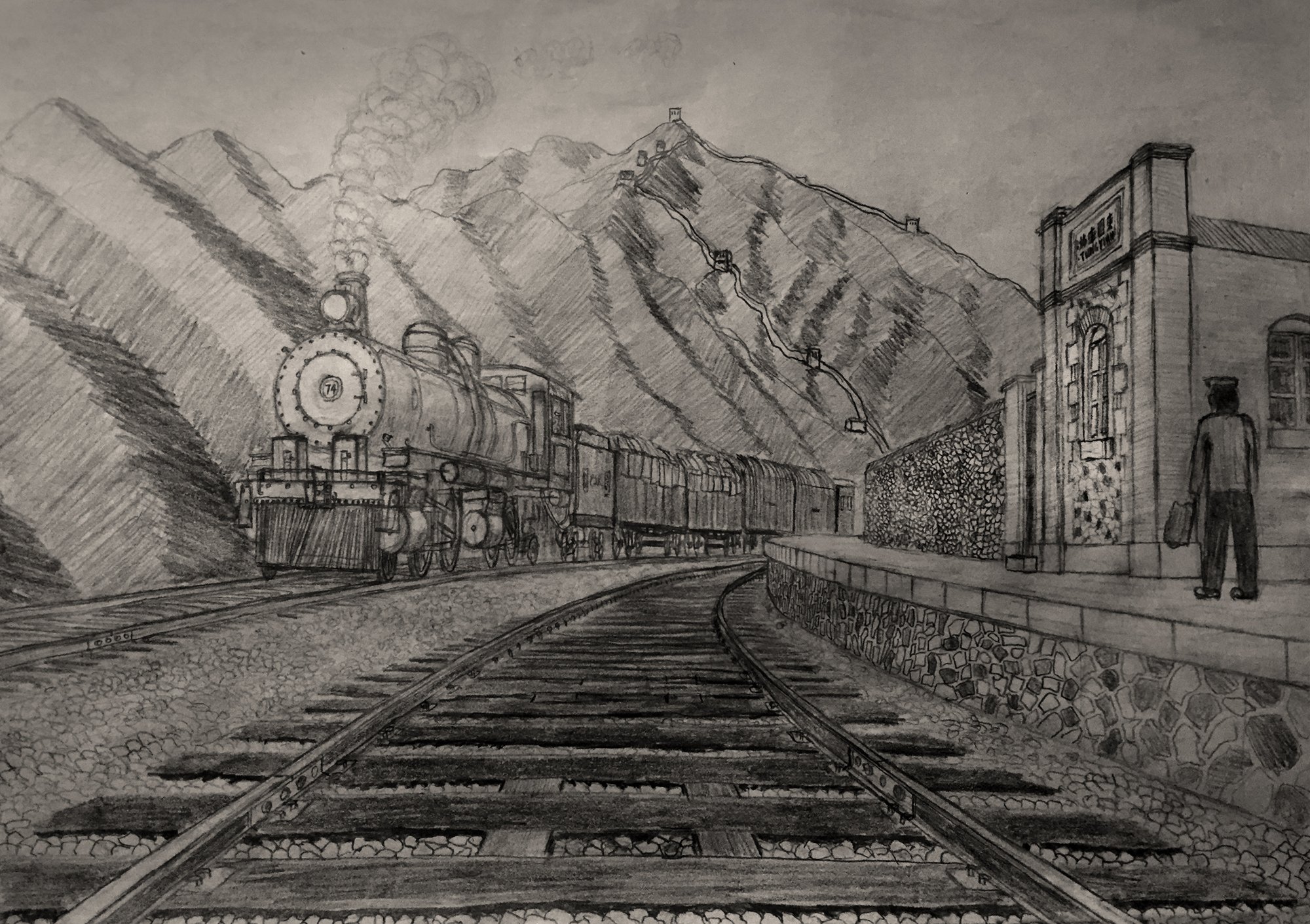
A Mallet articulated locomotive hauling an upbound train slowly passing through Dongyuan Station. Six such locomotives were built by the Baldwin Locomotive Works in 1909, with four deployed on the Beijing-Zhangjiakou Railway and two used on a logging railroad in the United States. In the 1950s, all four Mallet locomotives on the Beijing-Zhangjiakou Railway were retired and scrapped. Of the two in the United States, only one survives; after being preserved by generations of railway volunteers, it was restored to operation in 2019 and is currently preserved in operational condition at the Niles Canyon Railway on the U.S. West Coast(Columbia River Belt Line 7). Viewed from south to north, painted in February 2015.
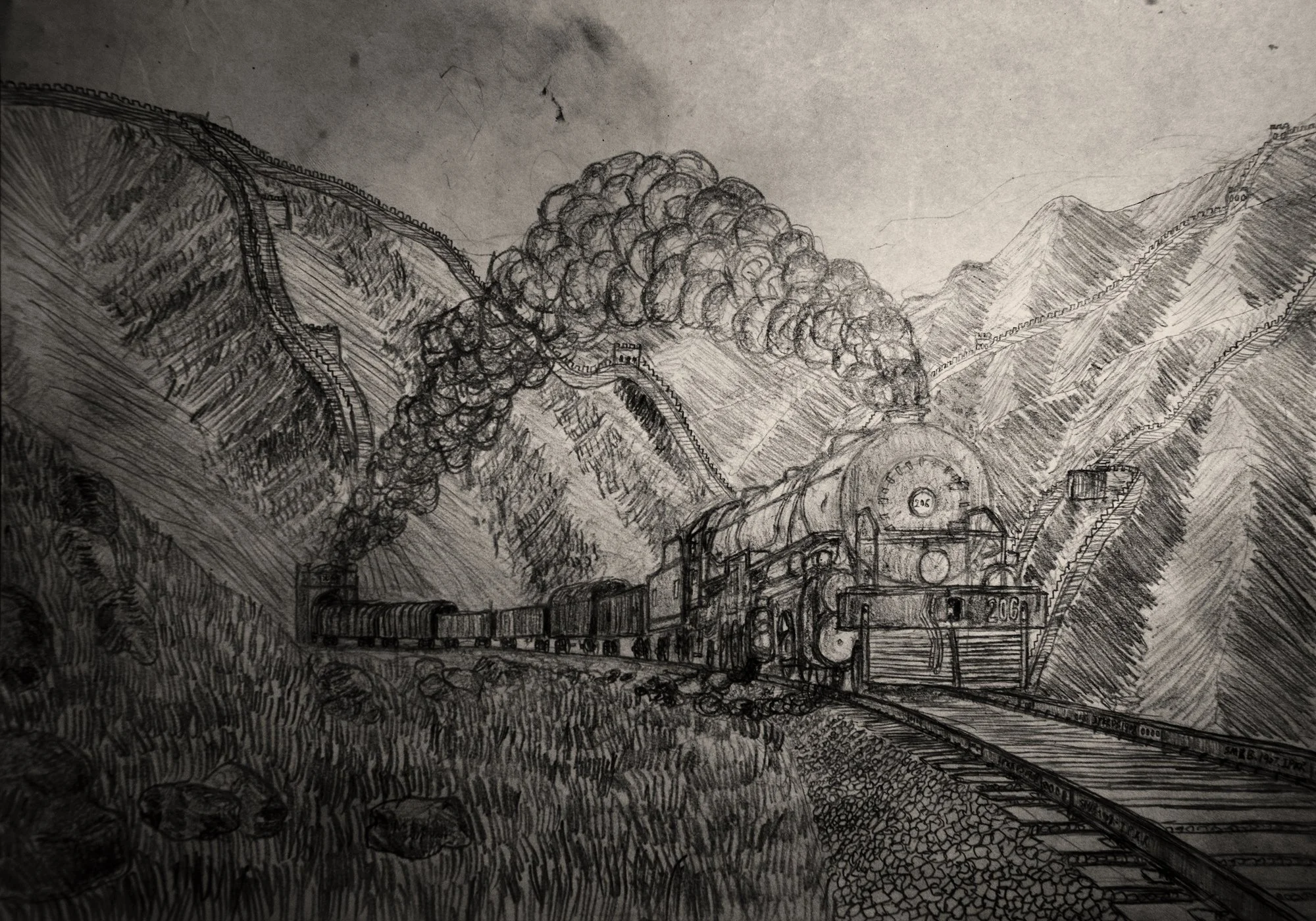
A Mallet Type 4 (2-8-8-2)steam locomotive hauling a freight train out of the Juyongguan Tunnel. Viewed from north to south, painted in May 2017.
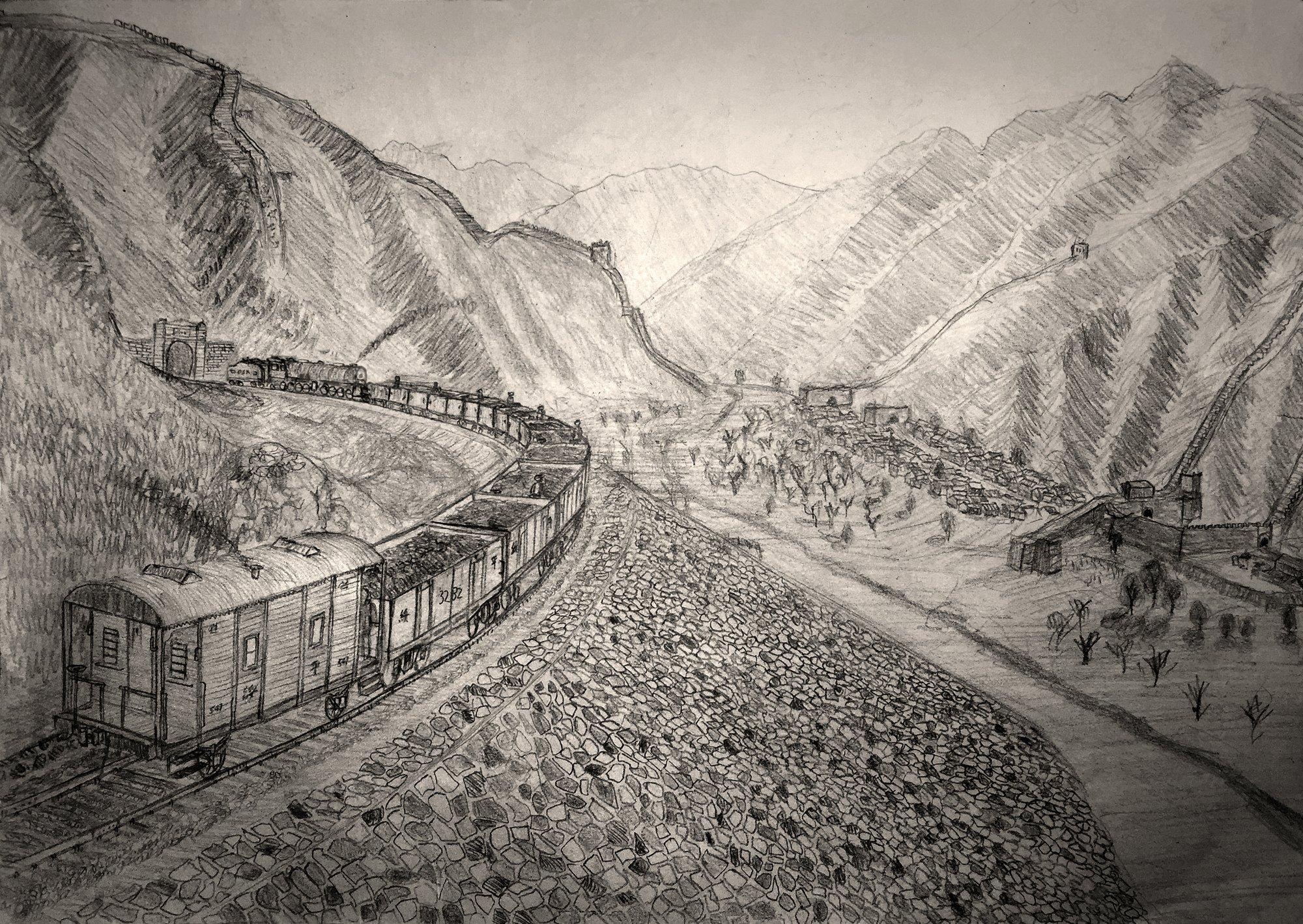
Back when freight trains still operated on the GuanGou section, it was common to see uphill freight trains with a total weight of 1,000 tons. Because freight train braking power was inferior to that of passenger trains, a "brakeman" (officially designated as a train brakeman) was assigned for every two freight cars. As the train descended the mountain, these brakemen stood on the footplates between the cars, working alongside the air brakes by turning the handbrake wheels to achieve the necessary braking force for the train. This practice had existed since the opening of the Beijing-Zhangjiakou Railway: "When trains depart from Nankou and Kangzhuang, team leaders are responsible for assigning guards to watch the train brakes—regardless of wind, rain, fog, snow, or scorching sun, they must stand outside the cars to ensure utmost caution, and once the train departs, they are not permitted to leave their brake posts along the route." Due to the low operational efficiency and high risks of running freight trains through the GuanGou section, after 1985, as all uphill freight trains were rerouted via the Fengtai-Shacheng Railway, this job operation also disappeared from the GuanGou section. The illustration depicts an uphill freight train descending the mountain using a combination of air brakes and handbrakes. Viewed from northwest to southeast, painted in April 2017.
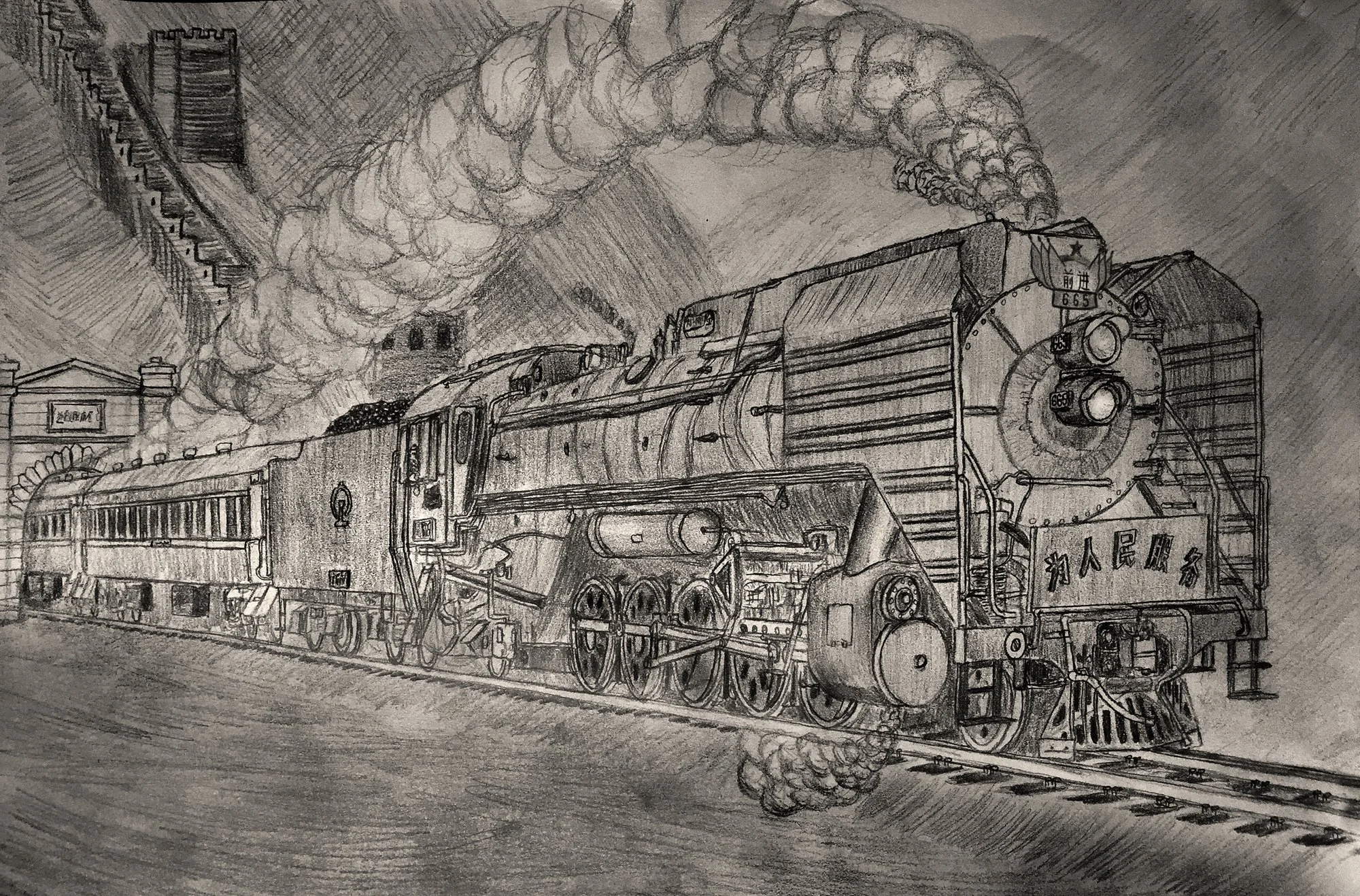
QJ-class steam locomotive No. 665 of the Beijing Railway Bureau's Nankou Locomotive Depot hauling a short-distance passenger train out of the north portal of the Juyongguan Tunnel. Viewed from north to south, painted in July 2016.
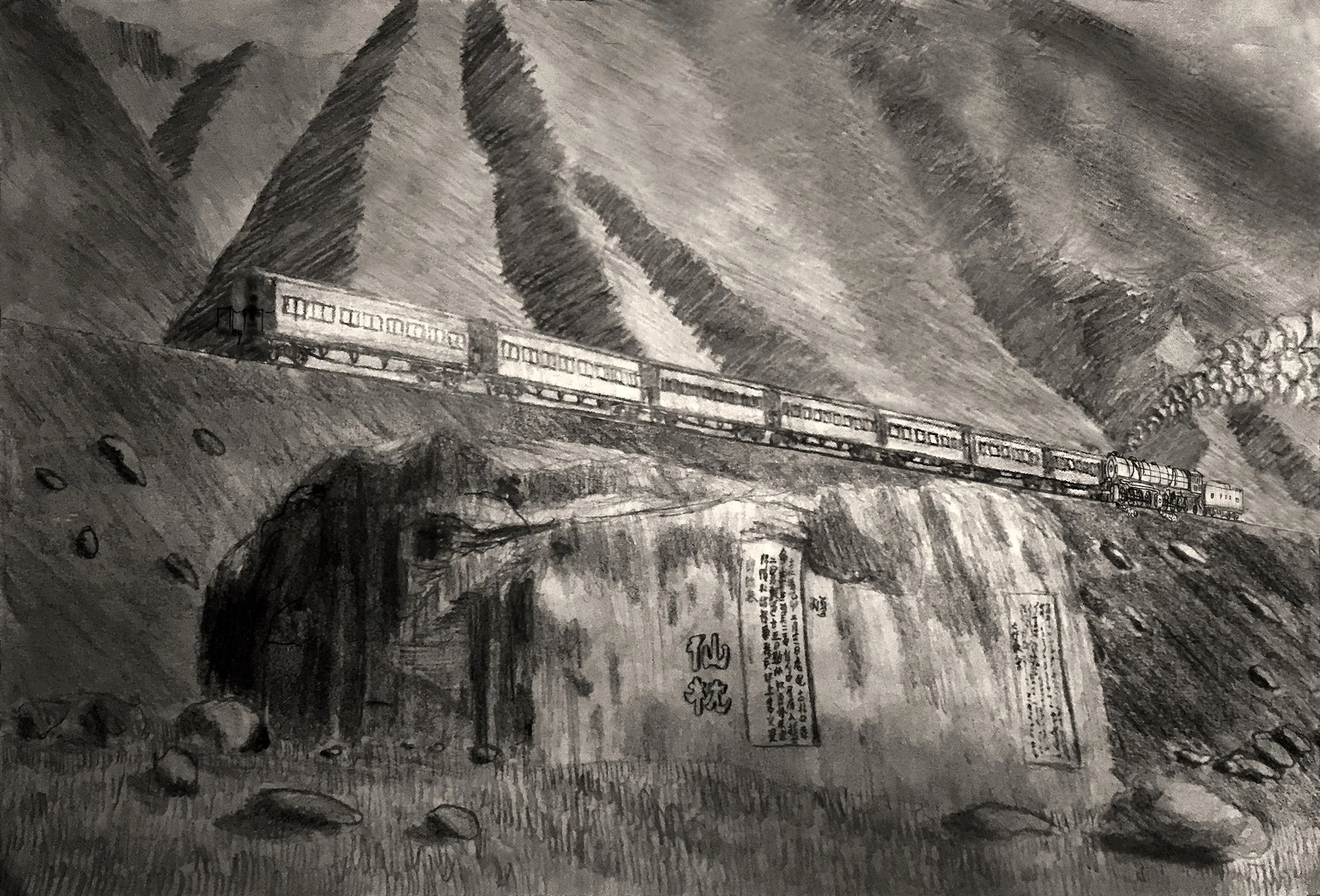
For a century, passengers riding passenger trains through the Guanguan section between Siqiaozi and Shangguan would often look at a large boulder below the roadbed known as the "Immortal's Pillow Stone." The illustration shows a Mallet Type 4 locomotive pushing a southbound (downbound) passenger train in operation. Painted in January 2015.
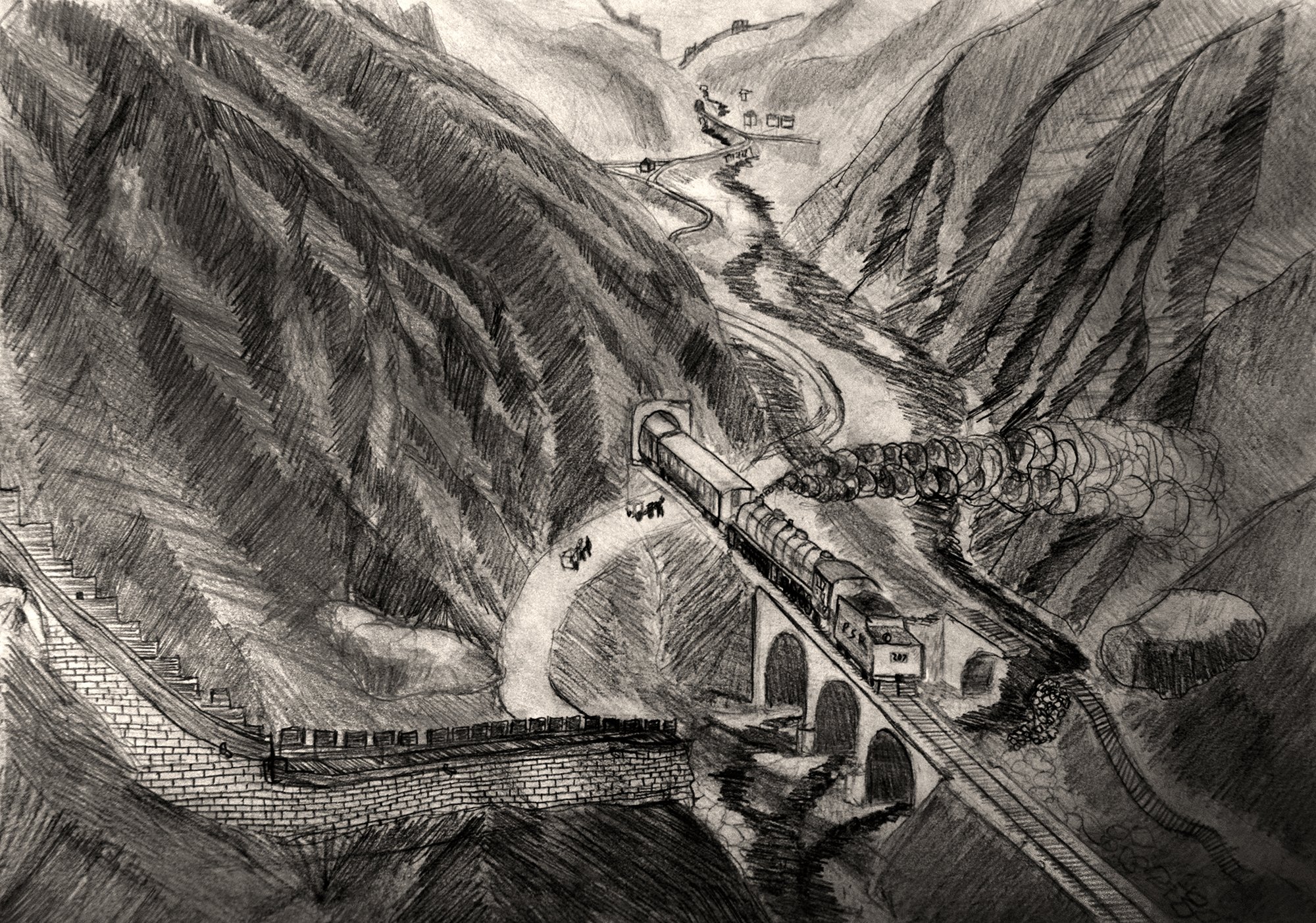
The valley between Shangguan and SanPu is extremely narrow, with the railway line running very close to the riverbed. In the summer of 1939, a flash flood washed out this section of the line. In 1940, the Japanese puppet authorities rebuilt a three-arch bridge and the Shangguan Tunnel at Shangguan. The illustration shows the restored scene after the flood-prevention rerouting opened to traffic. Viewed from south to north, painted in January 2015.
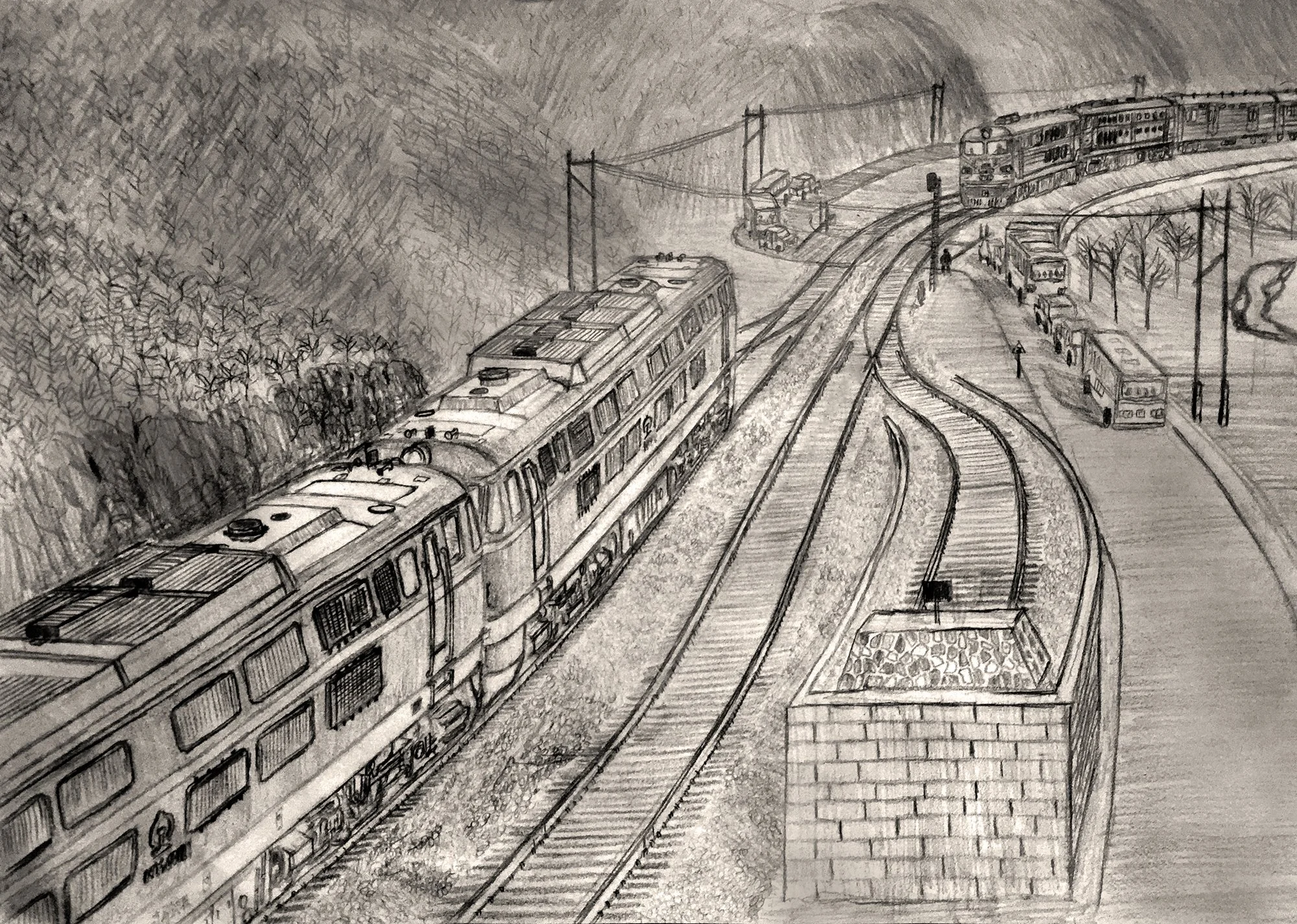
Following the track modification in 1939, the southern throat of SanPu Station reached a gradient of 36.0‰, briefly setting a new record for the steepest grade on the GuanGou section. In 1983, the highway and railway swapped positions, and after modifications were completed in 1987, the grade here was adjusted to 33.8‰. Before the SanPu level crossing was decommissioned, this location became a classic spot for tourists to photograph trains. The illustration shows upbound and downbound trains crossing paths within the station. Viewed from south to north, painted in June 2015.
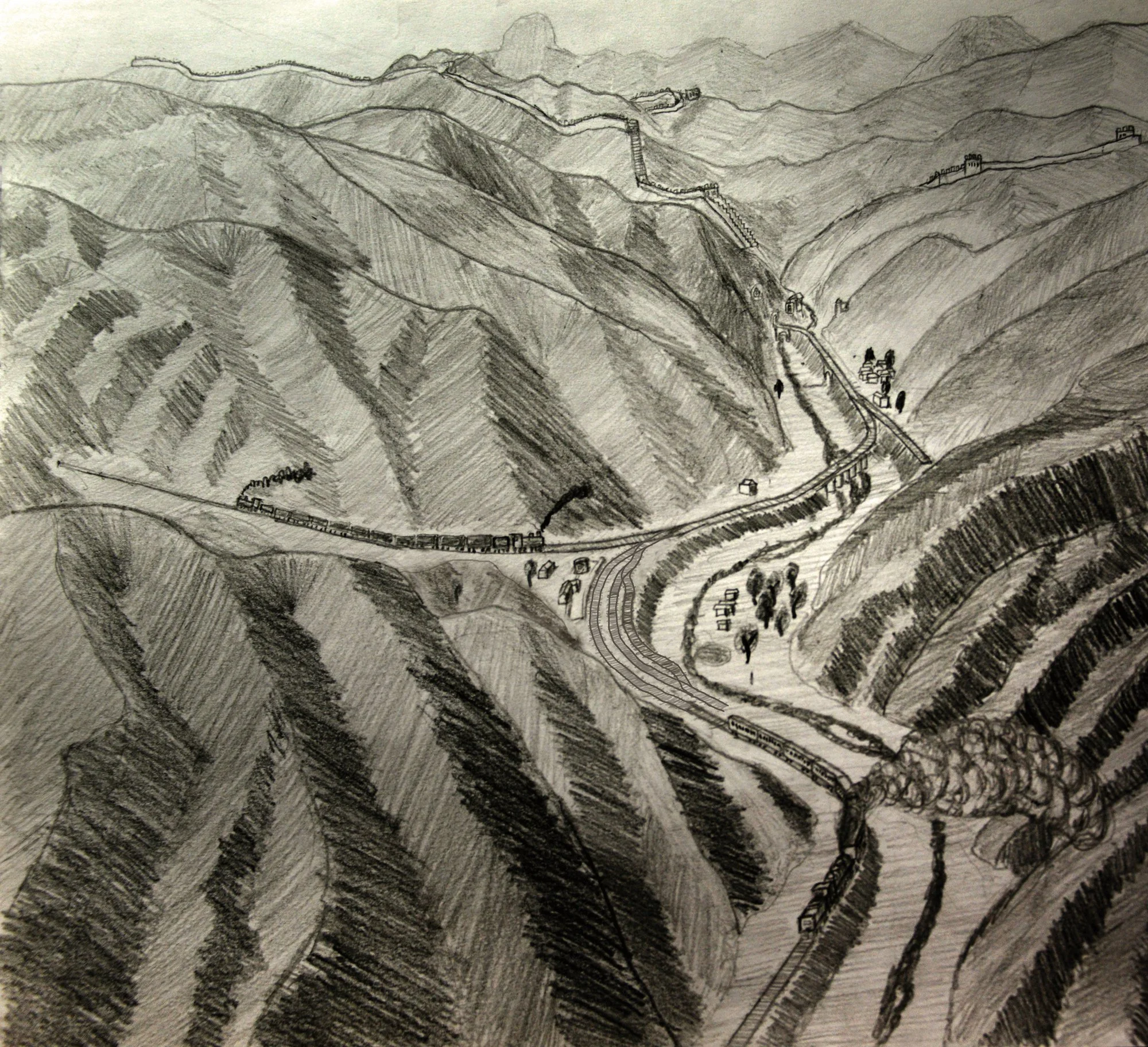
According to the recollections of stationmaster Yang Kuijiang, there were several abandoned bridge piers southwest of the SanPu Station building, where a "waiting siding" originally connected the main line with the refuge siding. This track was used for train meets: when trains from opposite directions were about to cross paths at the station, the train that arrived first would pull into the flat waiting siding on the west side of the station. Once the train from the opposite direction passed through the station on the main line, the train in the waiting siding would pull back out onto the main line. The illustration shows SanPu Station between 1910 and 1939. Painted in August 2014.
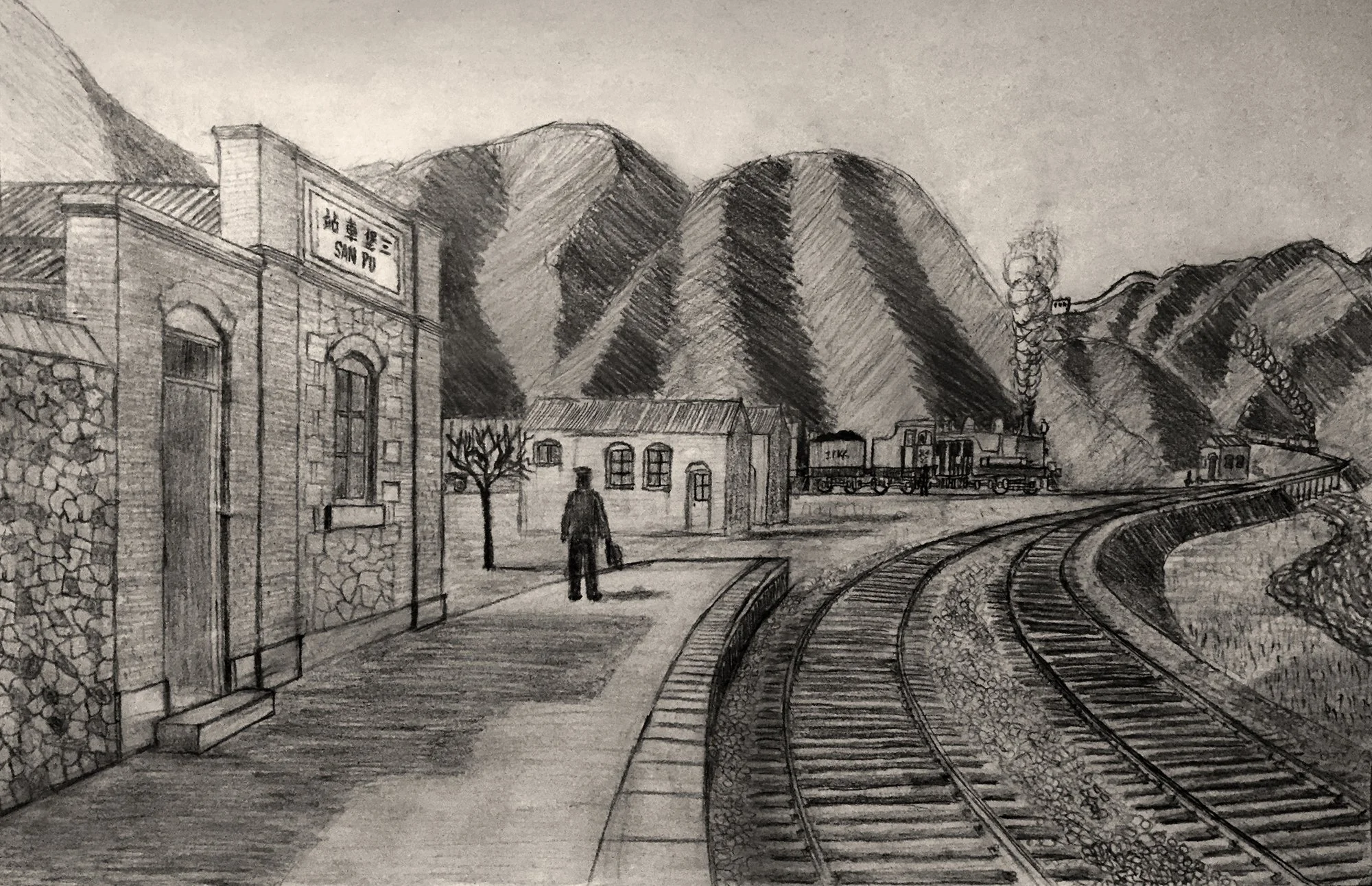
A restored scene of the old SanPu Station building and a Shay locomotive parked at the station. As can be seen, the old station building originally shared the same specifications as those at Dongyuan and Juyongguan stations, but it was demolished during reconstruction work in 1960. This illustration is viewed from south to north, painted in January 2015. At the time, the author had limited source materials and, based on the information available then, depicted the old SanPu Station building as parallel to the tracks. In 2020, the author learned from newly discovered historical materials that the old station building was actually perpendicular to the tracks, making this painting an erroneous version.
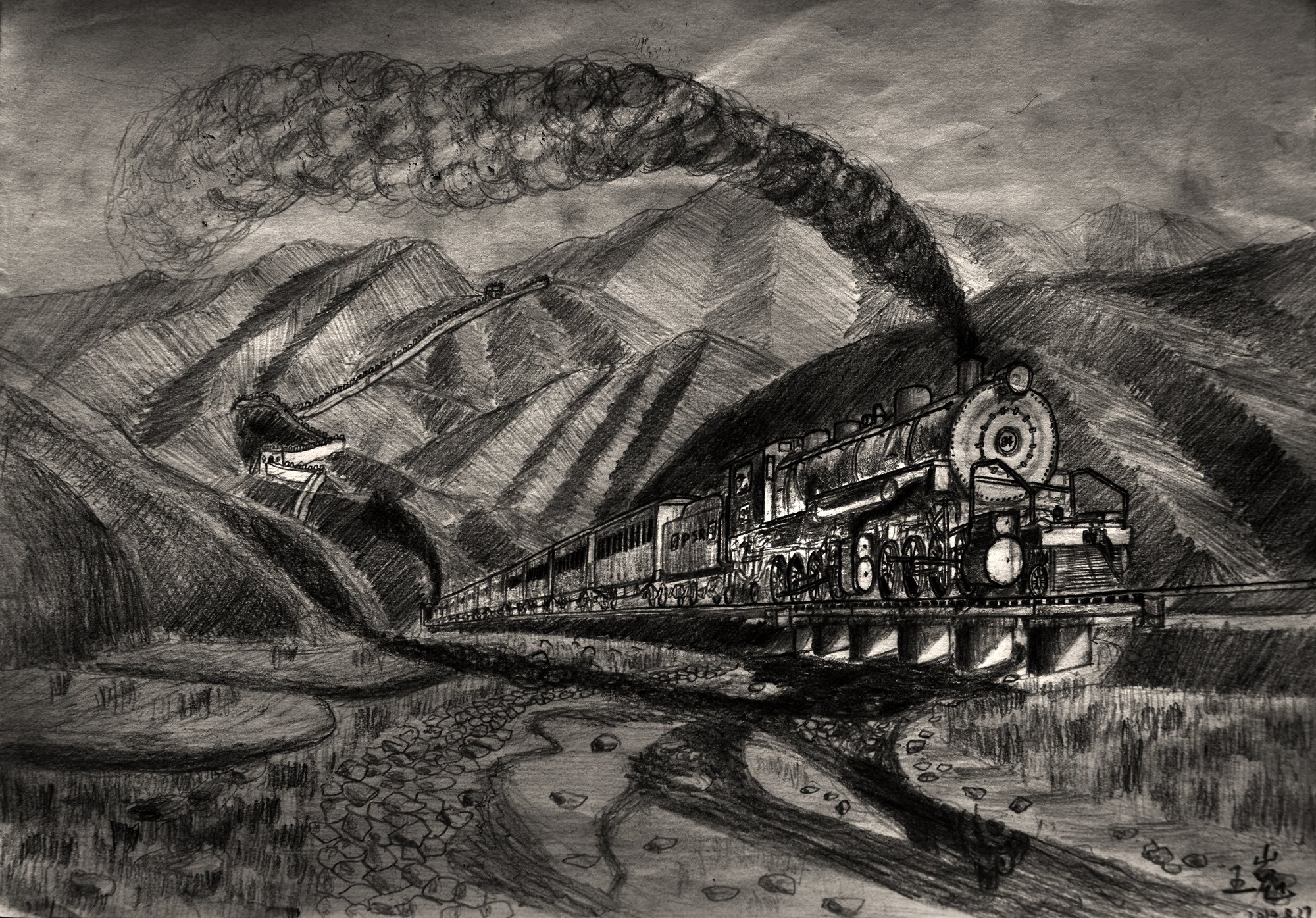
A restored scene of a Mallet Type 3 locomotive hauling a passenger train across the North Skew Bridge at Shifosi. Viewed from north to south, painted in August 2014.
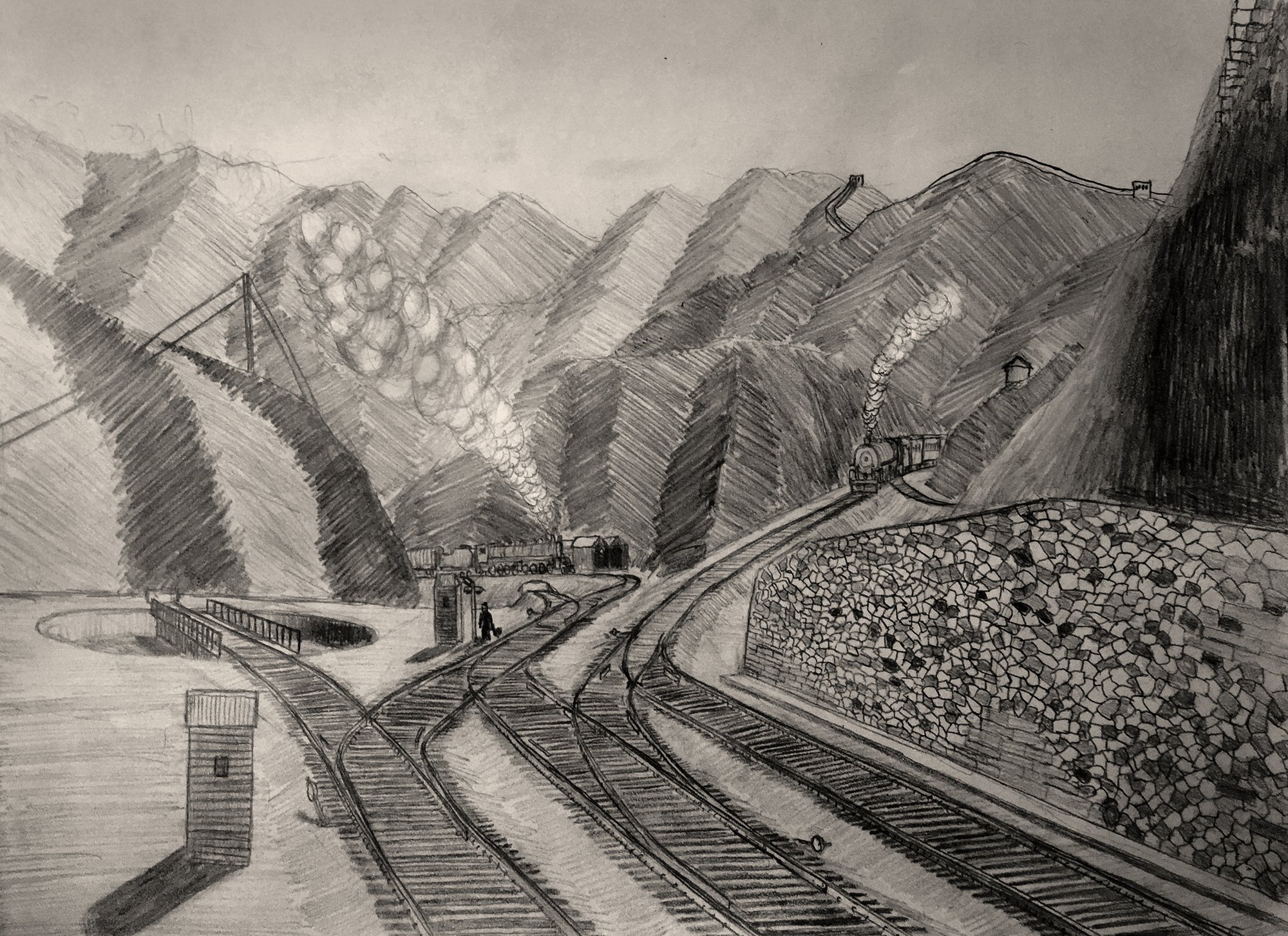
A restored scene of upbound and downbound trains entering Qinglongqiao Station simultaneously. As seen, during the early years of operation, the main lines from both directions ran parallel on a level grade for about 150 meters before connecting to the station throats. In 1958, to increase the train throughput capacity of the Guanguan section, the throat was moved 130 meters westward, and the original throat underwent switch track modifications. Thereafter, short-form trains could enter the station via the original throat, while long-form trains entered via the new throat. In 1986, the track connecting Track 1 to the Zhangjiakou-bound main line, along with parts of Track 2 and its switches, were dismantled; since then, the track layout within Qinglongqiao Station has remained unchanged to this day. Viewed from north to south, painted in February 2015.
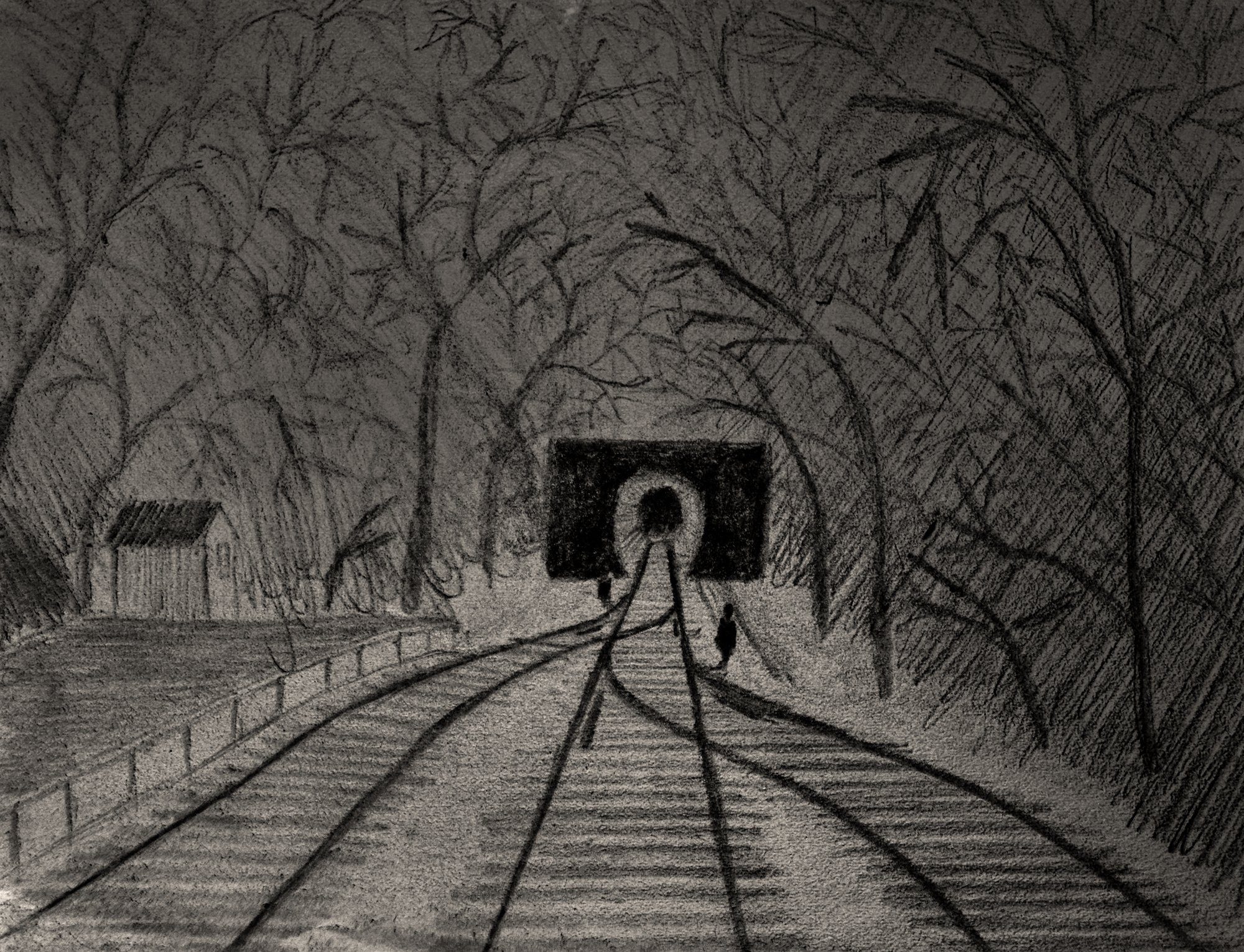
Based on a conjecture by Stationmaster Yang Kuijiang, the author hand-painted a possible stub-end reversing tunnel that may have existed at the end of Qinglongqiao Station during the 1920s-1930s. The hillside at this location was excavated in 1940, and the existence of a tunnel here has neither been confirmed nor falsified—it remains purely speculative. Viewed from south to north, painted in August 2014.
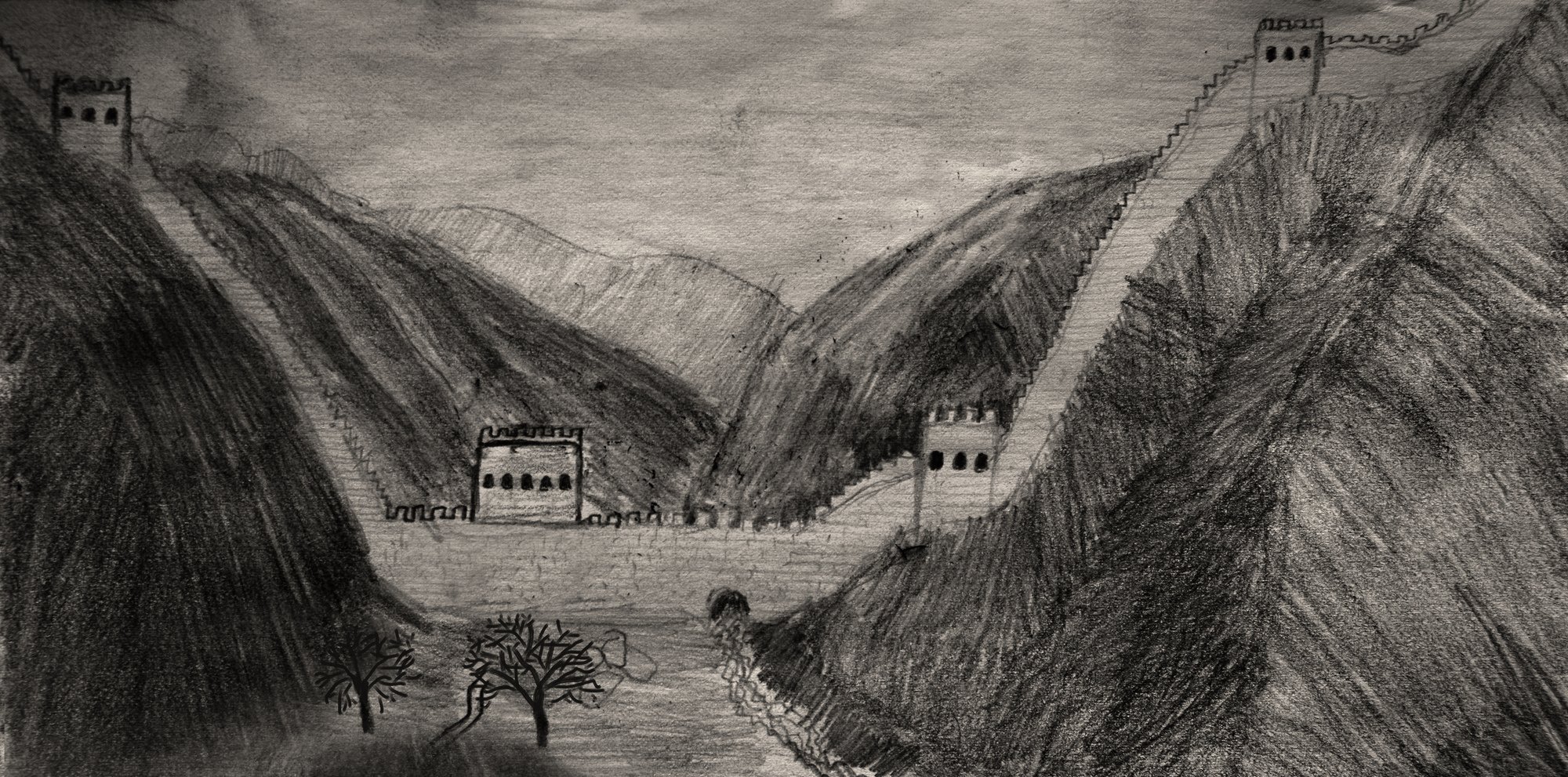
A conceptual illustration of the location of Qinglongqiao Station before the Great Wall was built there. Painted in August 2014.
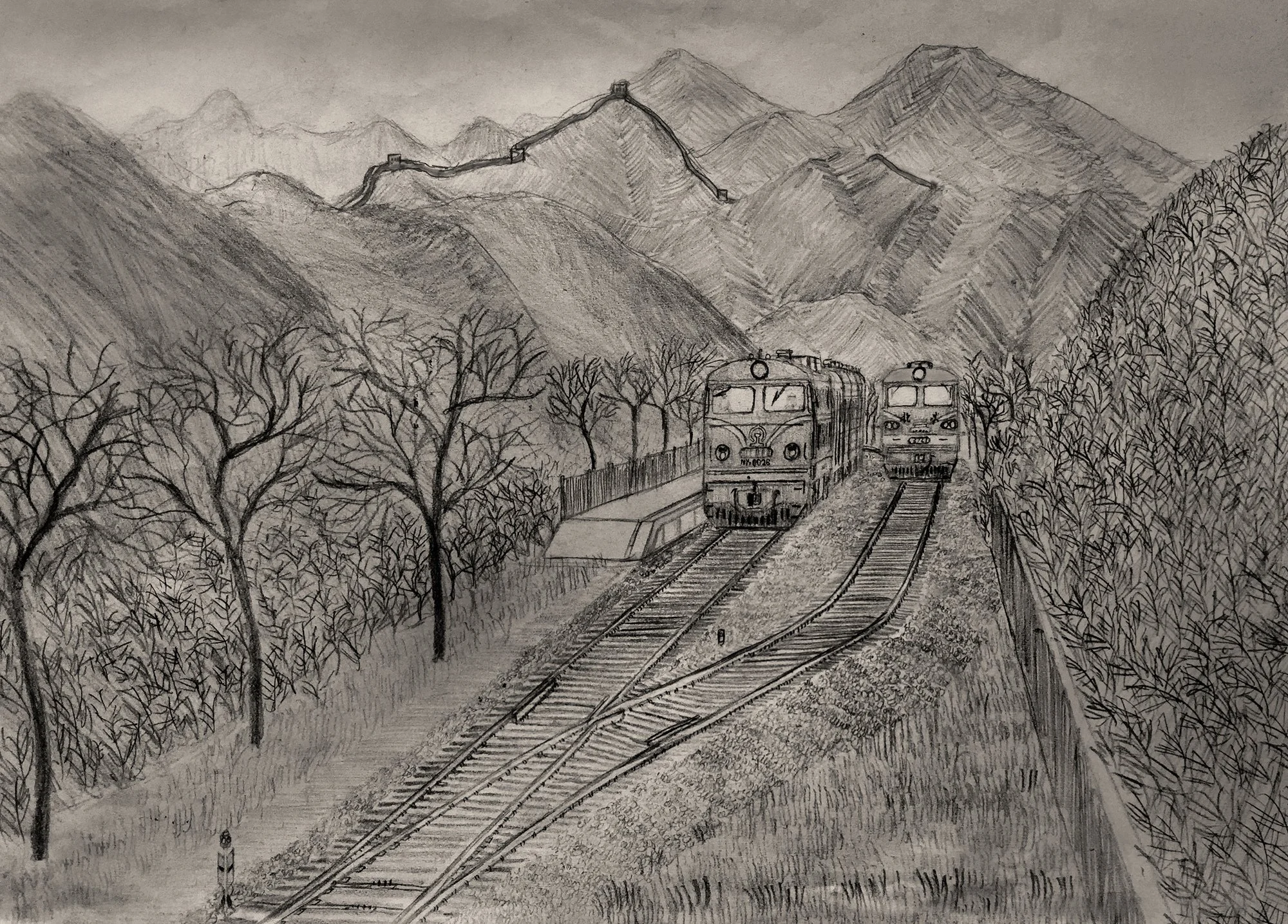
English: In the 1980s and 1990s, trains operated by the Beijing Locomotive Depot were hauled by double-heading locomotives. Upon arriving at Qinglongqiao West Station, the lead locomotive would uncouple and move to the rear of the train, while the second locomotive immediately became a helper engine. Once the lead locomotive was re-coupled and the brake pipes were tested, the train changed direction and departed. When the train arrived at Kangzhuang, the helper engine was uncoupled and returned to the engine shed, while the lead locomotive continued hauling the train toward Zhangjiakou. Viewed from south to north, painted in September 2015.
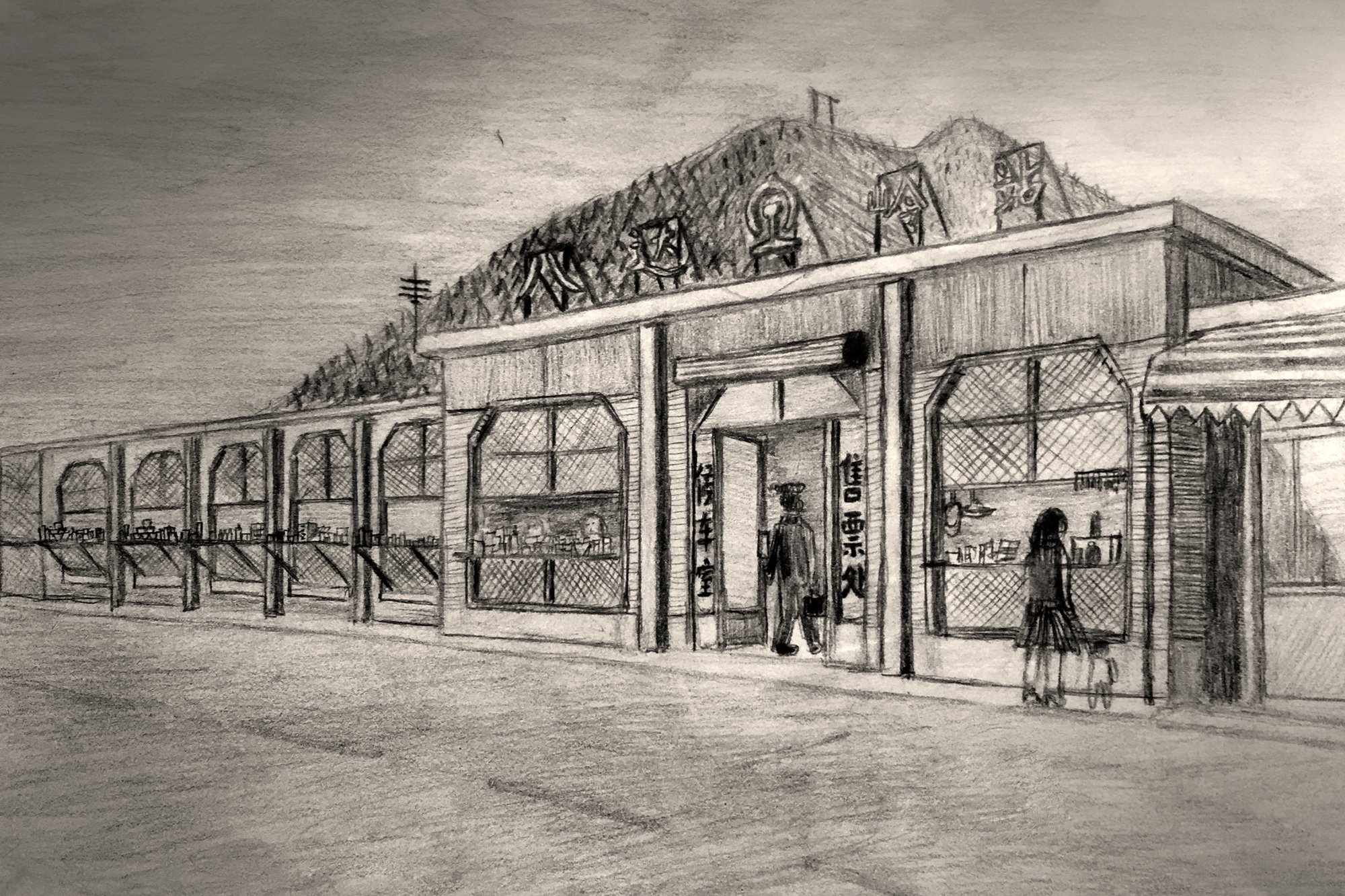
The waiting room of Badaling Station, built in 1979 and demolished during the construction of the new station building in 2005. Viewed from south to north, painted in September 2015.
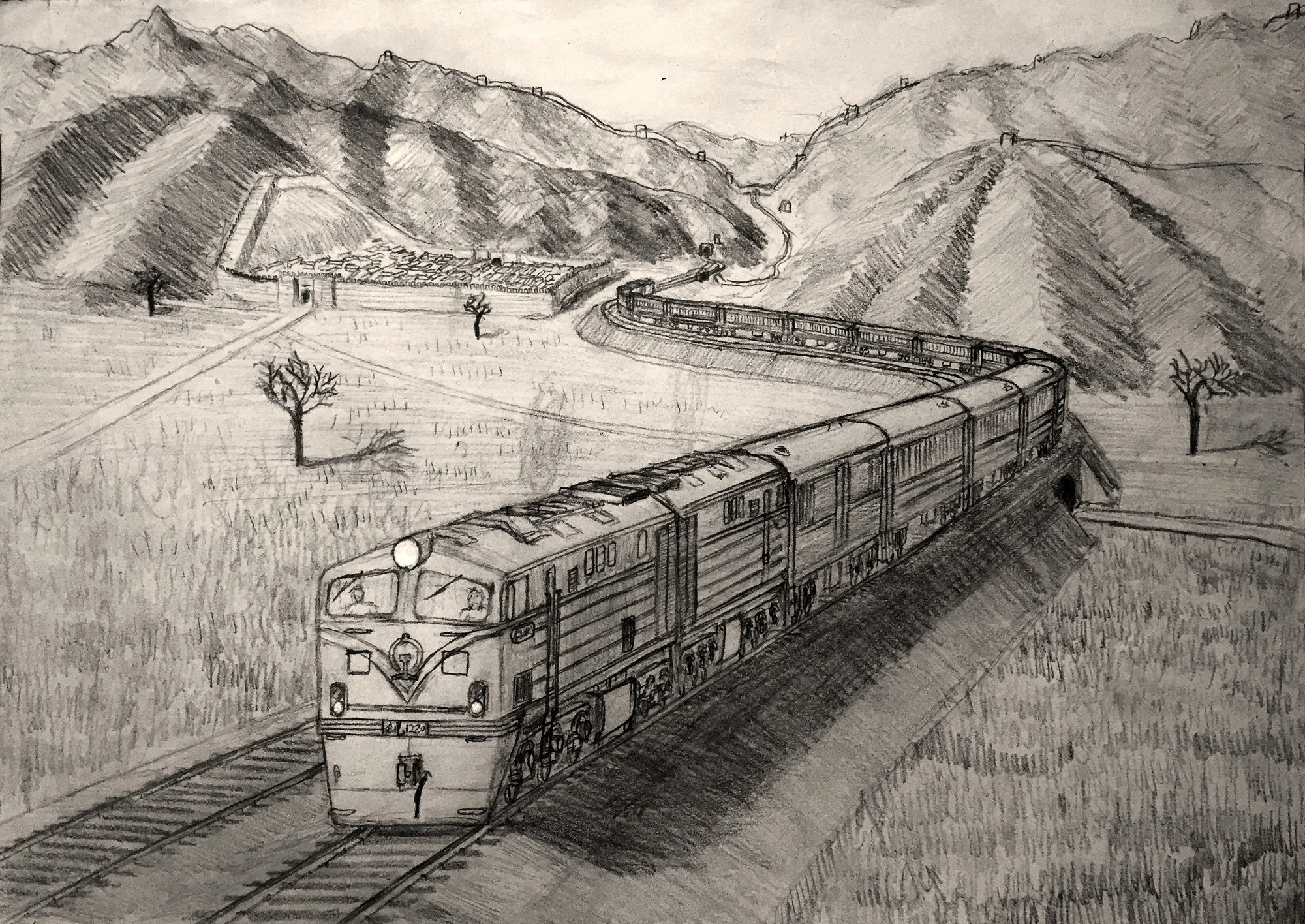
A Dongfeng 1 (DF1) internal combustion locomotive hauling a passenger train past Chatoucheng on the west side of Badaling. Painted in January 2015.
The old station building of Xibozi Station was located on the north side of the tracks, and its architectural style was identical to that of the "three GuanGou stations." After 1949, the front of the main station building was expanded from one bay to three bays, making the expanded facade similar to the station buildings of Sanjiadian and Mentougou stations on the Jingmen Branch. When creating this painting, the author gathered information suggesting that the Xibozi station building was built at this scale from the outset, and painted a plaque styled after the Mentougou Station. It wasn't until 2019, upon discovering new historical materials, that the author realized the error in the previous painting. Viewed from east to west, painted in May 2016.
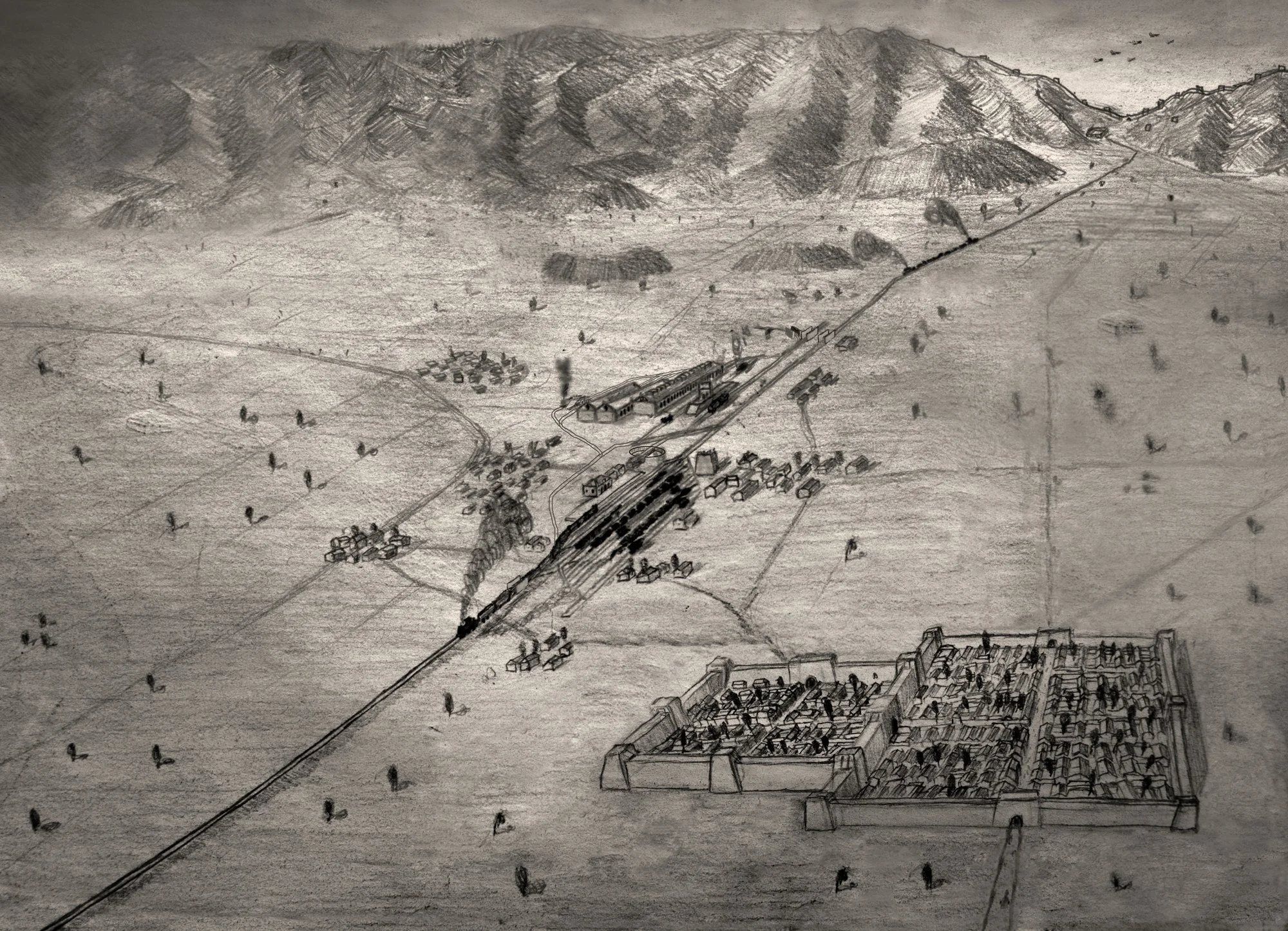
A distant view of Kangzhuang Station overlooking Yulinbao, one of the three major northern capital fortresses. The name "Kangzhuang" literally means pushing through the natural barrier of Juyongguan to step onto a broad, smooth highway of prosperity, hence the name. This place is also another home for the mountain locomotives of the Guanguan section. Viewed from west to east, painted in August 2014.
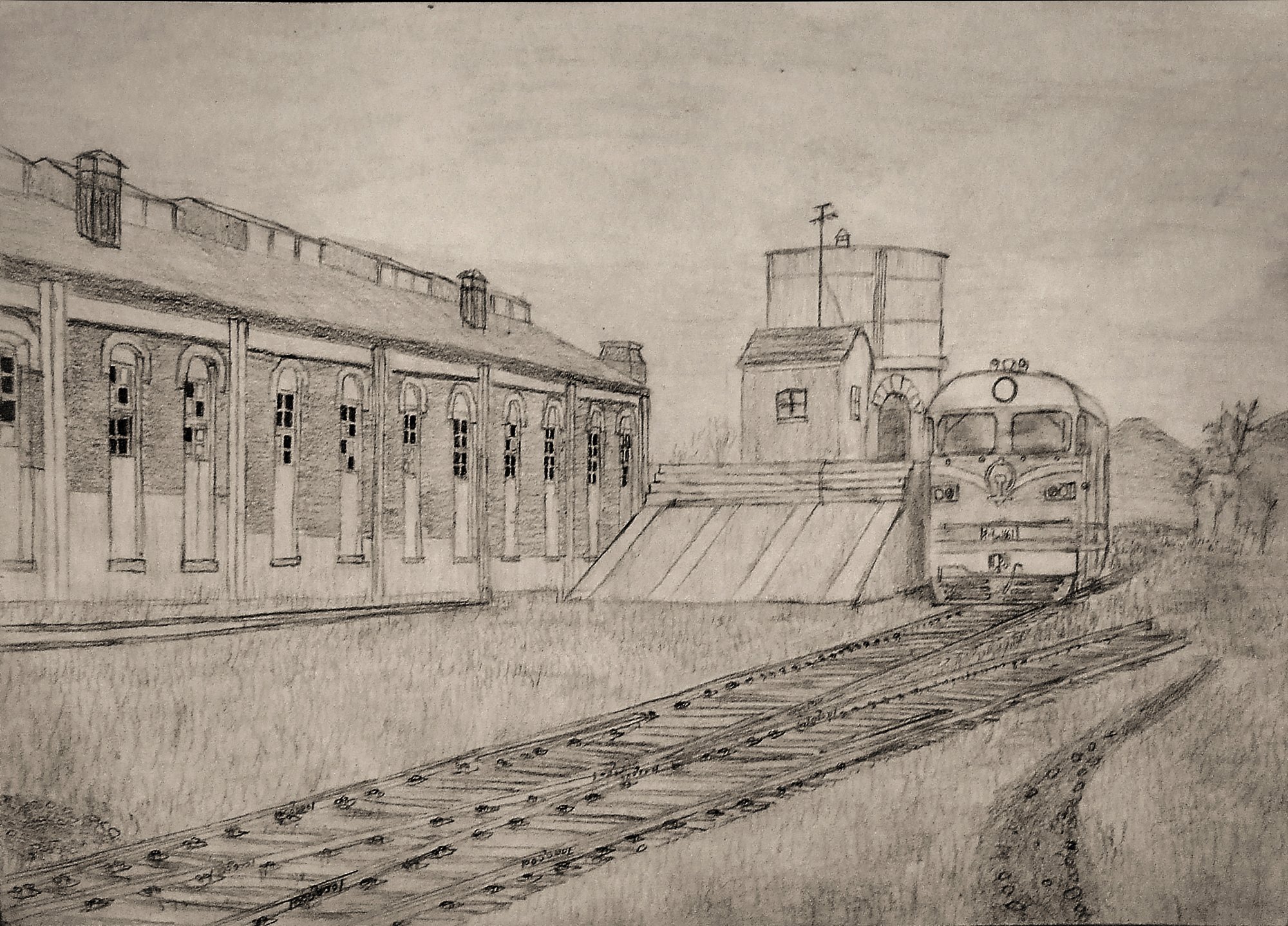
The Kangzhuang Engine Depot in 2006. Viewed from west to east, painted in December 2006.
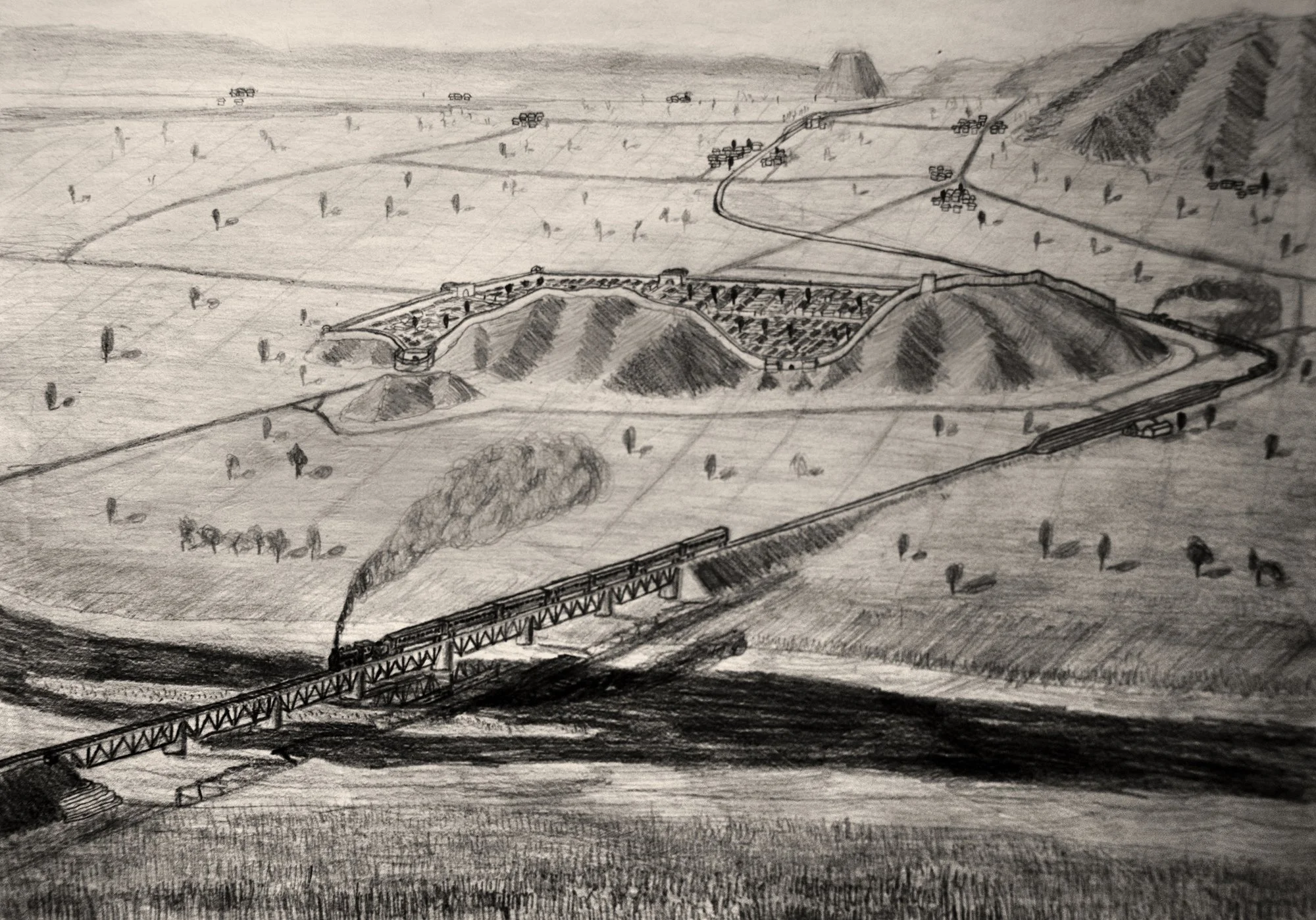
The Huailai River Bridge opened to traffic in 1909 and has endured floods, wars, and modifications. It remained in use until 1955 when, following the completion of the Guanting Reservoir and the commissioning of the newly built Guishui River Bridge, the old Huailai River Bridge was decommissioned. Over the following decades, the bridge rarely broke the water's surface. However, between 2005 and 2013, almost every dry season the bridge piers could be seen sitting about one meter underwater, with the bolts on them clearly visible—if a boat were not careful, its propeller would be sheared. With a bit of luck, the piers and abutments could be seen rising above the water surface; anglers were once known to fish while sitting on the abutment, sleeping right there on it through the night. The illustration shows a bird's-eye view looking west from the Huailai River Bridge, with Huailai Station located 1.3 kilometers west of the bridge. Viewed from east to west, painted in October 2014.
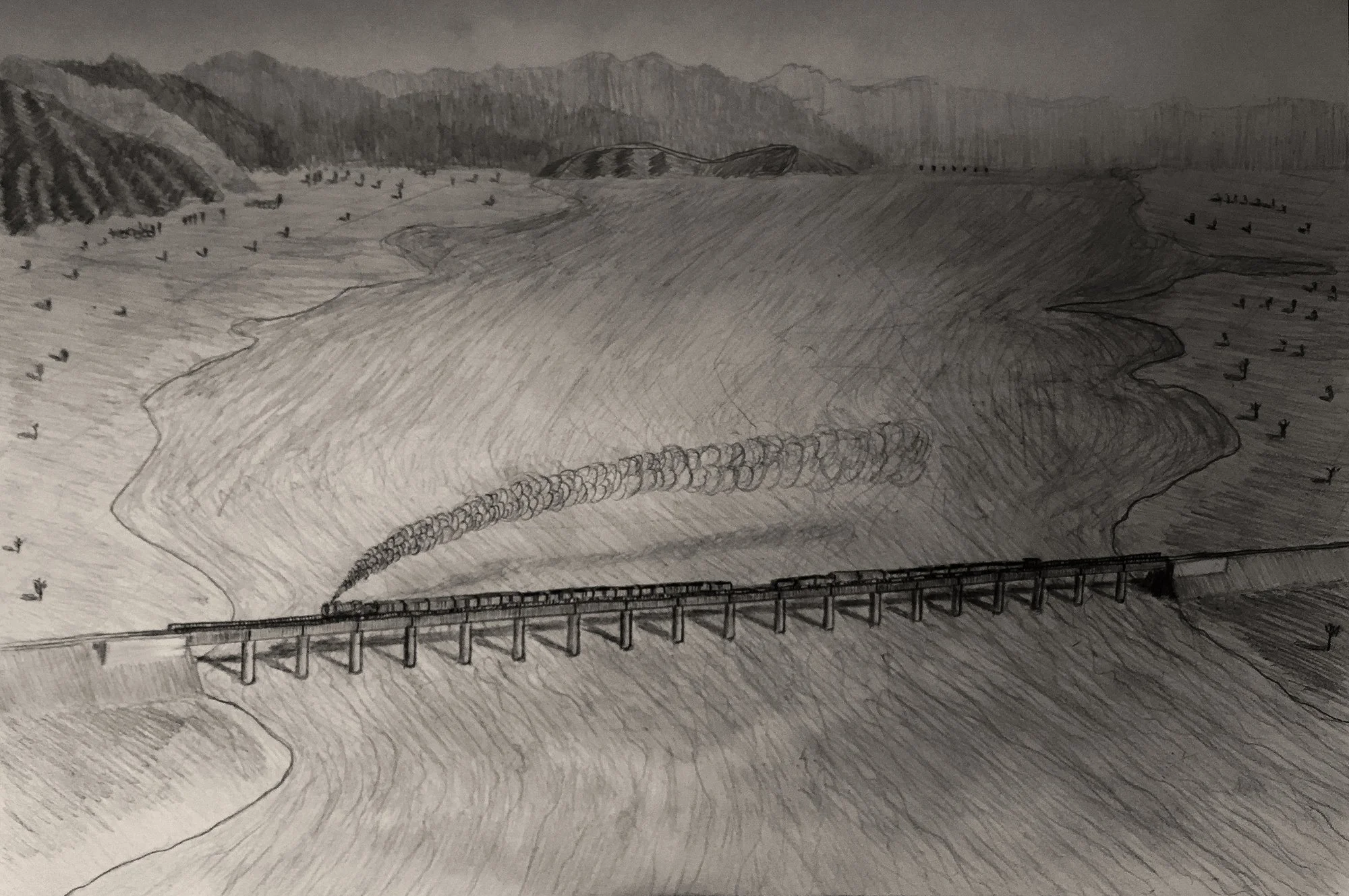
The Guishui River Bridge, opened to traffic in 1955. This bridge was built with assistance from Soviet experts. One year after opening, the bridge piers suffered frost cracking and the rails warped. Following repairs, ice-breaking was required every winter to ensure safety, and the bridge was decommissioned in the 1990s. Viewed from southwest to northeast, painted in February 2015.
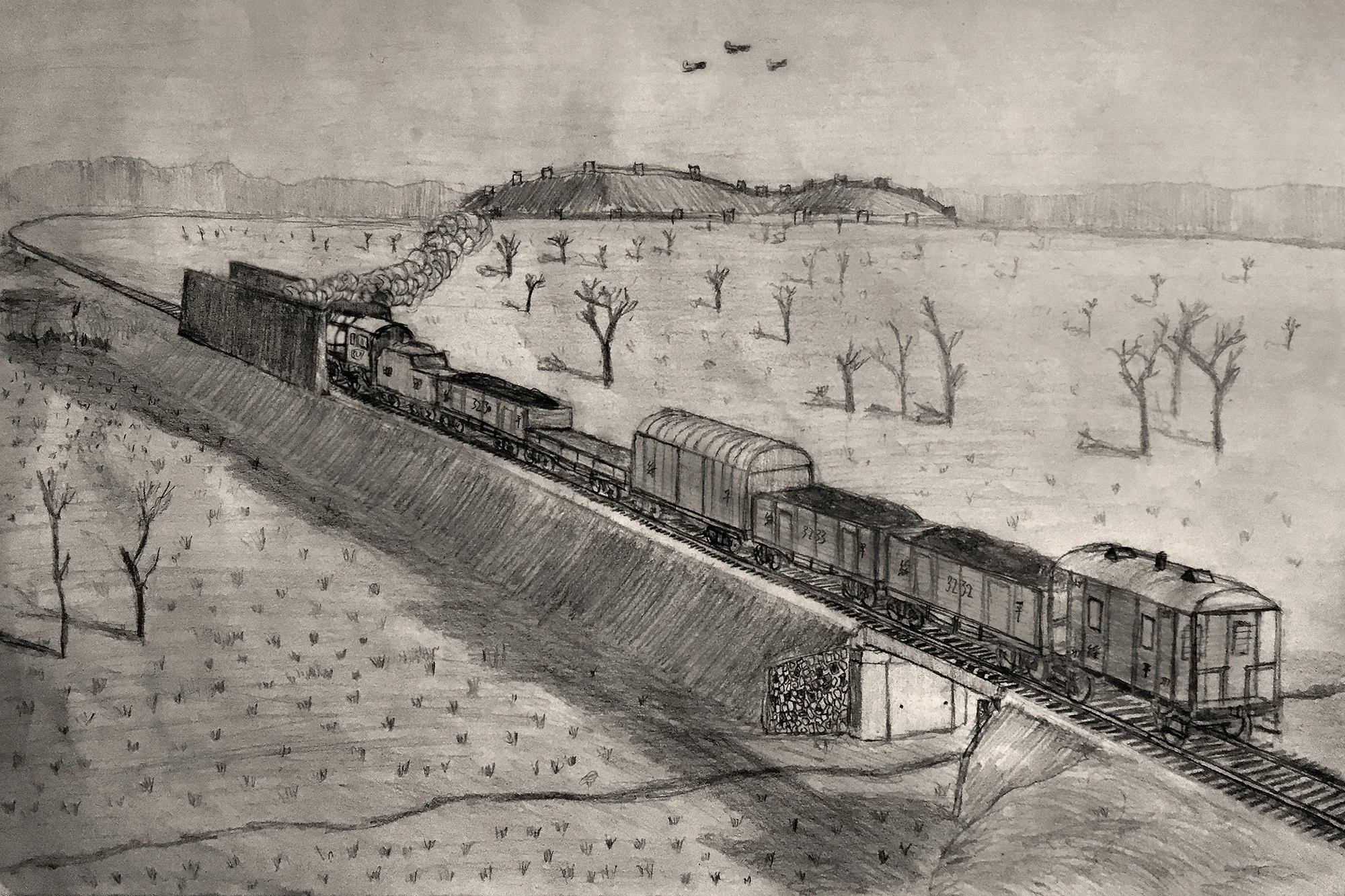
According to local elders: during the Japanese puppet regime period, an air-raid shelter tunnel was once built on an old section of the subgrade near Bridge No. 67 on the Huailai-Langshan section. If bombers from the Chinese-American Composite Wing attacked a train, the locomotive could pull into the shelter. Viewed from east to west, painted in October 2015.
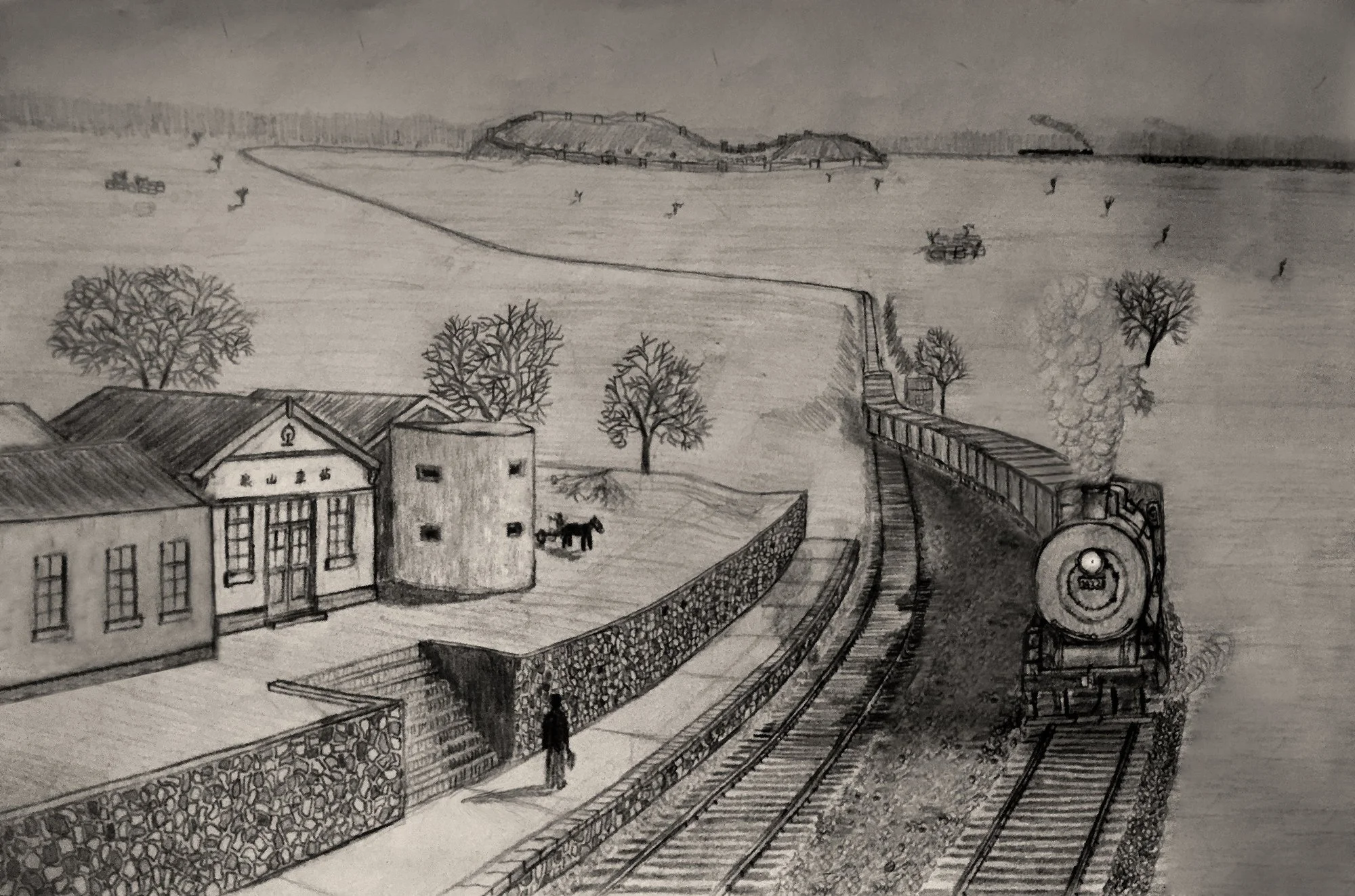
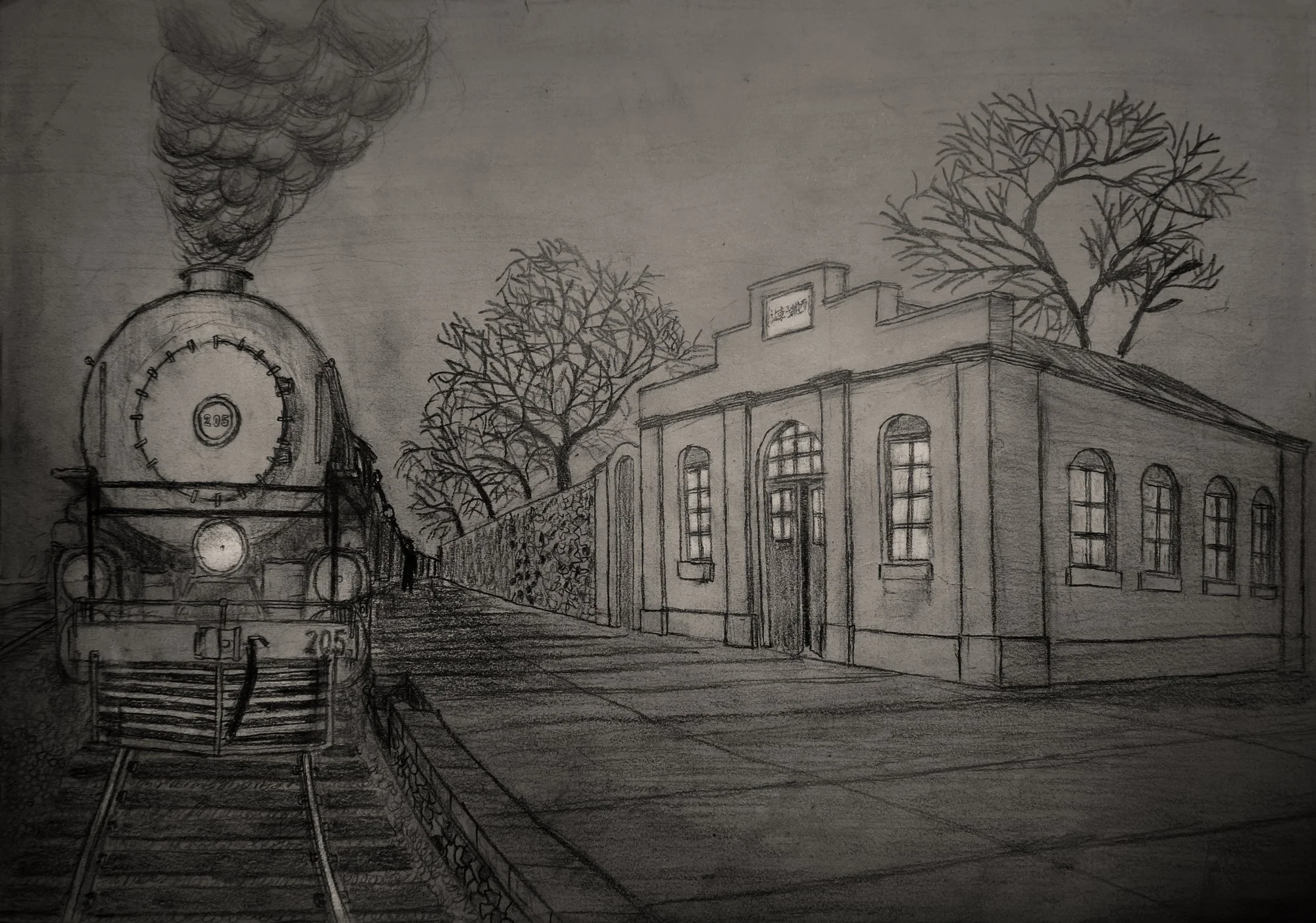
According to local resident Uncle Lu, who is the same age as Langshan Station, the Langshan station building from the late 1940s was the old building that survived until 2014. Built on a slope on the inner side of a curve, its exterior walls were pale yellow with red stripes. Inside the station building were long wooden benches and a small shop, with a ticket counter located on the west side. To the east of the station building stood a blockhouse from the Japanese puppet regime period; during the Cultural Revolution, Red Guards arriving by train demolished both the blockhouse and Langshan's old opera stage. To the west was the work section, where rails and ties were stacked year-round; to the north were railway dormitories, family quarters, and the loading crew. Viewed from east to west, painted in February 2015.
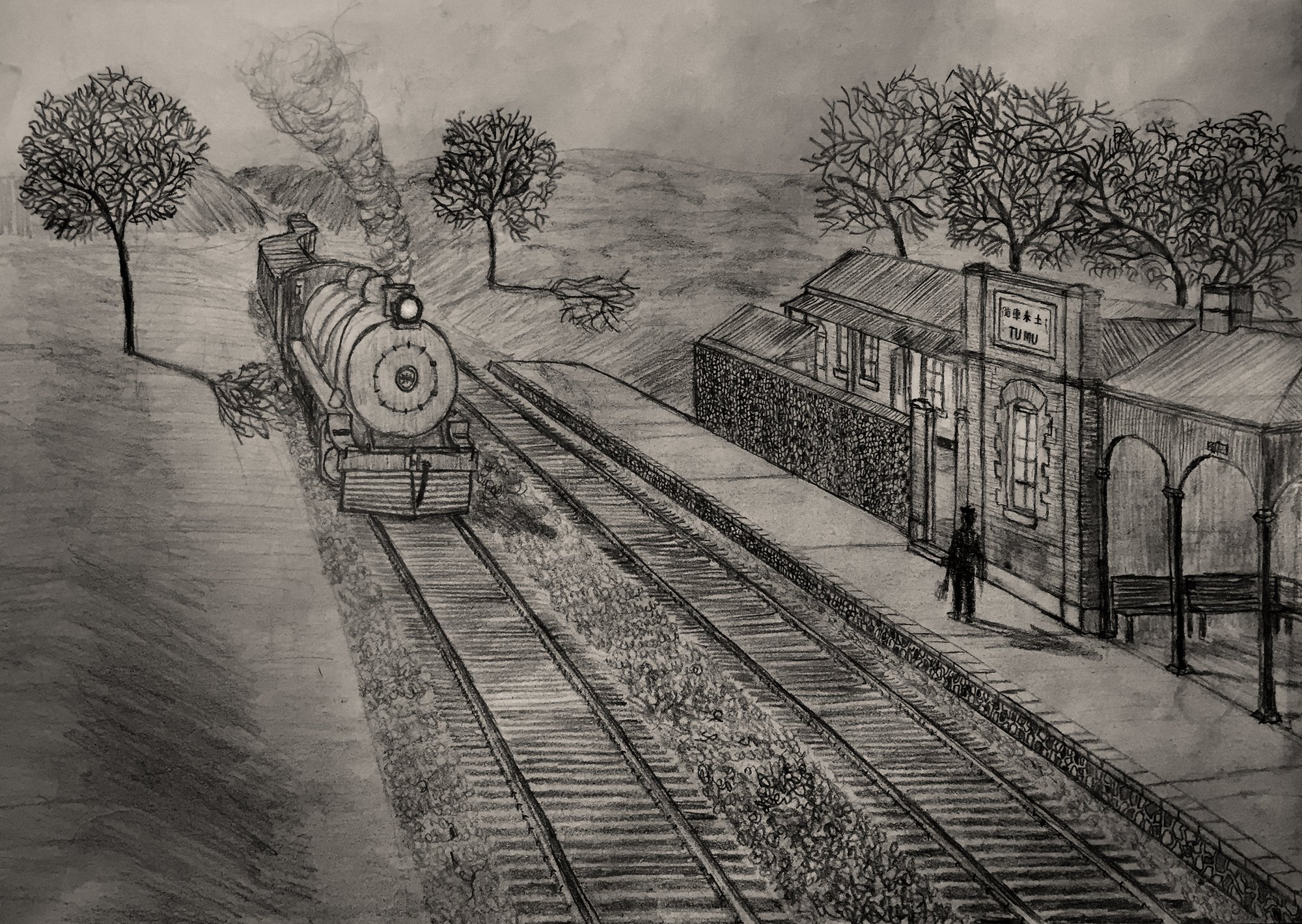
Tumu Station was built in the autumn of 1919. According to Uncle Cheng, an eyewitness born in 1936, the style of the old Tumu station building was identical to that of Changping Station. The front facade was embedded with a station plaque inscribed with "土木車站" (Tumu Station), the Wade-Giles romanization "TUMU," the date of inscription, and the signature. Due to prolonged periods of war and chaos, the old Tumu station building fell into a state of severe disrepair. After 1949, the main structure of the old station building was demolished, and a new station building was reconstructed on the original foundation. Viewed from east to west, painted in February 2015.
After the completion of the Fengtai-Shacheng Railway, most freight trains were diverted to the Fengtai-Shacheng line, while the majority of passenger trains continued to run via the GuanGou section. Due to the limited length of the station tracks at Qinglongqiao restricting passenger train marshalling and the severe speed limitations imposed by the long, steep gradients of the GuanGou section, most passenger trains gradually shifted to the Fengtai-Shacheng line after the 1990s, leaving only a few passenger trains on the GuanGou section. From then on, the Fengtai-Shacheng line took a dominant role. This illustration shows a Dongfeng-series internal combustion locomotive hauling an up passenger train out of Shacheng Station, viewed from east to west, with a down Fengtai-Shacheng line freight train about to enter Shacheng Station on the left. Painted in August 2014.
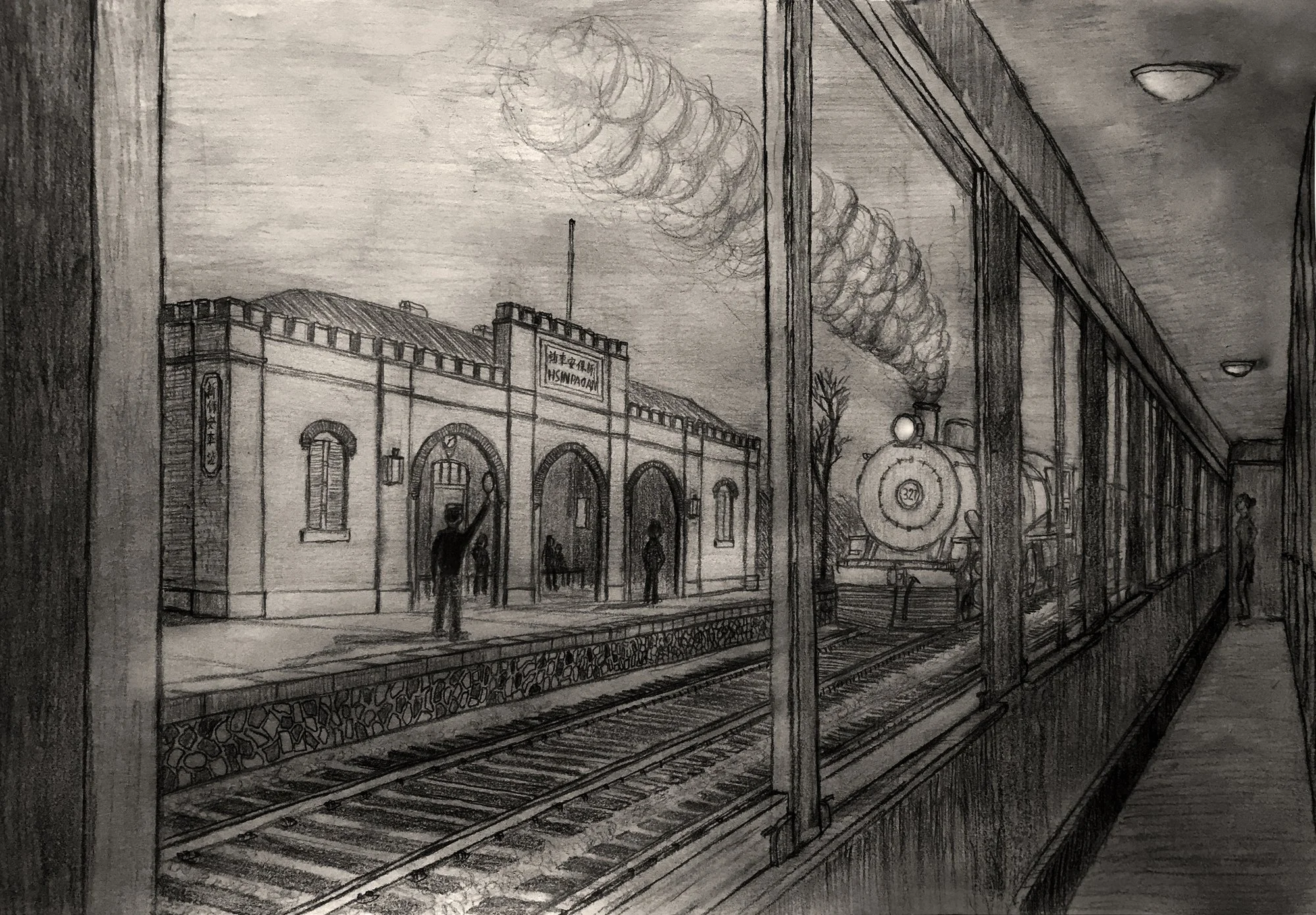
A passenger train hauled by a Mikado locomotive pulling into Xinbao'an Station, viewed from west to east. Painted in February 2015.
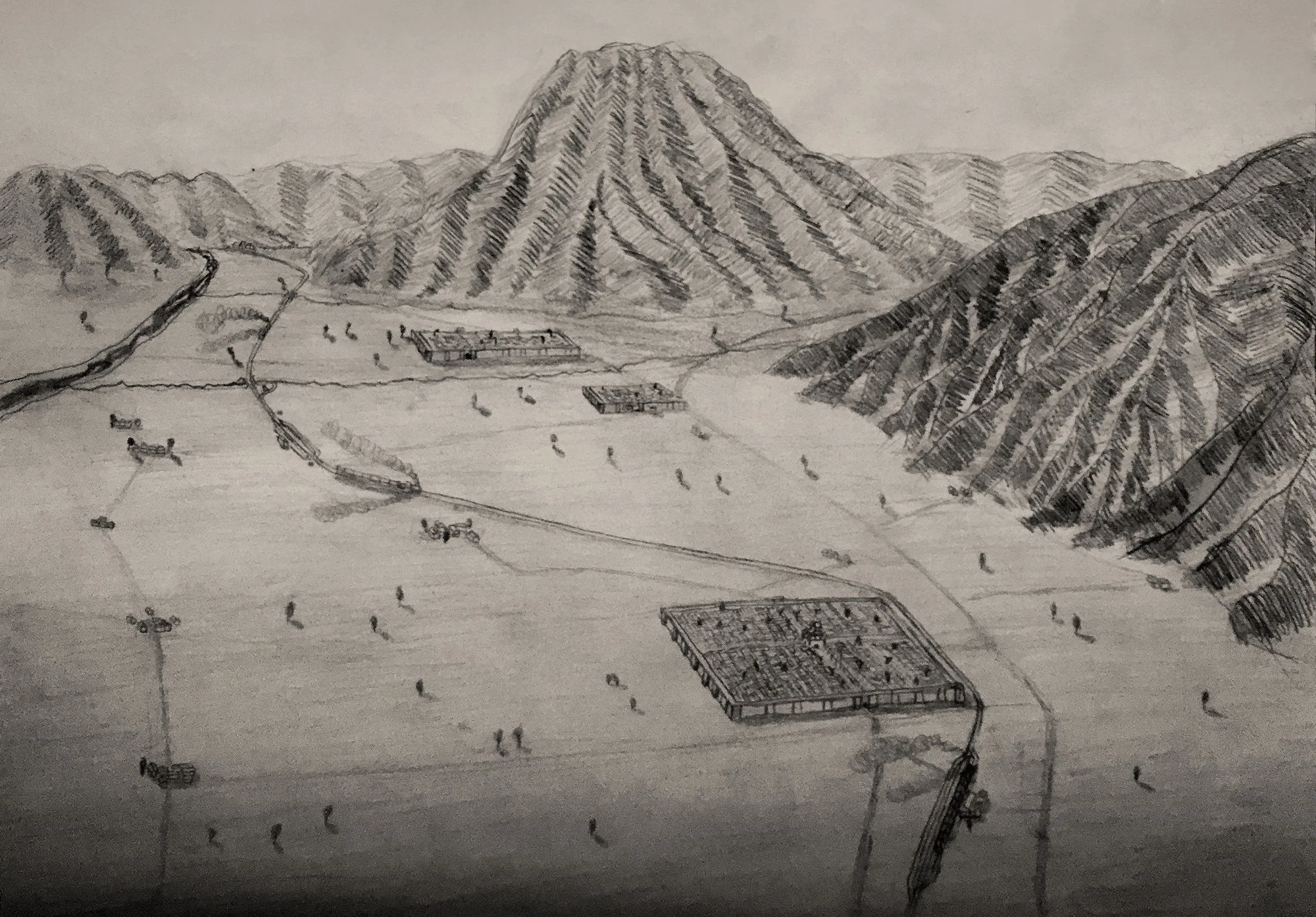
An impression of the Xinbao'an-Xibali section, featuring Xinbao'an Station and Xinbao'an Town in the foreground, with Xibali Fortress, Jimingyi Town, and Mount Jiming in the distance. Viewed from east to west, painted in February 2015.
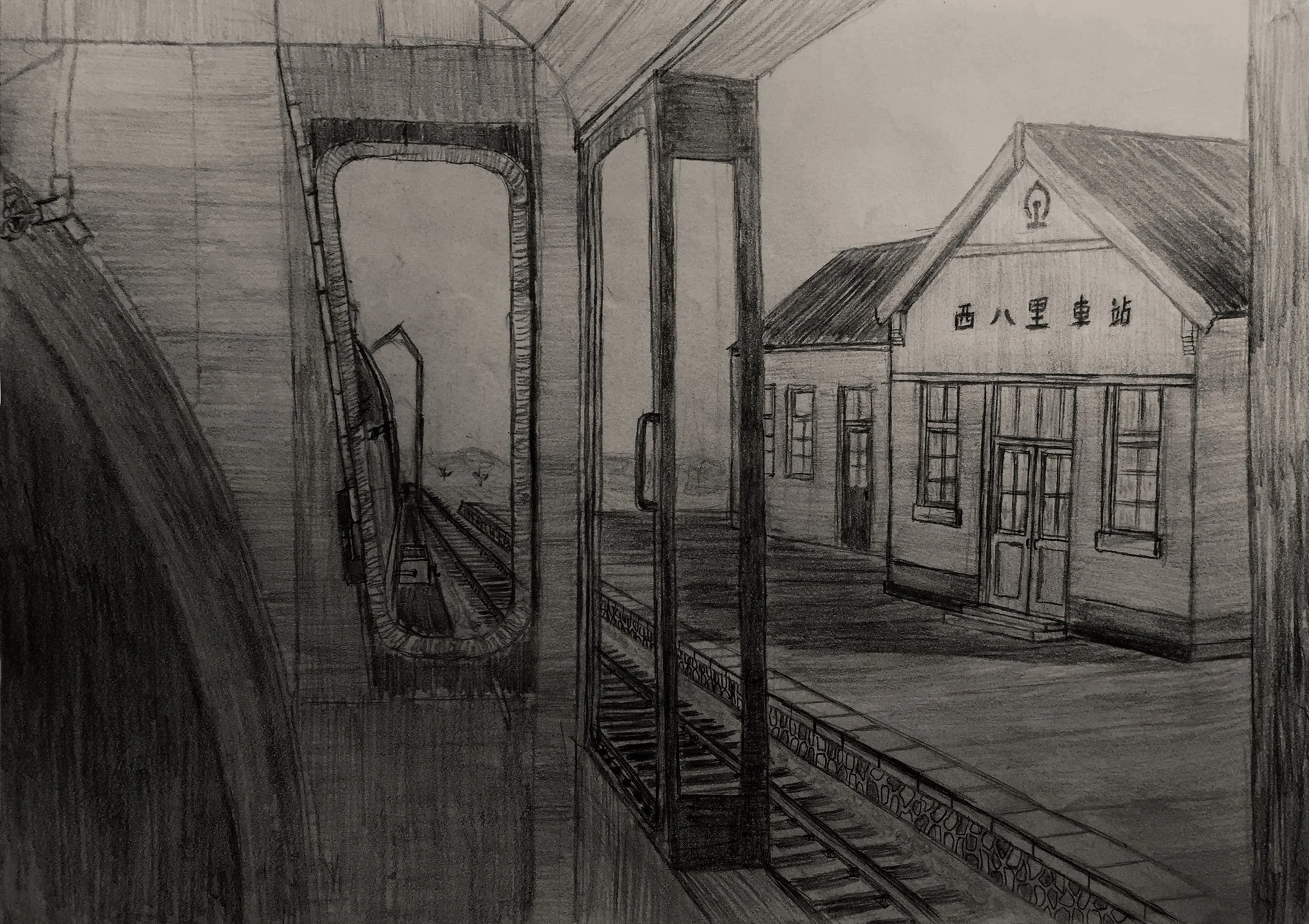
According to memories of local elders and train drivers, the Xibali station building was located on the south side of the main line. It was a peaked-roof structure built during the Japanese puppet regime period, covered with corrugated iron roofing, and was similar in style to the station building at Langshan Station. Two Japanese personnel were stationed there, one of whom had a leg severed by the Eighth Route Army. Viewed from west to east, painted in November 2015.
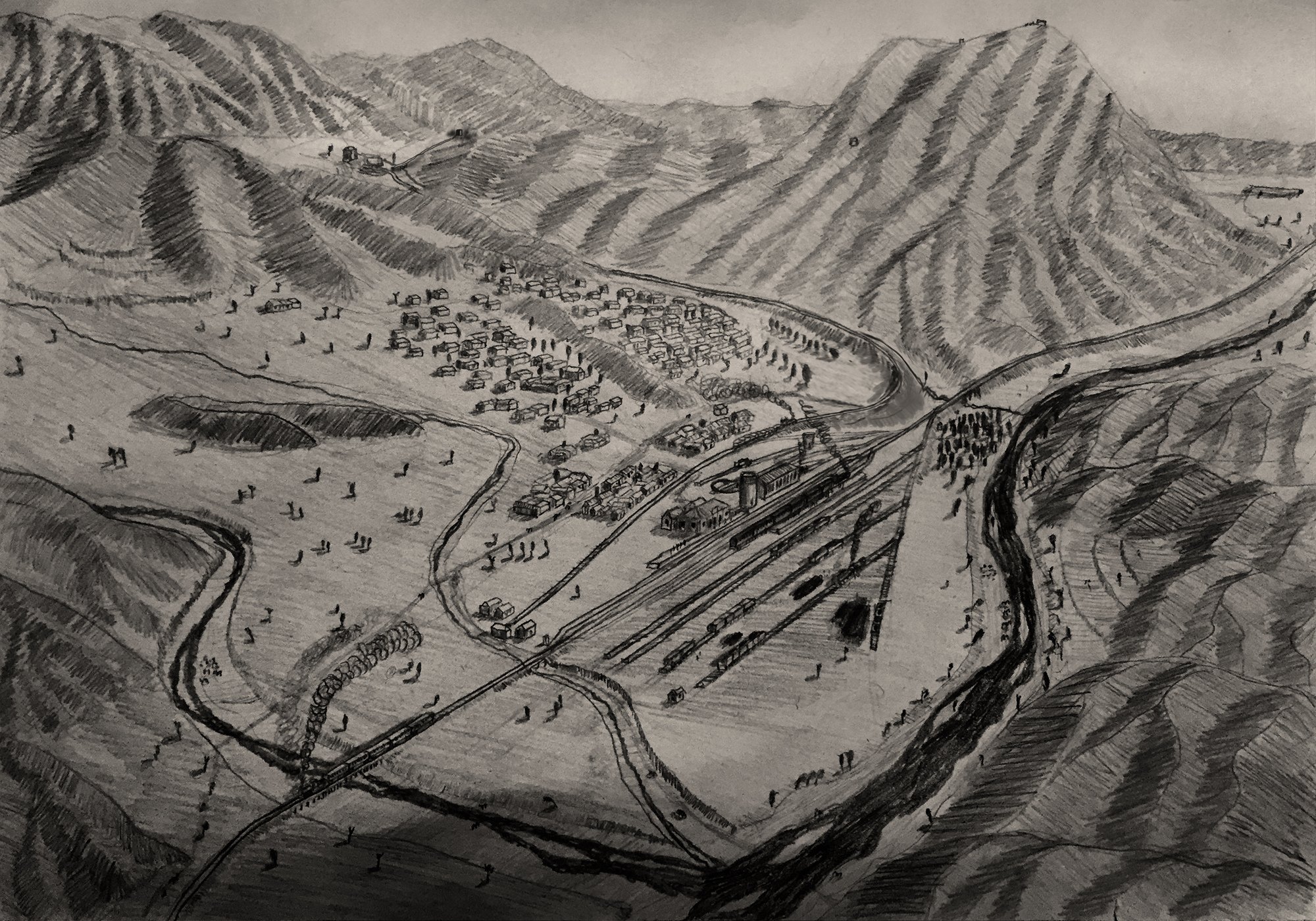
A bird's-eye view of Xiahuayuan, looking from northwest to southeast. The station can be seen situated right at the foot of Mount Jiming (the most prominent mountain). However, the railway line on the west side of Mount Jiming (top right of the image) is the Beijing-Zhangjiakou Railway, while the line on the north side (leading toward the top left of the image) is the Xiahuayuan Coal Mine branch line. Painted in February 2015.
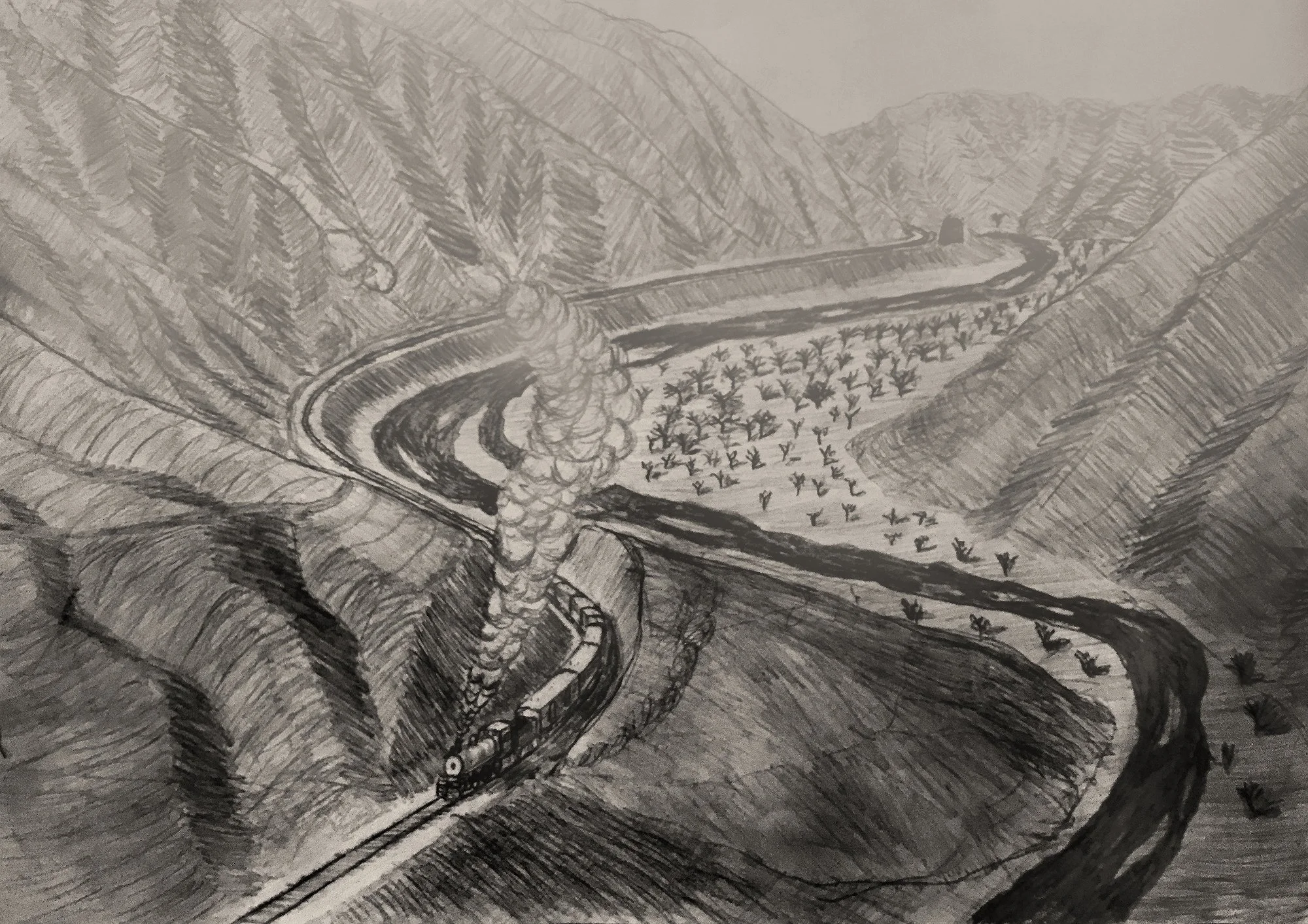
Laolongbei, a ridge located one kilometer west of Sheyaowan, is a mountain ridge. If a railway were to be built here today, the problem could likely be solved with a single tunnel. However, in an era lacking technology and capital, and constrained by strict completion deadlines, Mr. Zhan Tianyou had no choice but to excavate a deep cutting through the ridge of Laolongbei, establish a curve with a radius of 406 meters at the western end of Sheyaowan, and carve a curve with a 304-meter radius through the Laolongbei cutting to negotiate the terrain. The second track added in 1957 also passed through this cutting; however, due to the tight curve radii, this section was subject to a long-term speed limit of 60 km/h, and the outer rails suffered severe wear, requiring over 2,000 meters of track replacement every two years. Consequently, in 1970, construction began on a tunnel here to permanently resolve the issues caused by the small-radius curves. Because Laolongbei is situated near the 150-kilometer mark, the newly built tunnel was named "Tunnel 150." Completed on October 1, 1973, it is a double-track tunnel with a total length of 191 meters and a crown height of 7.93 meters. The illustration shows the overall view of the Laolongbei realignment, where the tracks in the old cutting have been abandoned. Viewed from west to east, painted in February 2015.
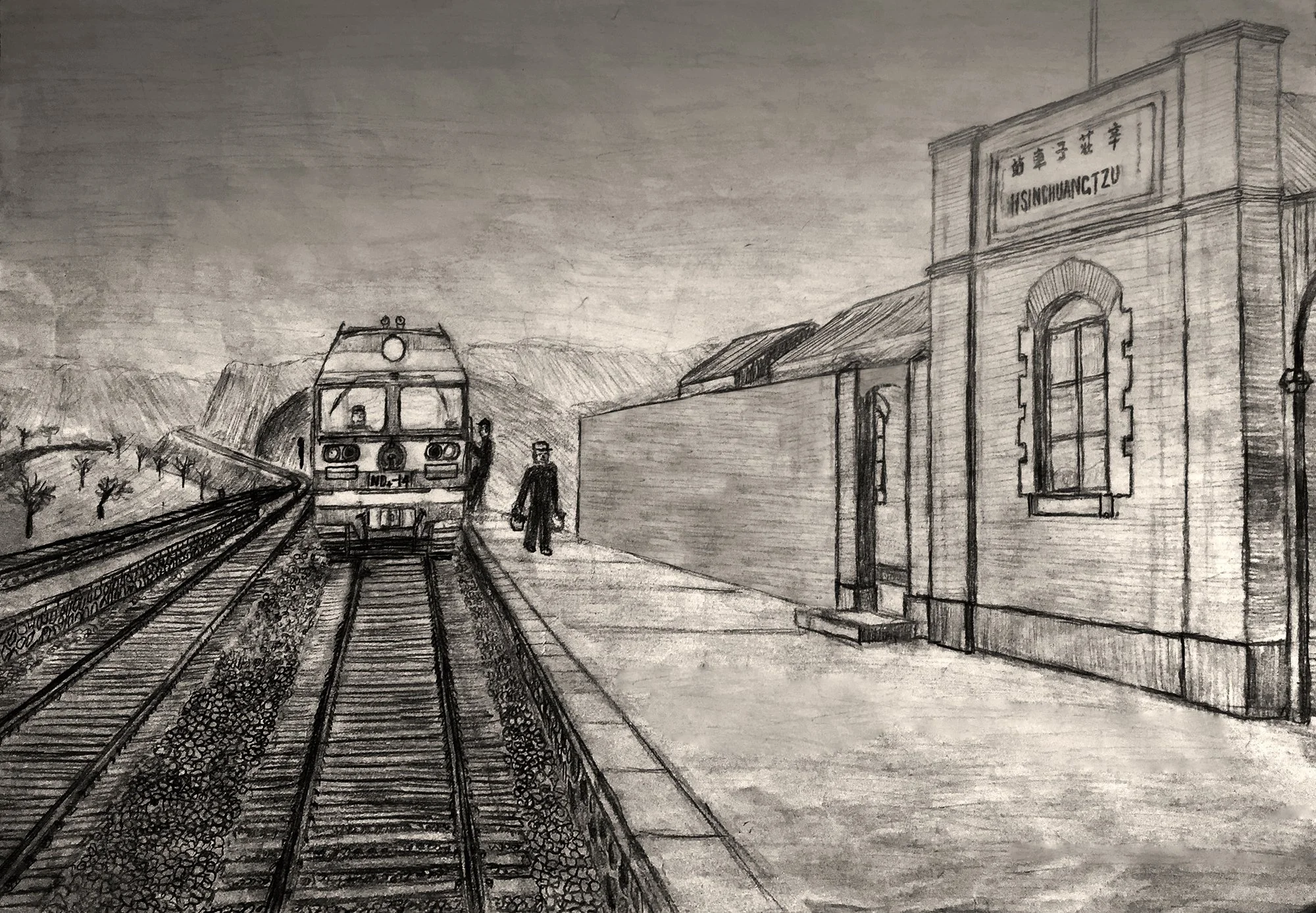
According to eyewitness Master Wang Shixuan, the old Xinzhuangzi station building shared the same design as the old station buildings at Tumu and Changping stations. Its overall layout was in the shape of a reverse "L," with a station plaque embedded above the front facade inscribed with the station name and Wade-Giles romanization, the signature on the left, and the date on the right. To the east of the main station building was a green-painted wooden corridor, similar to Changping Station. Back then, he once hauled ND4 locomotive No. 14 as a single engine to stop at Xinzhuangzi Station, carrying a bucket into the station building to fetch water. Unfortunately, the old station building was demolished around 1986. Today, only the station building foundation, courtyard gate, courtyard walls, and a portion of the structure behind the station building remain. Viewed from southeast to northwest, painted in May 2015.
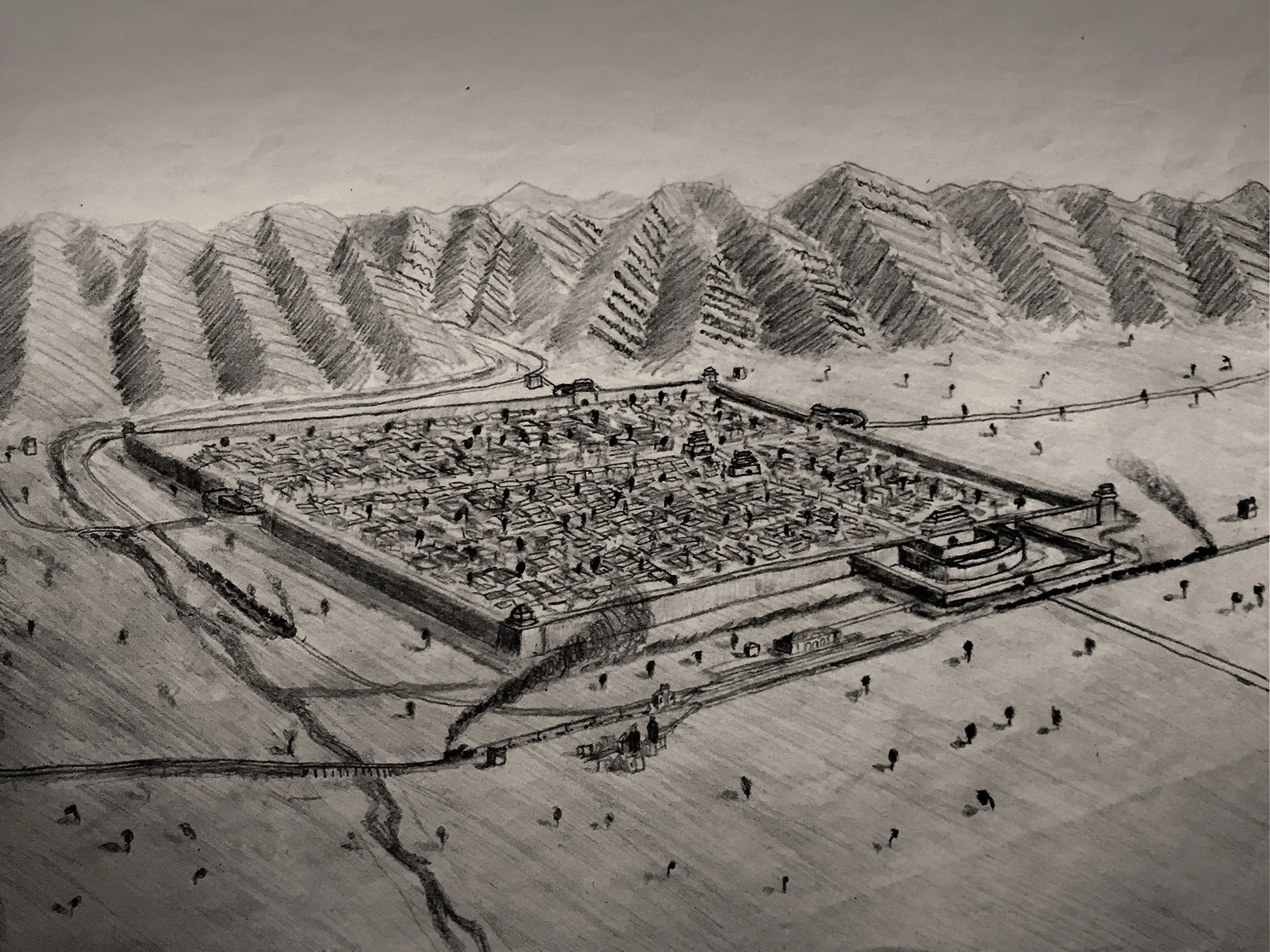
Xuanhuafu Station was located at the 300-li mark of the Beijing-Zhangjiakou Railway, currently at kilometer 168 plus 113 meters. During the survey, Mr. Zhan Tianyou positioned Xuanhuafu Station on a straight line almost parallel to the southern city wall of Xuanhua. On May 29, 1909, the track-laying of the Beijing-Zhangjiakou Railway reached this point, and it opened to traffic on September 24 of the same year. Chen He, a second-rank senior official holding the position of Daotai of the Koubei Military Circuit of Zhili Province, attended the opening ceremony. At that time, Xuanhuafu Station, along with Xizhimen Station and Zhangjiakou Station, was classified as a first-class station, and its station building was identical to that of Xizhimen Station at the time. In 1913, Xuanhua prefecture was abolished and replaced by a county, leading to the station's renaming as Xuanhua Station. The illustration shows a bird's-eye view of Xuanhua City from south to north, with Xuanhua Station situated outside the south city wall. The railway line that turns west and then north from the station along the west and north city walls is the Yantongshan branch line, built in 1918. This line led to Shuimo Station at the Yantongshan Iron Mine, transporting iron ore to the Xuanhua Iron Works and Shijingshan Iron Works. Painted in December 2015.
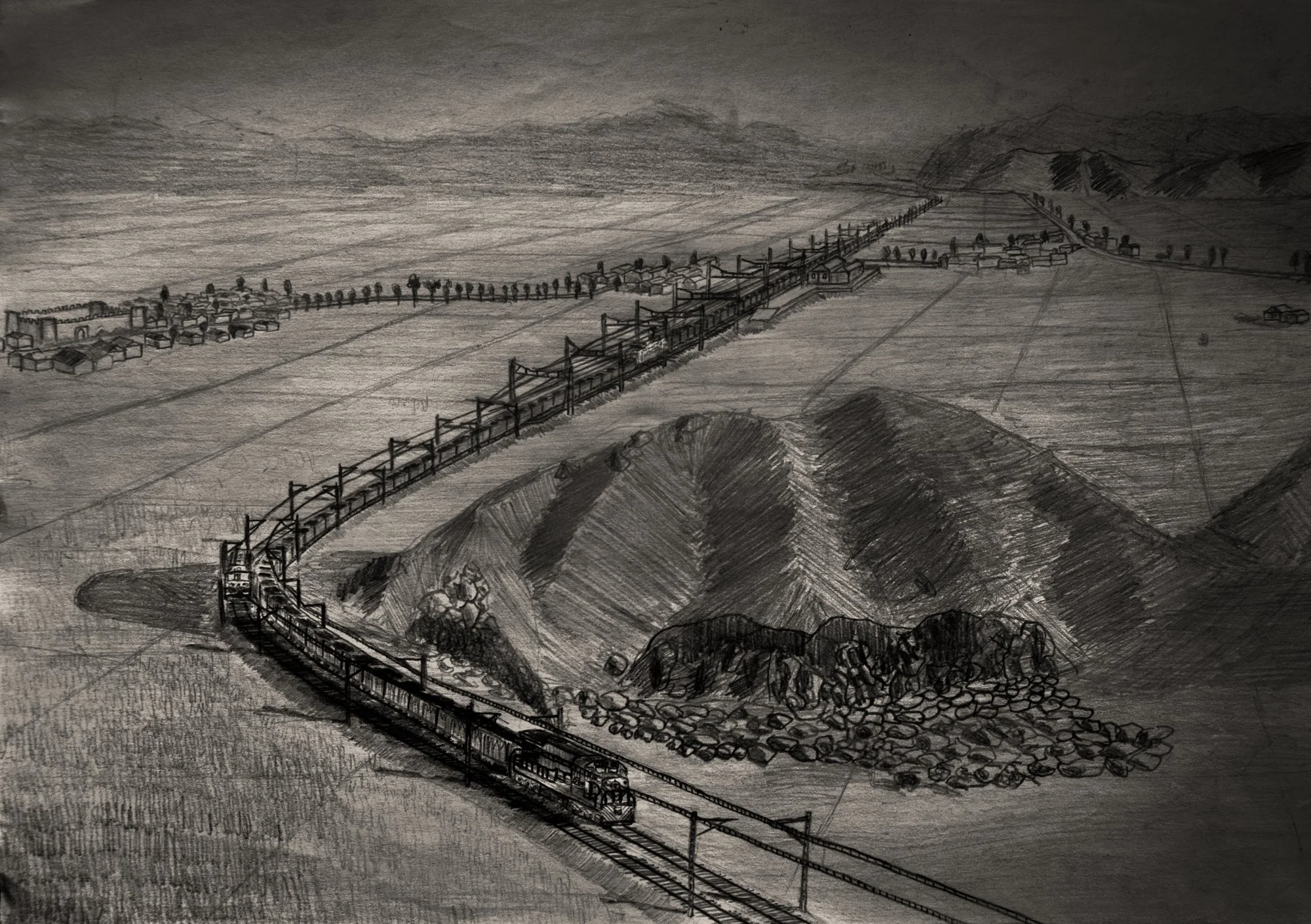
An up combined train passing through Shalingzi Station and bypassing Shalingzi Gushan. In the late 1980s, combined trains hauled by ND5 internal combustion locomotives appeared here. (The prototype locomotive of the ND5 internal combustion locomotive: the GE C36-7)Viewed from southeast to northwest in a distant panorama, painted in October 2014.
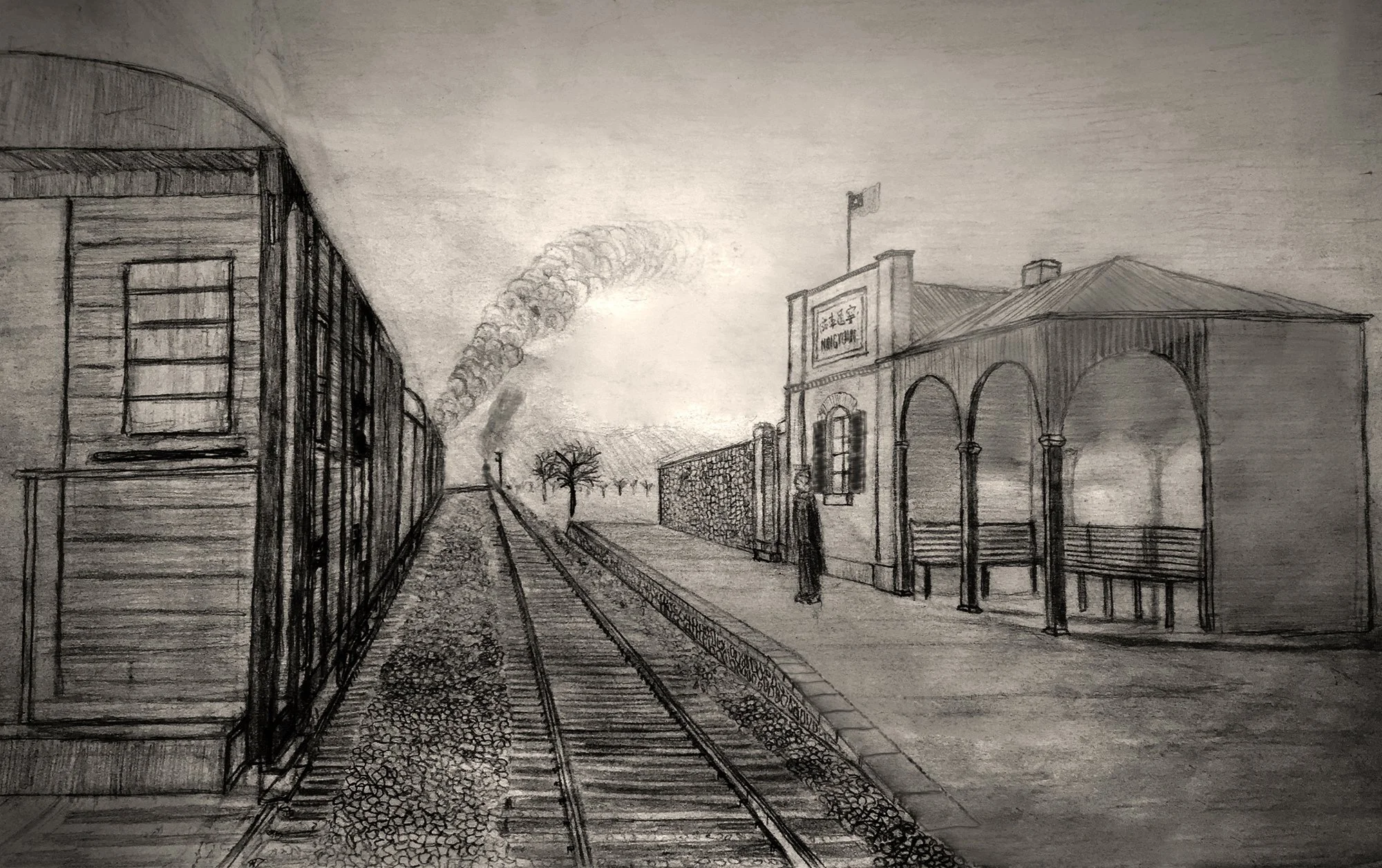
Restoration drawing of Ningyuan Station. The station building was identical to those at Changping and Xinzhuangzi stations and was built in 1919. The station tracks featured a 7.2‰ gradient, lower in the south and higher in the north. The station building was suspected to have been demolished around 2008, with platform remains still surviving nearby. In 2023, the remaining ruins were also demolished. Viewed from south to north, painted in October 2015.
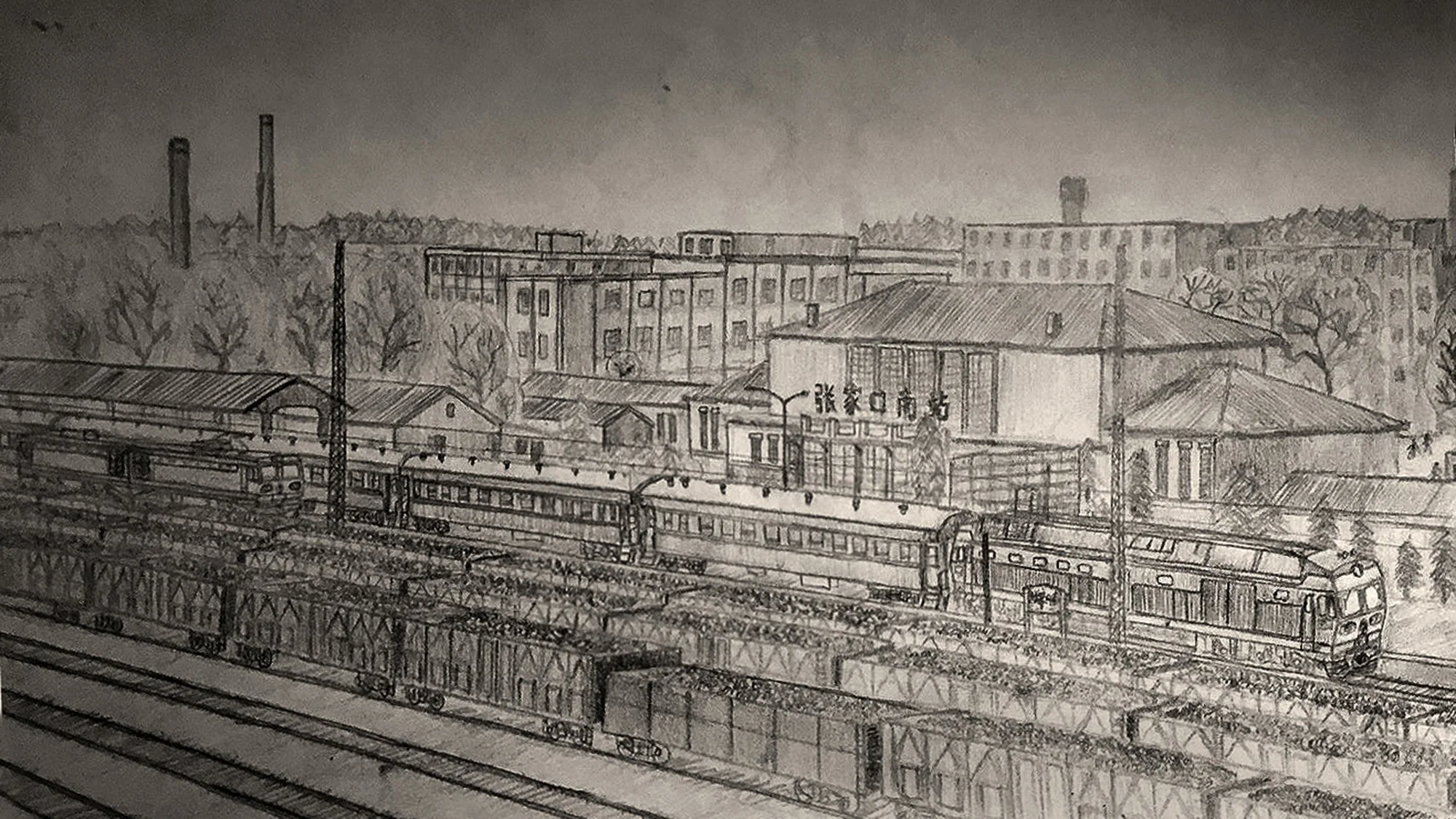
The station building of Zhangjiakou South Station, built in 1956. Viewed from south to north, painted in March 2016.
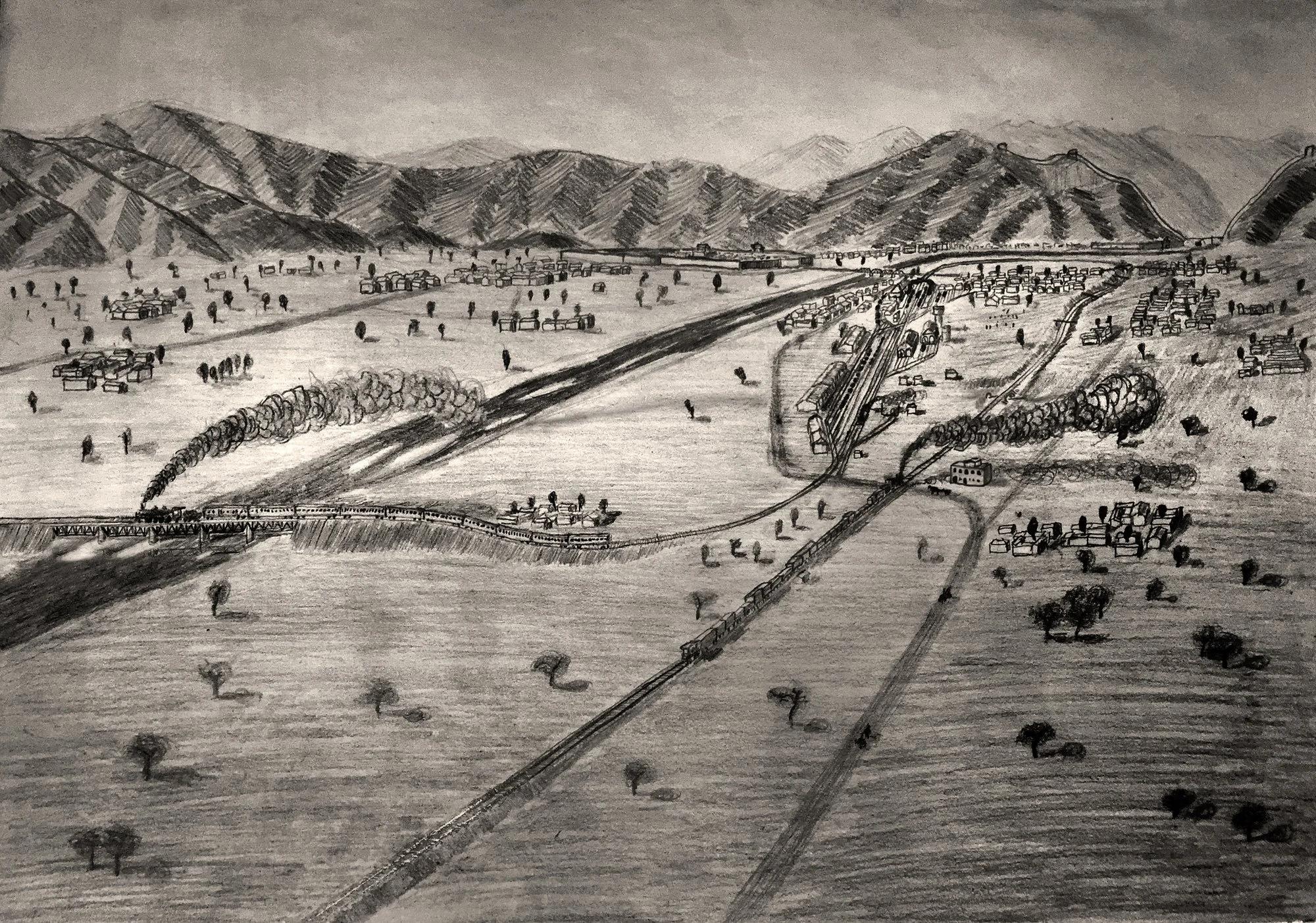
When the Beijing-Zhangjiakou Railway was completed and opened to traffic, the mainline from the Beijing direction connected into the south throat of Zhangjiakou Station at Nankou in Zhangjiakou. In 1910, as the Beijing-Zhangjiakou Railway was prepared for westward extension, a 2.3-kilometer mainline was built east of Zhangjiakou Station—including the Zhangjiakou Big Curve with a radius of 243.3 meters—so that trains could enter the north throat of Zhangjiakou Station without needing to reverse. At that time, Nankou in Zhangjiakou was not configured as it is today; down trains could not enter Zhangjiakou Station without passing through the Zhangjiakou Big Curve, meaning they had to make a large detour via Taipingqiao and enter the station from its north throat. Trains heading from Zhangjiakou toward Datong passed through the south throat of Zhangjiakou Station, heading west across the Qingshui River Bridge. In 1956, due to a line realignment, the mainline from Nankou via Taipingqiao to the north throat of Zhangjiakou Station was abandoned, and the mainline from the Beijing direction once again connected into the south throat of Zhangjiakou Station, allowing down trains to enter Zhangjiakou Station without passing through the big curve. However, Zhangjiakou ultimately became a stub-end station, with the former Suiyuan direction converted into a dedicated branch line. Viewed from south to north, painted in May 2015.
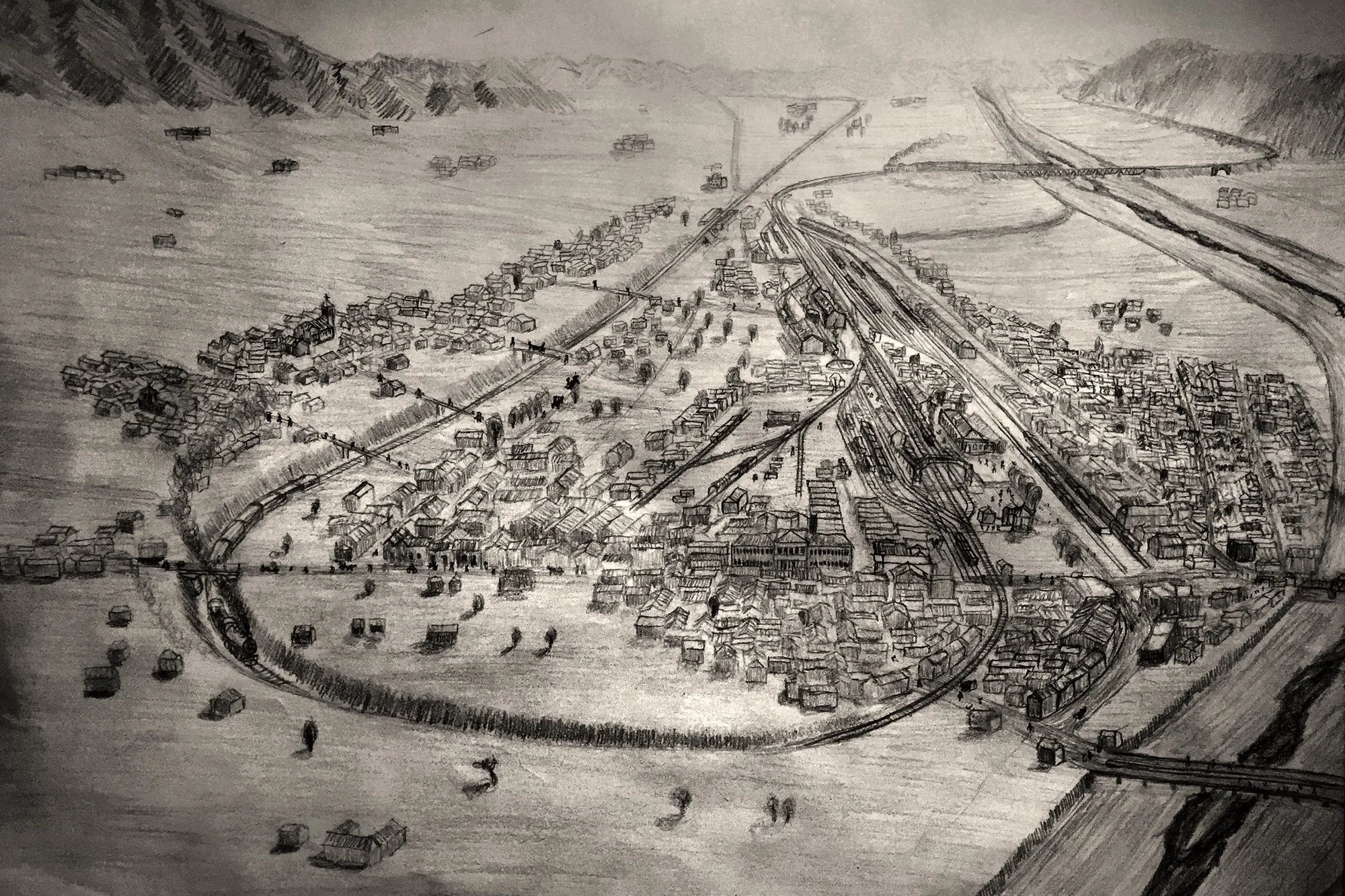
A panoramic hand-drawn illustration by the author of the Zhangjiakou Big Curve, viewed from north to south. It shows that the terrain around Taipingqiao (east of Zhangjiakou Station) slopes from high in the east to low in the west. To control the railway's gradient during the original design, this section of the line was placed inside a cutting. Consequently, the grade from Bridge No. 133 to Taipingqiao was a 5.0‰ ascending slope, requiring down trains to increase power here, while the grade from Taipingqiao to the north throat of Zhangjiakou Station was a 6.25‰ descending slope, allowing trains to coast directly into Zhangjiakou Station using inertia. According to local residents, the entire stretch from Bridge No. 133 through Taipingqiao to the northeast side of the north throat of Zhangjiakou Station was a cutting. However, because Taipingqiao was the highest point of the line and sloped downward in both directions, the cutting near Taipingqiao was the deepest—approximately five to six meters deep—gradually shallowing out toward Bridge No. 133 or the north throat of Zhangjiakou Station. Interestingly, railway dormitories with dense housing were distributed along both sides of this line, meaning a total of five bridges spanned the cutting between Bridge No. 133 and Taipingqiao. In 1956, the mainline from Nankou in Zhangjiakou to the north throat of Zhangjiakou Station was taken out of service and subsequently dismantled. In the early 1960s, Taipingqiao Bridge was demolished, and the railway cutting near Taipingqiao was vaulted over, covered with earth, and converted into a roadway. In the late 1960s, the abandoned railway near Bridge No. 133 was also dismantled, and the cutting was filled in to build what is now North Shengli Road. Painted in March 2016.
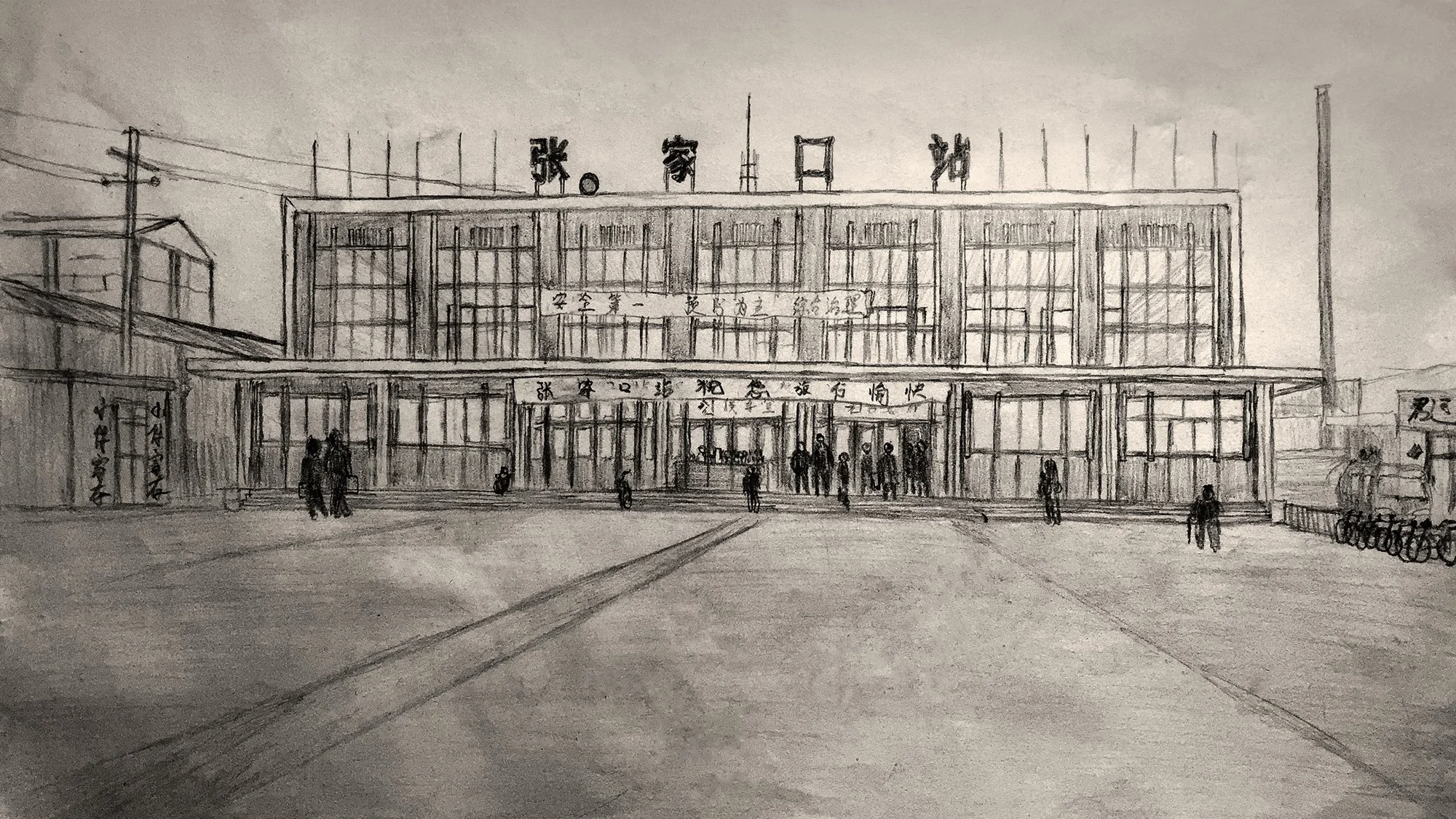
Zhangjiakou Station is the terminus of the Beijing-Zhangjiakou Railway. Today, the old station building constructed in 1909 remains well-preserved. In June 1983, the railway department built a new waiting room utilizing the former station square located dozens of meters north of the waiting room from the Japanese puppet regime period, which was completed at the end of December of the same year. In 2004, the municipal government renovated the station square, and after 2008, this waiting room took on a completely new look. In July 2014, although Zhangjiakou Station had ceased passenger transportation operations, this station building still handled ticket sales. Viewed from north to south, painted in February 2016.