
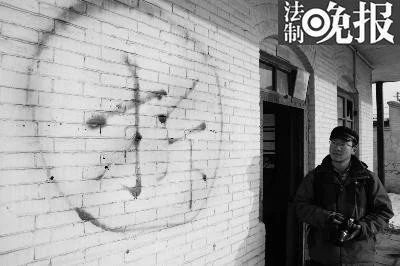
Pictured above: The walls of the Nankou Road Maintenance Engineer's Office building are painted with large "demolition" characters.
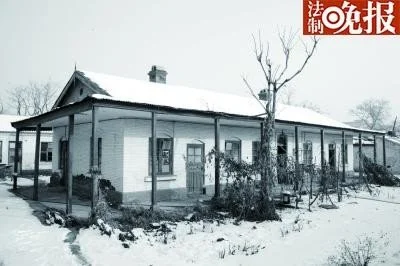
Pictured above: A full view of the Nankou Railway Maintenance Engineer's Office building.
December 7, 2015, Legal Evening News reported
December 7, 2015, 14:24 Legal Evening News
The section of the Beijing-Zhangjiakou Railway from Nankou to Badaling is a Major Historical and Cultural Site Protected at the National Level. However, when railway scholar Wang Wei recently visited the Nankou station area, he discovered that multiple "demolition" (拆) characters had unexpectedly appeared on the walls of the "Nankou Machine General Management Office" and the "Nankou Road Maintenance Engineer's Office."
Were these century-old buildings about to be demolished? This morning, a male staff member from the Nankou Construction Section of the Housing Construction Branch of the Beijing Railway Bureau told reporters from the Legal Evening News that these were left by a film crew shooting a production there many years ago, and there was no news that either of the two buildings was going to be demolished.
Although relieved, Wang Wei remains concerned. Although some old buildings along the Beijing-Zhangjiakou Railway have lost their original functions, they serve as historical witnesses and precious relics, and they should receive proper protection and respect.
Discovery: "Demolition" Characters Appear on Station Area Building Walls
During a recent visit to the Nankou station area, Wang Wei found that despite a century of vicissitudes, buildings such as the "Nankou Machine General Management Office"—which form an integral part of the Nankou station area—were well-preserved, yet the walls of these old structures were daubed with multiple "demolition" characters.
Having taken over 300,000 railway photographs and having published his new book Chasing Trains last month, post-90s railway scholar Wang Wei is intimately familiar with the architecture along the Beijing-Zhangjiakou Railway through years of field visits and research. The Beijing-Zhangjiakou Railway is the first trunk railway independently built by the Chinese people. "If the zigzag line at Qinglongqiao is the 'throat' of the Beijing-Zhangjiakou Railway, then the Nankou station area is its 'heart,'" Wang Wei remarked, describing the importance of Nankou.
According to historical records, on October 2, 1909, the entire Beijing-Zhangjiakou Railway opened to traffic, and the ribbon-cutting ceremony was held right in Nankou, effectively refuting the foreigners' rumors that "the engineers capable of cutting through the Guanguo pass have not yet been born in China." Multiple offices and workshops of the Beijing-Zhangjiakou Railway were established in Nankou, and Zhan Tianyou once worked here.
Exploration: Century-Old Old Buildings Remain Well-Preserved
A Legal Evening News reporter followed Wang Wei to Nankou Railway Station in Changping District, Beijing. About 200 meters northwest of the old station building lies the former "Nankou Machine General Management Office." Text in a 1909 archival photo shows that this courtyard was named the "Nankou Machine General Management Office." Wang Wei analyzed that it was used to centrally manage construction machinery. On the 1916 Nankou Station Boundary Map, the Machine General Management Office was changed to the Locomotive General Management Office, suggesting its use may have changed. After an interval of 106 years, many residential houses have been added nearby, but fortunately, the old building has changed little and still presents a complete appearance.
Two "demolition" characters appeared on the tiger-skin walls on both sides of the courtyard gate, and the handwriting has become blurred. The front courtyard is piled with beverage bottles and other waste debris, and both rooms are rented by residents. On the doors and windows, reporters saw signs such as reception room and car storage, proving that the old building had changed its use multiple times. According to Wang Wei, in recent decades, this old building has served as single dormitories, club rooms for the Nankou regional railway, and rental housing. Walking around the main room of the Machine General Management Office and passing through a gate hole leads to the "Nankou Road Maintenance Engineer's Office" in the backyard. This old building shares the same style as the front yard and has a history of over a century. Although the exterior of the building has been whitewashed, it cannot mask the old structure's backbone and its Chinese-and-Western mixed style. The wooden pillars and plinth stones have been used to this day; the "hanging fish" decoration at the top of the building's gable and the pig-nose-like chimney cap are still present. "These are all the original architectural relics," Wang Wei introduced. The front and back yards of this building were also daubed with multiple demolition characters, and the red handwriting remains clear.
"These old buildings are true history that can be seen and touched, and they are witnesses to the Chinese people safeguarding their own railway construction rights." Wang Wei is worried that the old buildings in the station area will face the fate of demolition.
Response: "Demolition" Characters Left by Film Crew During Shooting
This morning, Legal Evening News reporters called the Nankou Construction Section of the Housing Construction Branch under the Beijing Railway Bureau, which is responsible for managing railway property affairs. A male staff member explained that there was no news of the old houses mentioned by the reporter being demolished. According to him, regarding the demolition characters on the wall, other people had inquired about them previously; they were written because someone filming a TV drama "needed to set a scene," and they were not actually going to be demolished. Those "demolition" characters had existed for many years. Some railway workers living in Nankou also confirmed that a film and television crew had indeed visited the old houses, but about 10 years had passed, and no one remembered the content of their filming.
Appeal: Some Buildings Lack Plaque Protection; Heritage Protection Scope Should Be Expanded
Even so, Wang Wei remains concerned about the fate of the "Nankou Machine General Management Office" and the "Nankou Road Maintenance Engineer's Office." The Nankou-to-Badaling section of the Beijing-Zhangjiakou Railway was designated as a Major Historical and Cultural Site Protected at the National Level in 2013. In the relevant descriptions on the official website of the Beijing Municipal Cultural Heritage Bureau, inclusions are listed such as "Nankou Railway Station building, modern and contemporary architectural relics of the Nankou Locomotive and Rolling Stock Works, the herringbone railway, Qinglongqiao Station building and employee dormitories and supervisor's office, and Zhan Tianyou's tomb and bronze statue."
However, the "Nankou Machine General Management Office" is not mentioned in the descriptions by the cultural relics department. The 1916 Nankou Station Boundary Map includes multiple supporting buildings, including the Nankou Machine General Management Office. Through visits, Wang Wei found that apart from the railway station, station hotel, and other buildings enjoying protection, the Nankou Machine General Management Office, Nankou Road Maintenance Engineer's Office, Nankou Engineer's Office, General Material Depot, Floral Car House, Freight Warehouse, and others are also historical relics within the station area. They share an equally long history, yet they do not have plaque protection. Fortunately, aside from the old water tower in the locomotive section being demolished, other old buildings remain relatively intact. Wang Wei hopes that the cultural relics department can expand the scope of protection, conduct a meticulous inventory and sorting of the Beijing-Zhangjiakou Railway buildings in the Nankou station area, and lay the groundwork for the comprehensive protection of the entire Beijing-Zhangjiakou Railway in the future.
Expert Views: All Component Buildings Should Be Protected
Jin Wangzhi, former deputy curator of the China Railway Museum and an expert in Chinese railway history research, introduced that "Nankou-Kangzhuang" is the section with the steepest gradient on the Beijing-Zhangjiakou Railway, and up and down trains undergo servicing at Nankou. Therefore, Nankou is an important transportation node, and its importance is no less than that of the two terminal stations. Buildings such as the "Nankou Machine General Management Office" within the Nankou station area are an important part of railway cultural heritage, with histories exceeding a century, and all of them should be protected.
Relevant Departments: Specific Protection Scope Not Disclosed
Article 15 of the Law of the People's Republic of China on the Protection of Cultural Relics stipulates: The protection scope and record archives of major historical and cultural sites protected at the national level shall be reported by the cultural administrative departments of the people's governments of provinces, autonomous regions, and municipalities directly under the Central Government to the cultural administrative department of the State Council for the record. This morning, Legal Evening News reporters called the Cultural Relics Protection and Archaeology Department of the National Cultural Heritage Bureau and the Cultural Relics Protection Division of the Beijing Municipal Cultural Heritage Bureau respectively; staff members did not disclose the specific protection scope of the Nankou-to-Badaling section of the Beijing-Zhangjiakou Railway. Staff at the Municipal Cultural Heritage Bureau stated that the specific protection scope is kept confidential from the outside, and if citizens wish to participate in cultural relics protection, they can submit an "Immovable Cultural Relic Identification Application" to the Changping District Cultural Commission.
Text and photos by/Reporter Cui Yifei
