
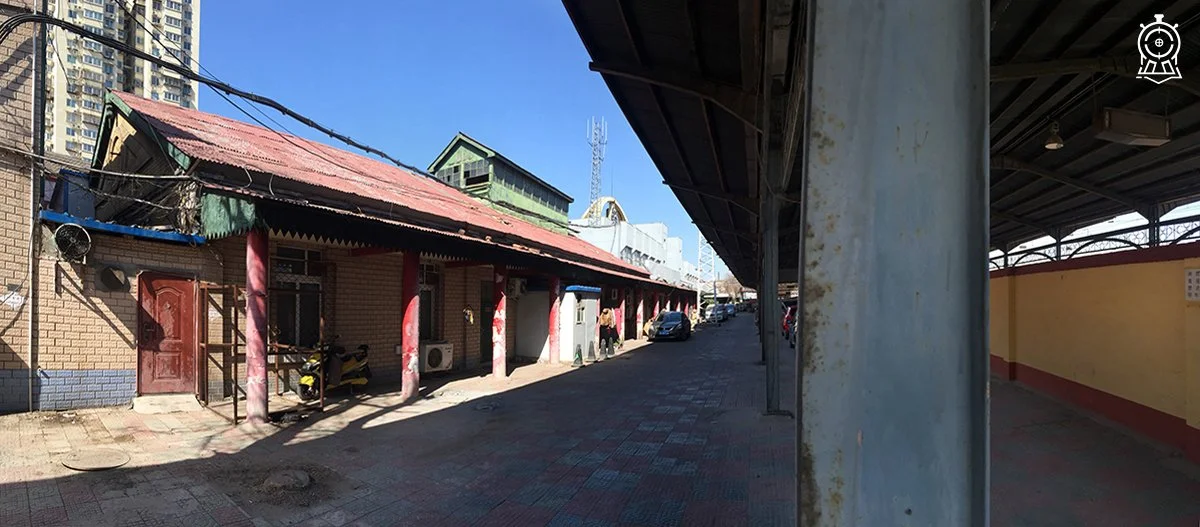
The eavesdropping canopies and 12 corridors extending from the old station building carry the breath of history.
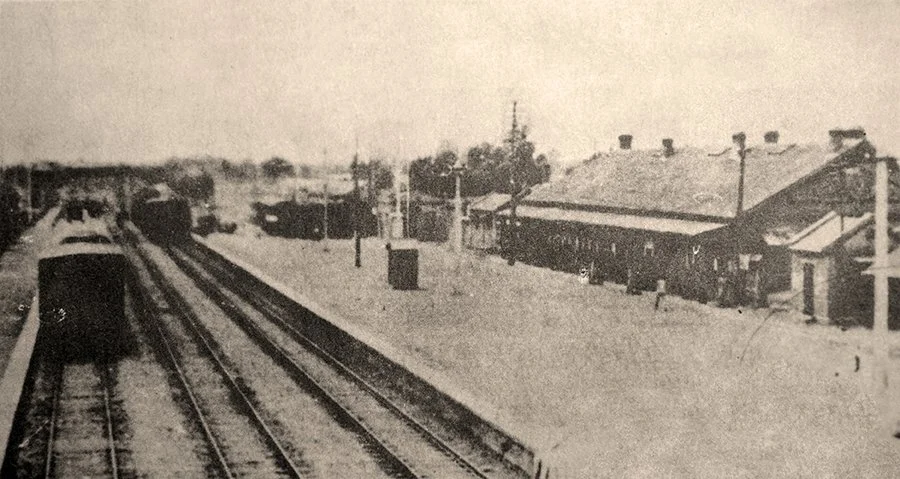
Archival photo of the Fengtai Station building during the Japanese puppet regime.
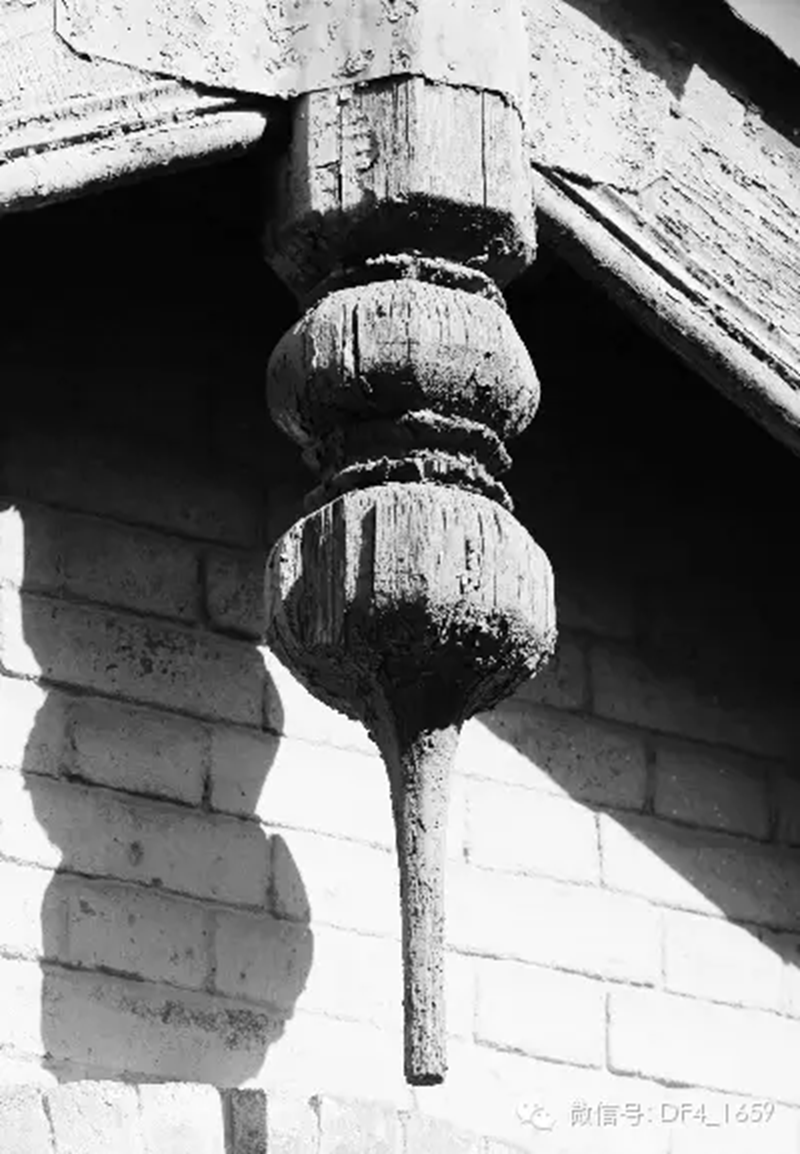
Beneath the bargeboards, decorative elements resembling "hanging fish" (finials) are still preserved, showing a strong British style.
Legal Evening News (March 31, 2016)
Legal Evening News (Reporter Cui Yifei): During the six years since Fengtai Railway Station suspended passenger transport, news of upgrades and renovations has surfaced almost every year, and this year is no exception.
Recently, other media reports indicated that the Fengtai Station expansion project will commence in the fourth quarter, with the new station positioned as a high-speed railway hub. This news has aroused concerns among scholars because a surviving old station building exists within the station area. It is one of the few historical witnesses to the century-old station, but it lacks cultural relic status and fears remain that it might be demolished during construction.
Legal Evening News (WeChat ID: fzwb_52165216) reporters investigation found that due to the scarcity of historical data, the construction date of the old station building remains obscure, leaving an unsolved mystery for this railway station facing drastic changes.
Exploration: Some Station Architectural Relics Rented Out
Having taken over 300,000 railway photographs, Wang Wei, the author of Chasing Trains, recently began paying attention to the old station building at Fengtai Station. Future upgrades and renovations have made this railway scholar worry about the fate of the old architecture.
Situated on the south side of Zhengyang Avenue, Fengtai Railway Station was first built in 1895 (the 21st year of the Guangxu reign of the Qing Dynasty). Flanked by Beijing South and Beijing Station to the east and Fengtai West Station to the west, it is a vital bottleneck throat leading to the Jingshan, Jingguang, Fengsha, and Jingyuan railway trunk lines. In the 1980s, daily boardings and alightings reached over 30,000 people, making it one of the special-class stations of the Beijing Railway Bureau.
In June 2010, Fengtai Station suspended passenger transport operations, bidding farewell to the public's travels. Today, the ticket hall and waiting room have been leased out to shops, making it difficult for people to realize that this is a century-old station. Only the stopped clock at the top of the central building reminds passersby of the passing time here.
The gatehouse, once guarded by people, can now be entered and exited freely. Turning right and heading west upon entering reveals an unassuming single-story bungalow building that comes into view. Opening the old photos on his phone, Wang Wei told reporters: "This is that old station building."
Reporters saw that the old building faces south and backs north, oriented toward the platform. The building is strip-shaped, with its north and east gables blocked by other structures, exposing only the south side and west gable. The old bricks on the entire south wall have been covered with new tiles; outdoor air conditioner units, aluminum-alloy windows, and metal security doors completely conceal the charm of the old house. Only the extended canopy and 12 pillars continue the appearance of the old house. A photo taken during the Japanese puppet regime shows that this station building already existed at that time.
Moving to the west side of the old house, the scene is completely different. The gable is not plastered with tiles; although painted with yellow paint, the old bricks are still fully displayed. Beneath the bargeboards, decorative elements resembling "hanging fish" are preserved.
Because the interior of the house has been partitioned, the original layout can no longer be recognized. Several rooms on the west side are still used as offices by the railway department, while the east side has been turned into rental housing. A tenant is leisurely washing a car in front of the house, and clothes are drying under the canopy, adding a bit of secular neighborhood flavor to the old house.
Wang Wei's textual research revealed that Fengtai Station has undergone multiple renovations, yet this old building has survived, becoming the oldest structure in the station area. However, opinions still vary regarding its initial construction date.
Memories: Used as Station Master's Office During the Japanese Puppet Regime
To figure out the initial construction date of the old station building, Legal Evening News (WeChat ID: fzwb_52165216) reporters interviewed multiple elderly people, with the view that it was built by the Japanese holding the majority.
Cui Guilu, an 80-year-old man who came to work at Fengtai Station in 1954, recalled that in his impression, the old station building served as the station master's office and also doubled as a conference room and recreation room, and it might have been built during the Japanese puppet regime.
Wu Xiaoshi, author of the book Chronicles of Fengtai Station, is already 90 years old this year. He is an old railway worker who served as the head of the technical office of Fengtai Station from 1952 to 1955. He did not conduct textual research on the old station building, but still retains some vague memories.
In 1943, Wu Xiaoshi graduated from the Beijing Railway College and went to work on operations at Fengtai Railway Station the following year. In Fengtai Station in 1944, management positions such as station master, deputy station master, and operation director were all held by Japanese people, middle-level cadres were mostly Northeasterners who came via the South Manchuria Railway, and ordinary workers were mostly locals.
During the Japanese occupation, the old station building was used as the station master's office. Station master Morikawa Susumu worked at Fengtai Station for eight years, but due to the lower operational level, Wu never saw this Japanese station master with his own eyes.
In 1945, the Nationalist Government took over Fengtai Station, and the function of the station master's office was continued.
Accounts: Japanese People Frequently Visited Fengtai Station
After 1949, Japanese people frequently visited Fengtai Station. According to a railway worker, in the early days of reform and opening up, Japanese people who had worked in the Fengtai area came back in large sedans to visit.
Last year, two other Japanese people came to Fengtai Station accompanied by a translator.
Wu Xiaoshi remembered that in the 1950s, an elderly Japanese couple came because their son had worked at Fengtai Station and was killed by a train in a work-related accident; they simply wanted to see the place where their child passed away.
The Annals of Fengtai Station record that after 1949, Fengtai Station successively received delegations from 11 countries including the former Soviet Union, North Korea, Britain, Vietnam, and the United States, mostly for technological exchanges.
Looking up the chronology of foreign affairs activities, exchanges with Japanese technical personnel and friendly figures were the most frequent.
The station annals record that in 1986, Kimura Hiroshi, President of the Japan-China Friendship Association of Kamojima Town, Tokushima Prefecture, Japan, visited Fengtai Station.
Kimura Hiroshi had worked in the railway department at Fengtai Station around 1943 and had continuously engaged in Sino-Japanese friendship activities after returning to China. Station leaders such as Station Master Qiu Yanpo were responsible for receiving him.
Views: Old Station Building Built in Early 20th Century, Unrelated to Japanese
Wang Wei disagrees with the claim that the Japanese built the old station building. He pointed out that from an architectural style perspective, it has nothing to do with the widely circulated idea that it was "built by the Japanese." The west gable of the old station building still preserves a "decorative graphic of one circle and two triangles," which also appeared on locomotive sheds built on Chinese railways during the same period. Moreover, station buildings newly built in the North China region during the Japanese puppet regime were generally smaller and completely mismatched in style with the old Fengtai Station building.
In addition, the west gable still has bargeboards and finial-like decorations. This style is reflected in some local British buildings, as well as in the engineer housing built by the British on the west side of Fengtai Station and almost all buildings along the Beijing-Zhangjiakou Railway.
Wang Wei estimates that the old station building should have been built in the early 20th century.
To this end, Wang Wei also sought out the housing construction department of the Beijing Railway Bureau, but the construction ledger of Fengtai Station does not record construction information prior to 1949.
Historical Materials: Japanese Expansion Projects Did Not Include Station Building
The Annals of Fengtai Station, published in 1989, also do not explicitly record the old station building, but through certain historical information, inferences can still be made:
The station annals record that in the late Qing Dynasty (1896–1911), station offices and buildings handling passenger and freight transport were all built on the north side of the first platform. This is precisely the location of the old station building.
On May 3, 1900 (the 26th year of the Guangxu reign), the Boxers burned down railway-related equipment from Zhuozhou to Fengtai, and the station buildings of Fengtai Station were all destroyed in the fire. From this, it can be inferred that the existing old station building should have been built after 1900.
During the Japanese puppet regime (1937–1945), Fengtai Station held strategic importance. The Japanese carried out expansion and renovation work there, increasing transport capacity and making it one of the large marshalling yards in the North China region.
Among the expansion and renovation projects, the station annals contain detailed records, but do not mention the station building. Meanwhile, photos taken by the Japanese during this period show that the old station building already existed.
From this, it can be deduced that this old station building existed even before it was occupied by the Japanese invaders.
Proposal: Draw on Beijing North Station to Preserve the Old Station Building
Regarding the initial construction date of the old station building, Wang Wei will conduct further textual research and hopes that after media reports, valuable information feedback can be obtained. What worries him most at present is that the old station building is very close to the railway track; once major demolition and construction take place, the old station building is very likely to be demolished, leaving the century-old station building untraceable.
To protect the old station building, he has begun collecting materials and intends to submit an "Immovable Cultural Relic Identification Application Form" to the cultural relics department to secure a legitimate cultural relic identity for the old building. "In the expansion and renovation planning of Fengtai Station, it is hoped that the historical heritage of the old station can be preserved, restoring the old station building to its original state and preserving the soul of the century-old station," Wang Wei hopes, drawing on the development model of Beijing North Station to treat the old station building kindly (now a Beijing Municipal Cultural Heritage Protection Unit) while expanding its scale, because architecture is the best historical testimony of an old station.
This morning, reporters from the Legal Evening News (WeChat ID: fzwb_52165216) called the Cultural Relics Section of the Fengtai Culture Commission regarding this matter. The relevant person in charge stated after learning about the situation that they would go to the scene to understand the situation and thanked citizens for providing the information. Text and photos by/Reporter Cui Yifei
