
"Little Train" Emerges from Abandoned Cave, Awakening Century-Old Memories of the Beijing-Zhangjiakou Railway
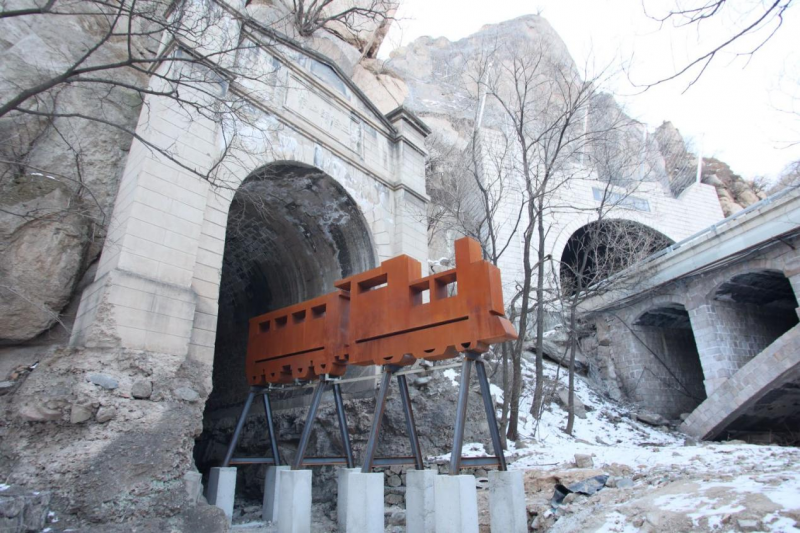
The newly built decoration of Wuguitou Tunnel
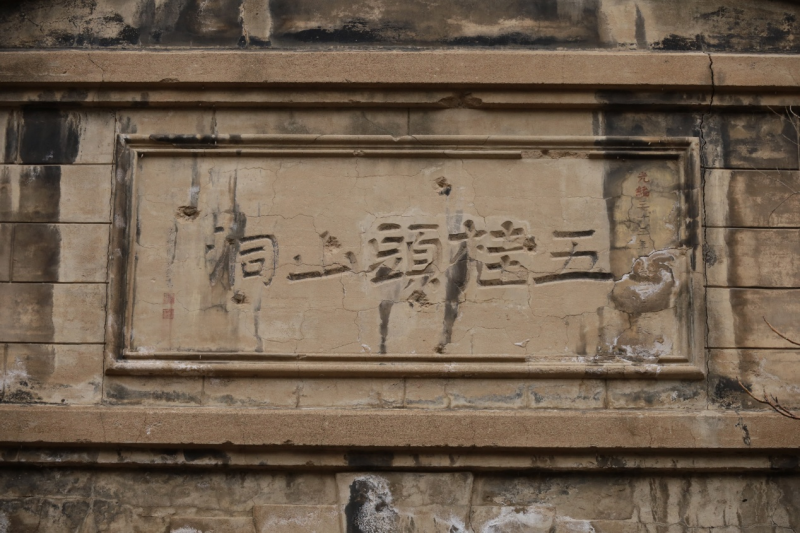
The plaque of Wuguitou Tunnel
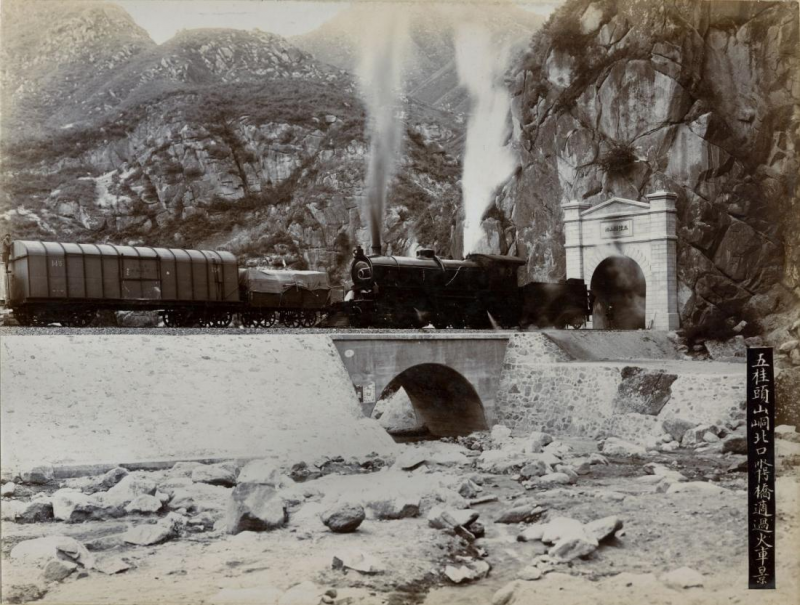
Northern entrance of Wuguitou Tunnel, 1909, photographed by Tan Jintang
January 21, 2026 Beijing Youth Daily
Having experienced decades of silence, the Wuguitou Cave along the Beijing-Zhangjiakou Railway has gradually faded from the public eye, its former rail transportation functions growing obscure in the passage of time... Recently, Fan Jiping, a member of the Beijing Cultural Relics Protection Association, discovered that a train-shaped themed installation has been quietly added to the northern entrance of Wuguitou Cave. Its modern design elements do not disturb the original appearance of the industrial heritage; instead, using a concise formal vocabulary, they awaken the historical memories deeply buried within the cultural relics. Situated in Badaling Town, Yanqing District, Beijing, Wuguitou Cave is one of the early tunnels completed on the Beijing-Zhangjiakou Railway. However, having been abandoned for 86 years, its former rail ties and roadbeds have long since vanished, leaving only the deep and quiet cave to recount past events. Western-style gate towers are built at both the northern and southern ends of the cave. Above the gateway, five traditional Chinese characters reading "Wuguitou Cave" (五桂頭山洞) stand out prominently on the plaque. This was inscribed by Guan Mianjun, then-associate director of the Beijing-Zhangjiakou Railway, with the inscription on the side reading "Completed in the second month of the Dingwei year of the Guangxu reign" (meaning February 1907). Wuguitou Cave was listed as a Yanqing County-level cultural relic protection unit in 1999. True to Fan Jiping's observation, right in the center of the northern cave entrance today, a brand-new decorative piece resembles a silhouette of time, outlining the posture of a steam locomotive pulling carriages and speeding toward Zhangjiakou. Fan Jiping noted that Wuguitou Cave lost its passage function long ago, and relying merely on a heritage protection sign as a brief prompt makes it difficult to vividly convey its original purpose. This installation, however, uses a visual narrative to reinforce its historical imprint as a railway cultural heritage site.
Why was Wuguitou Cave abandoned? According to textual research by railway cultural scholar Wang Wei, Wuguitou Cave was the first tunnel to be pierced all the way through along the entire Beijing-Zhangjiakou Railway line, and it was also a work where Chief Engineer Zhan Tianyou "first showed his prowess," accumulating valuable experience for subsequent tunnel engineering and boosting the confidence of all engineering personnel along the line. However, at the end of July 1939, a sudden mountain flood occurred in the area, causing severe damage to the railway roadbed and bridges near Wuguitou Cave. By 1940, due to flood control requirements, the route was realigned, and the tunnel was subsequently abandoned, fading from the annals of transportation history.
Recently, according to Yu Haikuan, director of the Yanqing District Cultural Relic Management Office, in order to reflect the history of the Beijing-Zhangjiakou Railway prior to the realignment of its original route, they commissioned a professional design team last year to create a themed installation featuring train silhouettes as imagery at the northern entrance of Wuguitou Cave. He stated that after the conclusion of the fourth national cultural relic census, they will continue to advance the protection, revitalization, and utilization of cultural heritage related to the Beijing-Zhangjiakou Railway.
By: Cui Yifei (Beijing Youth Daily)
Photography: Cui Yifei (Beijing Youth Daily)
Editor: Zhou Chao
Executive Editor: Ni Jianing
