
Old Inscribed Bricks Discovered During Urban Village Renovation! New Physical Evidence Added to This Railway Heritage Site in Fengtai
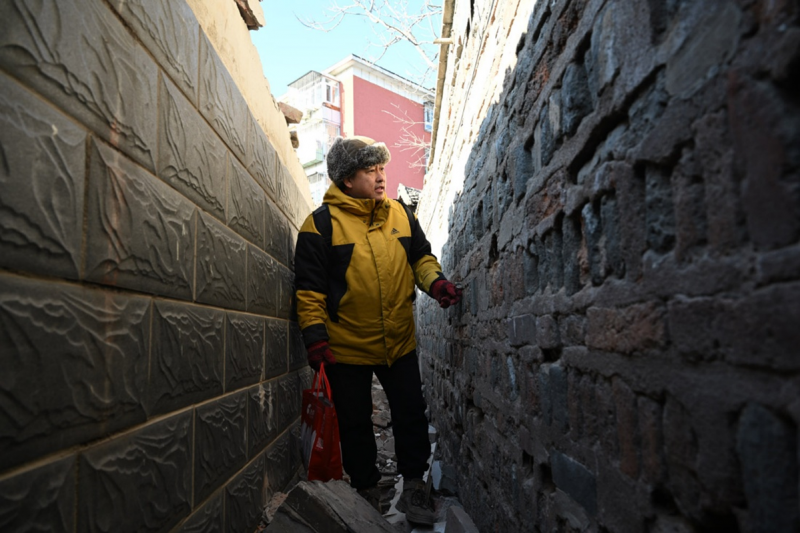
Chen Xinhua conducting field surveys
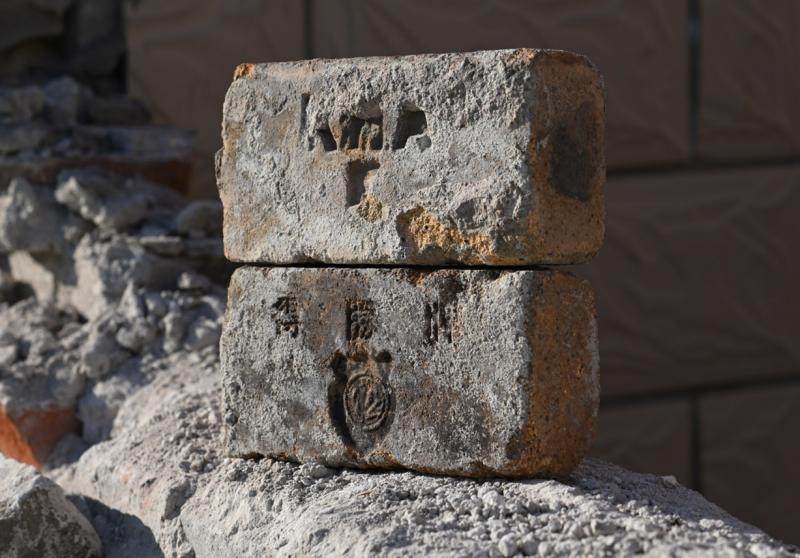
Newly Discovered Inscribed Bricks
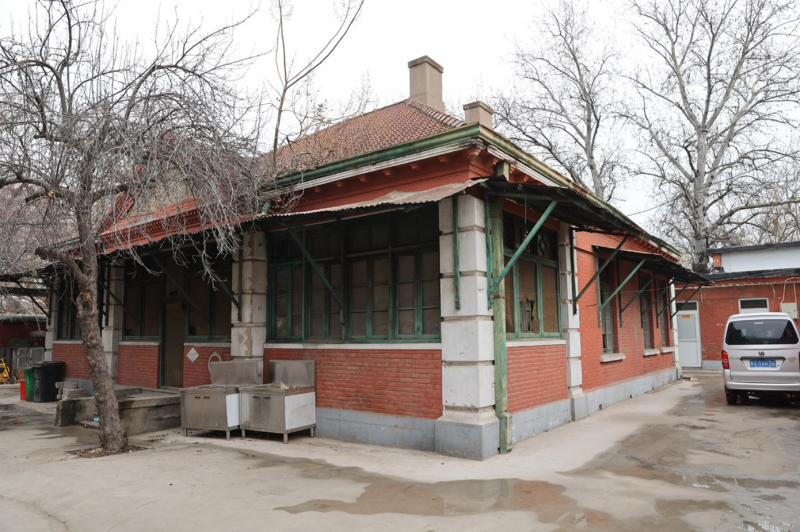
Railway Architectural Heritage South of Fengtai Bridge
January 29, 2026 Beijing Youth Daily
Recently, at the site of the urban village renovation south of Fengtai Bridge, two inscribed bricks embedded within a crumbling wall were discovered by a keen observer. One is a Kailan brick stamped with the "KMA" English trademark, and the other is recessed with the "Desheng Brand" (得勝牌) trademark and a shield-shaped logo. These weathered old bricks bear witness to the deep integration of China's modern industrial products and railway development, adding further physical remnants to the "Fengtai Bridge South Heritage Railway Building Complex," which is currently undergoing cultural relic recognition.
After the area south of Fengtai Bridge was incorporated into the scope of urban village renovation, demolition work was completed in some relocated sections. On a crumbling wall by the roadside in front of No. 1 Xihouwan Gate, two old bricks caught the attention of Chen Xinhua, a member of the Beijing Cultural Relics Protection Association. After cleaning away the cement mortar from the surfaces of the bricks, the characters and logos on the brick bodies gradually and clearly emerged: one brick displays the English letters "KMA" followed by the letter "F" underneath; the other is recessed with the traditional Chinese characters "得勝牌" (Desheng Brand), accompanied by a shield-shaped trademark below. The two dimensions are identical—22.5 centimeters long, 11 centimeters wide, and 6.5 centimeters thick—appearing somewhat heavier and thicker than ordinary machine-made bricks.
Chen Xinhua made a preliminary judgment that both bricks are refractory bricks, and the location where they were discovered is immediately adjacent to the "Fengtai Bridge South Heritage Railway Building Complex," an area that still preserves four sites (five structures) of Beijing-Mukden (Jingfeng) Railway architectural heritage. He surmised that these two refractory bricks did not originate from ordinary residential houses; they were most likely procured by the railway department in the early years to build boiler rooms or steam locomotive firebox walls, and after being discarded and phased out, they were reused by nearby residents to build into house walls. This practice of using old bricks to build houses was relatively common among the populace in the past.
Chen Xinhua's deduction is not without basis. To protect the "Fengtai Bridge South Heritage Railway Building Complex," railway cultural scholar Wang Wei submitted an Immovable Cultural Relic Recognition Application Form to the Fengtai District cultural relics department in 2018. Although a definitive recognition result has not yet been issued, the project he applied to protect has been listed as a clue for the fourth national cultural relic census and is expected to officially attain cultural relic status. It is worth mentioning that in 2023 and 2024, Chen Xinhua successively discovered Beijing-Mukden Railway inscribed bricks in the area south of Fengtai Bridge. This latest discovery of inscribed bricks further enriches his understanding of the industrial heritage in this region.
Authenticated by Ms. Wu Xiujuan, a collector of Kailan bricks, both bricks belong to refractory bricks produced in the Tangshan area, possessing good high-temperature resistance, wear resistance, and corrosion resistance, and were commonly used in industrial fields such as steel smelting, mining drilling, and coal-fired boilers.
Wu Xiujuan further explained that for the brick stamped with the "KMA" English trademark, the logo is the English abbreviation for the Kailan Mining Administration, and the letter "F" underneath indicates a first-class product grade. "Kailan bricks" were produced from 1912 to the early period of the People's Republic of China, selecting high-quality local refractory clay from Tangshan as raw material and fired using advanced brick-making machinery and kilns of that time. In addition to refractory bricks, Kailan also produced various other products such as building bricks and paving bricks, which can be seen in numerous celebrity former residences and foreign-style houses in Tianjin. Furthermore, Kailan bricks exported overseas at that time were also stamped with a "MADE IN CHINA" mark.
Regarding the "Desheng Brand" bricks, Wu Xiujuan introduced that this brand of refractory bricks was likewise produced in the Tangshan area, with a production period from 1932 to the early period of the People's Republic of China, and has previously been discovered in architectural structures along the Beijing-Zhangjiakou Railway. She specially mentioned that while bricks of the same brand in her collection mostly feature inscriptions arranged from right to left, the "Desheng Brand" brick discovered this time by Chen Xinhua has its inscription arranged from left to right, leading her to surmise that it should belong to a later product of this brand.
By: Cui Yifei (Beijing Youth Daily)
Photography: Cui Yifei (Beijing Youth Daily)
Editor: Hu Keqing
Executive Editor: Ni Jianing
