
Five-Hole Bridge Suspected to Have Been Built by Invading Japanese Forces Discovered in Western Beijing, Included in Cultural Relic Census Clues
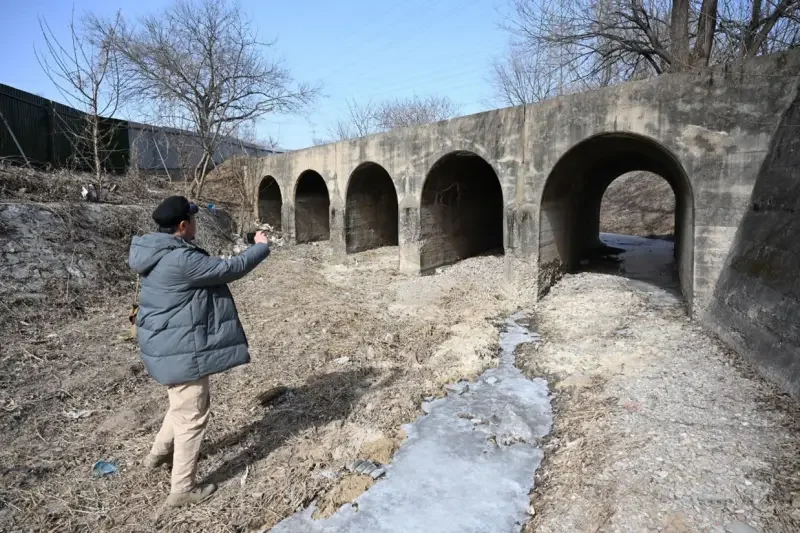
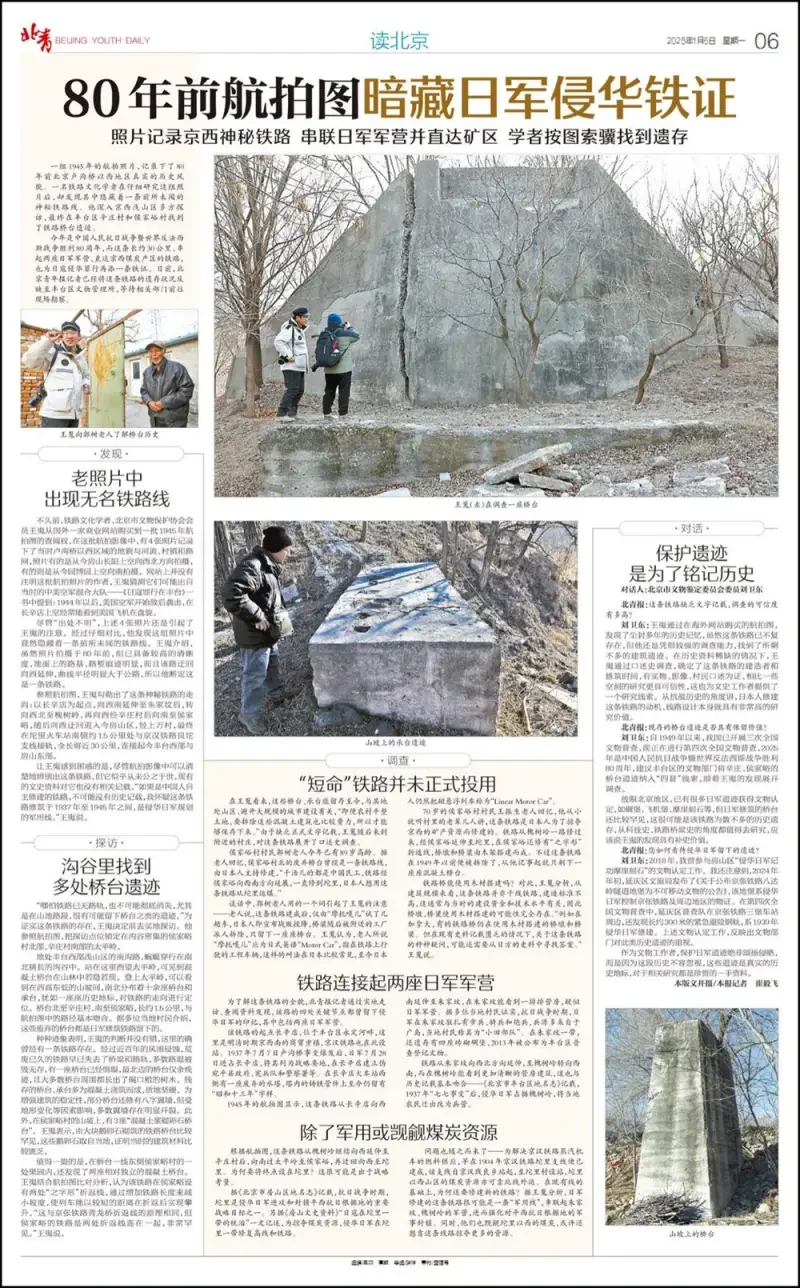
Wang Wei exploring the five-hole bridge built by the invading Japanese forces
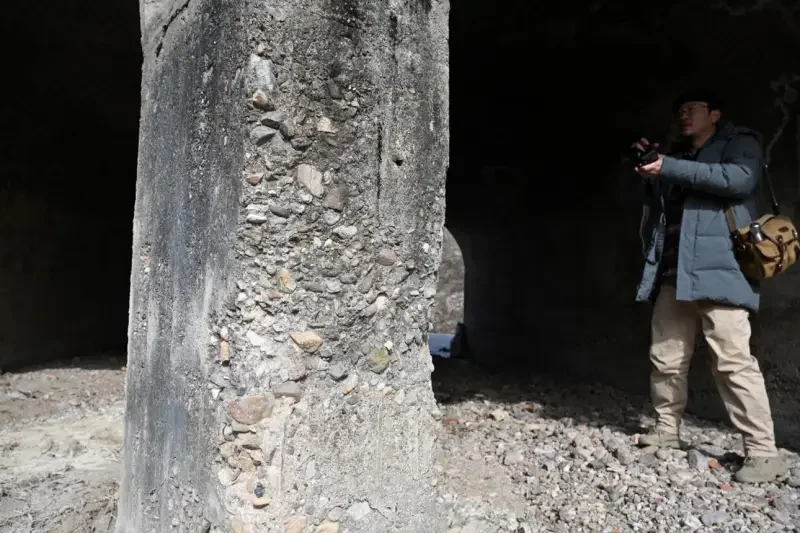
Wang Wei inside the arch ring
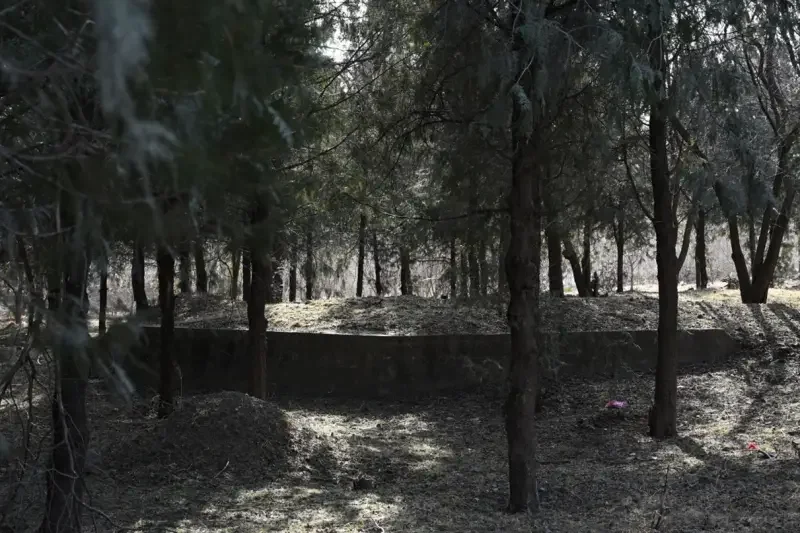
Suspected site where the Japanese army stored ammunition
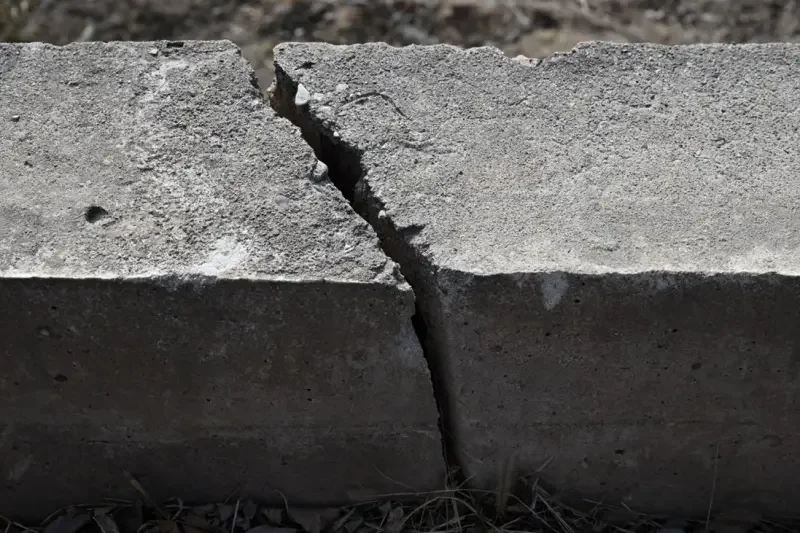
Expansion joints of the Five-Hole Bridge
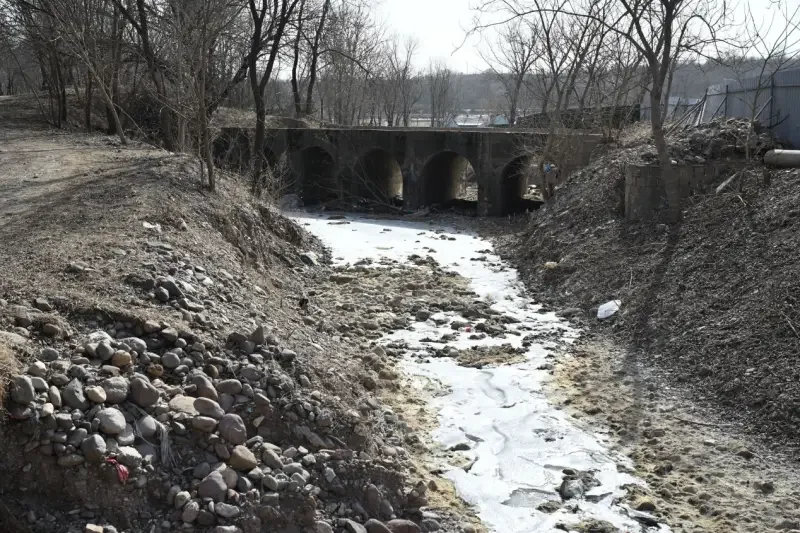
Zhangjiafen Village Five-Hole Bridge
March 23, 2026 Beijing Youth Daily
A historical trace sealed away in old photos has unveiled a covert supply route of the invading Japanese forces through on-site exploration by a civilian scholar... Recently, starting from an aerial photograph dating back 81 years, Wang Wei, a member of the Beijing Cultural Protection Association and a railway cultural scholar, discovered that a mysterious railway once existed in western Beijing. Although this railway no longer exists, Wang Wei, following the clues, discovered a concrete bridge in Zhangjiafen Village, Fengtai District. According to local villagers, this bridge is a military railway relic built by the invading Japanese forces to transport weapons and ammunition.
Recently, a reporter from Beijing Youth Daily learned from the Fengtai District Cultural Relic Management Office that the unit has included the Zhangjiafen Five-Hole Bridge in the clues for the fourth national cultural relic census.
Exploring the Five-Hole Bridge
Recently, while reviewing a set of 1945 aerial photographs, Wang Wei discovered that a railway approximately 1.7 kilometers long was once built between Zhujiafen and Zhangjiafen in Fengtai District. What puzzled him was that, logically speaking, any railway initiated and constructed by the Chinese people, even if later abandoned or dismantled, would always leave behind written records. Only this railway left almost no trace in history.
Wang Wei deduced that this railway appeared in the 1945 photographs and might be a military railway constructed by the invading Japanese forces. The photographs show that the railway established a station around Zhangjiafen, visually estimated to be about 200 meters long and 30 meters wide. After 81 years, the railway in the photographs no longer exists, but Wang Wei decided to conduct an on-site visit in hopes of finding related remains.
Recently, a Beijing Youth Daily reporter followed Wang Wei to a hilly slope in the northern part of Zhangjiafen Village, Fengtai District, a remote and uninhabited location. Comparing it with the 1945 aerial photographs, Wang Wei basically determined the location of the railway and station platform, but failed to find any architectural remains. However, near the inferred location of the platform, a five-hole bridge caught his attention.
According to observations by the Beijing Youth Daily reporter, this is a five-hole multi-arch concrete bridge crossing a river, complete in structure, thick, and solid. The five bridge openings show no silt blockage, and the pebbles at the piers are exposed, suspected to be caused by years of water erosion. The bridge deck is wide and flat, but both banks have been sealed off with soil, currently rendering it unfit for vehicular traffic. Upon measurement, the bridge is about 20.5 meters long, about 9.4 meters wide, and the bridge deck is about 3.5 meters above the riverbed. The five bridge openings are of equivalent size, with each opening having a clear height of about 3 meters and a width of about 2.7 meters.
Wang Wei did not find any signposts around the five-hole bridge, which draped the bridge in a layer of mystery. He analyzed that building a railway to such a covert location was likely for military purposes. Referring to the road network in the 1945 aerial photographs, the five-hole bridge was located at the connection point between the railway and the highway of that year. The Japanese army may have transferred supplies here, and while the bridge looks like a double-track railway bridge at first glance, its actual purpose was more likely to bear vehicular traffic.
Investigation: Oral Accounts from Villagers Corroborate that the Five-Hole Bridge Was Built by Invading Japanese Forces
Beijing Youth Daily
The Monograph on Place Names in Fengtai District, Beijing records that Zhangjiafen was originally named Dalaozhuang and was originally the estate of the Ming dynasty military general Zhang Fu. Later, because Zhang Fu and Zhang Mao were buried here, it was named Zhangjiafen. However, this monograph does not record any military deployments by the invading Japanese forces in Zhangjiafen. The Beijing Youth Daily reporter further consulted local chronicles and materials such as Chronicles of the Beijing Railway Bureau, Beijing Chronicles: Roads, Bridges and Drainage Chronicles, and Japanese Imperialist Crimes in Fengtai, but found no records of the Zhangjiafen railway or the five-hole bridge. In the Ledger of Immovable Cultural Relics in Fengtai District, there are registration records of Japanese invasion pillboxes and aircraft shelters, but the Zhangjiafen five-hole bridge is missing.
However, Wang Wei discovered an English map from 1945, which not only marked the alignment of the railway from Zhujiafen to Zhangjiafen, but also annotated that warehouses were built around Zhangjiafen, though it did not specify who built the railway and warehouses. Not far from the five-hole bridge, Wang Wei also discovered two low concrete structures whose pouring method was similar to that of the five-hole bridge, suspected to be architectural remains from the same period.
Related Report on January 6, 2025
Beijing Youth Daily: What is the construction process for this type of concrete bridge?
Wang Ruiying: Before constructing this bridge, diversion work was required, or construction had to take place during the dry season when there was no water. First, foundation pits were excavated at the pier and abutment locations on the riverbed, and the foundation was leveled. Then, formwork was erected on the gravel foundation, and pebble concrete was poured. Horizontal lines, which are the gaps between the formwork pieces, can be seen on the sides of the bridge, proving that this bridge was poured in layers—construction workers erected formwork in layers on the pier and abutment foundations. After pouring plain concrete for three or four layers of formwork and allowing it to reach sufficient strength, upper-level formwork was erected and concrete was poured. When pouring reached the arch rings, formwork for the arch rings began to be erected, forming a five-hole integrated arch ring framework, and then multi-layer concrete pouring continued until the bridge deck.
Beijing Youth Daily: The river crossed by this bridge is merely a small stream, yet it was built with such solidity. What is the reason for this?
Wang Ruiying: If this bridge was indeed built by the invading Japanese forces, it proves that it was not meant for temporary transportation, but rather in preparation for long-term occupation. In such a river environment, if it were only for temporary transportation, building a beam bridge would be the most convenient. Constructing such a solid five-hole multi-arch concrete bridge might have been to accommodate heavy-load vehicles, perhaps for military defense needs, or it might have been related to the scarcity of steel at the time of construction.
Beijing Youth Daily: What historical value does the discovery of the five-hole bridge hold?
Wang Ruiying: Taking the Beijing area as an example, as early as the end of the 19th century, concrete was already used in the construction of the Xiaoqing River Bridge west of Lugouqiao. During the construction of the Beijing-Zhangjiakou Railway, multi-arch concrete bridges also appeared, but they were rarely seen thereafter. After 1949, highway bridges built in Beijing were predominantly beam bridges. As for the Zhangjiafen Five-Hole Bridge, no related records have been found. Combined with the oral history of local villagers, the possibility that this bridge was hosted and constructed by the invading Japanese forces is high. In the history of highway bridges in Beijing, this may be the first "five-name multi-arch solid-web gravity cast-in-place plain concrete arch bridge," which is worthy of study. In addition, the Japanese invasion relics in Fengtai District are worth excavating and sorting out, and those with conditions can be made into patriotic education bases.
END
By: Cui Yifei (Beijing Youth Daily)
Photography & Videography: Cui Yifei (Beijing Youth Daily)
Editor: Hu Jintong
March 23, 2026 Beijing Youth Daily
