
Follow-up Report | Century-Old Station Plaque Donated by Villagers Evaluated as a Grade III Cultural Relic
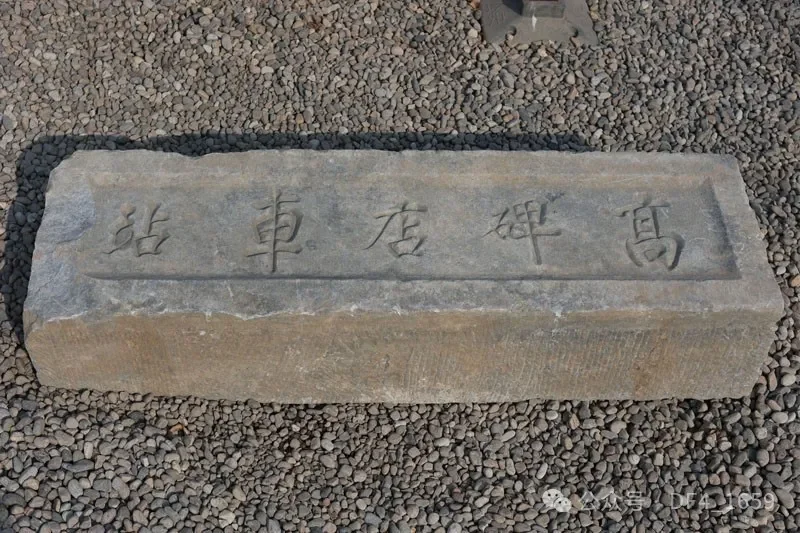
The stone plaque of the first-generation station building in Gaobeidian
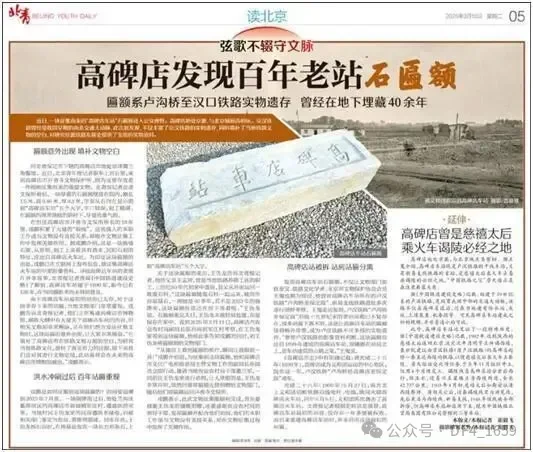
Beijing Youth Daily, September 22, 2025
Beijing Youth Daily, September 22, 2025
The century-old station plaque of Gaobeidian Station, having been buried underground for more than 40 years, was discovered by villagers and donated to cultural heritage departments, thereby enriching the historical remnants of the Lu-Han (Lugouqiao–Hankou) Railway... On September 22, a reporter from Beijing Youth Daily learned from the Culture, Radio, Television and Tourism Bureau of Gaobeidian City, Hebei Province, that following assessment by cultural heritage experts, the Qing dynasty "Gaobeidian Station" stone plaque has been identified as a Grade III cultural relic. Gaobeidian City, administered by Baoding City in Hebei Province, is located in the hinterland of the Beijing-Tianjin-Baoding triangle. Housed within the Kaishanshan Temple Cultural Relic Protection Institute in Gaobeidian City is a heavy stone plaque measuring 1.5 meters in length, 0.46 meters in height, and 0.3 meters in thickness. Its face features five large characters carved in intaglio reading "Gaobeidian Station" from right to left, originating from the Gaobeidian Railway Station completed in 1899. On March 18, Beijing Youth Daily reported on the discovery and protection of this plaque under the title "Century-Old Station Stone Plaque Discovered in Gaobeidian".
According to Sun Guoliang, deputy director of the Culture, Radio, Television and Tourism Bureau of Gaobeidian City, the "Gaobeidian Station" stone plaque was collected from the private sector this March. It fills a gap in Gaobeidian City's railway cultural relics and further enriches the historical remnants of the Lu-Han Railway. Following expert evaluation recently, it was designated as a Grade III cultural relic, and this station plaque will be exhibited in the future Gaobeidian City Museum. Regarding the concept of Grade III cultural relics, a reporter from Beijing Youth Daily consulted the Law of the People's Republic of China on the Protection of Cultural Relics and learned that movable cultural relics—such as important physical objects from various historical eras, artworks, arts and crafts, documentary materials, manuscripts, books, and representative physical items—are divided into precious cultural relics and general cultural relics; precious cultural relics are further classified into Grade I, Grade II, and Grade III cultural relics.
How was this station plaque discovered? Going back to the end of July 2023, Junzhuang Village, Xincheng Town, Gaobeidian City—located in the Langouwa Flood Storage and Detention Basin—suffered flood disasters, and the house of local villager Wang Weilong was soaked by floods, requiring demolition and reconstruction. At the end of that same year, when Wang Weilong was dismantling the old house, he discovered a rectangular strip of stone at the foundation inscribed with five large characters reading "Gaobeidian Station." Later, persuaded by local cadres, he donated this plaque to the cultural heritage department.
Regarding the provenance of the plaque, Wang Weilong recalled that his father was once an employee of the local railway maintenance work zone. In the early 1980s, when building a house, his father drove a truck to haul back a pile of waste stone materials, which included this stone plaque. It was subsequently used as a foundation stone for the house and remained buried for over 40 years.
Gaobeidian sits in the capital region and has a close relationship with the city of Beijing. Wang Wei, a railway cultural scholar and member of the Beijing Cultural Protection Association, once investigated the "Lugouqiao to Baoding section" of the Lu-Han Railway where Gaobeidian Station is located, as well as the ruins of the Xinyi Branch Line railway. He introduced that the Lu-Han Railway, constructed in the late 19th century, was a major transportation artery running north-south through central China. Gaobeidian Station was not only a main-line station of the Lu-Han Railway but also the starting station of the Xinyi Branch Line railway, serving as a mandatory passage for Empress Dowager Cixi when she took a train to Yixian County to pay respects at the imperial tombs. The old station buildings from the late 19th century along the "Lugouqiao to Baoding section" of the Lu-Han Railway no longer exist, and the whereabouts of many station plaques are unknown. Gaobeidian Station was destroyed by the Boxers shortly after its completion, and the newly discovered plaque was originally embedded in the station building, serving as an important architectural landmark with exceptionally unique historical value.
By: Cui Yifei (Beijing Youth Daily)
Photography: Cui Yifei (Beijing Youth Daily)
Editor: Liu Zhongyu
