
Railway Culture Scholar Wang Wei: Protecting the Peking-Zhangjiakou Railway Since Age 15 and Helping 11 Architectural Relics Gain Cultural Relic Status

(Photo Caption) In September 2021, Wang Wei (right) conducting an oral history survey in Kangzhuang, Yanqing.
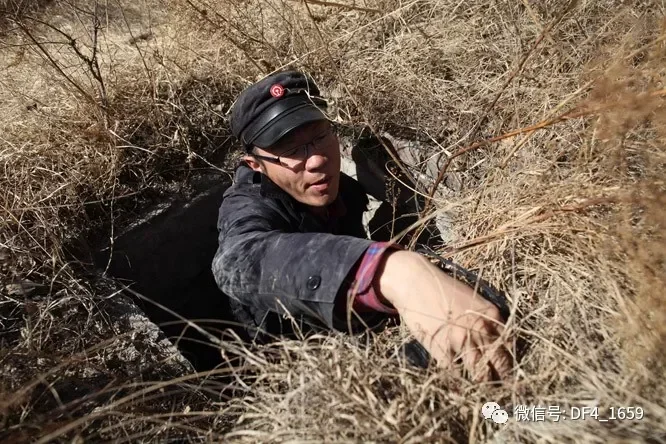
Wang Wei inspecting the pedestrian underpass at Xibozi Station
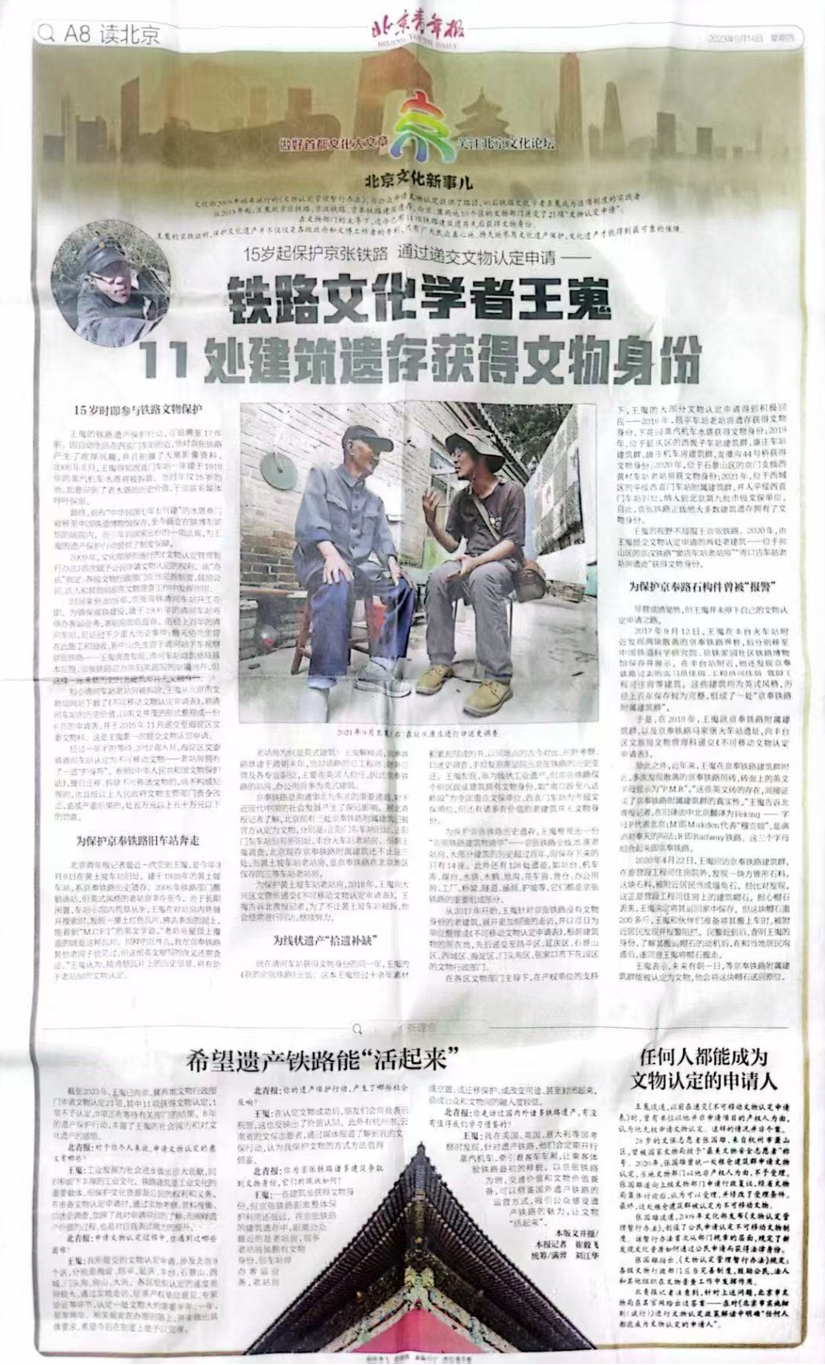
September 14, 2023 Beijing Youth Daily
September 14, 2023 Beijing Youth Daily
The Provisional Measures for the Administration of Cultural Relics Recognition, promulgated and implemented by the Ministry of Culture in 2009, provided a pathway for the public to apply for cultural relic recognition. Wang Wei, a post-1990s railway culture scholar, has become a practitioner of this system.
Since 2015, regarding the architectural relics of the Peking-Zhangjiakou Railway, the Peking-Hankou Railway, and the Peking-Mukden Railway, Wang Wei has submitted 21 "cultural relic recognition applications" to cultural relics departments across 10 districts in Beijing and Hebei. Under the leadership of cultural relics departments, 11 railway architectural relics have successively obtained cultural relic status to date.
Wang Wei's practice proves that protecting cultural heritage is not merely the exclusive domain of governments at all levels and museum professionals; only when the general public sincerely and persistently participates in cultural heritage protection can cultural heritage receive the most reliable safeguards.
Participating in Railway Relic Protection at Age 15
Wang Wei’s railway heritage protection actions can be traced back 17 years. Because he grew up near Xizhimen Station, he developed a strong interest in the Peking-Zhangjiakou Railway and photographed a vast amount of visual materials. In August 2006, Wang Wei learned that a steam locomotive water tower built in 1918 at Xizhimen Station was going to be demolished. At only 15 years old at the time, he recognized the historical value of the old water tower and contacted the media to call for its preservation.
Ultimately, the arched gateway of the water tower, inscribed with "Built in July, the Seventh Year of the Republic of China," was moved to the China Railway Museum for preservation and still stands today in the courtyard of the museum's Dongjiao Branch. A regulation issued by the state three years later provided institutional safeguards for Wang Wei's heritage protection actions.
In 2009, the Provisional Measures for the Administration of Cultural Relics Recognition, promulgated and implemented by the Ministry of Culture, granted citizens the right to apply for cultural relic recognition for the first time. The "Measures" stipulated: Cultural relics administrative departments at all levels shall improve systems and encourage citizens, legal entities, and other organizations to play a role in cultural relics census work.
Time came to 2015, and the construction of Qinghe Station on the Peking-Zhangjiakou High-Speed Railway was imminent. To ensure high-speed rail construction, Qinghe Station, built in 1906, was to suspend passenger transport operations, and the old station building faced abandonment. Having experienced over a century, Qinghe Station has witnessed many major historical events: Mr. Zhan Tianyou once supervised construction and acceptance here, and Mr. Sun Yat-sen once got off at Qinghe Station to inspect the Peking-Zhangjiakou Railway... Wang Wei discovered through investigation that the architectural layout of Qinghe Station is largely intact, and the station plaque inscribed by Chen Zhaochang, Director-General of the Peking-Zhangjiakou Railway, still survives. However, such an old building carrying history lacked cultural relic status.
Fearing that the old station building of Qinghe Station would be demolished, Wang Wei downloaded the Application Form for the Recognition of Immovable Cultural Relics from the Beijing Municipal Bureau of Cultural Heritage website, organized the historical value of Qinghe Station into an illustrated 6-page application form, and submitted it to the Cultural Relics Section of the Haidian District Culture Commission in November 2015. This was Wang Wei's first time submitting a cultural relic recognition application.
After a year and a half of waiting, in May 2017, the Haidian District Culture Commission recognized Qinghe Station as an immovable cultural relic—giving the old station building a "protective talisman." According to the Law of the People's Republic of China on the Protection of Cultural Relics, where immovable cultural relics are unauthorizedly relocated or demolished without constituting a crime, the cultural relics administrative department of the people's government at or above the county level shall order corrective action, and if serious consequences are caused, a fine of not less than 50,000 yuan and not more than 500,000 yuan shall be imposed.
Campaigning to Protect Old Stations of the Peking-Mukden Railway
The Beijing Youth Daily reporter last met Wang Wei on March 9 this year at the former site of Huangtupao Station. Built in 1928, Huangtupao Station is a historical relic of the Peking-Mukden Railway. The railway department abolished the station in 2005, but the British-style old station building has survived to this day. Due to long-term abandonment, weeds overgrown the station's small courtyard. While searching inside and outside the station building, Wang Wei discovered a stack of earthy-red tiles. Brushing away the surface soil, he could see the English lettering "M.C.F.T." "The roof of the old station building is covered with this kind of tile. I have seen the same tile pieces in other old houses along the Peking-Mukden Railway, but the meaning of this group of English abbreviations still needs to be verified," Wang Wei believes that figuring out the historical information on the tiles will help secure cultural relic recognition for the old station building.
Why is the old station building British-style? Wang Wei explained that the Peking-Mukden Railway was built in the late Qing Dynasty. At that time, the chief engineer, financial director, and various professional positions of the railway were mainly held by British people. Therefore, most station buildings and office buildings along the Peking-Mukden Railway were British-style architecture.
The Peking-Mukden Railway was an important channel connecting North China and Northeast China, having a profound impact on the social development of modern China. According to Beijing Youth Daily reporters, three existing subsidiary buildings of the Peking-Mukden Railway in Beijing have been officially recognized as cultural relics: the former site of Zhengyangmen East Station, the former site of the Zhengyangmen East Station Signal Office, and the old station building of Fengtai Railway Station. However, according to Wang Wei's investigation, there are more than just these three surviving subsidiary buildings of the Peking-Mukden Railway in Beijing, and the old station building of Huangtupao Station is the only surviving third-class station old building of the Peking-Mukden Railway in the Beijing region.
To protect the old station building of Huangtupao Station, Wang Wei submitted an Application Form for the Recognition of Immovable Cultural Relics to the Daxing District Cultural Relics Management Office in 2018. Wang Wei told Beijing Youth Daily reporters that to prevent Huangtupao Station from being demolished, he frequently makes return visits and continues his efforts.
"Filling Gaps and Rectifying Omissions" for Linear Heritage
In the same year that Qinghe Station gained cultural relic status, Wang Wei's book My Peking-Zhangjiakou Railway was published. Written after more than a decade of material accumulation, this book presents the historical changes of the Peking-Zhangjiakou Railway through past-and-present comparisons of the same locations, field investigations, oral history surveys, and hand-drawn restoration diagrams. Wang Wei discovered that although it is a linear industrial heritage, only individual sections or buildings of the Peking-Zhangjiakou Railway possess cultural relic status—such as the "Nankou Section to Badaling Section," which is a Major Historical and Cultural Site Protected at the National Level, and Xizhimen Station, which is a municipal-level cultural relic protection unit—while many other valuable old buildings lack cultural relic status.
To protect the historical relics of the Peking-Zhangjiakou Railway, Wang Wei compiled a "List of Peking-Zhangjiakou Railway Buildings"—most of the 25 old station buildings along the entire line have a history exceeding a century, but only 14 have survived. In addition, there are 128 ruins, such as platforms, locomotive sheds, coal platforms, water towers, water cranes, inspection pits, private car houses, warehouses, office buildings, factories, bridges, tunnels, culverts, and revetments, all of which are important components of the Peking-Zhangjiakou Railway.
Beginning in 2017, targeting old buildings of the Peking-Zhangjiakou Railway without cultural relic status, Wang Wei launched more meticulous visits and organized them project by project into Application Forms for the Recognition of Immovable Cultural Relics, submitting them successively to the cultural relics administrative departments of Changping, Yanqing, Shijingshan, Xicheng, Haidian, Mentougou, and Xiayuan District in Zhangjiakou based on the locations of the buildings.
Under the leadership of cultural relics districts and with the support of property-owning units, most of Wang Wei's cultural relic recognition applications received positive responses: in 2018, the old station building relics of Changping Station and the Xiayuan steam locomotive water tower obtained cultural relic status; in 2019, the Xibozi Station building complex, Kangzhuang Station building complex, Kangzhuang locomotive shed complex, and Longtangou Bridge No. 44 located in Yanqing District gained cultural relic status; in 2020, the old station building of Xihuangcun Station on the Jingmen Branch Line in Shijingshan District gained cultural relic status; in 2021, the Pingsui Xizhimen Station subsidiary building complex in Xicheng District was merged into the former site of Pingsui Xizhimen Station and incorporated into Beijing's ninth batch of municipal-level cultural relic protection units. Since then, the vast majority of mainline architectural relics of the Peking-Zhangjiakou Railway have acquired cultural relic status.
Wang Wei's vision is not limited to the Peking-Zhangjiakou Railway. In 2020, two old buildings for which Wang Wei submitted cultural relic recognition applications—the "Doudian Station Old Station Building" and the "Doudian Station Old Station Building Ruins" of the Peking-Hankou Railway in Fangshan District—obtained cultural relic status.
Once "Reported to the Police" While Protecting Stone Components of the Peking-Mukden Line
Despite his remarkable achievements, Wang Wei has not stopped his journey of applying for cultural relic recognition.
On September 12, 2017, Wang Wei discovered two scattered Peking-Mukden Railway boundary posts near Fengtai Railway Station, which were later moved to the China Academy of Railway Sciences and the Railway Museum in Jingtie Jiayuan Community for preservation and display respectively. Near Fengtai Station, he also discovered past railway trainee housing, engineer housing, engineering section housing, and other buildings of the Peking-Mukden Railway. These buildings are all British-style, have survived for over a century in a relatively complete state, and form a "Peking-Mukden Railway Subsidiary Building Complex."
Therefore, in 2018, Wang Wei submitted Application Forms for the Recognition of Immovable Cultural Relics to the Cultural Relics Management Section of the Fengtai District Culture and Tourism Bureau regarding the Peking-Mukden Railway Subsidiary Building Complex and the Majiapu Railway Station site of the Peking-Mukden Railway.
In addition, in recent years, Wang Wei has repeatedly discovered scattered Peking-Mukden Railway bricks near the Peking-Mukden Railway building complex, with the English letters on the brick faces showing "P.M.R." "The existence of these English bricks indirectly confirms the authenticity of the Peking-Mukden Railway subsidiary building complex," Wang Wei told Beijing Youth Daily reporters. In the old translation method, Beijing was translated as Peking—the letter P represents Peking; M stands for Mukden, which is the Manchu pronunciation for Fengtian; R stands for Railway. The combination of these three letters represents the Peking-Mukden Railway.
On April 22, 2020, Wang Wei revisited the Peking-Mukden Railway building complex and discovered a square-pyramidal stone block outside the courtyard of the former engineering section housing. This stone block was used as a corner cornerstone by nearby residents. Upon comparison, it was found to be precisely the architectural capstone from the engineering section housing. Fearing that the capstone would be lost, Wang Wei decided to transport it home for preservation. However, this capstone weighed more than 200 catties. When Wang Wei and his partners prepared to load it onto a vehicle, they were spotted by nearby residents who called the police to stop them. After the police arrived, verified Wang Wei's identity, and understood his motivation for moving the capstone, they communicated with the local residents and agreed to let Wang Wei take the capstone away.
Wang Wei stated that one day in the future, when the Peking-Mukden Railway subsidiary building complex can be recognized as cultural relics, he will return this capstone to its original position.
New Concept: Hoping Heritage Railways Can "Come Alive"
As of 2023, Wang Wei has submitted 21 cultural relic recognition applications to cultural relics administrative departments in Beijing and Hebei, among which 11 have obtained cultural relic recognition, 1 was rejected, and 9 are awaiting results from relevant departments. Eight years of heritage protection actions have enriched Wang Wei's social experience and insights into cultural heritage.
Beijing Youth Daily: For you personally, what are the significances of applying for cultural relic recognition?
Wang Wei: Industrial development has made huge contributions to social progress while accumulating rich industrial culture. Railway architecture is an important carrier of industrial culture, and protecting cultural resources is a citizen's right and obligation. When preparing cultural relic recognition applications, through field investigations, data collection, and oral history surveys, my understanding of the applied project was deepened; meanwhile, the process of interpreting heritage value is also an enhancement of self-expression ability.
Beijing Youth Daily: What difficulties have you encountered during the process of applying for cultural relic recognition?
Wang Wei: The cultural relic recognition applications I submitted involve 9 districts in Beijing: Haidian, Changping, Yanqing, Fengtai, Shijingshan, Xicheng, Mentougou, Fangshan, and Daxing. The speed of organizing recognition varies greatly among districts. Through field visits, soliciting opinions from property-owning units, expert demonstrations, and other links, it takes about half a year, a year, or even two years to recognize a cultural relic. Relevant regulations do not specify operational time limits, and I hope this can be improved institutionally in the future.
Beijing Youth Daily: What social responses have your heritage protection actions generated?
Wang Wei: After successful cultural relic recognition, friends congratulate me, which also reflects value identity. In addition, cultural preservation volunteers from Hangzhou and Yunnan learned about my preservation actions through media reports and believed that my methods and approaches to protecting cultural relics are worth referencing.
Beijing Youth Daily: You have campaigned to secure cultural relic status for many buildings of the Peking-Zhangjiakou Railway; what is their current status?
Wang Wei: Although some buildings have obtained cultural relic status, the overall protection and utilization of the Peking-Zhangjiakou Railway are still a long way off. Among the architectural relics of the Peking-Zhangjiakou Railway, those closest to the public are the old station buildings. Although many old station buildings possess cultural relic status, passenger transport operations at the stations have been suspended, and the old station buildings are either vacant, relocated for protection, repurposed, or even closed off, resulting in low integration between the public and the cultural relics.
Beijing Youth Daily: You have visited many railway heritages at home and abroad; are there any worth learning from and referencing?
Wang Wei: During my investigations in countries like the United States, the United Kingdom, and Italy, I found that for heritage railways, they regularly run steam locomotives pulling passenger carriages to let passengers experience the original appearance of the railway. Taking the Peking-Zhangjiakou Railway as an example, it possesses both transportation and cultural relic value. We can draw upon the operation methods of foreign heritage railways to attract the public to experience the charm of heritage railways and make cultural relics "come alive."
(Text and Photos / Beijing Youth Daily Reporter Cui Yifei)
(Overall Coordination / Manyi, Liu Jianghua)
Anyone Can Become an Applicant for Cultural Relic Recognition
Wang Wei mentioned that previously when submitting Application Forms for the Recognition of Immovable Cultural Relics, some units argued that he had no right to apply for cultural relic recognition on the grounds that he was not the property owner of the applied project. Such cases are not isolated.
Zhang Guoxiong, a 28-year-old cultural preservation volunteer from Xiaoshan District, Hangzhou, was once awarded the title of "Most Beautiful Cultural Relics Safety Volunteer" by the National Cultural Heritage Administration. In 2020, Zhang Guoxiong applied for cultural relic recognition regarding a granary building complex, but local cultural relics departments refused to accept it on the grounds that he was not the property owner. Zhang Guoxiong then applied for administrative reconsideration to the higher-level cultural relics department. After collective discussion by the Provincial Cultural Heritage Bureau, it was deemed acceptable, and the acceptance conditions were modified. Ultimately, this granary building complex was recognized as an immovable cultural relic.
Zhang Guoxiong noted that in 2009, the Ministry of Culture issued the Provisional Measures for the Administration of Cultural Relics Recognition, establishing a system for citizens to apply for the recognition of immovable cultural relics. These provisional measures stipulated for the first time at the departmental regulatory level how newly discovered cultural resources can obtain legal identity through citizen applications.
Zhang Guoxiong pointed out that the Provisional Measures for the Administration of Cultural Relics Recognition stipulate: Cultural relics administrative departments at all levels shall improve systems and encourage citizens, legal entities, and other organizations to play a role in cultural relics census work.
Beijing Youth Daily reporters noticed that regarding the above issue, the Beijing Municipal Bureau of Cultural Heritage has given an answer on its official website—clearly stating in the policy interpretation of cultural relic recognition for the Beijing Implementation Rules (Trial) that "anyone can become an applicant for cultural relic recognition."
