
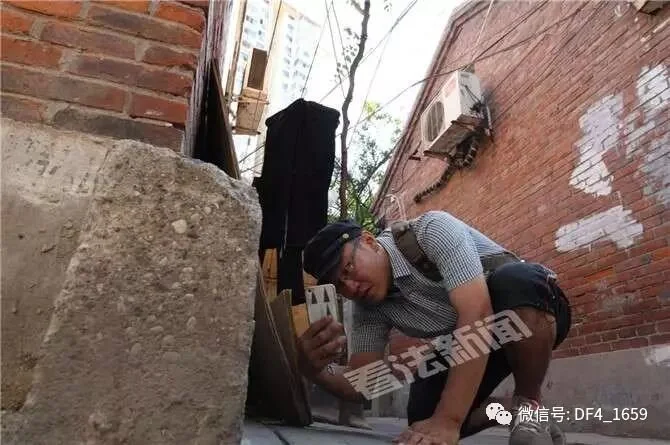
When Wang Wei discovered the boundary markers, most of them were buried in the earth. Photo / Legal Evening News / Law Vision News Reporter Cui Yifei
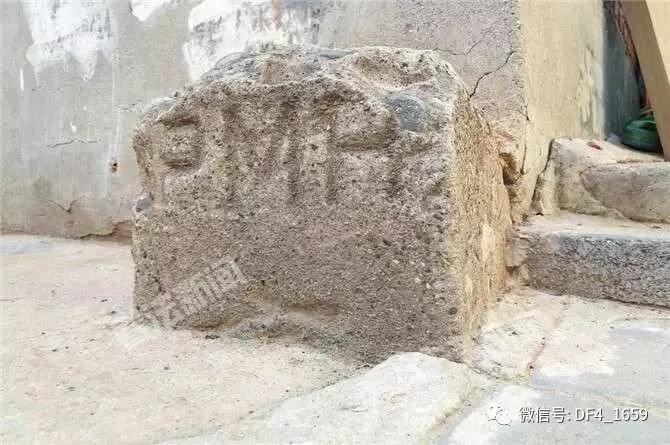
The state of the two boundary markers when they were half-buried. Photo / Legal Evening News / Law Vision News Reporter Cui Yifei
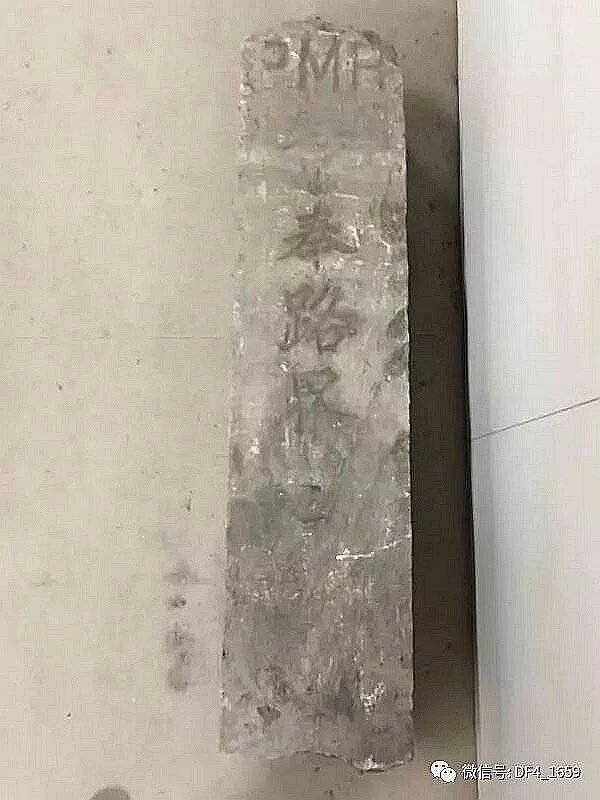
After the boundary markers were pulled out of the mud, the complete clerical script Chinese characters "京奉路界" (Beijing-Mukden Railway Boundary) were revealed. Image Provided by / Jin Wangzhi
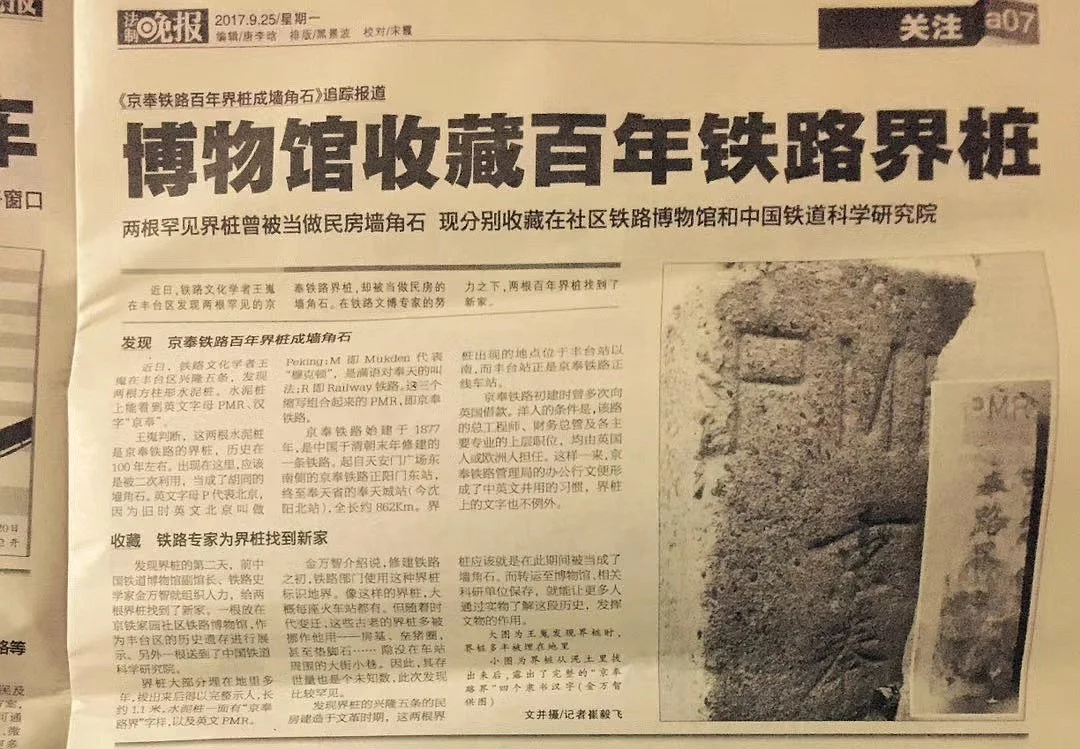
September 21, 2017, Legal Evening News
September 21, 2017, Legal Evening News
Legal Evening News / Law Vision News (Reporter Cui Yifei) — Recently, a railway cultural scholar discovered two rare Beijing-Mukden Railway boundary markers in Fengtai District, Beijing, which were being used as corner stones for residential houses.
Through the efforts of railway culture and museum experts, these two century-old boundary markers recently moved into their new homes: the Jingtie Jiayuan Community Railway Museum and the China Academy of Railway Sciences.
Discovery: Century-Old Beijing-Mukden Railway Boundary Markers Become Corner Stones
Recently, railway cultural scholar Wang Wei discovered two square-column concrete posts in Xinglong Fifth Lane, Fengtai District. The English letters "PMR" and the Chinese characters "京奉" (Beijing-Mukden) could be seen on the concrete posts.
Wang Wei told Legal Evening News / Law Vision News reporters that these two concrete posts are boundary markers of the Beijing-Mukden Railway, with a history of about 100 years. Their appearance here suggests they were secondary-reused, serving as hutong corner stones. The English letter P stands for Peking, as Beijing was called in English in the old days; M stands for Mukden, which is the Manchu designation for Fengtian; and R stands for Railway. The combination of these three abbreviations, PMR, stands for the Beijing-Mukden Railway.
The Beijing-Mukden Railway was initially built in 1877, a railway constructed by China in the late Qing Dynasty. It started from Zhengyangmen East Station of the Beijing-Mukden Railway on the southeast side of Tiananmen Square and ended at Fengtian City Station in Fengtian Province (now Shenyang North Station), with a total length of about 862 km. The location where the boundary markers appeared is situated south of Fengtai Station, and Fengtai Station was precisely a mainline station of the Beijing-Mukden Railway.
When the Beijing-Mukden Railway was initially built, it borrowed money from Britain multiple times. The foreigners' condition was that the chief engineer, financial manager, and senior positions in various major specialized fields of the railway must be held by British or European personnel. Consequently, the official correspondence and documentation of the Beijing-Mukden Railway Administration formed a habit of using both Chinese and English, and the text on the boundary markers was no exception.
Collection: Railway Experts Find a New Home for the Boundary Markers
On the second day after discovering the boundary markers, Jin Wangzhi, former deputy curator of the China Railway Museum and a railway historian, organized personnel to find a new home for the two boundary markers. One was placed in the Jingtie Jiayuan Community Railway Museum to be exhibited as a historical relic of Fengtai District, and the other was sent to the China Academy of Railway Sciences.
Most of the boundary markers had been buried in the ground for years, and after being pulled out, they were able to be displayed in their entirety, measuring about 1.1 meters in length. One side of the concrete posts features the words "京奉路界" (Beijing-Mukden Railway Boundary) as well as the English letters PMR.
Jin Wangzhi introduced to Legal Evening News / Law Vision News reporters that at the beginning of railway construction, the railway department used such boundary markers to demarcate land boundaries. Boundary markers like these probably existed at every railway station. However, with the vicissitudes of time, these ancient boundary markers were mostly repurposed for other uses—foundations, building pigsties, or even stepping stones... Therefore, the quantity surviving in the world remains an unknown, making this discovery quite rare.
The residential houses in Xinglong Fifth Lane where the boundary markers were discovered were built during the Cultural Revolution, and these two boundary markers must have been used as corner stones during that period. Transferring them to museums and relevant scientific research units for preservation will allow more people to understand this history through physical objects, giving full play to the role of cultural relics.
Reporter: Cui Yifei
