
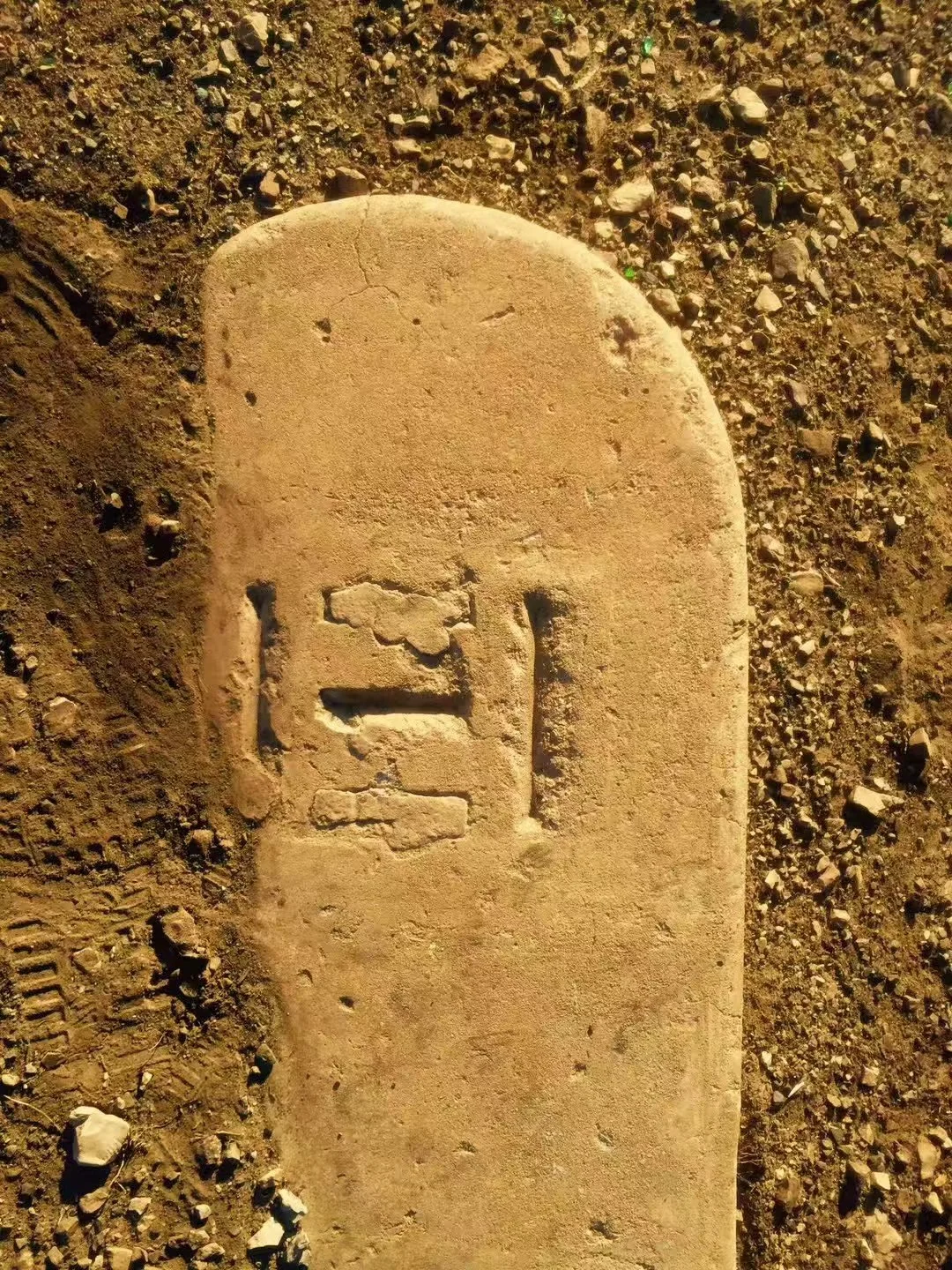
131 Suzhou numeral mileage post. Image provided by Wang Wei
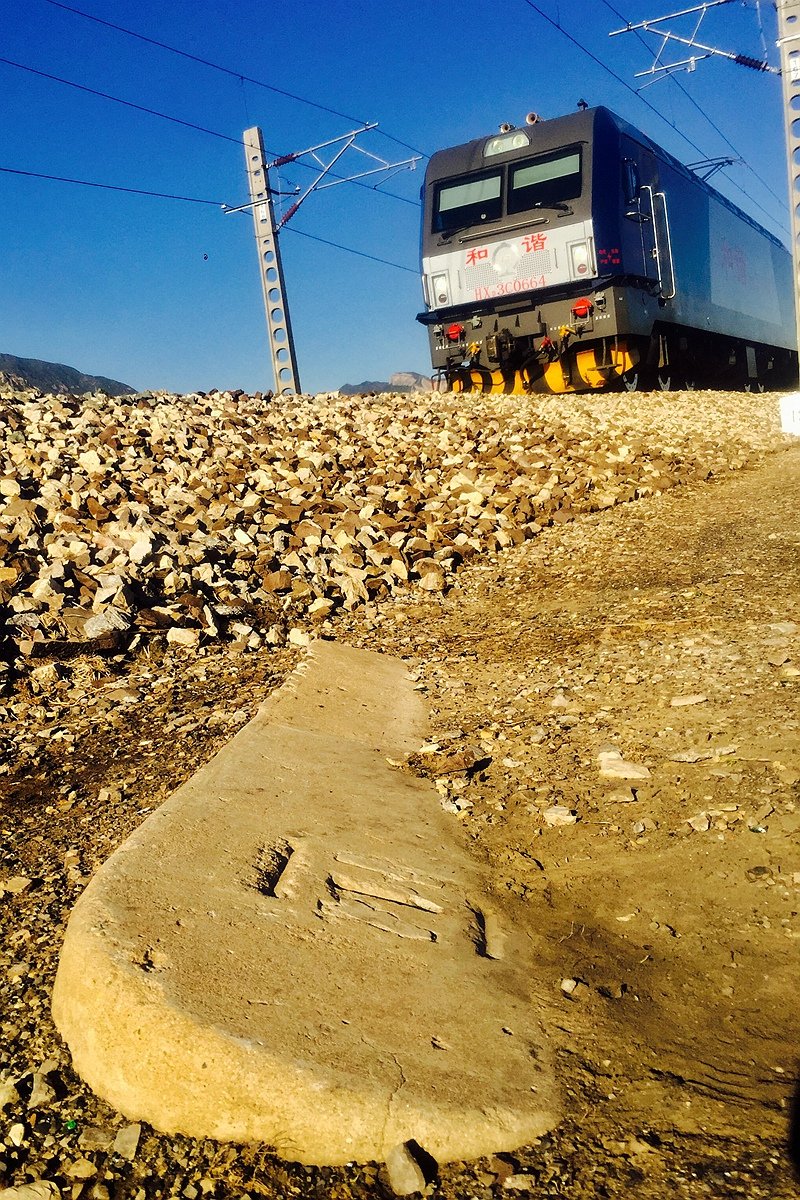
A southbound train passes the 131 mileage post. Image provided by Wang Wei
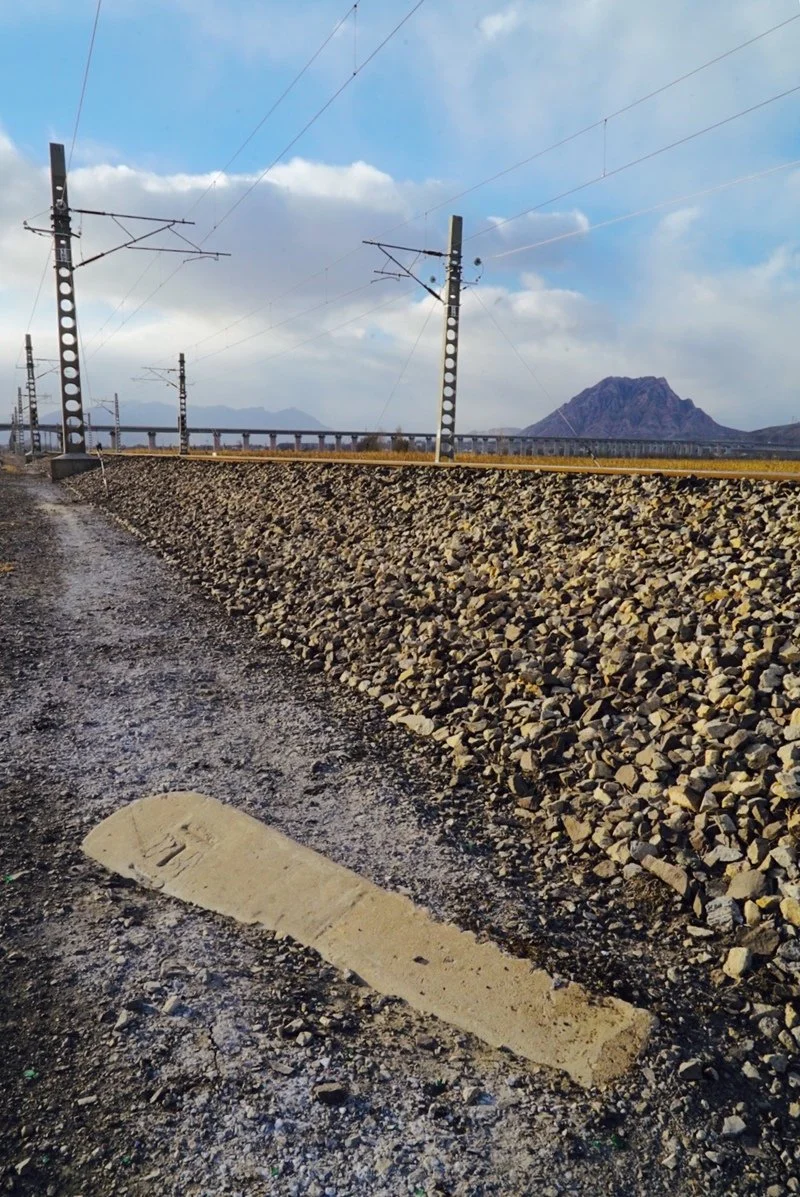
Pictured above: The Suzhou numeral post by the railway side
Image provided by: Wang Wei
September 25, 2017, Legal Evening News
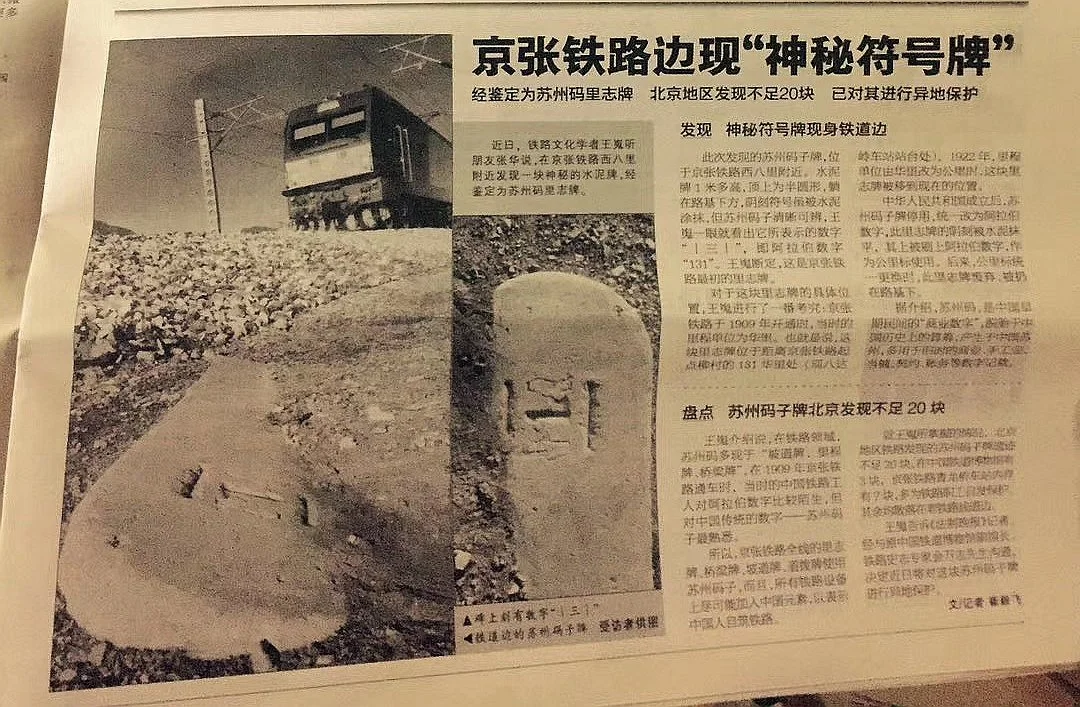
Legal Evening News / Law Vision News (Reporter Cui Yifei) — Recently, railway cultural scholar Wang Wei heard from his friend Zhang Hua that a mysterious cement board was discovered near Xibali along the Beijing-Zhangjiakou Railway, which was identified upon appraisal as a Suzhou numeral mileage post.
Discovery: Mysterious Symbol Board Appears Beside the Railway
The Suzhou numeral post discovered this time is located near Xibali along the Beijing-Zhangjiakou Railway. The cement board is over 1 meter tall with a semi-circular top, lying below the roadbed. Although the carved symbols were coated with cement, the Suzhou numerals remain clearly discernible. Wang Wei recognized at a glance that the numbers represented are "〡三〡", which corresponds to the Arabic numeral "131". Wang Wei concluded that this is an original mileage post of the Beijing-Zhangjiakou Railway.
Regarding the specific location of this mileage post, Wang Wei conducted some research: when the Beijing-Zhangjiakou Railway opened in 1909, the mileage unit at that time was the li (Chinese mile). In other words, this mileage post was located 131 li away from Liucun, the starting point of the Beijing-Zhangjiakou Railway (now at the platform of Badaling Station). In 1922, when the mileage unit was changed from li to kilometers, this mileage post was moved to its current location.
After the founding of the People's Republic of China, Suzhou numeral posts were discontinued and uniformly replaced by Arabic numerals. The carved inscriptions on this mileage post were smoothed over with cement and painted with Arabic numerals to be used as a kilometer marker. Later, when kilometer markers were uniformly replaced, this mileage post was abandoned and discarded beneath the roadbed.
According to introductions, Suzhou numerals are early Chinese folk "commercial numerals," evolved from counting rods in Chinese history, originating in Suzhou, China, and mostly used for numerical records in old-time commerce, handicrafts, pawnshops, contracts, accounting, and bookkeeping.
Inventory: Fewer Than 20 Suzhou Numeral Posts Discovered in Beijing
Wang Wei introduced that in the railway field, Suzhou numerals mostly appeared on "gradient boards, mileage posts, and bridge boards." When the Beijing-Zhangjiakou Railway opened to traffic in 1909, Chinese railway workers at the time were relatively unfamiliar with Arabic numerals, but were most familiar with traditional Chinese numbers—Suzhou numerals. Therefore, the mileage posts, bridge boards, gradient boards, and switch boards along the entire Beijing-Zhangjiakou Railway used Suzhou numerals. Moreover, Chinese elements were incorporated into all railway equipment as much as possible to signify that it was a railway built by the Chinese themselves.
Based on information mastered by Wang Wei, fewer than 20 relics of Suzhou numeral posts have been found on railways in the Beijing area. There are 3 at the China Railway Museum, 7 preserved inside Qinglongqiao Station on the Beijing-Zhangjiakou Railway (mostly voluntarily protected by railway workers), and the rest are scattered along the tracks of old railway lines.
Wang Wei told Legal Evening News / Law Vision News reporters that, after communicating with Mr. Jin Wangzhi, former deputy curator of the China Railway Museum and a railway history and gazetteer expert, it was decided that this Suzhou numeral post will be relocated for off-site preservation in the near future.
Text and photos by/Reporter Cui Yifei
September 25, 2017, Legal Evening News
