

Pictured above: The public toilet where Wang Wei discovered the brick.Photo / Legal Evening News / Law Vision News Reporter Cui Yifei
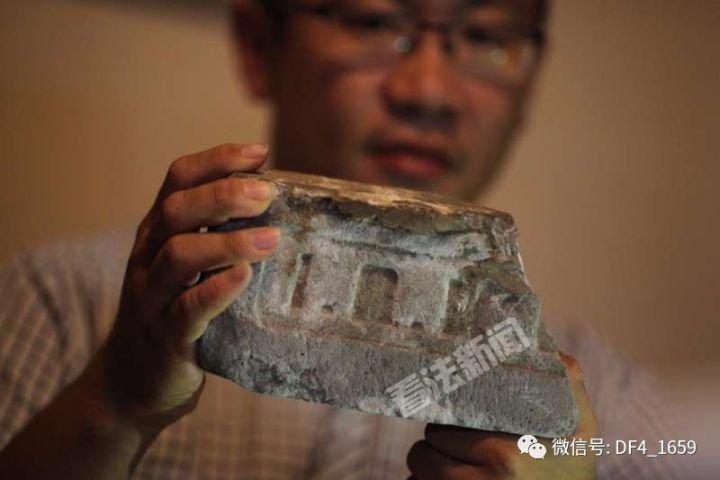
Pictured above: Wang Wei holding the incomplete old brick, with the characters "I·R·N" visible on it.
Photo / Legal Evening News / Law Vision News Reporter Cui Yifei
September 30, 2017, Legal Evening News
Legal Evening News / Law Vision News (Reporter Cui Yifei) — Treasures can be hidden even in toilets. Recently, railway cultural scholar Wang Wei discovered in a public toilet south of Fengtai District, Beijing, that the brick used to prop open the door was actually engraved with English letters. Preliminary judgment indicates that the history of this brick exceeds a century.
Recently, while using a public toilet south of Fengtai Railway Station, Wang Wei squatted down at the door as he was leaving. His companion thought he felt unwell, but little did he know Wang Wei had made a new discovery: the brick used as a doorstop for the public toilet had caught Wang Wei's attention.
Relying on his cultural relic intuition honed from years of field surveys, Wang Wei picked up this doorstop brick and found that it bore the English letters "I·R·N". There should have been other letters after the letter N, but they could no longer be identified due to the brick being chipped and incomplete. Wang Wei immediately took the brick home.
Upon arriving home, Wang Wei first gave the grey brick a "bath" with laundry detergent and then began his research. Searching online, he found that similar grey bricks had been unearthed in China before, with the letters "I·R·N·C" on one side of the brick, which were almost identical to the grey brick he discovered this time.
He consulted materials to learn the meaning of the letters: I—imperial; R—railway; N—north; C—china. Online, some scholars translated it as the "Imperial Railways of North China," namely the railway administration established by the Qing government in 1891.
Wang Wei deduced that this grey brick should have originated from railway auxiliary buildings. The location where it was discovered near Fengtai Railway Station further proves its connection to the railway, and Fengtai Railway Station is one of the earliest railway stations in Beijing.
Jin Wangzhi, an expert in Chinese railway history, believes that the brick discovered by Wang Wei is quite rare and has a history of over 100 years, holding certain material value for the study of Chinese railway history.
Text and photos by/Reporter Cui Yifei
