
Beijing Republic-Era Building Questioned as "Restored to Look Like New"; Officials State It Restores the Original Historical Appearance
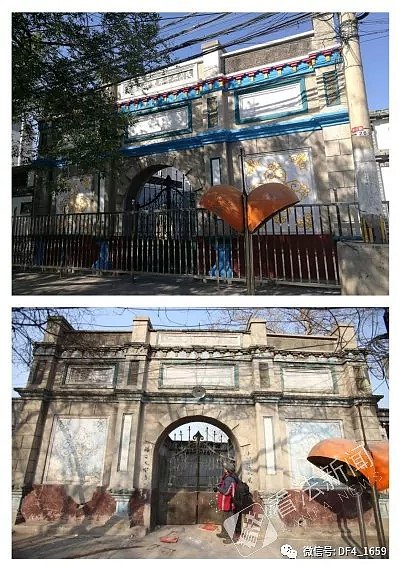
Compared to before the restoration, the restored gateway features vibrant colors. Photo: Legal Evening News · Lookout News Reporter: Cui Yifei
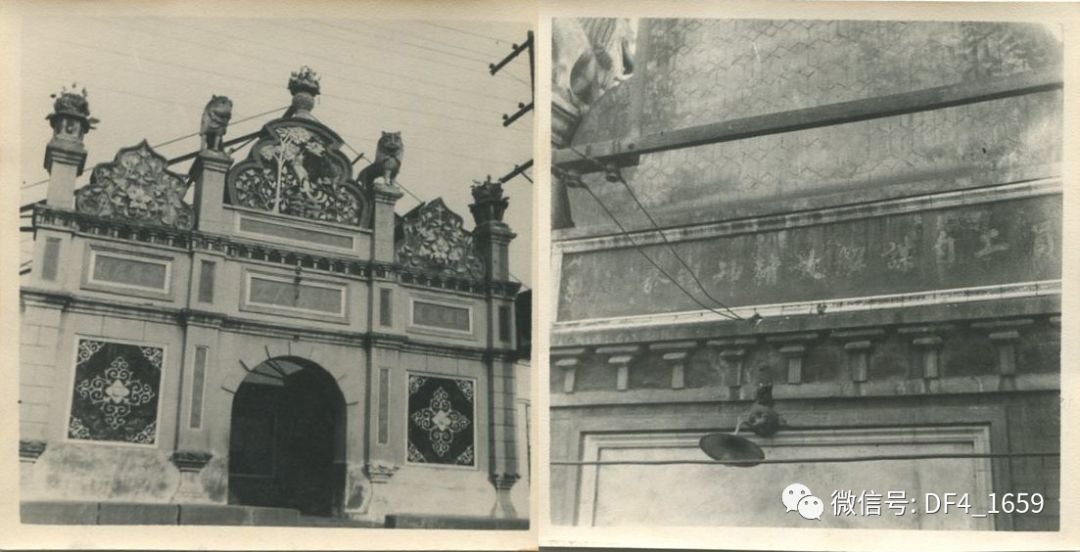
The gateway's appearance before the Cultural Revolution: a pair of stone lions sat atop it, and the words "Workers' Bathhouse" can be seen. The inscription on the back reads "Employees striving for self-emancipation reflected in the bathhouse." These decorations and inscriptions were not reinstated during the restoration. (Photographer unknown)
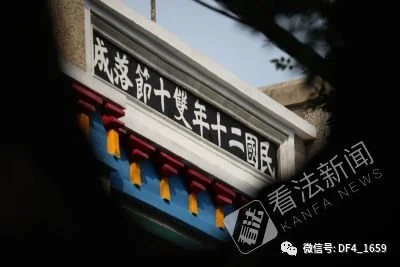
After the restoration, "new" inscriptions appeared on the gateway. Photo: Legal Evening News · Lookout News Reporter: Cui Yifei
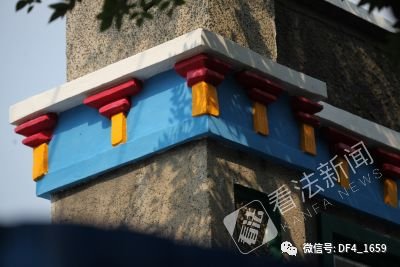
After the restoration, "new" inscriptions appeared on the gateway. Photo: Legal Evening News · Lookout News Reporter: Cui Yifei
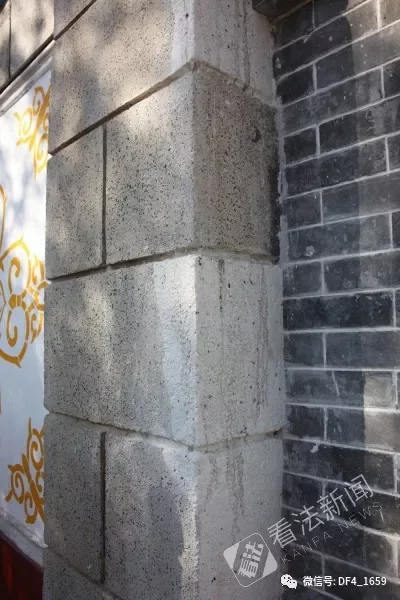
Uneven painting is visible on the wall.
Photo: Legal Evening News · Lookout News
Reporter: Cui Yifei
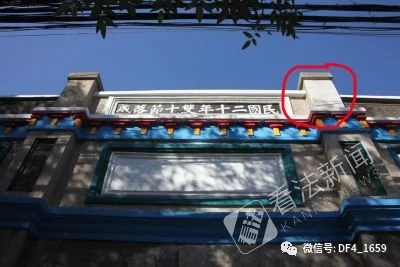
The two symmetrical column capitals: the left one is unpainted, and the right one is unevenly painted. Photo: Legal Evening News · Lookout News Reporter: Cui Yifei
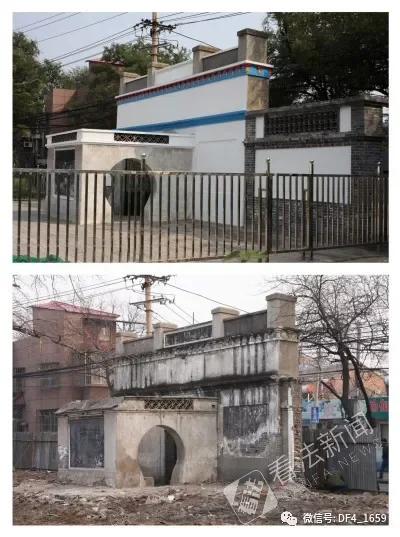
A large area of the back of the restored gateway is painted white. Photo: Legal Evening News · Lookout News Reporter: Cui Yifei
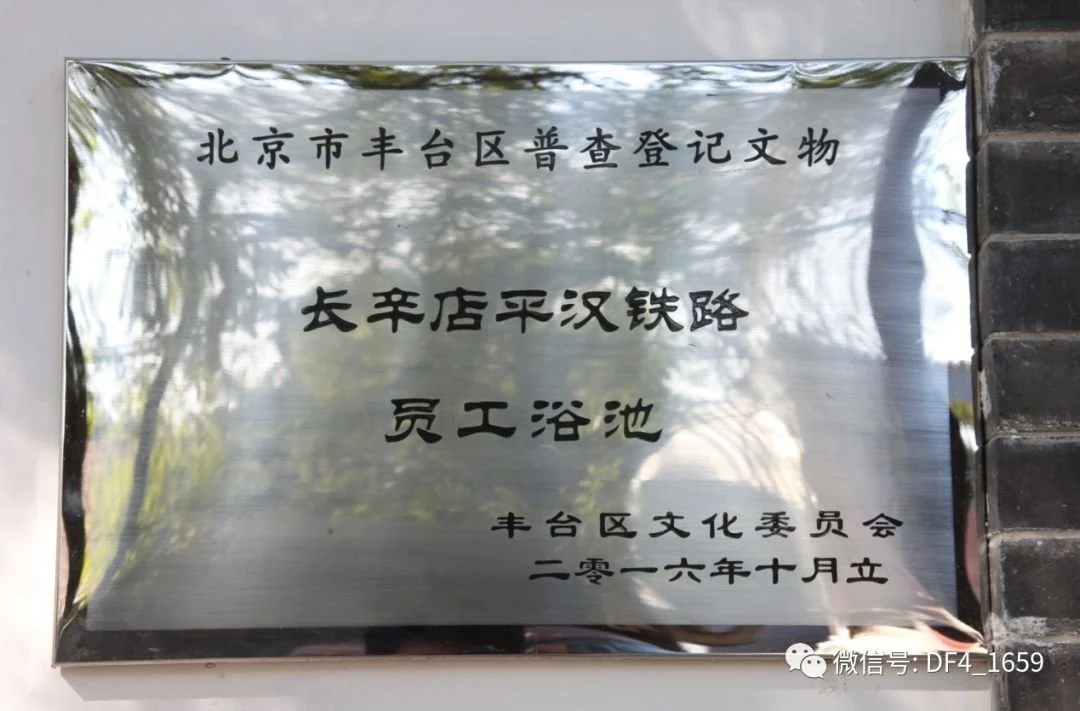
The bathhouse on the cultural relic protection sign was demolished in 2015, leaving only the bathhouse archway and screen wall. (Photo: Legal Evening News · Lookout News, Reporter Cui Yifei)
October 25, 2018, Legal Evening News
Legal Evening News · Lookout News (News Observer: Fan Jiping, Reporter: Cui Yifei) Among the numerous cultural relics in the Changsinan area, the Pinghan Railway Employee Bathhouse holds the lowest official grading, categorized merely as a census-registered project, yet it is the most closely connected to the local people because this old bathhouse served generations of Changsinan residents. Recently, the surviving gateway of the bathhouse completed its restoration project, but it has drawn skepticism from surrounding residents. Many who experienced the old bathhouse firsthand believe that the gateway's paint is too vibrant, masking its historical vicissitudes. The relevant department of the Fengtai Cultural Commission responded by stating that the purpose of the coloring was to restore the original historical appearance.
Question 1: Post-Restoration Inscription Appears, Never Seen by Residents On Chenzhuang Street in Changsinan, Fengtai District, Beijing, a Western-style gateway enclosed by corrugated iron walls for three years recently completed its cultural relic restoration. The newly unveiled old gateway feels both familiar and unfamiliar. Following the restoration, the gateway's structure of four columns and three bays remains unchanged. Embedded masonry plaques were positioned above the entrance, though much of the text information had worn away over the course of 87 years. Through this restoration, a horizontal plaque at the top of the lintel now displays the traditional Chinese characters reading "Completed on Double Ten Day, the 20th Year of the Republic," corresponding to October 10, 1931. Double Ten Day serves as both the anniversary of the Xinhai Revolution and the national day of the Republic of China. "I remember a pair of stone lions once sat atop the gateway, which were destroyed during the Cultural Revolution. But I really don't recall this line of text," said Mr. Yin, who used to bathe at the bathhouse, looking puzzled as he gazed at the writing. Mr. Yin believes it is true that the bathhouse was built in 1931, but he never actually saw this line of text. Not just Mr. Yin—reporters interviewed 10 local residents, none of whom remembered any such inscription. Nearby Erqi Factory employees provided two old photographs of the gateway showing that several stone plaques on it did indeed feature inscriptions. Above the entrance read "Workers' Bathhouse," though the characters for "Completed on Double Ten Day, the 20th Year of the Republic" could not be made out. Meanwhile, the horizontal plaque on the back of the gateway bore the traditional characters "Employees Striving for Self-Emancipation Reflected in the Bathhouse" written from right to left. However, the text visible in the old photographs was not reinstated during the restoration.
Official Response: Inscription Is a New Discovery; Coloring Is to Restore the Original Historical Appearance
Recently, a Legal Evening News · Lookout News reporter called the Cultural Relics Management Office of the Fengtai District Cultural Commission. A female staff member explained that the text on the lintel was discovered when they were scraping off the wall surface during the restoration process. These characters were originally covered by paint and were therefore restored.
During the restoration process, they discovered that parts of the building had residual colors, though they had weathered years of wind and sun. To restore the original historical appearance, they made judgments based on the base colors and chose traditional mineral pigments to restore the colored sections.
The reporter noted that on June 5, 2018, the Fengtai District Cultural Commission published an announcement on its official website stating that the District Cultural Relics Office had organized a commencement briefing for the restoration project of the Changxindian Pinghan Railway Employee Bathhouse. Due to years of disrepair, the gateway had become tilted. To ensure the safety of the cultural relic, the District Cultural Relics Office commissioned professional designers to formulate a design plan, and after approval by the District Cultural Commission, launched the restoration project. The restored Changxindian Pinghan Railway Employee Bathhouse will, on the premise of not altering its historical style, better showcase the Republican-era architectural characteristics of the Changxindian area to the public.
The reporter consulted the Principles for the Conservation of Heritage Sites in China, which stipulates that the purpose of restoration is to eliminate structural hazards, repair damaged components, and restore the original state of the cultural relic. Restoration does not permit redecorating and repainting for the purpose of pursuing a fresh and gorgeous appearance.
In the responses from relevant departments, the purpose of the restoration was to restore the original historical appearance, rather than pursuing a fresh and gorgeous look; however, the outcome ended up giving the public a fresh and gorgeous visual impression.
Question 2: Colors Are Too Vibrant; Is Painting Necessary? After three months of restoration, the wall base of the gateway was painted brownish-red, the repeating geometric patterns on both sides of the entrance were repainted, the junction in the upper part of the gateway was colored blue, the deformed small lantern decorations were painted red and yellow, the embedded masonry plaques were outlined in green, and a large area of the back of the gateway was painted white. These newly painted colors were criticized by local residents as being flashy, gaudy, and overly bright. "Tragic, ridiculous, lamentable..." Having bathed at the workers' bathhouse since childhood, Mr. Yin holds deep emotional attachment to this gateway. He believes that the newly applied paint colors are too vibrant and harsh, masking the historical vicissitudes of the old gateway and making it feel as though one has entered an "amusement park." Ms. Wang, born in the 1990s, used to accompany her mother to the workers' bathhouse during her childhood. She feels that the restored gateway lacks the characteristic ambiance a cultural relic ought to have. Restoring cultural relics should not simply involve a fresh coat of paint; rather, items should be repaired to preserve their old appearance. Structural instability can be reinforced, but parts like these that were painted do not affect the building's safety or stability. There was entirely no need to embellish them, and keeping the original appearance would have sufficed. Upon seeing the restored gateway, railway culture scholar Wang Wei raised a question: Is this completely finished? He believes the paint is too brilliant, giving it a somewhat "restored to look like new" appearance. What Wang Wei finds most regrettable is that the bathhouse building was demolished in 2015 with the promise of building a parking lot, yet it remains a vacant lot to this day. Comparing it with pre-restoration photographs, the painted parts all showed traces of original colors, which had mostly weathered and faded after 87 years of exposure to the sun and rain, looking weathered by time. Observers noted that the painted sections were selected based on the original colors and repainted accordingly. In individual locations, uneven painting was evident.
Scholar Commentary: Insufficient Historical Research; Restoration Should Be More Cautious Cui Jinze, a doctoral researcher at the Department of Civil Engineering, Faculty of Engineering Science, KU Leuven, Belgium, and the Raymond Lemaire International Centre for Conservation, believes that in the restoration of the Changxindian Pinghan Railway Employee Bathhouse, the cultural relics department only focused on "historical information," assuming that as long as the historical information is sufficient, restoration can proceed. To external experts, it may merely be an ordinary census-registered Republican-era building, so the sole starting point for restoration was "historical information." However, the local residents' perception of the gateway is evidently more direct, subjective, and emotionally driven. Their emotions need to be anchored through a sense of temporal distance. These living generations may have never seen those newly uncovered historical pieces of information and thus do not resonate with the cultural relics department's restoration outcome. The fundamental reason is that because this building does not possess an ancient history, nor is its artistry prominent enough universally, the cultural relics department and local residents perceive the cultural relic's value differently. The historical timeframes from which they derive their sense of identity toward the cultural relic building also differ, which is why stakeholders perceive differing values. Since the goal is to restore the original historical appearance, more historical information should have been gathered. However, comparing the restoration results with historical photographs gives the impression that the design team's collection of historical information was not comprehensive. The builders and designers wanted to restore the state of the building upon its initial completion, but due to insufficient historical research, they created a sense of temporal confusion. They restored the colors to the newly built state while leaving the form incomplete, resulting in a state that never existed historically—neither truly old nor truly new, neither authentic nor fake. Cui Jinze believes that when historical information is insufficient, restoration should be approached more cautiously. Rather than taking bold and overly confident steps to restore it, it would be better to respect the social value inherent in the cultural relic itself, listen to the opinions of stakeholders and local residents, and respect their emotional connection to the relic.
Related Information: The 87-Year Rise and Fall of the Old Bathhouse The Changxindian Pinghan Railway Employee Bathhouse is located on Chenzhuang Street, Changxindian Street, Fengtai District. It was initiated by the Pinghan Railway Union and funded through donations by over 3,000 railway workers in the Changxindian area. Completed in the 20th year of the Republic (1931), it resolved the difficulty of taking baths for tens of thousands of railway workers and their families in the Changxindian area. The "Historical Sketch of the Changxindian Pinghan Railway Employee Bathhouse" embedded in the screen wall has survived to this day and serves as a unique witness to this history. Unlike other public bathhouses, the workers built this bathhouse not for profit, but purely as a welfare benefit for fellow workers. According to Mr. Liu, who experienced it firsthand, railway workers bathed at the workers' bathhouse for free in the 1970s, and family members could obtain a permit and buy a bath ticket for five cents. The most distinctive feature of the bathhouse was its three large pools: "warm water, hot water, and scalding water." The warm water pool back then was a paradise for children, where swimming and breath-holding competitions began. By the end of the last century, showers entered ordinary households, and the workers' bathhouse gradually fell into disuse. Until early 2015, ownership of the bathhouse had transferred from the original Erqi Factory to Beijing University of Chinese Medicine Dongfang Hospital, and the workers' bathhouse building—which embodied the simple emotions of several generations of Changxindian residents—was razed to the ground. Fortunately, the Western-style gateway and screen wall of the bathhouse were preserved and recognized as immovable cultural relics by the Fengtai District Cultural Commission on January 22, 2015. On April 25, 2018, the restoration project for the gateway of the Changxindian Pinghan Railway Employee Bathhouse commenced and was completed on July 23 of the same year. The funding source was financial appropriation, and the quality standard was designated as qualified.
