
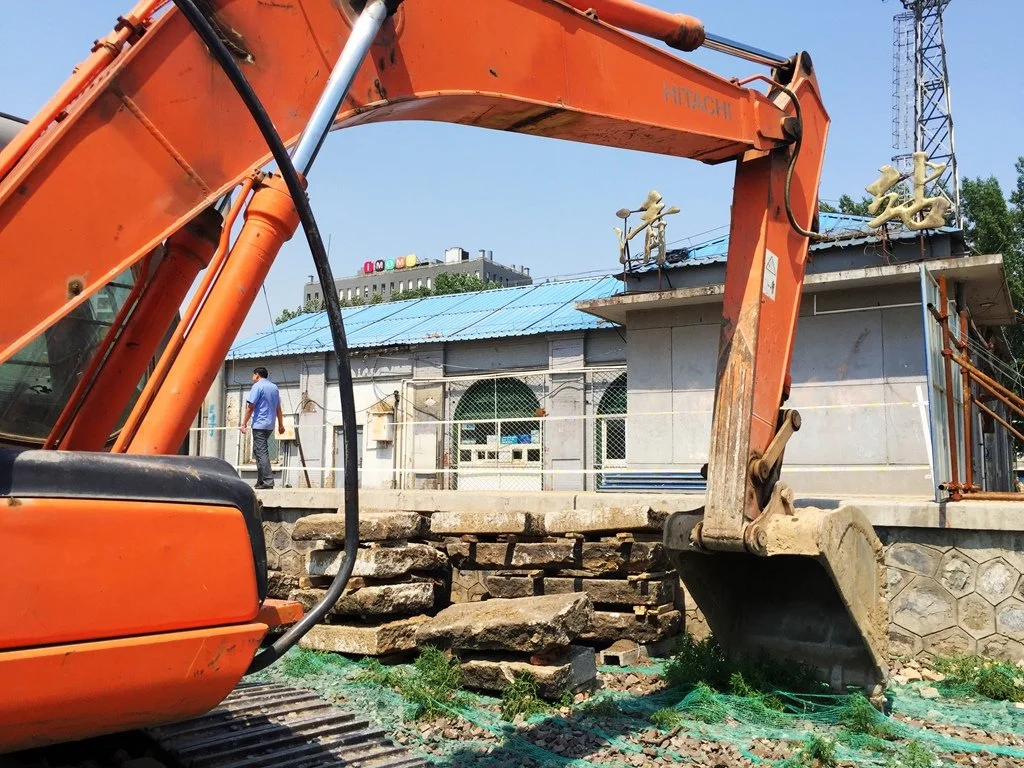
Pictured above: After the 1906 platform on the west side of Qinghe Station was demolished, its platform capstones were piled up in front of the old station building.
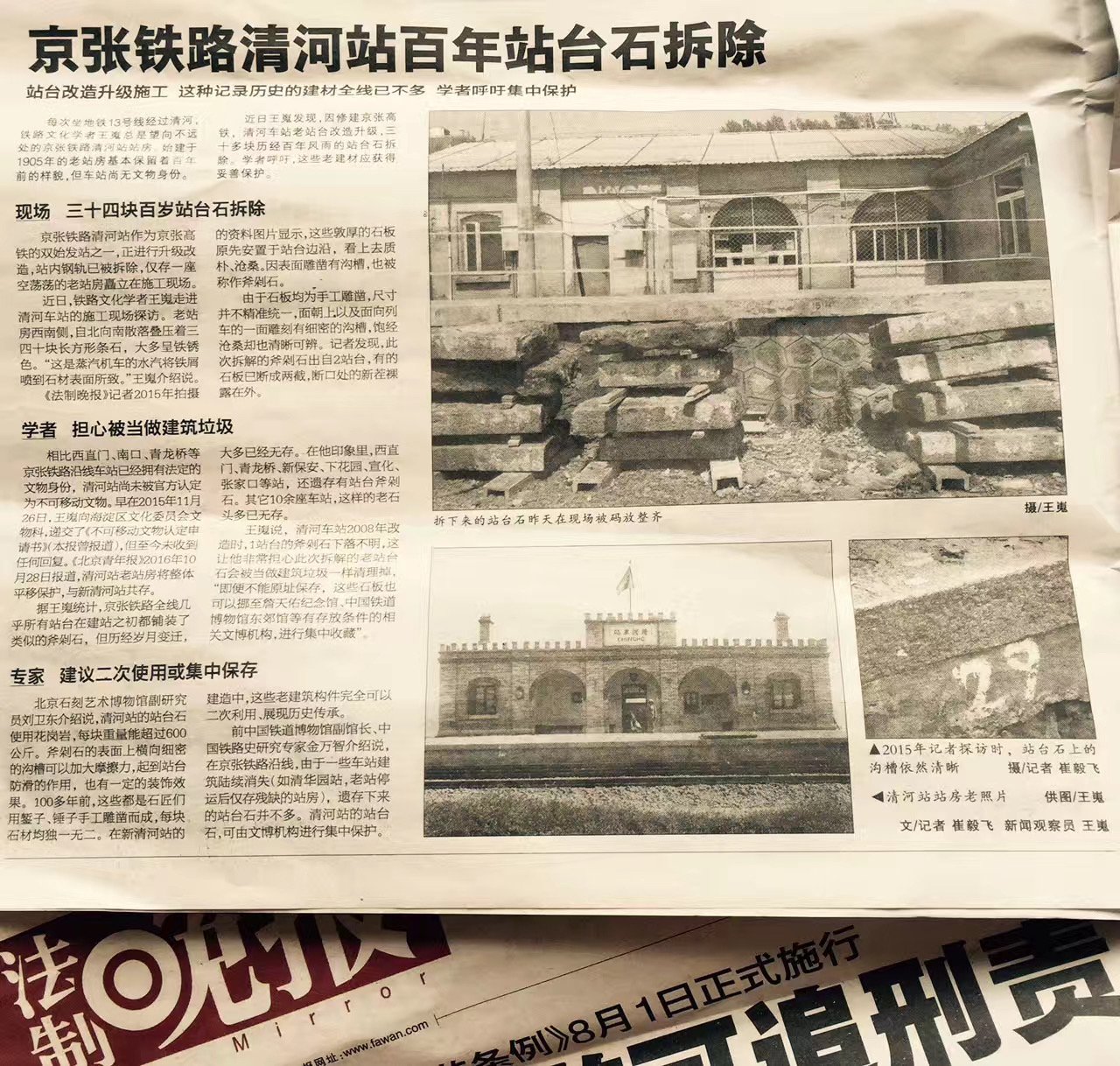
May 26, 2017, Legal Evening News
May 26, 2017, Legal Evening News
Every time he passes Qinghe on Metro Line 13, railway cultural scholar Wang Wei always looks toward the Qinghe Station building of the Beijing-Zhangjiakou Railway not far away. First built in 1905, the old station building largely retains its appearance from a century ago, but the station still lacks cultural relic status.
Recently, Wang Wei discovered that due to the construction of the Beijing-Zhangjiakou High-Speed Railway, the old platform of Qinghe Station was upgraded and renovated, and more than thirty platform stones that had weathered a century of wind and rain were demolished. Scholars are calling for these old building materials to receive proper protection.
Scene: Thirty-Four Century-Old Platform Stones Demolished
As one of the dual starting stations for the Beijing-Zhangjiakou High-Speed Railway, the Qinghe Station of the Beijing-Zhangjiakou Railway is undergoing upgrades and renovations. The steel rails inside the station have been removed, leaving only an empty old station building standing tall at the construction site.
Recently, railway cultural scholar Wang Wei walked into the construction site of Qinghe Station to visit. On the southwest side of the old station building, thirty to forty rectangular strip stones were scattered and stacked from north to south, mostly showing a rust-colored tint. "This is caused by the steam locomotive's water vapor spraying iron filings onto the stone surface," Wang Wei introduced.
Archival pictures taken by Legal Evening News reporters in 2015 show that these thick stone slabs were originally placed at the edge of the platform, looking simple and weathered. Because grooves were carved onto their surfaces, they are also called axe-chopped stones.
Because the stone slabs were all hand-carved, their dimensions are not precise and uniform. The side facing upward and the side facing the train are carved with fine grooves, which, despite weathering, are clearly distinguishable. Reporters found that the axe-chopped stones dismantled this time came from Platform 2, and some stone slabs had already broken into two pieces, with the new fractures exposed on the outside.
Scholars: Worried They Might Be Treated as Construction Waste
Compared with stations along the Beijing-Zhangjiakou Railway such as Xizhimen, Nankou, and Qinglongqiao that already possess statutory cultural relic status, Qinghe Station has not yet been officially recognized as an immovable cultural relic. As early as November 26, 2015, Wang Wei submitted an "Immovable Cultural Relic Identification Application Form" to the Cultural Relics Section of the Haidian District Culture Commission (as previously reported by this newspaper), but he has not received any reply to date. According to a report by the Beijing Youth News on October 28, 2016, the old station building of Qinghe Station will be relocated and protected as a whole, coexisting with the new Qinghe Station.
According to Wang Wei's statistics, almost all platforms along the entire Beijing-Zhangjiakou Railway line were paved with similar axe-chopped stones when they were first built, but through years of changes, most of them no longer exist. In his impression, stations such as Xizhimen, Qinglongqiao, Xinbao'an, Xiahuayuan, Xuanhua, and Zhangjiakou still retain platform axe-chopped stones. In more than 10 other stations, such old stones are mostly gone.
Wang Wei said that when Qinghe Station was renovated in 2008, the axe-chopped stones of Platform 1 went missing, which makes him very worried that the old platform stones dismantled this time will be cleared away like construction waste. "Even if they cannot be preserved in situ, these stone slabs can be moved to relevant cultural and museum institutions with storage conditions, such as the Zhan Tianyou Memorial Museum and the Dongjiao Branch of the China Railway Museum, for centralized collection".
Experts: Recommend Secondary Use or Centralized Preservation
Liu Weidou, associate researcher at the Beijing Stone Carving Art Museum, introduced that the platform stones of Qinghe Station are made of granite, and each piece can weigh more than 600 kilograms. The horizontal fine grooves on the surface of the axe-chopped stones can increase friction, playing an anti-slip role on the platform, and also have a certain decorative effect. More than 100 years ago, these were all hand-carved by stonemasons using chisels and hammers, and each piece of stone material is unique. In the construction of the new Qinghe Station, these old architectural components can be completely reused to showcase historical inheritance.
Jin Wangzhi, former deputy curator of the China Railway Museum and an expert in Chinese railway history research, introduced that along the Beijing-Zhangjiakou Railway, because some station buildings have successively disappeared (such as Qinghuayuan Station, where only the incomplete station building remains after the old station ceased operations), the surviving platform stones are not many. The platform stones of Qinghe Station can be centrally protected by cultural and museum institutions.
Responsible Editor: Yang Chengyuan (QN0044) | Author: Cui Yifei
