
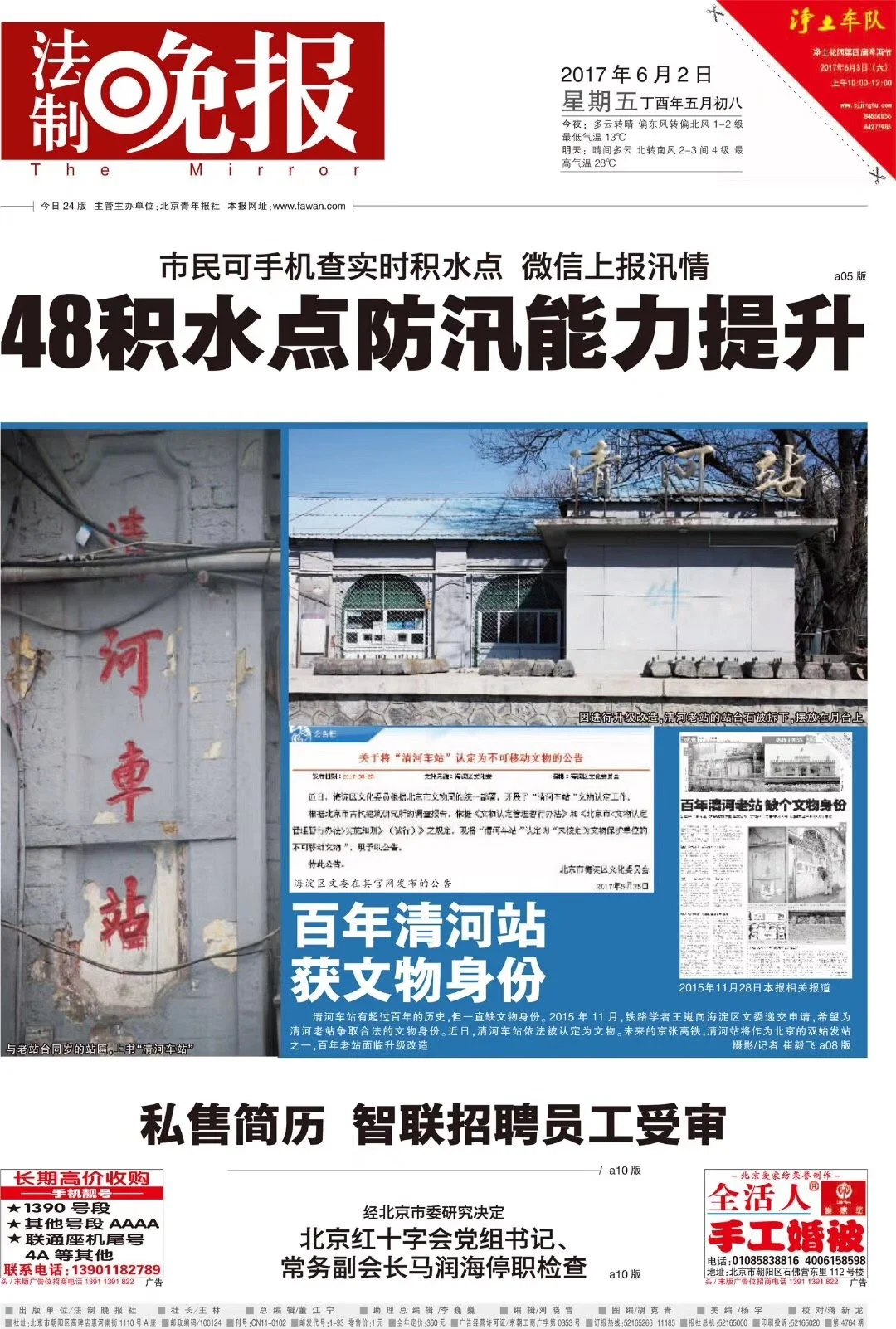
Legal Evening News Front Page: Century-Old Qinghe Station Granted Cultural Heritage Status
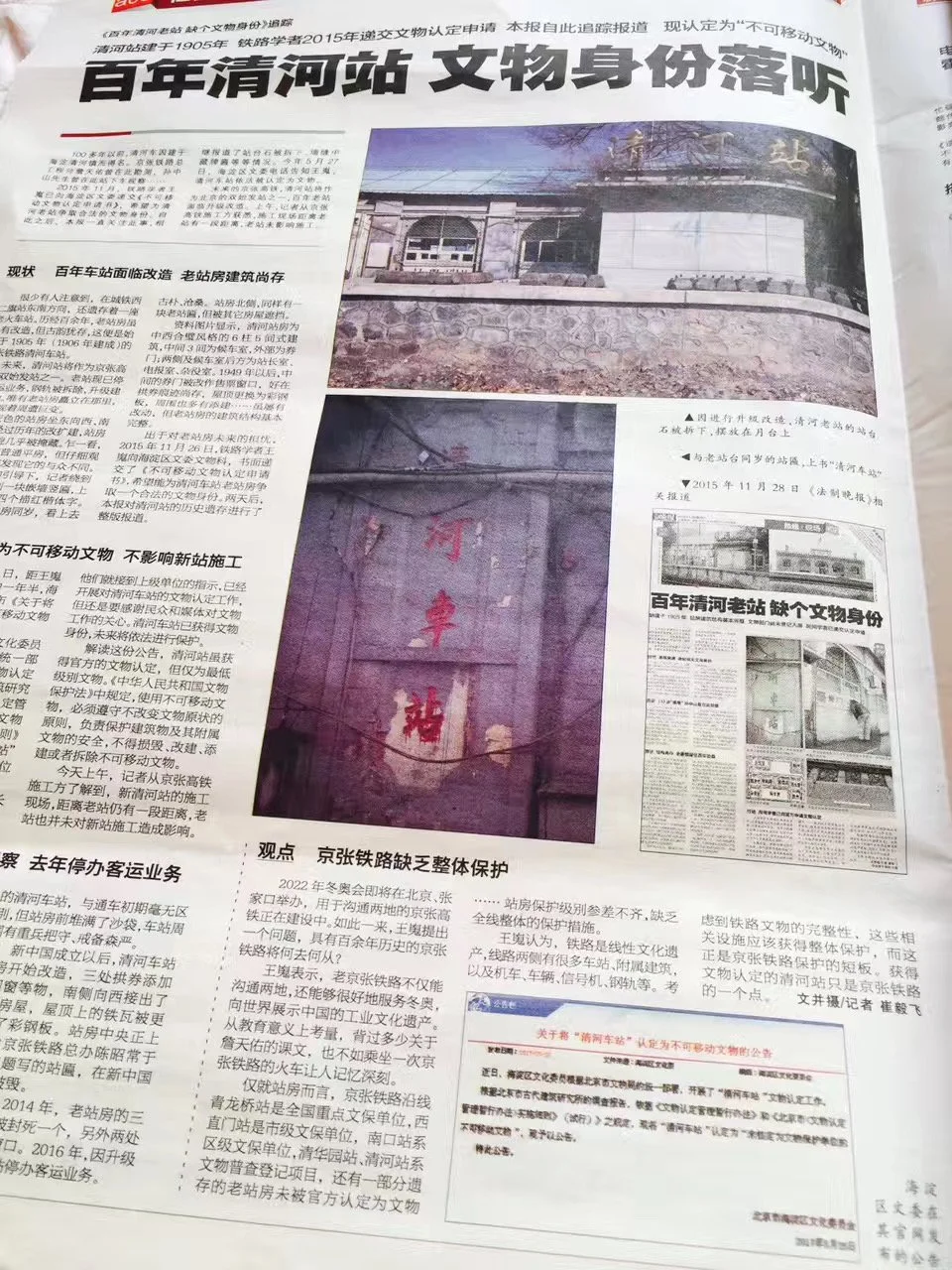
Century-Old Qinghe Station Cultural Heritage Status Confirmed
June 2, 2017, Legal Evening News
June 2, 2017, Legal Evening News
Legal Evening News Report (Reporter Cui Yifei): More than 100 years ago, Qinghe Station got its name because it was built in Qinghe Town, Haidian. Zhan Tianyou, the chief engineer of the Beijing-Zhangjiakou Railway, once surveyed here, and Dr. Sun Yat-sen once got off the train here to inspect the station...
In November 2015, railway scholar Wang Wei submitted an "Immovable Cultural Relic Identification Application Form" to the Haidian District Culture Commission, hoping to secure a legitimate cultural relic identity for the old Qinghe Station. Since then, this newspaper has continuously followed the matter, successively reporting on situations such as the platform stones being dismantled and the plaque hidden in the wall crevice. On May 27 of this year, the Haidian District Culture Commission informed Wang Wei via phone that Qinghe Station had been recognized as a cultural relic according to law.
For the upcoming Beijing-Zhangjiakou High-Speed Railway, Qinghe Station will serve as one of Beijing's dual starting stations, facing upgrades and renovations for the century-old station. This morning, reporters learned from the construction party of the Beijing-Zhangjiakou High-Speed Railway that the construction site is at a distance from the old station, and the old station has not affected the construction.
Current Status: Century-Old Station Faces Renovation; Old Station Building Structure Survives
Few people have noticed that to the southeast of the Xierqi Subway Station, an old railway station still survives. After more than a century, although the old station building has undergone many modifications, its ancient charm remains. This is the Qinghe Station of the Beijing-Zhangjiakou Railway, initially built in 1905 (completed in 1906).
In the future, Qinghe Station will serve as one of the dual starting stations for the Beijing-Zhangjiakou High-Speed Railway. The old station has now suspended passenger transport operations, its steel tracks have been removed, and upgrade construction has begun. Only the old station building stands there, silently watching the drastic changes around it.
The grayish-blue station building faces east and west with north-south symmetry. Through years of alterations and expansions, the original appearance of the station building has been almost concealed. At first glance, this is merely an ordinary single-story house, but upon closer observation, one can still discover its uniqueness.
Under Wang Wei's guidance, reporters walked around to the south side of the station building and saw an embedded vertical plaque inscribed with four red-painted regular script characters: "清河車站" (Qinghe Railway Station). This station plaque is as old as the old station building, looking simple and weathered. On the north side of the station building, there is a similar old station plaque, but it is blocked by other buildings.
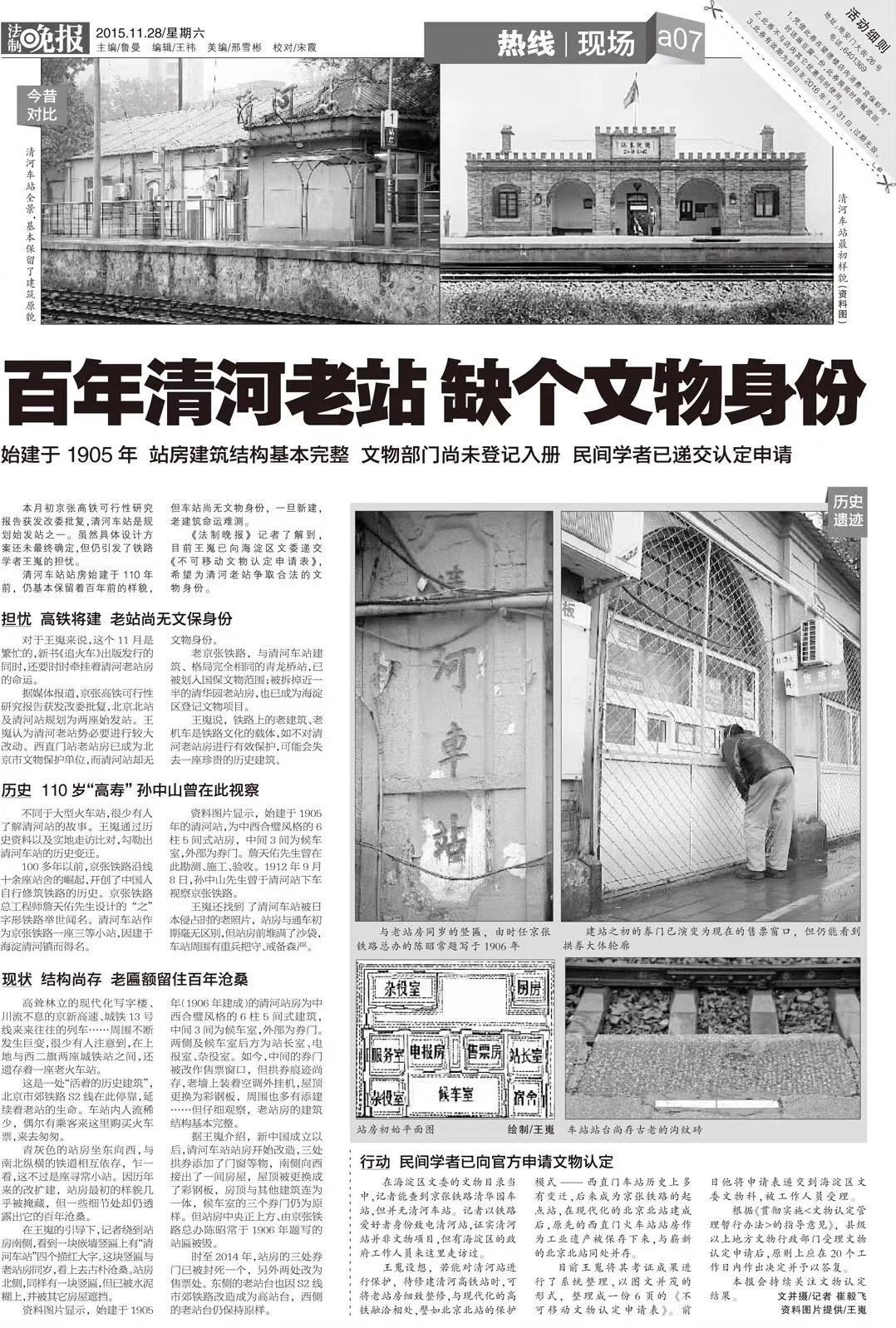
Archival pictures show that the Qinghe station building was a Chinese-and-Western-style 6-pillar, 5-bay architecture. The middle 3 bays served as the waiting room with arched external doors; the sides and the rear of the waiting room housed the station master's office, telegraph room, and utility room. After 1949, the middle arched gate was converted into a ticket window, though fortunately the arch traces still remain, the roof was replaced with color steel plates, and many additions were made around it... Despite repeated modifications, the architectural structure of the old station building remains largely intact.
Out of concern for the future of the old station building, on November 26, 2015, railway scholar Wang Wei submitted a written "Immovable Cultural Relic Identification Application Form" to the Cultural Relics Section of the Haidian District Culture Commission, hoping to secure a legitimate cultural relic identity for the old Qinghe station building. Two days later, this newspaper published a full-page report on the historical relics of Qinghe Station.
Progress: Recognized as an Immovable Cultural Relic; Does Not Affect New Station Construction
On May 25, 2017, about a year and a half after Wang Wei submitted his application form, the Haidian District Culture Commission released the "Announcement on Recognizing 'Qinghe Station' as an Immovable Cultural Relic" on its official website.
The announcement shows: In accordance with the unified deployment of the Beijing Municipal Cultural Heritage Bureau, the Haidian District Culture Commission carried out the cultural relic identification work for "Qinghe Station." Based on the investigation report of the Beijing Municipal Institute of Ancient Architecture and in accordance with the Interim Measures for the Administration of Cultural Relic Identification and the Implementation Rules (Trial) of Beijing Municipality's , "Qinghe Station" is now recognized as an "immovable cultural relic not verified as a cultural relic protection unit."
According to Section Chief Zhu of the Cultural Relics Section of the Haidian District Culture Commission, long before Wang Wei submitted his application form, they had received instructions from superior units and had already initiated cultural relic identification work for Qinghe Station, but they still thanked the public and the media for their concern for cultural relic work. Qinghe Station has obtained cultural relic status and will be protected according to law in the future.
Interpreting this announcement, although Qinghe Station has gained official cultural relic recognition, it is only at the lowest tier of cultural relics. The Law of the People's Republic of China on the Protection of Cultural Relics stipulates that the use of immovable cultural relics must adhere to the principle of not altering the original state of the cultural relics, ensuring the safety of the buildings and their subsidiary cultural relics, and prohibiting the destruction, reconstruction, addition, or demolition of immovable cultural relics.
This morning, reporters learned from the Beijing-Zhangjiakou High-Speed Railway construction party that the construction site of the new Qinghe Station remains at a distance from the old station, and the old station has not caused any impact on the construction of the new station.
Historical Changes: Sun Yat-sen Once Visited Here; Passenger Transport Suspended Last Year
Unlike large railway stations, few people understand the story of Qinghe Station. Wang Wei has studied the Beijing-Zhangjiakou Railway for over a decade, outlining the historical changes of Qinghe Station through historical data and on-site visits and comparisons.
More than 100 years ago, the rise of a dozen station buildings along the Beijing-Zhangjiakou Railway pioneered the history of Chinese-built railways. As a third-class small station on the Beijing-Zhangjiakou Railway, Qinghe Station got its name because it was built in Qinghe Town, Haidian. Mr. Zhan Tianyou, chief engineer of the Beijing-Zhangjiakou Railway, once surveyed, constructed, and inspected here. On September 8, 1912, Dr. Sun Yat-sen got off the train at Qinghe Station to inspect the Beijing-Zhangjiakou Railway.
Archival pictures show that under Japanese occupation, Qinghe Station was indistinguishable from its early opening period, but sandbags were piled up in front of the station building, and the station was heavily guarded by troops with strict precautions.
After the founding of New China, the station building of Qinghe Station began to be modified. Doors and windows were added to the three arches, a room was extended westward from the south side, and the iron tiles on the roof were replaced with color steel plates. Directly above the center of the station building, the station plaque inscribed in 1906 by Chen Zhaochang, General Manager of the Beijing-Zhangjiakou Railway, was destroyed after the founding of New China.
By 2014, one of the three arched gates of the old station building had been sealed off, and the other two were converted into ticket windows. In 2016, due to upgrades and renovations, Qinghe Station suspended passenger transport operations.
Views: Lack of Comprehensive Protection for the Beijing-Zhangjiakou Railway
The 2022 Winter Olympics are about to be held in Beijing and Zhangjiakou, and the Beijing-Zhangjiakou High-Speed Railway connecting the two places is under construction. Consequently, Wang Wei raised a question: Where will the century-old Beijing-Zhangjiakou Railway go?
Wang Wei stated that the old Beijing-Zhangjiakou Railway can not only connect the two places well, but also serve the Winter Olympics effectively, showcasing China's industrial cultural heritage to the world. From an educational perspective, memorizing countless textbooks about Zhan Tianyou is not as impressive as experiencing a ride on the Beijing-Zhangjiakou Railway in person.
Regarding station buildings alone, Qinglongqiao Station along the Beijing-Zhangjiakou Railway is a Major Historical and Cultural Site Protected at the National Level, Xizhimen Station is a municipal-level cultural relic protection unit, Nankou Station is a district-level cultural relic protection unit, Qinghuayuan Station and Qinghe Station are cultural relic census-registered items, and some surviving old station buildings have not been officially recognized as cultural relics... The protection levels of station buildings vary unevenly, lacking comprehensive protection measures for the entire line.
Wang Wei believes that the railway is a linear cultural heritage, with many stations, subsidiary buildings, locomotives, vehicles, signal machines, rails, and other items along both sides of the line. Considering the integrity of railway cultural relics, these related facilities should receive overall protection, which is precisely the shortcoming in the protection of the Beijing-Zhangjiakou Railway. Qinghe Station, which has obtained cultural relic recognition, is merely a single point on the Beijing-Zhangjiakou Railway.
Reporter: Cui Yifei
