
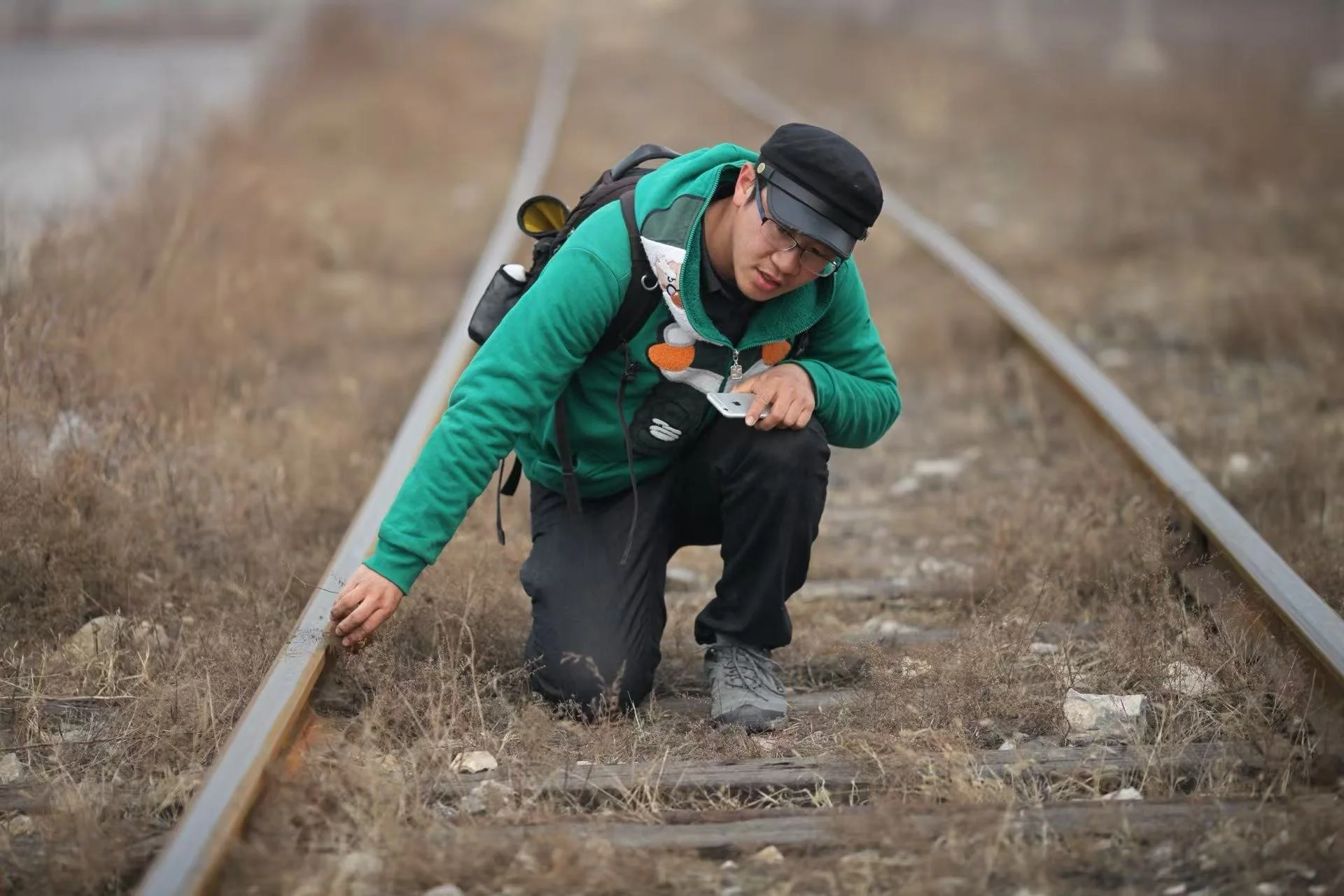
In the Kangzhuang section of the Beijing-Zhangjiakou Railway, Wang Wei discovered century-old railway tracks. Source: Legal Evening News
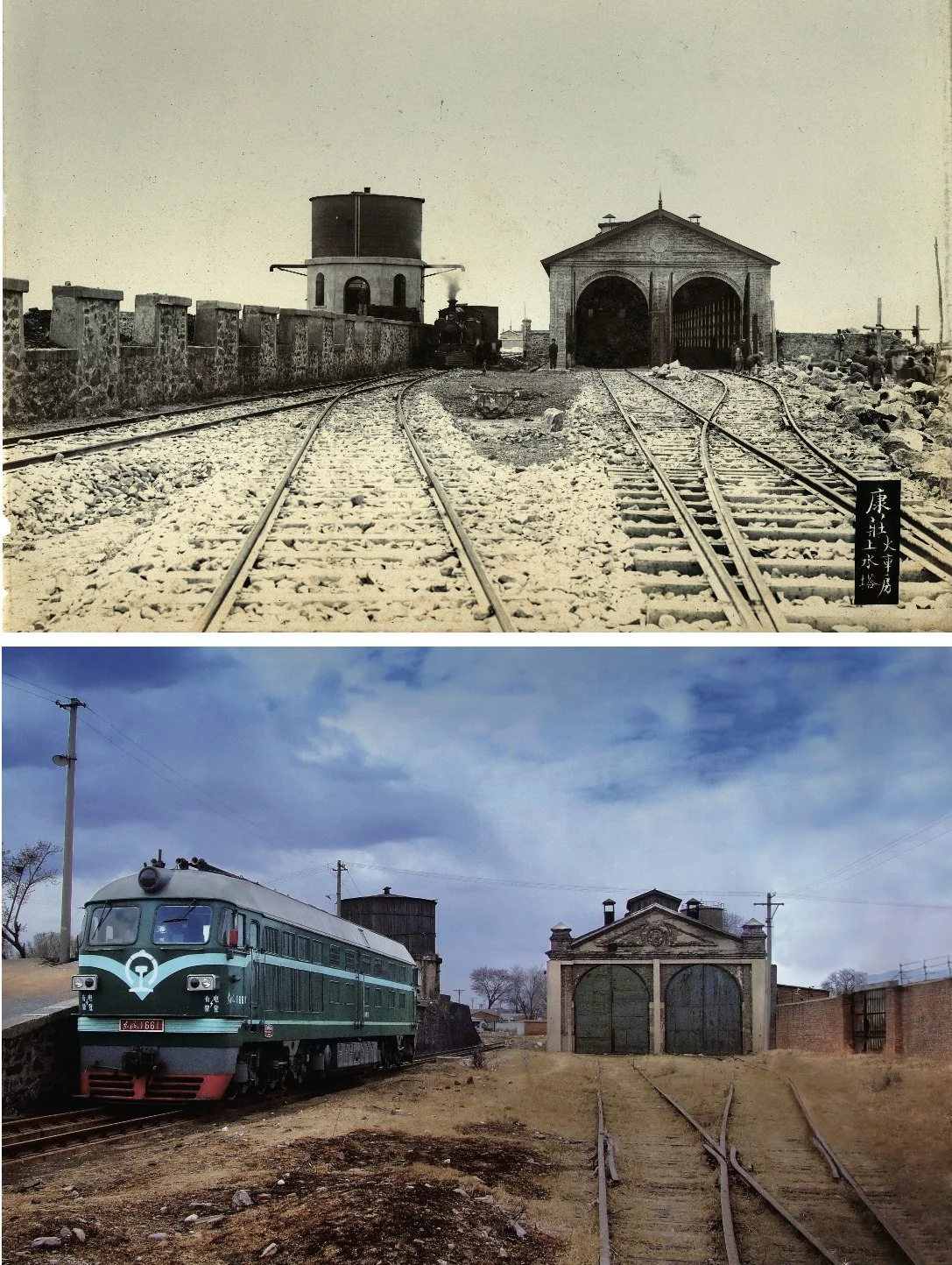
Pictured above: A comparison of century-old historical changes in Kanggzhuang along the Beijing-Zhangjiakou Railway; its engine house and water tower have not yet obtained official cultural relic recognition.
August 6, 2017, Cui Yifei / Legal Evening News
Half of Old Station Buildings Disappeared, Only Two Water Towers Remain, and Century-Old Architecture Falls Outside Cultural Relic Protection Scope, Facing Constant Risk of Demolition
The zigzag railway designed by Zhan Tianyou, the first trunk railway independently built and constructed by the Chinese people... The Beijing-Zhangjiakou Railway found in school textbooks is a source of pride. However, little known to the public, as a linear industrial cultural heritage, the Beijing-Zhangjiakou Railway has not yet received comprehensive, overall protection. Wang Wei, a post-90s railway cultural scholar, spent over a decade conducting a comprehensive and meticulous self-funded census of the cultural relics along the Beijing-Zhangjiakou Railway, discovering that related historical remains are diminishing year by year.
Writing My Beijing-Zhangjiakou Railway Over a Decade
In June 2017, Wang Wei's new book My Beijing-Zhangjiakou Railway was published. The material accumulation for this book spanned over a decade, and the compilation took more than three years. It collected over 2,000 pictures (including past-and-present comparisons of the same locations), field surveys, on-site measurements, hand-drawn restoration diagrams, and oral history investigations, recording the historical changes of the Beijing-Zhangjiakou Railway in an all-around, multi-angle manner.
Born in 1990, Wang Wei grew up alongside the Beijing-Zhangjiakou Railway. He has loved trains for as long as he can remember, and as a child, he always asked his parents to take him to Xizhimen Station to take photos.
Starting to photograph and document independently at the age of 12, Wang Wei was still in school back then, so he always shot in places close to home, naturally choosing the Beijing-Zhangjiakou Railway right outside his doorstep. Riding the small commuter train and shooting stop by stop, Wang Wei was deeply fascinated by the historical architecture along the way, such as station buildings, engine sheds, bridges, and tunnels.
In 2005, Wang Wei posted on the Beijing Railway Railfans website under the username "Beijing-Zhangjiakou Railway Knowledge," sharing the pictures he took of various stations and sections, as well as the stories of the Beijing-Zhangjiakou Railway.
By chance, Wang Wei came across a collection of images commissioned by Zhan Tianyou, chief engineer of the Beijing-Zhangjiakou Railway, from a photographer over a hundred years ago. Upon careful examination, he found that the angles of many photos he had taken coincided with them. Comparing them from the same angle couldn't help but make people sigh at how fast the times have changed. In addition, Wang Wei wondered: among the buildings in these old photos, how many could still survive today? The demolished old buildings he had witnessed with his own eyes numbered more than ten, such as the Xizhimen water tower.
As his understanding deepened, Wang Wei discovered that the nearly century-old engine house at Zhangjiakou Station had been demolished, and the Mentougou Station building on the Jingmen Branch Line of the Beijing-Zhangjiakou Railway had also been torn down. This further accelerated his pace to record these ancient sites on the verge of vanishing.
Over a Quarter of Original Open-to-Traffic Routes Have Disappeared
Legal Evening News (hereinafter referred to as Legal Evening News): In your new book My Beijing-Zhangjiakou Railway, besides the railway lines connected by steel rails, you also recorded many supporting facilities along the route, comprehensively and meticulously displaying the landscape of the Beijing-Zhangjiakou Railway. Could you list their categories and cultural relic value?
Wang Wei: As the first trunk railway independently built by the Chinese people, the Beijing-Zhangjiakou Railway, besides the railway line itself, also featured station buildings, platforms, engine houses, coal platforms, water towers, water cranes, drainage trenches, imperial/saloon car sheds, freight warehouses, administrative offices, workshops, bridges, tunnels, culverts, and slope protection works built along the way; as well as operating equipment such as rails, switches, signals, locomotives, and rolling stock. They are all important components of the Beijing-Zhangjiakou Railway, possessing equal cultural relic value and urgently awaiting overall protection.
Legal Evening News: Through your investigation and visits to the remains of the Beijing-Zhangjiakou Railway, what is their preservation status?
Wang Wei: The actual situation is worrying, and these historical remains show a declining trend year by year. When the Beijing-Zhangjiakou Railway opened to traffic in 1909, the total length of the entire line was about 200 km (including the Fengliu Branch Line). Affected by natural disasters, urban expansion, reservoir construction, line modifications, and other factors, the existing 1909 open-to-traffic route is 143.48 km long—meaning that more than a quarter of the 1909 open-to-traffic route has disappeared. In 1909, there were a total of 123 bridges along the line; later, 49 were artificially dismantled, 10 were rebuilt on the original sites, and 15 were naturally damaged. In 1909, 5 coal platforms were built, and 1 currently survives. When it opened in 1909, there were a total of 11 water towers, and now only 2 survive...
Legal Evening News: As the most iconic station buildings, what is their preservation status?
Wang Wei: When the Beijing-Zhangjiakou Railway opened in 1909, there were 14 station buildings, and only 7 old station buildings from 1909 survive today. Except for Qinglongqiao Station, which is under national key cultural relic protection and is relatively well protected, all others have problems. Two-fifths of the old Qinghuayuan station building was demolished, and the remainder has been reduced to rented housing. The station plaque personally inscribed by Zhan Tianyou is tottering, pulled and secured by just two steel ropes. Most of the central station plaques, which served as the finishing touch of the old station buildings, are gone; the station plaques of Nankou Station, Dongyuan Station, Juyongguan Station, and Xibazi Station were plastered over with cement after Liberation.
Legal Evening News: What problems exist in the cultural relic protection of the Beijing-Zhangjiakou Railway?
Wang Wei: As a linear industrial cultural heritage, the Beijing-Zhangjiakou Railway lacks comprehensive protection. The protection levels of cultural relics along the line vary unevenly, and many old buildings with historical value have not yet obtained cultural relic recognition from administrative departments. For example, only the Nankou-Badaling section along the entire line is a Major Historical and Cultural Site Protected at the National Level, and other protected parts are merely isolated points. For instance, the Xizhimen old station building is a municipal-level cultural relic protection unit, the Nankou Station old station building is a district-level cultural relic protection unit, the Qinghuayuan old station building is a cultural relic census-registered item (the lowest level of immovable cultural relic), and some century-old buildings are not even within the scope of cultural relic protection—such as the Changping Station old station building, Xibazi Station old station building, Kanggzhuang engine house, coal platform, and water tower... They face the risk of being demolished at any time.
Spending 100,000 to 200,000 RMB Out of Pocket to Survey Cultural Relics Across the Entire Line
Legal Evening News: Besides photographing and recording, the book extensively uses oral history. How many eyewitnesses of the Beijing-Zhangjiakou Railway did you interview?
Wang Wei: A total of over 200 eyewitnesses were interviewed, mostly railway workers and local residents along the route... Many interviewees were already 80 or 90 years old, and interviewing them felt like racing against time, carrying a sense of rescue archaeology. When choosing interviewees, I tried to find people who grew up by the tracks since childhood and whose fathers were railway workers; having a good memory and strong articulation skills were also very important. Before the interviews, I spent a year reviewing relevant historical materials from the late Qing Dynasty and the Republic of China, trying my best to thoroughly understand them. Only by doing so could I ask targeted questions in subsequent interviews and better judge the oral accounts. Moreover, for the same question, I often interviewed many people and repeatedly verified the information.
Legal Evening News: Is it accurate to summarize the content of your new book as a "cultural relic census of the entire Beijing-Zhangjiakou Railway"?
Wang Wei: Accurate. Regarding the Beijing-Zhangjiakou Railway, whatever I know, see, or hear, I will go on-site to visit, record, and verify, conducting a preliminary assessment for the comprehensive protection of the Beijing-Zhangjiakou Railway. Through publishing this book, I want to arouse more people's concern for the cultural relics around them. Too many cultural relics that I have personally experienced have disappeared over the years, which is truly a pity. I have a wish: I hope the Beijing-Zhangjiakou Railway can receive comprehensive protection along its entire line. After the Beijing-Zhangjiakou High-Speed Railway is built, the old and the new will coexist, allowing people to see the inheritance of historical veins.
Legal Evening News: During your years of visits and material organization, what funding did you receive?
Wang Wei: The Beijing Studies Institute of Beijing Union University gave me some financial support, providing 20,000 RMB in funding, and the royalties for publishing the book were 40,000 RMB. But when I started doing this, it was completely self-funded, and the expenses over several years amounted to no less than 100,000 to 200,000 RMB. Furthermore, many historical materials and old photos were also obtained by me browsing ancient books or purchasing them from domestic and foreign second-hand websites. Fortunately, my daily writing, documentary filming, and other work can maintain a balance between income and expenses.
(Original Title: Post-90s Youth Spends Over 100,000 RMB Out of Pocket to Search for Beijing-Zhangjiakou Railway Cultural Relics: Half of Old Station Buildings Disappeared, Only Two Water Towers Remain, and Century-Old Architecture Falls Outside Cultural Relic Protection Scope, Facing Constant Risk of Demolition)
Reporter Cui Yifei
