
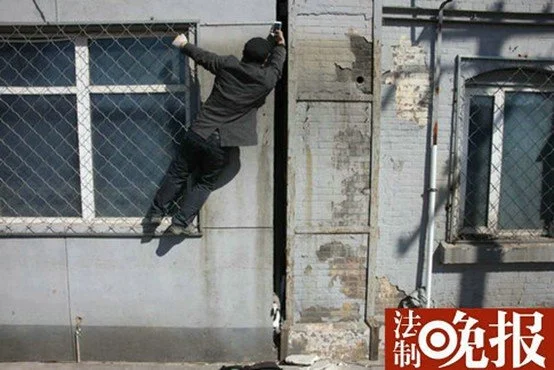
Pictured above: Wangwei squeezed into a wall crevice to photograph the concealed old station plaque.
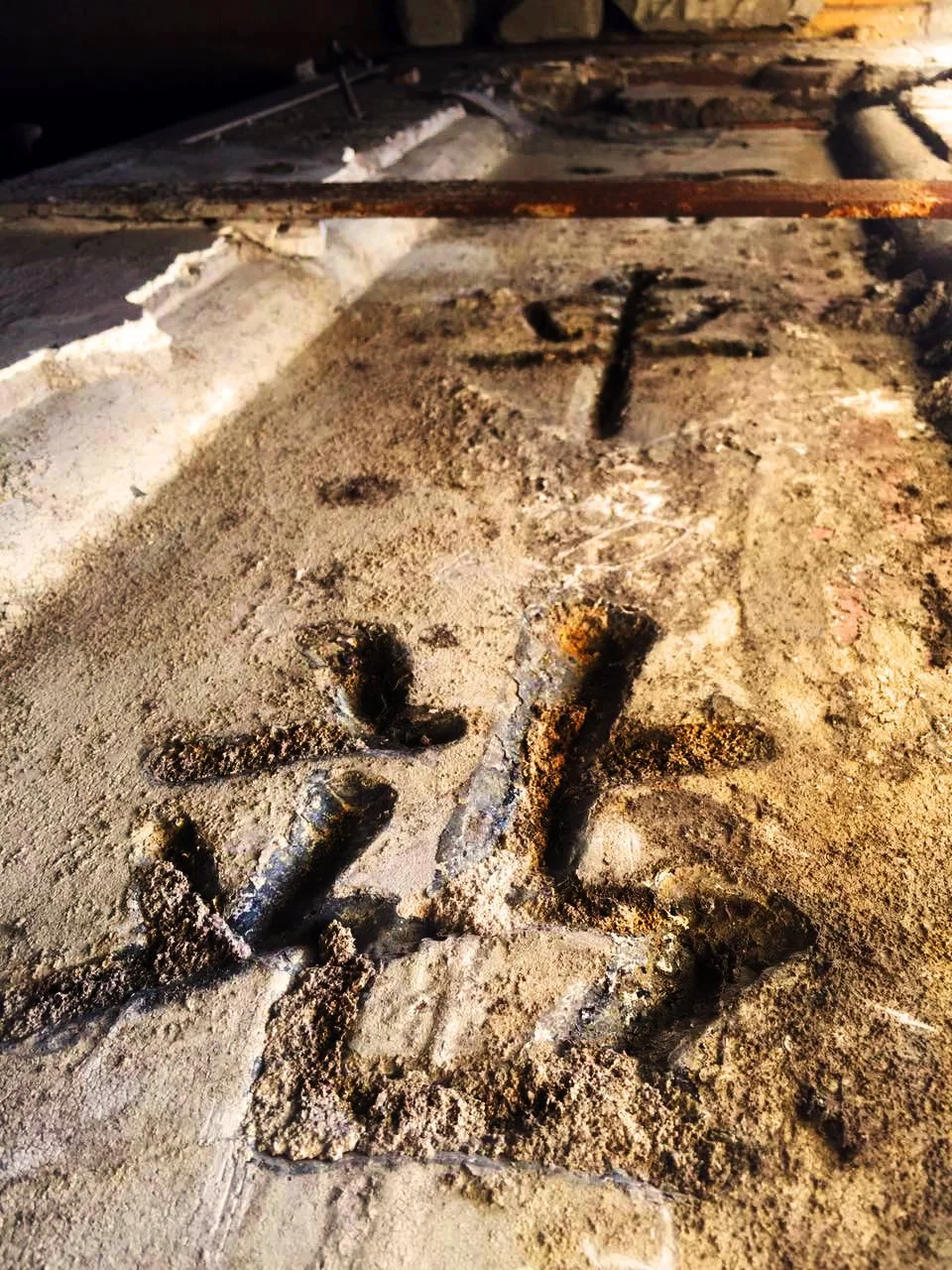
Pictured above: The vertical plaque on the north side of Qinghe Station.
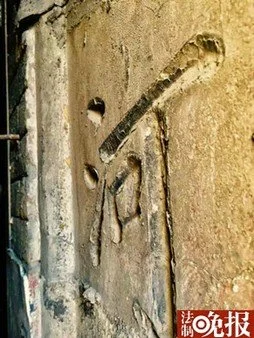
Wangwei extended his phone inside and barely managed to photograph the characters "清河車站" (Qinghe Railway Station) on the edge of the station.
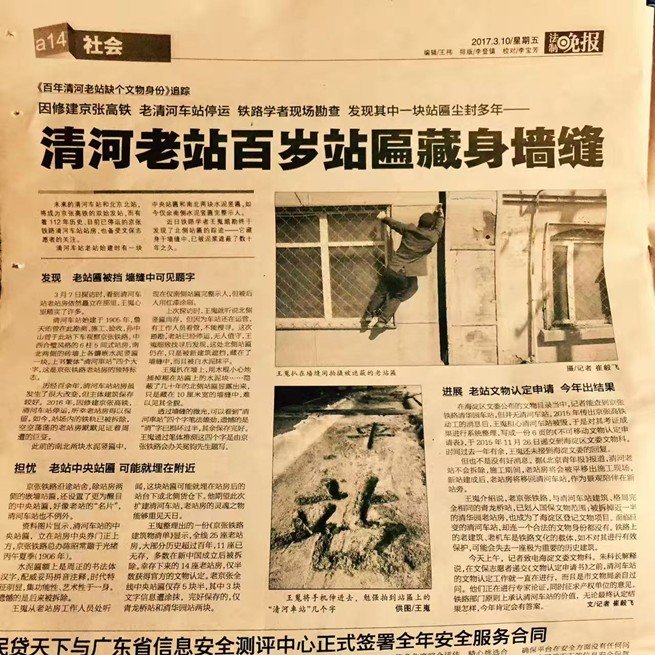
March 9, 2017, Legal Evening News
March 9, 2017, Legal Evening News
According to a report in the Legal Evening News on March 9, the future Qinghe Station and Beijing North Station (formerly the Xizhimen Station of the Beijing-Zhangjiakou Railway) will become the dual starting points for the Beijing-Zhangjiakou High-Speed Railway. Meanwhile, the 112-year-old, currently defunct Qinghe Old Station on the Beijing-Zhangjiakou Railway has also attracted the attention of volunteers.
When the Qinghe Station was originally built, it had one central station plaque and two vertical cement plaques to the north and south. Today, only the southern vertical cement plaque remains fully visible. Today, railway scholar Wang嵬 finally discovered the whereabouts of the northern station plaque—it was hidden in a wall crevice, obscured by mud for decades.
Discovery: Old Station Plaque Blocked, Inscription Visible in Wall Crevice
During a visit on March 7, seeing the old station building of Qinghe Station still standing there, Wang嵬 felt much more at ease.
Qinghe Station was first built in 1905, and Zhan Tianyou once surveyed, constructed, and inspected the site. The Chinese-and-Western-style station building features 6 pillars and 5 bays. A vertical cement plaque was embedded in the brick walls on both the north and south sides, inscribed with the four traditional characters "清河車站" (Qinghe Railway Station). This was a unique mark of the old Beijing-Zhangjiakou Railway station buildings. Over more than a century, although the Qinghe Station building has undergone significant changes, the main structure has been relatively well-preserved. In 2016, due to the construction of the Beijing-Zhangjiakou High-Speed Railway, Qinghe Station ceased operations, but fortunately, the station building was preserved. Today, the tracks within the station yard have been removed, and the empty old station building silently witnesses the drastic changes around it. Of the previous two north and south vertical cement plaques, only the southern plaque is now fully visible, but it was later painted over with red paint in later years.
During his last visit, Wang嵬 heard that the northern vertical plaque still existed, but because the station was still in operation and staffed, he could not search for it. During this survey, the old station had ceased operations and was unattended. After a meticulous search by Wang嵬, he discovered that this northern station plaque was still there, but it was blocked by a new building, hidden in a wall crevice, and plastered over with white cement. Wang嵬 climbed onto the wall and carefully chipped away the cement patches covering the plaque with a wooden stick... The northern station plaque, hidden for decades, was revealed, but it was hidden in a 10-centimeter-wide wall crevice, making it difficult to see its full picture. Through the faint light filtering through the wall crevice, the four characters "清河車站" (Qinghe Railway Station) can be seen with vigorous brushwork. Regrettably, the character "清" (Qing) is more than half damaged, but the rest are well preserved. Wang嵬 deduced from the handwriting style that these four characters should have been inscribed by Mr. Guan Mianjun, the associate director of the Beijing-Zhangjiakou Railway.
Concern: Central Station Plaque of the Old Station May Be Buried Nearby
Along the Beijing-Zhangjiakou Railway, in addition to the station plaques embedded in the walls on both sides of the station building, a more prominent central station plaque was set up, like the "business card" of the old station. Qinghe Station was no exception. Archival pictures show that the central station plaque of Qinghe Station stood directly above the central arched gate of the station building, inscribed by Chen Zhaochang, the General Manager of the Beijing-Zhangjiakou Railway, in the summer of the Bingwu year of the Guangxu reign (1906).
The regular calligraphic Chinese characters on the cement plaque, accompanied by Wade-Giles romanization, had distinct characteristics of the era, combining functionality and artistry. Regrettably, it was later dismantled. Wang嵬 heard from staff at the old station building that this station plaque might be buried under the platform behind the station building or under the northern warehouse. He hopes that during this expansion of Qinghe Station, the soul-stirring object of the old station building can see the light of day again.
A "List of Beijing-Zhangjiakou Railway Buildings" compiled by Wang嵬 shows that of the 25 old station buildings along the entire line, most have a history of over a century. 11 no longer exist, most of which were dismantled after the founding of New China. Of the 14 surviving old station buildings, only half have received official cultural relic recognition. Only 5 central station plaques remain along the entire old Beijing-Zhangjiakou line; 3 of them have had their textual information painted over, and only two—Qinglongqiao Station and Qinghuayuan Station—are preserved intact.
Progress: Cultural Relic Recognition Application for the Old Station to Yield Results This Year
In the cultural heritage catalog published by the Haidian District Culture Commission, reporters could find the Qinghuayuan Station of the Beijing-Zhangjiakou Railway, but not Qinghe Station. After news of the start of the Beijing-Zhangjiakou High-Speed Railway broke in 2015, Wang嵬 worried that the century-old Qinghe Station would be destroyed, so he systematically organized his research findings and wrote a 6-page "Immovable Cultural Relic Identification Application Form," which he submitted to the Cultural Relics Section of the Haidian District Culture Commission on November 26, 2015. More than a year has passed, and Wang嵬 has not yet received a reply from the Haidian Culture Commission.
However, it's not all bad news. According to a report by the Beijing Youth News, the Qinghe Old Station will not be demolished. During construction, the old station building will be moved horizontally out of the construction site. After the new station is built, the old station building will be moved back to Qinghe Station to accompany the new station as a landscape.
Wang嵬 introduced that the Qinglongqiao Station on the old Beijing-Zhangjiakou Railway, which has the exact same architecture and layout as Qinghe Station, has been included in the scope of national key cultural relics; the old Qinghuayuan Station building, nearly half of which was demolished, has also become a registered cultural relic project in Haidian District. However, Qinghe Station, which is facing drastic changes, does not even have a legal cultural relic status. Old buildings and locomotives on the railway are carriers of railway culture. If they are not effectively protected, an extremely important historical building might be lost.
This morning, reporters called the Cultural Relics Section of the Haidian District Culture Commission. Section Chief Zhu explained that even before the cultural relic protection volunteers submitted the "Cultural Relic Recognition Application Form," the cultural relic recognition work for Qinghe Station had been ongoing, and the Municipal Cultural Heritage Bureau had personally inquired about it. They are currently conducting expert argumentation and soliciting opinions from the property rights units. The railway department has acknowledged the value of Qinghe Station in principle. Regardless of the final recognition result, there will definitely be an answer this year.
Reporter: Cui Yifei
