
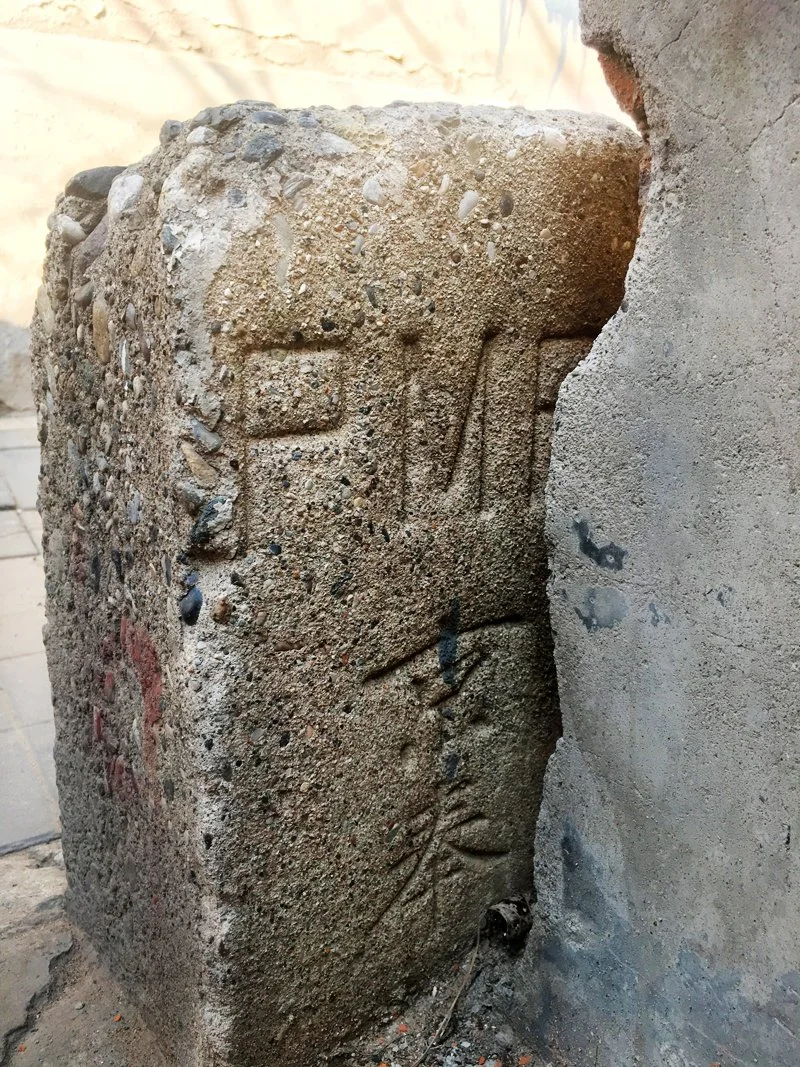
One of the boundary markers clearly shows the clerical script Chinese characters for "Jingfeng" (Beijing-Mukden).
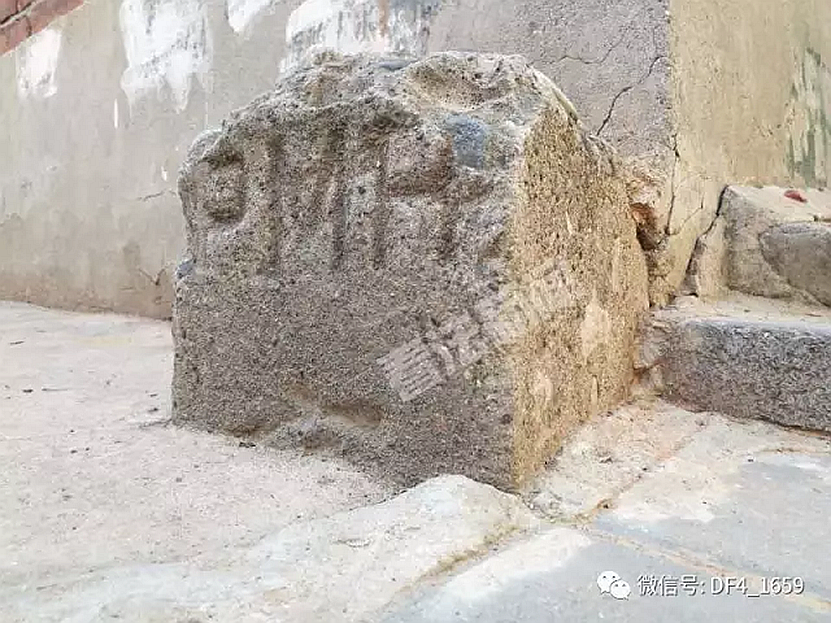
Only PMR (the English abbreviation for the Beijing-Mukden Railway) can be seen on the other boundary marker.
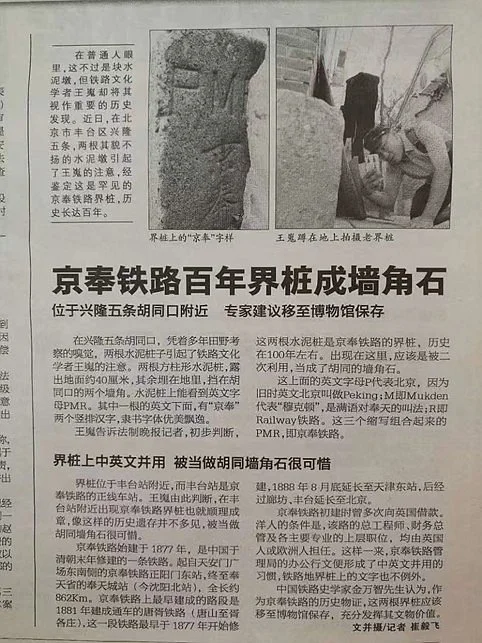
September 15, 2017, Legal Evening News
September 15, 2017, Legal Evening News
One of the boundary markers clearly shows the clerical script Chinese characters for "Jingfeng" (Beijing-Mukden).
Legal Evening News / Law Vision News (Reporter Cui Yifei) — Recently, in Xinglong Fifth Lane, Fengtai District, Beijing, two unassuming concrete piers caught the attention of railway cultural scholar Wang Wei. Upon observation, Wang Wei judged them to be rare Beijing-Mukden Railway boundary markers with a history of a century.
Xinglong Fifth Lane is a little-known alley located north of Fengtai Railway Station. Railway cultural scholar Wang Wei frequently wanders around this area. At the entrance of Xinglong Fifth Lane, two concrete posts caught Wang Wei's attention.
The two square-column concrete posts protrude about 40 centimeters above the ground, with the rest buried in the earth, serving as guards in front of the two wall corners at the mouth of the hutong. The English letters "PMR" can be seen on both concrete posts. Below the English text on one of them, two vertically arranged Chinese characters reading "京奉" (Beijing-Mukden) can be seen.
Wang Wei told Legal Evening News / Law Vision News reporters that, preliminarily judging, these two concrete posts are boundary markers of the Beijing-Mukden Railway with a history of around 100 years. Their appearance here suggests they were secondary-reused, serving as hutong corner stones.
The English letters on them—P stands for Peking, as Beijing was called in English in the old days; M stands for Mukden, which is the Manchu designation for Fengtian; and R stands for Railway. The combination of these three abbreviations, PMR, stands for the Beijing-Mukden Railway.
The Beijing-Mukden Railway was initially built in 1877, with a total length of about 862 km. The earliest completed section of the Beijing-Mukden Railway was the Tangshan-Xugezhuang Railway, completed and opened to traffic in 1881. Construction of this section first began in 1877, and by the end of August 1888, it was extended to Tianjin East Station, later extending through Langfang and Fengtai to Beijing.
Fengtai Station is a mainline station on the Beijing-Mukden Railway. Wang Wei deduced from this that it is logical for Beijing-Mukden Railway boundary markers to appear near Fengtai Station, and historical relics like this are quite rare.
Mr. Jin Wangzhi, a historian of Chinese railway history, examined this stone pier and also believes it is a boundary marker of the Beijing-Mukden Railway. Due to its great age, such relics have become quite rare along the Beijing-Mukden Railway and he recommended moving it to a museum for preservation.
Photo / Legal Evening News / Law Vision News Reporter Cui Yifei
