
Expansion of Restoration Scope for the "Qinglongqiao Station" on the Jingzhang Railway
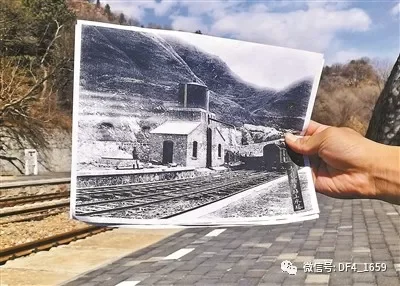
Through onsite comparisons with old photographs, the former location of the steam locomotive water tower can be found.
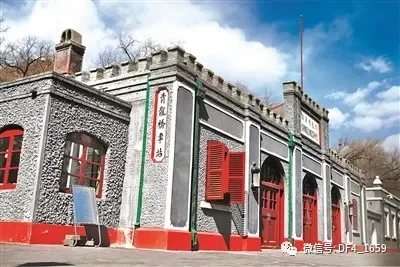
The old station building of Qinglongqiao Station, put into use in 1909
March 18, 2019, Beijing Youth Daily
Qinglongqiao Station is known as the "throat" of the Jingzhang Railway; it features the "Z"-shaped (switchback) railway that remains in use to this day, and Jeme Tien Yow, the chief engineer of the Jingzhang Railway, also rests here in peace. Qinglongqiao Station is a major historical and cultural site protected at the national level and is also the best-preserved historical building along the Jingzhang Railway. A reporter from the Beijing Youth Daily learned that the century-old station will present a more diverse historical landscape. The Yanqing District Cultural Relics Management Office will carry out restoration work on the remains of the steam locomotive water tower and the barracks left by the Japanese invading forces near Qinglongqiao Station.
The China Government Procurement Network recently published the Bidding Announcement for the Protection, Restoration, and Environmental Improvement Project (Design) of the Water Tower and Anti-Japanese War Cultural Relics at Qinglongqiao Railway Station in Yanqing. The bid opening date is March 29. The budgeted amount is 317,800 RMB, and the purchasing unit is the Yanqing District Cultural Relics Management Office of Beijing.
Qinglongqiao Station was put into use in 1909. Near the old station building beside the platform, a steam locomotive water tower and water crane were constructed during the same period to supply water to steam locomotives, though they no longer exist. Archival photos show that the old water tower was trapezoidal, topped with a cylindrical water tank directly above, and the outlet pipe of the water crane extended toward the railway track side. According to research by railway culture scholar Wang Wei, this water tower was demolished after 1949. A site marker currently stands on the original location of the water tower.
The Beijing Youth Daily reporter learned from the Yanqing District Cultural Relics Management Office that while the base of the original water tower at Qinglongqiao Railway Station still exists, cultural relics regulations do not permit reconstruction, so this restoration plan aims to protect the site. However, staff members did not disclose specific implementation details.
As a major historical and cultural site protected at the national level, the old station building of Qinglongqiao Station has received sound protection and restoration, becoming a "business card" for the Jingzhang Railway. Yet few people notice that on the hillside behind the old station building, four or five rows of single-story brick-and-tile flat buildings are distributed in an idle state. These are the barracks left behind by the Japanese invading forces. To control the transportation lines, the Japanese invaders deployed troops along the Jingzhang Railway, and Qinglongqiao Station was once heavily guarded.
Treading on thick fallen leaves, the Beijing Youth Daily reporter climbed the hillside behind the old station building and saw that the barracks all faced the station, neatly constructed with brick and stone masonry. Surrounding the barracks were two circular blockhouses, one of which is well-preserved, featuring staggered shooting slits that guarded the mountain ravine behind the station to prevent Chinese troops from launching attacks and resistance from the mountains. Around the barracks, thick and straight barrier walls were also built, with fan-shaped shooting slits on the walls surviving to this day.
According to Yang Cunxin, the stationmaster of Qinglongqiao Station, in the 1950s and 1960s when housing was tight, these barracks left by the Japanese also housed railway worker families, and even the blockhouses were utilized. By the 1980s, this area of barracks began to sit idle.
These barracks and blockhouses are traces left by the war on the Jingzhang Railway and historical evidence of the Japanese War of Resistance Against Japanese Aggression. According to a staff member from the restoration department of the Yanqing District Cultural Relics Management Office, the Japanese invaders not only built barracks behind Qinglongqiao Station but also structures such as watchtowers; this restoration will at least ensure that they are free from the danger of collapse.
Interview: Historical Buildings Along the Jingzhang Railway Yet to Obtain Cultural Property Status
Interviewee: Railway culture scholar and author of My Jingzhang Railway, Wang Wei
Beijing Youth Daily: What other cultural relics along the Jingzhang Railway need protection?
Wang Wei: Taking the steam locomotive water towers of the Jingzhang Railway as an example alone, Kangzhuang Station, which is in Yanqing District alongside Qinglongqiao, preserves a very complete water tower built in 1909, but it does not even have cultural property status yet.
Beijing Youth Daily: How many steam locomotive water tower remnants are there along the Jingzhang Railway?
Wang Wei: A total of 11 steam locomotive water towers were constructed along the entire Jingzhang Railway to supply water to steam locomotives. However, as diesel locomotives replaced steam locomotives, the accompanying water towers were gradually abandoned and demolished one after another, leaving only two surviving to this day. One is located at Xiahuayuan Station in Hebei Province, which obtained cultural property recognition in 2018. The other is located near Kangzhuang Station in Yanqing District, Beijing, is relatively well-preserved, and has not yet obtained cultural property recognition.
Beijing Youth Daily: Are there any protection measures for the old water tower in Kangzhuang?
Wang Wei: There are no protection measures as of yet. In October 2018, regarding the old water tower at Kangzhuang Station, I submitted an Application for Immovable Cultural Property Recognition to the Yanqing District Culture Commission, expecting it to be recognized as early as possible.
Memory Bank: Qinglongqiao Station Serves as the "Throat" of the Jingzhang Railway
Construction of the Jingzhang Railway began in September 1905 and opened to traffic in 1909. It is the first trunk railway independently designed and constructed by China, holding an important position in China's railway construction history and serving as an early industrial heritage site of the country. Among them, the section from Nankou to Badaling, located from Nankou in Beijing's Changping District to Badaling in Yanqing District, has been announced as the seventh batch of major historical and cultural sites protected at the national level. This includes the station building of Nankou Railway Station, the modern and contemporary architectural remnants of the Nankou Locomotive and Rolling Stock Works, the switchback ("ren" character) railway, the station building, employee dormitories, and supervisory office of Qinglongqiao Station, as well as Jeme Tien Yow's tomb and bronze statue. Because Qinglongqiao Station is close to the famous "Z"-shaped railway, it is hailed as the "throat" of the Jingzhang Railway. The Overview of Station Systems of the Beijing Railway Bureau records that the current station facilities of Qinglongqiao Station were built in 1909. Based on the topography and terrain, the line leads from the Badaling tunnel northeastward into Donggou, then turns back westward and southward to head toward Sanbao Station, forming a switchback railway. Qinglongqiao is a fourth-class passenger station.
Text / Beijing Youth Daily Reporters Wang Wei and Cui Yifei
Photography / Beijing Youth Daily Reporter Cui Yifei
Editor / Ji Fei
