
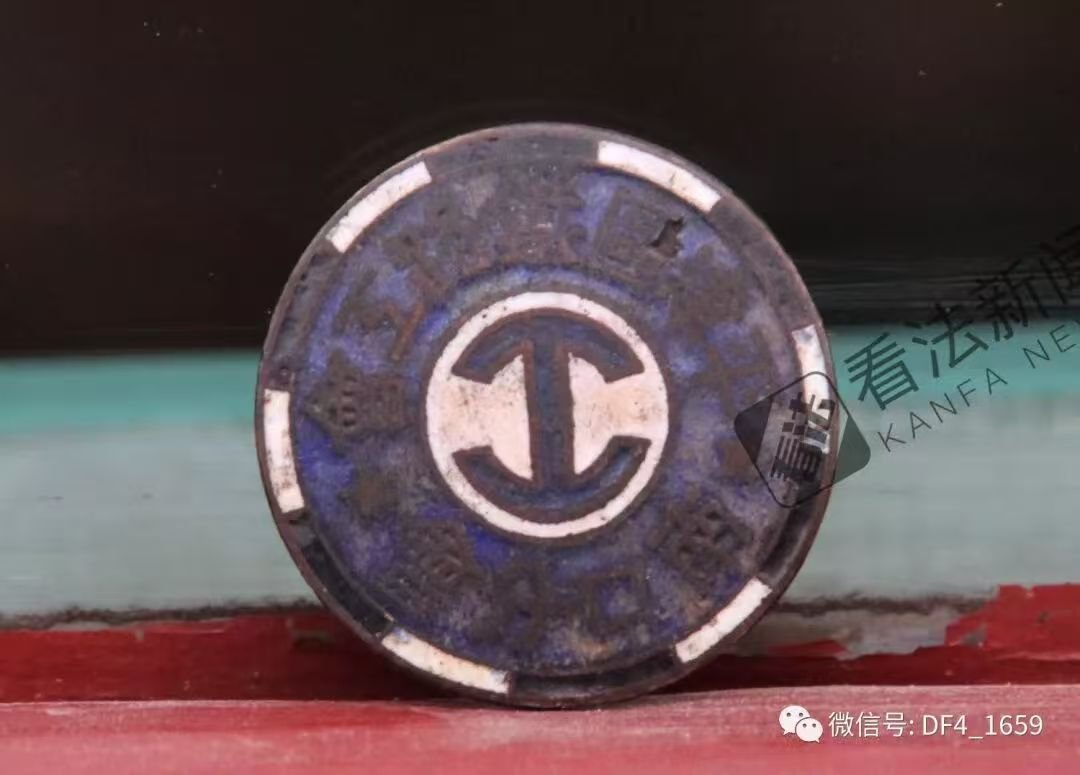
Text on the badge: Pingjin Region Railway Union - Nankou Branch
Photo / Reporter Cui Yifei
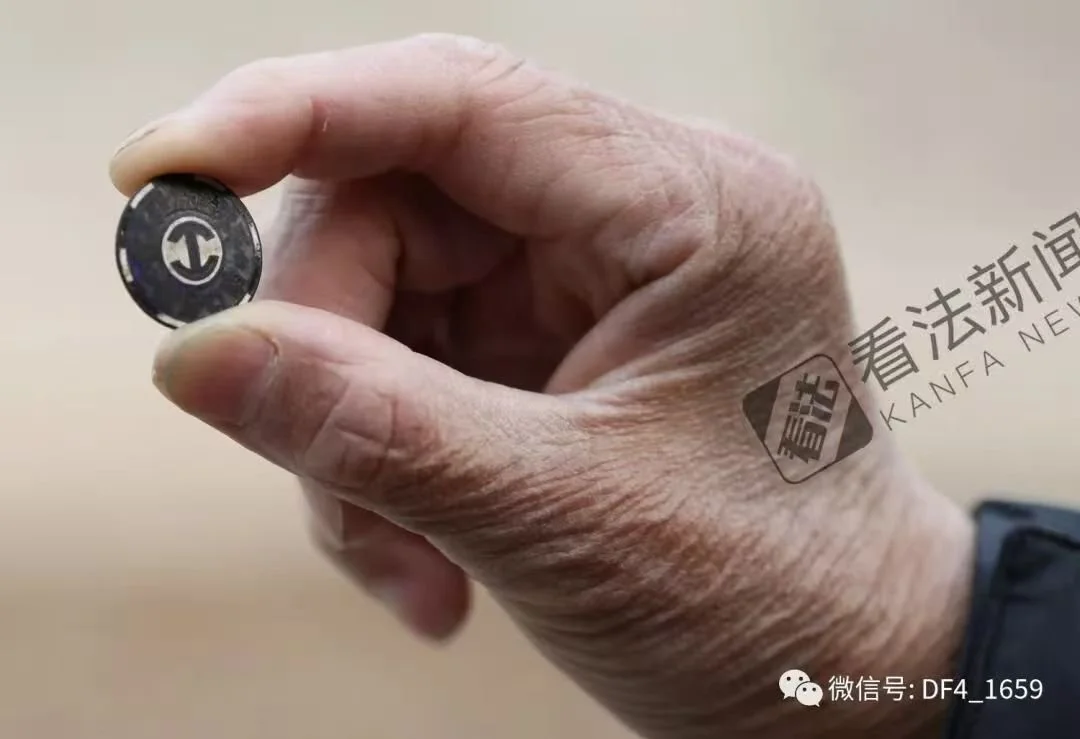
The badge donated by Master Lu Sheng
March 31, 2018, Legal Evening News
Legal Evening News / Law Vision News (Reporter Cui Yifei) — On March 21, retired railway worker Mr. Lu Sheng donated a button-sized badge to Qinglongqiao Station on the Beijing-Zhangjiakou Railway. Upon appraisal by railway cultural scholars, this is a railway union badge from the Republic of China era.
Yesterday afternoon, guided by railway cultural scholar Wang Wei, Mr. Lu Sheng came to Qinglongqiao Station on the Beijing-Zhangjiakou Railway and personally handed the badge over to Station Master Yang Cunxin. Station Master Yang introduced that although Qinglongqiao Station has ceased passenger operations, as an important node of the Beijing-Zhangjiakou Railway, it has been designated as a National Key Cultural Relic Protection Unit. At the same time, the station's historical exhibition room is also under preparation, and Mr. Lu Sheng's collection enriches their exhibition and display content.
This circular metal badge has a diameter of about 1.5 centimeters. In the center of the badge is a modified design of the character "工" (labor), surrounded by a circle of traditional Chinese characters reading "平津區鐡路工會·南口分会" (Pingjin Region Railway Union - Nankou Branch), with a black-and-white alternating modified railway pattern along the outer edge. The back of the badge is engraved with the numbers "1915," suspected to be the union membership number.
Mr. Lu Sheng told Legal Evening News / Law Vision News reporters that he picked up this badge many years ago near Nankou in Changping District, Beijing, and subsequently kept it in his home collection. Two days ago, while tidying up items in his room, he remembered this badge again. At Wang Wei's suggestion, the elderly gentleman decided to donate it to Qinglongqiao Station.
Wang Wei told Legal Evening News / Law Vision News reporters that after the victory in the War of Resistance against Japanese Aggression, the Ministry of Communications of the National Government adjusted the regional administrative divisions of various local railways. In March 1946, it was announced that the national railway system would implement a trunk-line district management system. Railway administrative bureaus were established, including the Pingjin Region, Jinpu Region, Jinghu Region, Zhegan Region, Yuehan Region, Xianguiqian Region, Pinghan Region, Longhai Region, Kunming Region, and Jinji Region, to manage the trunk lines and their branch lines within their respective districts. Additionally, a special commissioner's office was established in the Northeast to govern five railway administrative bureaus: Jinzhou, Shenyang, Jilin, Qiqihar, and Mudanjiang.
At that time, the Pingjin Region Railway Administrative Bureau governed the Pingsui Line, the Bening Line (Beijing-Shanhaiguan section), and the Tonggu Line (Tongzhou-Gubeikou section).
Wang Wei analyzed that this badge is a product created after the establishment of the Pingjin Region Railway Administrative Bureau in March 1946, proving the existence of the railway bureau's union at that time and the establishment of a branch in Nankou. This badge should date from between 1946 and 1949, and very few have survived.
