
High School Freshman Provides Clues, Leading to the Discovery of a Menzhai Railway Boundary Stone
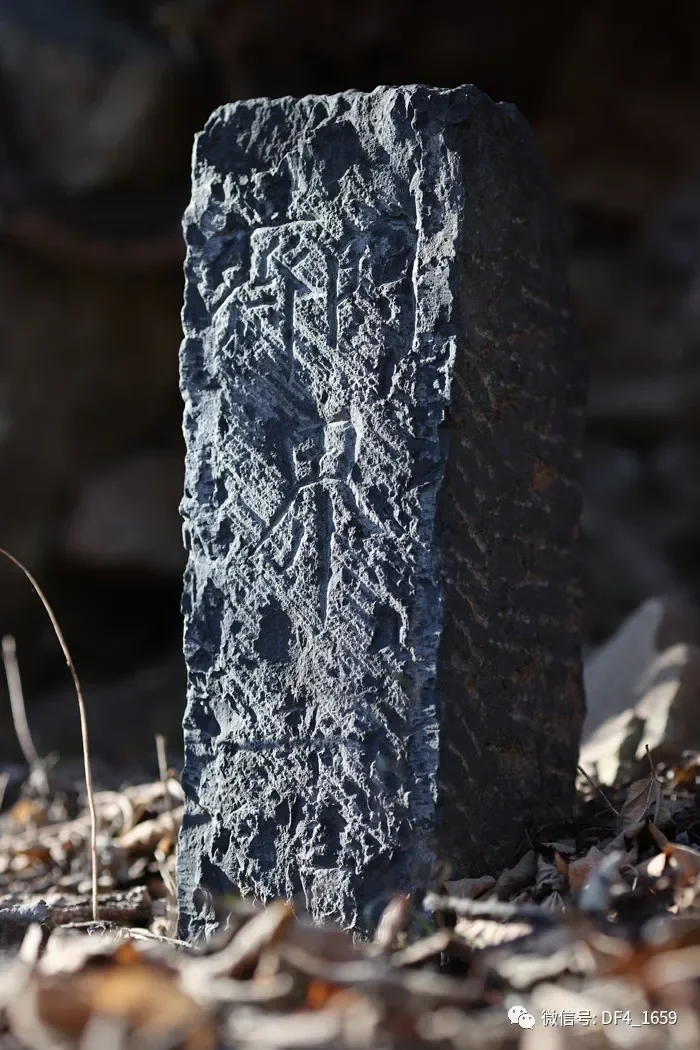
The "Menzhai Boundary" stone discovered near Datai
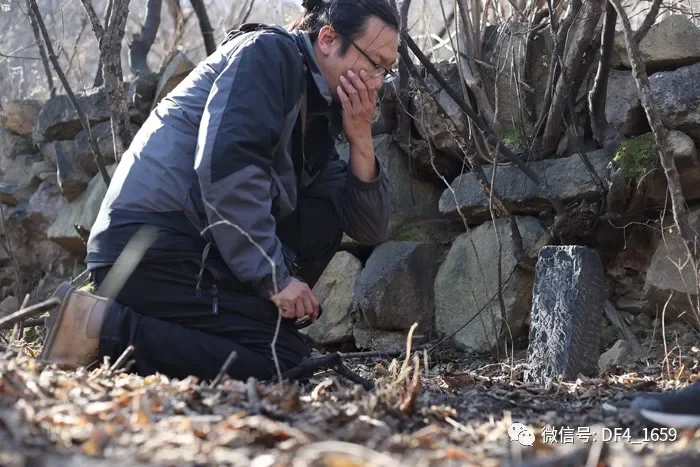
Wang Wei, who found the Menzhai Railway boundary stone
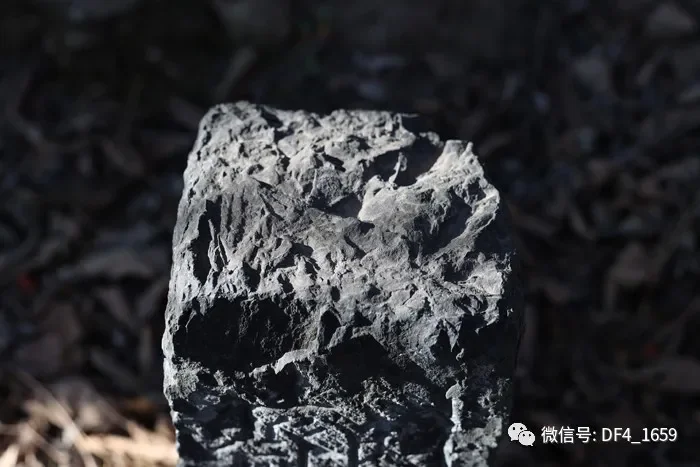
Rugged craftsmanship
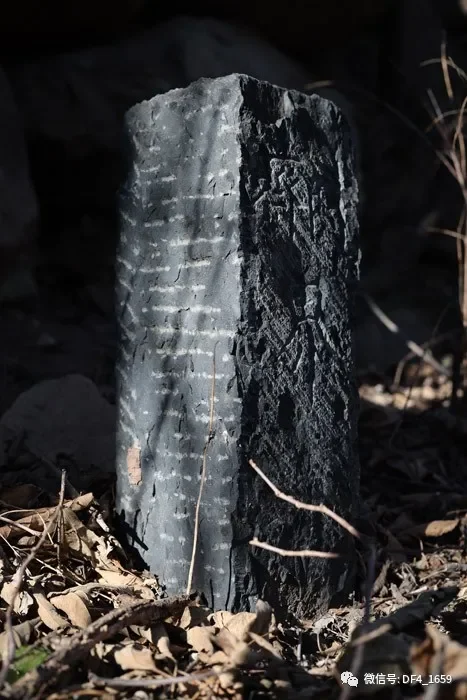
Clear chisel marks

Huang Haoyuan, the high school freshman who provided the clue leading to the discovery of the boundary stone

A villager pointing out the location of the boundary stone to Wang Wei
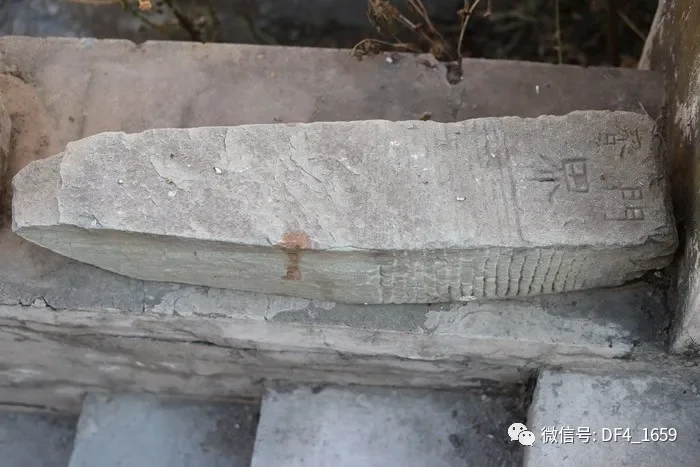
The "Menzhai Boundary" stone in Xiluopo Village
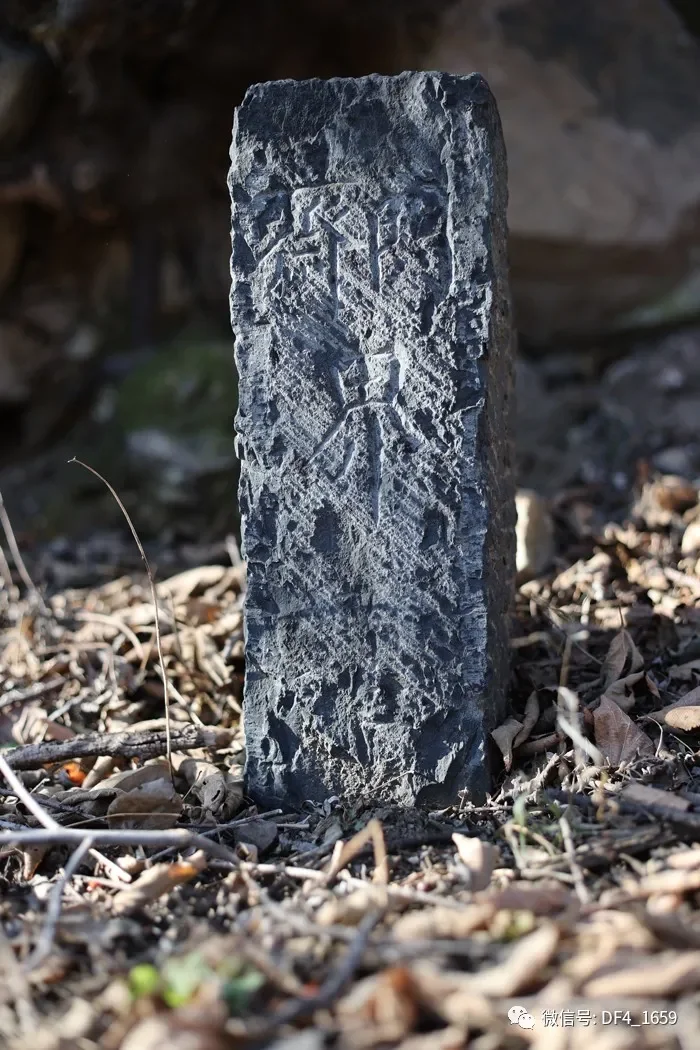
Inscribed face of the boundary stone
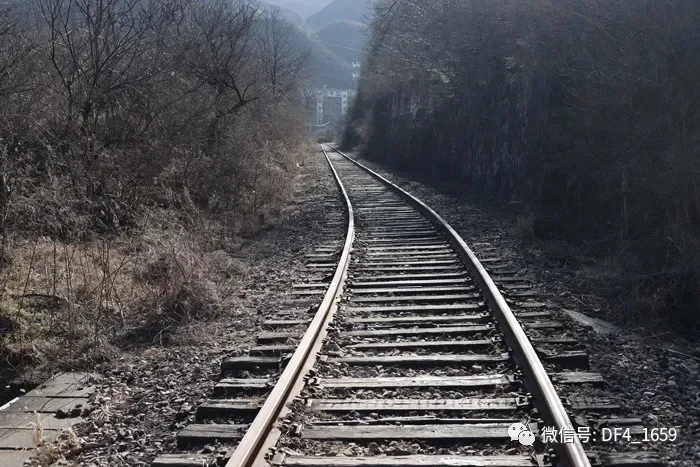
Mentougou-Zhaitang (Menzhai) Railway
December 25, 2021, Beijing Youth Daily
High School Freshman Provides Clues, Leading to the Discovery of a Menzhai Railway Boundary Stone
A small boundary stone witnesses a major history. Recently, after twists and turns, multiple cultural relic protection volunteers found a "Menzhai Railway Boundary Stone" in Mentougou District. A reporter from the Beijing Youth Daily learned that the Menzhai Railway is one of China's early merchant-run railways, with a history of more than 90 years since its completion. According to railway culture scholar Wang Wei, the boundary stone discovered this time is extremely rare, as it bears witness to the rise and fall of the Menzhai Railway.
Railway Culture Scholar Discovers "Menzhai Railway Boundary Stone" for the First Time
Guided by railway culture scholar and author of My Jingzhang Railway, Wang Wei, the Beijing Youth Daily reporter came to the vicinity of Datai Railway Station in Mentougou District and climbed a small cliff beside the railway tracks, where a columnar stone monument stood among the mountain terraces. The boundary stone is dark gray, protruding about 0.35 meters above the ground and approximately 0.13 meters wide. Its rugged chisel marks reveal a rough craftsmanship. On the side facing the railway, the three traditional characters "門齋界" (Menzhai Boundary) are carved. The two characters "門齋" (Menzhai) are written horizontally above, with the character "界" (Boundary) centered below, forming an inverted triangle layout with sharp and clear character strokes. "This is the first time I have discovered a Menzhai Railway boundary stone. Preserved in its original site to this day, about 10 meters away from the railway line, the stone marks the scope of the railway land and possesses unique historical value." Wang Wei introduced that as early as the beginning of the last century, entrepreneurs from Beijing and Tianjin requested to open mines in Zaitang and build a railway. In 1928, the entire Menzhai Railway was completed and opened to traffic, serving as an early Chinese merchant-run railway. Having weathered more than ninety years of vicissitudes, many structures along the Menzhai Railway line survive, including old station buildings, platforms, culverts, tunnels, and steam locomotive water towers.
On February 1, 2019, Wang Wei submitted an Application Form for the Recognition of Immovable Cultural Relics concerning the comprehensive protection of the entire Menzhai Railway to the local cultural relics department through the Mentougou District Government Services Center, which has not yet received a recognition result. At the time, the application and recognition project did not include the "Menzhai Boundary" stone. Wang Wei candidly admitted that among the subsidiary structures of the Menzhai Railway, he had never seen the word "Menzhai" before, making this boundary stone extremely precious.
High School Freshman Provides Clues, Taking 3 Hours to Find the Boundary Stone
"To be able to find this 'Menzhai Boundary' stone, we must thank a big boy." Wang Wei told the Beijing Youth Daily reporter that the boundary stone was hidden in the mountain forests in an extremely concealed location. Had it not been for the clue provided by Huang Haoyuan, a 16-year-old high school freshman and railway enthusiast, finding the boundary stone would have been like finding a needle in a haystack. Huang Haoyuan studies at Beijing No. 165 High School and has loved photographing trains since he was 12. Recently, while visiting Datai Railway Station, he learned from local villagers that there was a "Menzhai Boundary" stone in the mountainous area. "I was very excited at the time, believing this to be a historical relic of the Menzhai Railway." Huang Haoyuan immediately started searching with his good friend Yang Rui, but due to the complex terrain of the mountainous area, neither of them managed to find it. Subsequently, Huang Haoyuan shared this clue with Wang Wei. Possessing rich field survey experience in the mountains, Wang Wei spent over three hours of reconnaissance based on the direction described in the clue, and finally found the legendary boundary stone.
However, as luck would have it, similar boundary stones are not one-off finds. According to cultural history scholar Mao Qin (@Qinyezhai), in front of Courtyard No. 37, Xiluopo Village, Mentougou District, another "Menzhai Boundary" stone also lies on the ground, having been relocated there from elsewhere. The Beijing Youth Daily reporter saw at the scene that this boundary stone has regulations similar to the former, but their stone materials, fonts, and carvings differ greatly, and it is far away from the Menzhai Railway line. Whether it is related to the railway remains to be investigated.
Fonts Possess Characteristics of the Republic of China Era, Should Be Protected In Situ
Liu Weidong, a member of the Beijing Cultural Relics Appraisal Committee, stated that among common boundary stones, there are administrative boundary stones, tomb boundary stones, and railway boundary stones. The "Menzhai Boundary" stone discovered near Datai is very likely a historical relic of the Menzhai Railway. At the beginning of the construction of the Menzhai Railway, similar boundary stones must have been more than one along the line, but after more than 90 years of changes, it is unknown how many have survived. Liu Weidong indicated that judging from the photographs, the stone processing of this boundary stone is rough, weathering signs are not obvious, and the font has characteristics of the late Qing Dynasty and the Republic of China period. The "Menzhai Boundary" stone discovered in Xiluopo Village has inferior carvings compared to the former, with obvious weathering marks, and the reason for its scattering to Xiluopo Village remains to be verified. Liu Weidong said that one must thank the perseverance of the cultural relic protection volunteers; the "Menzhai Boundary" stone discovered near Datai Station bears witness to the local coal mining history and transportation history, enriching the industrial relics on the Xishan Yongding River Cultural Belt, and it is best to protect it in situ. The "Menzhai Boundary" stone in Xiluopo Village can be considered for centralized storage.
China's Early Merchant-Run Railway Rose Because of Coal and Declined Because of Coal
The Beijing Youth Daily reporter consulted historical materials such as Ye Shuxian's The Beginning and End of the Menzhai Railway and the Chronicles of the Beijing Railway Bureau to briefly outline the historical evolution of the Menzhai Railway.
In the 7th year of the Republic of China (1918), the Zaitang Coal Mining Company was established, and a shareholders' meeting was held the following year, determining that the Zaitang mining area had abundant coal reserves and high economic value. However, Zaitang was located deep in the mountainous area of western Beijing with blocked transportation, and building mines and starting production would inevitably lead to a backlog of coal. Constructing the Menzhai Railway could both transport equipment for building mines and timely ship out the coal produced.
In 1924, construction of the Menzhai Railway commenced. In 1927, the first section of the Menzhai Railway trunk line (Mentougou to Qingshuijiankou / total length 25 kilometers) was completed and opened to traffic; in the same year, the Menzhai Railway branch line (Qingshuijiankou to Banqiao / total length 8 kilometers) was completed and opened to traffic, which is the section where the boundary stone was discovered this time. In 1928, the second section of the Menzhai Railway trunk line (Qingshuijiankou to Zaitang / total length 30 kilometers) was completed and opened to traffic, laying narrow-gauge tracks on this section (now basically non-existent). From 1927 to 1948, affected by floods, political situations, and other factors, the operation of the Menzhai Railway experienced twists and turns.
In 1957, the Menzhai Railway was converted to state-ownership and taken over by the Beijing Railway Administration. The name "Menzhai Railway" then ceased to exist, and it was renamed the Datai Branch Line. For more than half a century afterward, the Datai Branch Line continued to focus on coal transportation supplemented by commuting, playing an important role in local economic construction.
In recent years, with Mentougou District implementing air pollution control and ecological restoration projects, from 2015 to 2020, the Qianjuntai Coal Mining Operation, Wangpingcun Coal Mining Operation, Muchengjian Coal Mining Operation, and Datai Coal Mining Operation along the Datai Branch Line were successively closed down. Mentougou District bid farewell to its coal mining history, and the Menzhai Railway line, which prospered because of coal, also basically ended its more than 90 years of coal transportation history.
Related report in the Beijing Youth Daily, December 26, 2021
Text / Beijing Youth Daily Reporter Cui Yifei
Photography / Beijing Youth Daily Reporter Cui Yifei
Editor / Cui Yifei
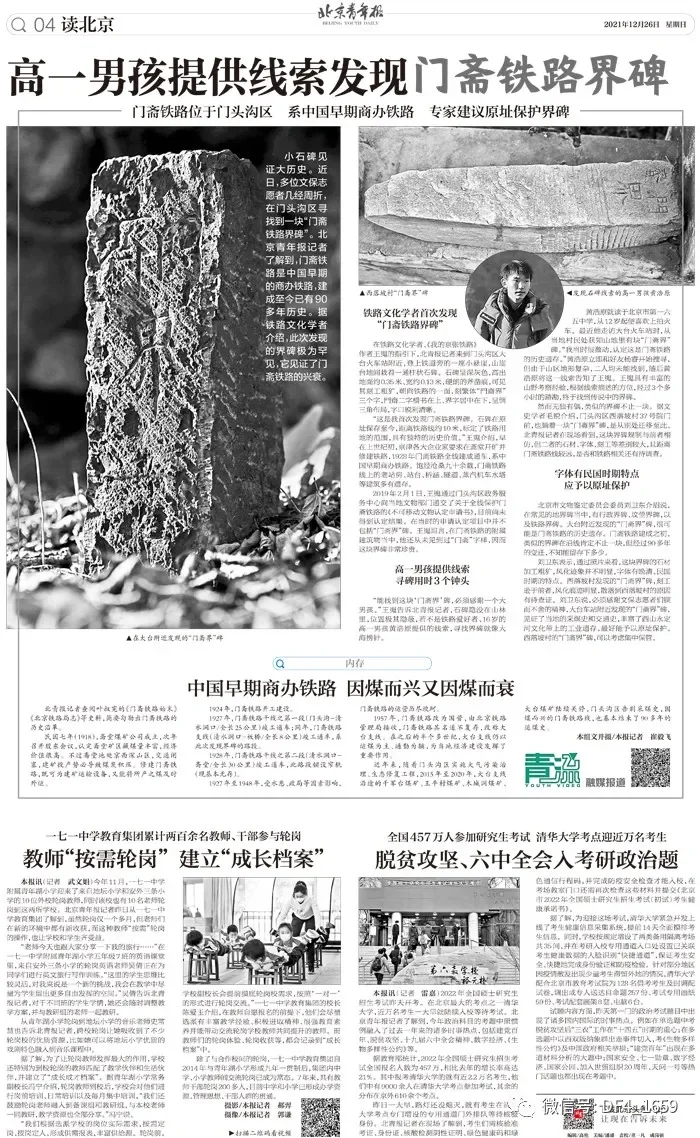
December 25, 2021, Beijing Youth Daily
